High-Temp 2000F Paint for Stacks and Furnaces: Specifier's Guide (2026)
High temp 2000F paint compared for exhaust stacks, kilns, and flares. DFT, ASTM standards, silicone vs inorganic chemistry, surface prep, cure schedules, and contractor path.

Disclosure: Affiliate links to retailers and manufacturer-direct programs. Recommendations are spec-driven, not commission-driven.
Use Case
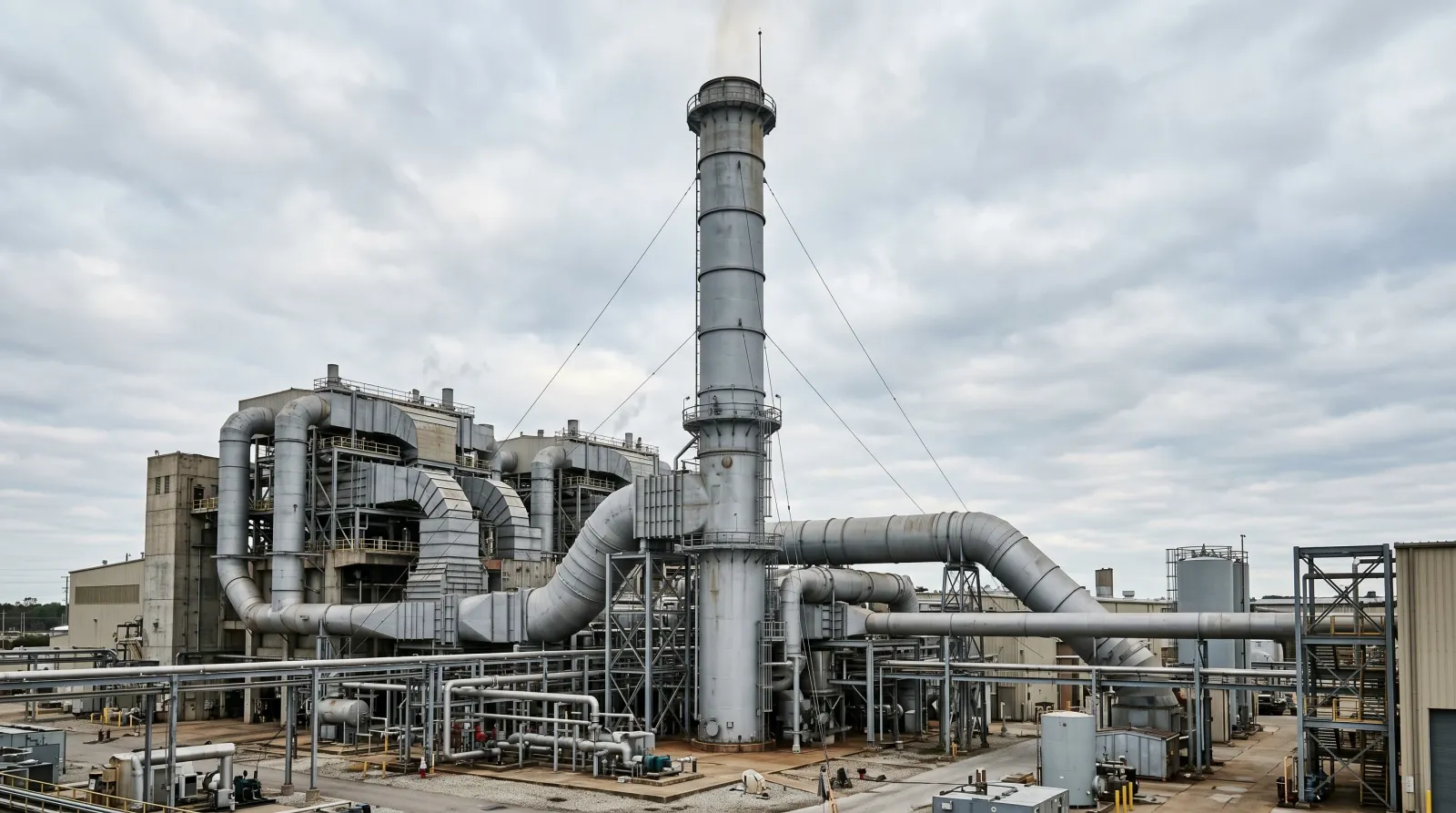
High-temp coating in the 2000°F class is specified for the hottest exposed steel on a plant site: exhaust stacks, breeching and ductwork, kiln shells, incinerator casings, flare tips, boiler exteriors, mufflers, manifolds, and the uninsulated process piping that runs above 600°F. The job the coating actually does depends on the temperature band. Below 1000°F the spec wants corrosion protection plus heat resistance. Above 1000°F the steel itself is the weak link, and the coating’s job narrows to oxidation resistance, surface emissivity, and color retention while the substrate carries the structural load.
That distinction is where most “2000°F paint” specs go wrong. Carbon steel begins losing yield strength near 1000°F and scales heavily by 1,200°F. A true continuous 2000°F service temperature means the substrate is stainless, a heat-resisting alloy, or a refractory-lined shell. The aluminum-silicone and ceramic-filled coatings sold for the 2000°F class are inert-pigment films. They survive the temperature without rusting away, but at that heat they are not inhibiting corrosion. They are holding a surface and resisting oxidation. The spec has to name the real service temperature and the real substrate before it names a product.
For the band most facility buyers actually live in, continuous 600°F to 1000°F on uninsulated carbon-steel stacks and ductwork, the answer is an inert multipolymeric matrix coating: Sherwin-Williams Heat-Flex Hi-Temp 1000, Carboline Thermaline 4900, PPG HI-TEMP 1027. These carry both heat resistance and corrosion protection, including corrosion under insulation (CUI) qualification, and air-dry without a separate bake. Above 1000°F, and for the 1200°F to 1500°F-plus range, the spec moves to silicone-aluminum chemistry (Sherwin-Williams Heat-Flex 3500, Carboline Thermaline 4700, PPG HI-TEMP 222G) applied thin and heat-cured on the first firing.
Service life runs 10 to 15 years for inert matrix systems on continuous-duty stacks, and 5 to 10 years for thin-film silicones in the highest band, recoated on turnaround. Premature failure traces to over-application, thermal shock, or chloride contamination on a coastal site.
Spec Requirements
The spec block, before any product name. Numbers vary by manufacturer TDS and by the service-temperature band; the categories hold across the class.
| Spec | Value |
|---|---|
| Dry film thickness (DFT) — inert matrix | 4–8 mils total for continuous service to 1000°F–1200°F |
| Dry film thickness (DFT) — silicone | 1–2 mils per coat, 2–4 mils total; do not exceed manufacturer max |
| Coverage @ spec’d DFT | 200–400 sq ft/gal for inert matrix; 350–600 sq ft/gal for thin-film silicone |
| VOC | <340 g/L solvent-borne silicone (SCAQMD Rule 1113 industrial maintenance); near-zero for inorganic copolymer |
| Standards | ASTM D2485 (heat-resistant coating eval), ASTM D6577, ASTM D4541 adhesion, ASTM B117 salt spray (ambient), ASTM G154 QUV |
| Substrate prep — to 1000°F | SSPC-SP6 commercial blast, 1.5–3 mil angular anchor profile |
| Substrate prep — above 1000°F or CUI service | SSPC-SP10 near-white blast; SSPC Guide 15 soluble-salt test under insulation |
| Service temp — inert matrix | Cryogenic to 1000°F–1200°F continuous; CUI cyclic |
| Service temp — silicone | 1000°F to 1500°F-plus; aluminum silicone to ~1400°F continuous |
| Cure to service | Air-dry to handle 1–4 hours; full heat/corrosion resistance after first thermal cycle or 350°F–450°F bake per TDS |
| Ambient at application | 50°F to 100°F; substrate ≥5°F above dew point; relative humidity <85% |
| Recoat window | 30 min to a few hours between thin silicone coats; verify TDS, since silicones have short, temperature-sensitive windows |
Three numbers govern whether the coating survives in service: the DFT relative to the manufacturer maximum, the cleanliness of the steel (chlorides especially, on insulated and coastal assets), and the cure ramp on the first heat cycle. Miss the DFT ceiling and the film cracks on first firing. Miss the salt test under insulation and you get CUI within two cycles. Miss the cure ramp and the film blisters before it ever protects anything.
System Chemistry Compared
Three chemistries cover the high-temp class. They do not overlap much; each owns a temperature band and a service condition.
| Chemistry | Service temp (continuous) | Corrosion / CUI | UV / weather | $/sq ft installed | Best for |
|---|---|---|---|---|---|
| Inert multipolymeric matrix | Cryogenic to 1000°F–1200°F | 🟢 Full corrosion + CUI qualified | 🟢 Good, holds color | $3–7 | Stacks, ductwork, insulated piping, cyclic-service vessels |
| Silicone-aluminum (single-component) | 1000°F to 1400°F | 🔴 No corrosion package; oxidation resistance only | 🟡 Chalks but holds heat | $2–5 | Mufflers, manifolds, flare tips, uninsulated hot exposed steel |
| Ceramic / inorganic high-range silicone | 1200°F to 2000°F class | 🔴 Surface protection only; substrate must be alloy/stainless | 🟡 Color shift at peak temp | $4–9 | Kiln shells, incinerators, the genuine 1500°F-plus surfaces |
Inert matrix wins the corrosion job and owns the band where carbon steel still has strength. Single-component silicone is the maintenance answer for hot exposed steel that does not need a corrosion package. Ceramic and high-range silicone are for the genuine 1500°F-and-up surfaces, where the substrate is already alloy and the coating manages emissivity and oxidation. Picking by temperature alone is the trap. A coating rated to 2000°F over carbon steel below the dew point will still corrode under insulation, because heat rating and corrosion rating are two different things.
Recommended Systems
Three multi-coat approaches across the major industrial lines. Each pairs an inert multipolymeric matrix base for the corrosion-and-heat band with a high-range silicone for the surfaces that run hotter. Verify the specific product temperature limit and cure schedule against your service condition before bid.
System A — Sherwin-Williams Heat-Flex (inert Matrix Plus High-Range)
| Layer | Product | DFT |
|---|---|---|
| Base / single-coat (to 1000°F) | Heat-Flex Hi-Temp 1000 inert multipolymeric matrix | 4–8 mils |
| High-range topcoat (cyclic to 1200°F) | Heat-Flex 3500 inorganic copolymer | 5–10 mils |
| Total (banded) | 4–10 mils per service zone |
Heat-Flex Hi-Temp 1000 is the CUI workhorse: cryogenic to 1000°F, full corrosion and corrosion-under-insulation qualification, air-dry application. For the hotter exposed steel, Heat-Flex 3500 carries an inorganic copolymer to higher cyclic ranges. Specify the two as separate single-coat systems keyed to zone temperature, not as a stacked buildup. Sherwin-Williams Heat-Flex product line.
System B — Carboline Thermaline (matrix Plus Silicone)
| Layer | Product | DFT |
|---|---|---|
| Single-coat (to 1200°F) | Thermaline 4900 inert multipolymeric matrix | 4–8 mils |
| High-range silicone (to 1500°F) | Thermaline 4700 silicone | 1–2 mils per coat, 2–4 mils total |
| Total (banded) | 4–8 mils matrix / 2–4 mils silicone |
Thermaline 4900 covers the corrosion-and-heat band to 1200°F as a single-coat inert matrix with CUI service. Thermaline 4700 is the thin-film silicone for the 1200°F to 1500°F surfaces; it goes on thin, cures on first firing, and holds at temperatures the matrix coating cannot reach. The mistake on this stack is treating 4700 like a build coat. Two mils, not six. Carboline high-temperature product line.
System C — PPG HI-TEMP (matrix Plus Aluminum Silicone)
| Layer | Product | DFT |
|---|---|---|
| Single-coat (to 1200°F) | HI-TEMP 1027 inert multipolymeric matrix | 4–8 mils |
| High-range silicone (to 1400°F+) | HI-TEMP 222G aluminum silicone | 1–2 mils per coat |
| Total (banded) | 4–8 mils matrix / 2–4 mils silicone |
HI-TEMP 1027 is the inert matrix base with CUI qualification and a long installed track record on refinery and power-plant ductwork. HI-TEMP 222G is the aluminum-silicone topcoat for the higher exposed band. PPG’s matrix coatings are common on refinery turnaround work where CUI is the dominant failure risk. PPG HI-TEMP 1027 product page.
For light-duty and consumer-scale jobs, Rust-Oleum High Heat and the Rust-Oleum 1000°F enamels cover grills, manifolds, mufflers, and small exposed brackets at a fraction of the industrial cost. They are not CUI coatings and not a stack-lining spec. Use them for small uninsulated parts, not for a process-vessel scope.
Systems Compared
| System | Total DFT | $/sq ft installed | Service life | Best for |
|---|---|---|---|---|
| A — S-W Heat-Flex | 4–10 mils (banded) | $4–8 | 10–15 yrs matrix / 6–10 yrs high-range | CUI piping, stacks, ductwork, mixed-zone plants |
| B — Carboline Thermaline | 4–8 / 2–4 mils | $3–7 | 10–15 yrs matrix / 5–10 yrs silicone | 1200°F–1500°F surfaces alongside CUI service |
| C — PPG HI-TEMP | 4–8 / 2–4 mils | $3–7 | 10–15 yrs matrix / 5–10 yrs silicone | Refinery turnaround, CUI-dominant ductwork |
Pricing assumes a 5,000-plus sq ft scope through a certified industrial applicator with blast prep included. Small retrofit scopes and rope-access stack work run 40 to 120 percent higher per square foot. The CUI-qualified matrix base is where the long service life lives; the silicone topcoat is the maintenance-cycle item that gets recoated on turnaround.
Application and Contractor Path
High-temp coating is not a DIY product at the plant scale, and it is not a general industrial painting scope. The cure-on-first-firing behavior, the thin-film DFT ceiling on silicones, and the soluble-salt testing under insulation all require a crew that has run the specific product line. A small uninsulated part (a manifold, a muffler, an exposed bracket) is within reach of a Rust-Oleum High Heat aerosol and a controlled bake. A stack, a kiln shell, or insulated process piping is a contractor job.
Specify a contractor with one of the following:
- Manufacturer certification on the product line (Sherwin-Williams Protective & Marine, Carboline, or PPG PMC approved applicator).
- SSPC-QP1 certification for field industrial coatings work, QP2 for hazardous-substance removal where existing high-temp coatings contain lead or chromate pigments.
- NACE/AMPP CIP Level 2 inspector for DFT and soluble-salt verification on CUI-critical scopes.
Three contractor-qualifying questions before signing:
- How will the first-cure thermal ramp be managed? On new equipment the commissioning burn is the cure; on a live retrofit, the contractor needs a staged ramp plan or a bake schedule. A crew that cannot describe the cure schedule will field-improvise it and crack the film.
- What is the soluble-salt protocol under insulation? Chlorides drive CUI. SSPC Guide 15 testing belongs on any insulated or coastal scope, and the contractor should name the test method without prompting.
- Who measures DFT on the silicone coats? Thin-film silicones fail from over-application more than under-application. The inspector needs a wet-film and dry-film protocol that catches the over-thick zones, which is the opposite instinct from corrosion-coating work.
The manufacturer rep network on all three lines includes a free pre-bid review: service-temperature mapping by zone, CUI qualification check against the project condition, and a cure-schedule plan keyed to the commissioning sequence. Use it. A wrong product picked on temperature rating alone, without the corrosion and CUI check, is the most common and most expensive specification error on high-temp work.
Failure Modes
Five failures cover most high-temp field rejections and warranty claims.
- Over-application of thin-film silicone. Cause: a crew used to corrosion coatings applied 5 to 8 mils of silicone expecting more is better. Prevention: hold silicones to the 1 to 2 mil per-coat TDS maximum; wet-film gauge during application; reject over-thick zones before first firing. Thicker silicone cracks on the first thermal cycle.
- Corrosion under insulation (CUI). Cause: a non-CUI silicone heat paint specified on insulated piping, or chlorides left on the steel before insulation closed up. Prevention: specify a CUI-qualified inert matrix coating (Heat-Flex Hi-Temp 1000, Thermaline 4900, HI-TEMP 1027); run SSPC Guide 15 soluble-salt testing; verify the coating’s cyclic dew-point service rating.
- Missed or improper first-cure ramp. Cause: equipment put straight into full-temperature service before the film cured, or an air-dry-only assumption on a coating that needs a bake. Prevention: follow the TDS cure schedule; on retrofits, schedule a controlled ramp or bake; on new builds, treat the commissioning burn as the cure step.
- Thermal shock cracking. Cause: rapid quench or violent up-and-down cycling beyond what the coating’s thermal-cycle rating allows. Prevention: match the coating to the actual cycling profile, not the peak temperature; ASTM D2485 thermal-cycling data on the TDS is the reference, not the single-point max temp.
- Chloride and coastal contamination. Cause: salt-laden air on a coastal site contaminated the steel before coating, or under-blasted prep left soluble salts in the profile. Prevention: SSPC-SP10 near-white blast for the high band and CUI service; salt-soluble testing; recoat windows tight enough that contamination does not settle between coats.
Over-application and missed CUI qualification account for most of the high-temp failures I review. Both are decided at the spec stage, not on the scaffold. The crew applying 6 mils of silicone is following an instinct that is correct for epoxy and wrong here.
Where to Buy / Spec
| Channel | Best for | Path |
|---|---|---|
| Amazon Business | Small parts, mufflers, manifolds, Rust-Oleum High Heat aerosol and quart stocking | Amazon Business account, search Rust-Oleum High Heat |
| Sherwin-Williams Protective & Marine | Spec’d stack and CUI piping projects; Heat-Flex line | S-W Heat-Flex page |
| Carboline / PPG rep network | High-range silicone and CUI-critical refinery turnaround | Carboline high-temp · PPG HI-TEMP 1027 |
| Industrial distributor (Rawlins Paints US, KTA-Tator) | Multi-manufacturer bids, mixed-system scopes | Distributor account with project-specific pricing |
Manufacturer-direct is the channel for any insulated or above-1000°F scope. The rep network’s service-temperature mapping and CUI check are worth more than any retail discount on the can, because the failure mode on this class is a specification error, not a material defect.
FAQ
Can I apply high temp paint without a contractor? On small uninsulated parts, yes. A muffler, a manifold, an exposed bracket, or a grill takes a Rust-Oleum High Heat aerosol, SSPC-SP6-equivalent hand prep, and a controlled bake or a first-firing ramp. On a stack, kiln shell, or insulated process piping, no. The CUI testing, the thin-film silicone DFT ceiling, and the cure-ramp management are a certified-applicator scope.
What’s the warranty? Manufacturer product warranties run 1 to 5 years on the can. Installed-system warranties through certified applicator networks extend to 5 to 10 years on the inert matrix lines, shorter on the high-range silicones because those are maintenance-cycle coatings. The installed warranty under documented inspection is the one that matters; confirm it covers the CUI service condition.
Does this need a specific surface prep? SSPC-SP6 commercial blast with a 1.5 to 3 mil angular profile for inert matrix coatings to 1000°F. SSPC-SP10 near-white blast plus SSPC Guide 15 soluble-salt testing for silicones above 1000°F and for any insulated or coastal asset. Skipping the salt test under insulation is the fastest route to corrosion under insulation.
Is high temp paint OSHA-compliant for plant service? The coating itself is not a walking or working surface, so OSHA 1910.22 anti-slip rules do not apply. The application work does fall under OSHA 1910.146 confined-space and 1910.134 respirator rules for any vessel-interior or enclosed-duct scope, and existing high-temp coatings that contain lead or chromate require SSPC-QP2 hazardous-removal handling.
Is the 2000°F number real, or marketing? Both. The coatings rated to the 2000°F class are real silicone and ceramic films that survive that surface temperature. What they do not do at 2000°F is protect carbon steel from corrosion, because carbon steel has no structural future at that temperature anyway. A genuine 2000°F surface is alloy, stainless, or refractory-lined, and the coating manages oxidation and emissivity, not rust.
Related
Frequently asked questions
is there a single paint rated to a true 2000°F on steel?+
do high temp coatings need to be heat-cured before they work?+
what surface prep does the spec call for under high temp paint?+
is high temp paint compatible with corrosion under insulation service?+
what is the service life of a high temp coating on a stack?+
- How to prep and prime galvanized steel
- Petroleum storage tank coating specifier guide
- How to coat rusted metal so it stays sealed
- Rust-Oleum industrial line review