Hangar Floor Paint: Coatings and Safety Striping Specifier's Guide (2026)
Hangar floor paint specified by DFT, fuel and Skydrol resistance, and FAA AC 150 line layout. Epoxy and polyaspartic systems, MVE limits, and the contractor path that survives jet traffic.

Disclosure: Affiliate links to retailers and manufacturer-direct programs. Recommendations are spec-driven, not commission-driven.
Use Case
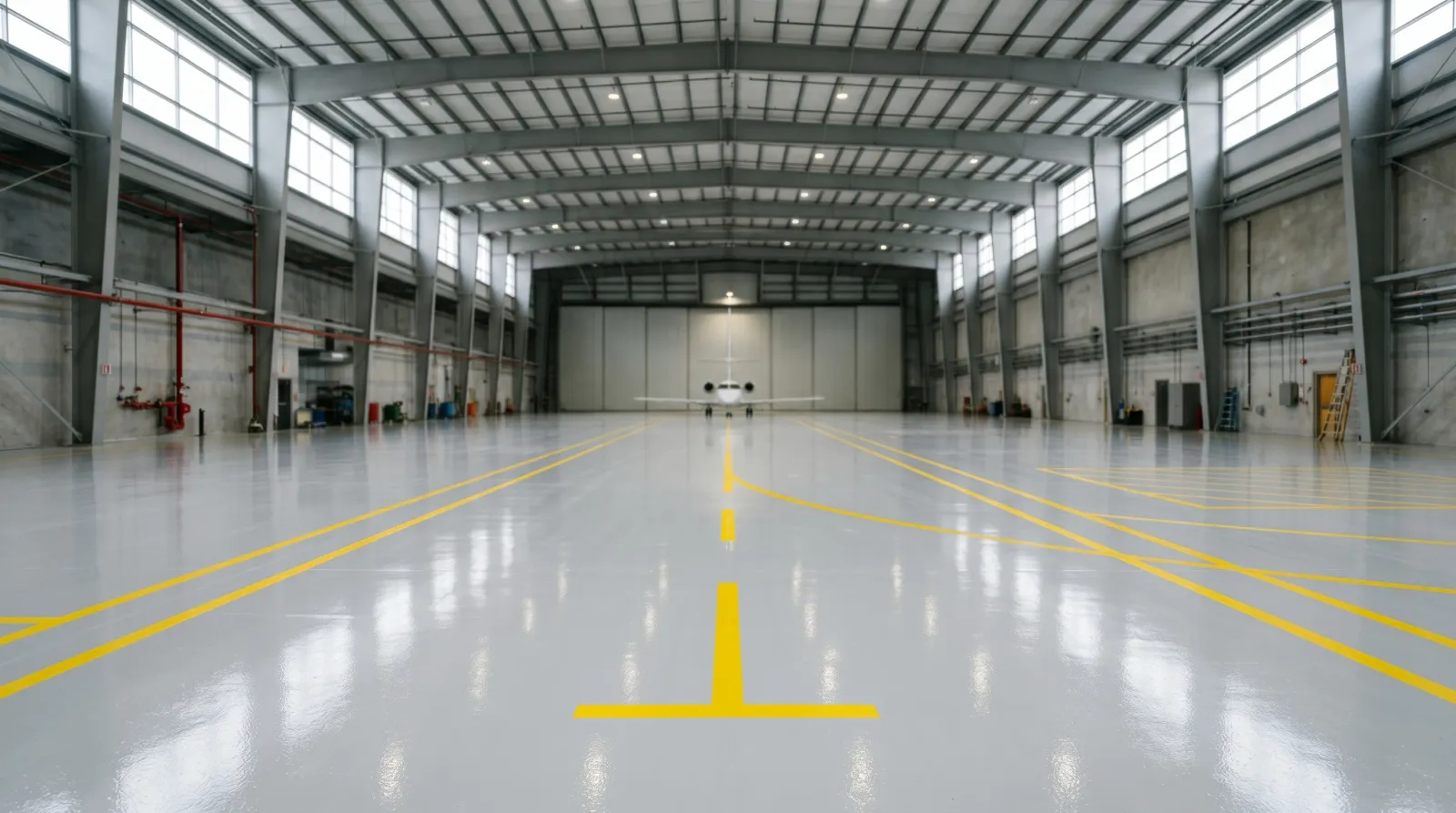
A hangar floor is a structural concrete slab that has to do four jobs at once: carry the rolling load of a towed or jacked aircraft, shed jet fuel and hydraulic fluid without softening, give maintenance crews a slip-resistant walking surface under OSHA 1910.22, and carry the painted positioning and safety lines that put a nose wheel on its mark every time. The asset is a corporate FBO hangar, an MRO maintenance bay, a National Guard or active-duty military hangar, a flight-school T-hangar, or an agricultural-aviation shop. Each sees a different load and a different chemical exposure, but they share one failure point. The coating bonds to old, often vapor-open concrete and lives under point loads that no warehouse floor sees.
Service life runs 3 to 5 years for a budget single-coat install, 8 to 12 years for a mid-tier epoxy build with a polyaspartic or chemically resistant topcoat, and 15-plus years for a high-build novolac or polymer-cement system in a fuel-heavy MRO. Service life is set by surface prep and moisture control far more than by topcoat brand. A premium product over an unprepped, vapor-wet slab fails in two years; a mid-tier system over a shotblasted, moisture-mitigated slab outlasts the lease.
The marking layer is regulation-driven. FAA Advisory Circular 150/5360-13 gives hangar floor marking guidance, NFPA 409 governs aircraft hangar fire protection and the fire-lane and equipment-access lines that ride with it, and OSHA 1910.22 and 1910.144 control the safety-color code on the walking-working surface. The spec writer picks a chemistry that survives the fuel and Skydrol exposure, meets the state VOC ceiling, and lays out the positioning lines so a tow crew can place an aircraft to within inches in low light. Get the chemistry, the moisture spec, and the line layout right and the rest of the spec follows.
Zoned Recommendation Matrix
A hangar is not one floor. The system depends on what each zone sees.
| Zone | Recommended system | Why |
|---|---|---|
| Aircraft parking / nose-wheel area | System A (high-build epoxy + chemical topcoat) | Point loads, fuel drips, tow tractor traffic |
| Maintenance bay / under-wing work | System C (Tnemec novolac glaze) | Hydraulic fluid and Skydrol pooling under repair |
| Walk lanes and equipment paths | System A/B with aggregate broadcast | OSHA 1910.22 anti-slip, foot and cart traffic |
| Fuel transfer / drum storage | Chemically resistant novolac, secondary containment | OSHA 1910.106 flammable-liquid spill control |
| Office / parts crib / breakroom | Budget thin-build epoxy | Light traffic, ease of cleaning |
| Apron transition at hangar door | System A high DFT | Chloride from de-icing, hot tire pickup, freeze-thaw |
| Positioning and safety striping | Setfast / Industrial Choice over cured topcoat | FAA AC 150 layout, OSHA color code |
The apron transition at the hangar door is the zone owners underspec. The 10 to 20 feet just inside the door sees everything the apron sees: de-icing chloride dragged in on tires, freeze-thaw, and hot tire pickup from a tow tractor turning under load. Spec the door-line zone to the same high DFT as the parking area, not to the lighter interior build.
Spec Requirements
| Spec | Value |
|---|---|
| Dry film thickness (DFT) | 12–28 mils total system; 6–10 mil build, 4–8 mil topcoat; 5–7 mils dry per stripe coat |
| Coverage @ DFT | 80–160 sq ft / gal (build); 110–120 lf @ 4-in line per gallon (stripe) |
| VOC | under 100 g/L water-based epoxy build; under 250 g/L polyaspartic topcoat; solvent build restricted under SCAQMD Rule 1113 and OTC states |
| Standards | ASTM F1869 (MVE ≤3 lb), ASTM D4060 (abrasion), ASTM D7234 (adhesion), ASTM D543 (fuel / Skydrol resistance) |
| Substrate prep | ICRI CSP 3 shotblast (standard); CSP 4 for high-build or worn slabs; SSPC-SP1 solvent clean after blast |
| Moisture ceiling | ASTM F1869 ≤3 lb/1000sf/24h, or ASTM F2170 ≤75% RH; MVE primer if exceeded |
| Service temp | -20°F to +200°F (system-dependent); door-zone freeze-thaw rated |
| Cure to service | Foot traffic 24h · aircraft tow 7 days · full chemical resistance 14 days |
| Dew point / humidity | Substrate temp ≥5°F above dew point at every coat; ≤85% RH during application |
| OSHA 1910.22 | Static COF ≥0.5 dry; aggregate broadcast or anti-slip topcoat in walk lanes |
| Marking authority | FAA AC 150/5360-13, NFPA 409, OSHA 1910.144 color code |
These specs are not interchangeable. ASTM F1869 is the moisture gate. A hangar slab poured in the 1960s or 70s without a poly vapor barrier under it pulls ground moisture continuously, and epoxy is not vapor-permeable, so the vapor has nowhere to go except the bond line. ASTM D543 is the fuel-and-fluid gate. It tells you whether the cured film holds up to Jet-A, AvGas, and phosphate-ester hydraulic fluid. Skydrol is the test that separates a hangar coating from a garage coating, because it attacks ordinary epoxy and many polyurethanes. ASTM D7234 pull-off adhesion is the contractor’s proof of bond; spec a minimum 250 psi pull and require the test log. The marking standards are read by a different inspector than the coating, and they will pull a tape on stripe width and a marking plan against the airport or base ground-operations standard.
System Chemistry Compared
Pick the chemistry class before the product name.
| Class | Pot life | Recoat | Service temp | UV stable | Fuel / Skydrol | $/sq ft installed | Best for |
|---|---|---|---|---|---|---|---|
| Epoxy (chemically resistant) | 30–45 min | 8–24h | -20°F to 180°F | No (ambers) | Good / fair | $5–10 | General hangar floor, build coats |
| Novolac epoxy | 20–40 min | 12–24h | -20°F to 220°F | No | Excellent / good | $9–16 | MRO bays, fuel and Skydrol zones |
| Polyaspartic | 15–30 min | 1–2h | -40°F to 200°F | Yes | Good / fair | $8–15 | Fast turnaround, UV topcoat |
| Polymer / urethane cement | 30 min | 12h | -40°F to 250°F | Yes | Good / good | $12–25 | Wash bays, thermal-cycling door zones |
For a typical corporate or flight-school hangar with light fuel exposure, a chemically resistant epoxy build with a polyaspartic topcoat is the right answer. The polyaspartic earns its premium two ways: it cures fast enough to put a bay back in service in days instead of a week, and it holds color where bare epoxy ambers under skylight UV. For an MRO bay or a fuel-transfer area where Skydrol and Jet-A pool under a parked aircraft, step up to a novolac epoxy. Novolac is the only common chemistry that shrugs off phosphate-ester hydraulic fluid over a full service life. For a wash bay or a thermal-cycling door zone in a northern climate, urethane cement handles the moisture and the freeze-thaw that crack a rigid epoxy.
Recommended Systems
System a — Sherwin-Williams ArmorSeal Epoxy with Setfast Striping
The FBO and corporate-hangar standard. A chemically resistant epoxy build with a pigmented epoxy topcoat and DOT-grade traffic paint for the lines. Service life 8 to 12 years. Total DFT 12 to 20 mils plus stripe.
| Layer | Product | DFT |
|---|---|---|
| Primer / MVE | ArmorSeal 1K HS, or Tnemec Series 218 where MVE fails | 2–4 mils |
| Build coat | ArmorSeal 8100 HS Epoxy, silica aggregate broadcast in walk lanes | 6–10 mils |
| Topcoat | ArmorSeal 1000 HS Epoxy (pigmented light gray or tile red) | 4–6 mils |
| Stripe coat | Setfast Acrylic Waterborne (safety yellow / white per FAA AC 150) | 5–7 mils dry |
Sherwin-Williams ProIndustrial ArmorSeal page · Setfast traffic paint page
The amber note is the spec edge here. ArmorSeal 1000 HS is an epoxy, and epoxy ambers under the UV that pours through hangar clerestory skylights. On a light-gray floor under heavy daylight, swap the epoxy topcoat for a clear polyaspartic to hold the color. The lines stay sharp longer because Setfast goes down over the cured topcoat, not into the epoxy, so a worn line restripes without disturbing the floor system below.
System B — Rust-Oleum 9100 Epoxy Mastic with 9800 Polyaspartic
A faster-turnaround system for hangars that can’t sit down for a week. The 9100 epoxy mastic penetrates and builds in one product; the 9800 polyaspartic tops it with a UV-stable, abrasion-resistant film that recoats in 1 to 2 hours. Service life 7 to 10 years. Total DFT 10 to 16 mils plus stripe.
| Layer | Product | DFT |
|---|---|---|
| Primer / build | 9100 System Epoxy Mastic | 4–6 mils |
| Topcoat | 9800 System DTS Polyaspartic | 4–8 mils |
| Stripe coat | Industrial Choice 2300 / EpoxyShield striping over cured topcoat | 3–5 mils dry |
Rust-Oleum 9100 System page · Rust-Oleum Industrial Choice striping
The 9800 polyaspartic is what makes this system worth its premium for an active flight school or charter operation. A two-day return to tow traffic instead of a seven-day shutdown can be worth more than the floor itself when every grounded day is lost revenue. The tradeoff is chemical resistance. Polyaspartic handles fuel drips and the occasional spill, but it is not the choice for a bay with standing Skydrol. Keep this system in the parking and walk zones and step up to System C under the wing.
System C — Tnemec Series 280 Glaze over Epoxoprime
The MRO and military-bay system. A penetrating epoxy primer, a high-build aggregate-loaded body coat, and a chemical- and fuel-resistant glaze that holds up to phosphate-ester hydraulic fluid. Service life 12 to 18 years in a fuel-heavy bay. Total DFT 15 to 23 mils.
| Layer | Product | DFT |
|---|---|---|
| Primer | Series 201 Epoxoprime (penetrating epoxy primer) | 3–5 mils |
| Build coat | Series 237 Power-Tread or 222 Deco-Tread with aggregate (walk zones) | 8–12 mils |
| Topcoat | Series 280 Tneme-Glaze (chemical- and fuel-resistant) | 4–6 mils |
Tnemec Series 280 product page · Tnemec rep locator
Tneme-Glaze earns its spec where the others fail. Series 280 holds up to Skydrol, Jet-A, and the alkaline cleaners crews wash down at end of shift, and it carries the chemical-resistance data sheets a base or insurer asks for. Tnemec sells only through its rep network, not retail, so the spec runs through a Tnemec rep who will pull the right primer and aggregate for the slab condition and the bay’s chemical exposure.
Systems Compared
| System | Total DFT | $/sq ft installed | Service life | Best for |
|---|---|---|---|---|
| A (ArmorSeal epoxy) | 12–20 mils + stripe | $6–10 | 8–12 yrs | FBO, corporate, flight-school hangars |
| B (Rust-Oleum poly) | 10–16 mils + stripe | $7–12 | 7–10 yrs | Fast-turnaround active operations |
| C (Tnemec glaze) | 15–23 mils | $11–18 | 12–18 yrs | MRO bays, fuel and Skydrol exposure |
Cost includes prep (shotblast), MVE primer where needed, build, topcoat, striping, and contractor labor. Owner installation on a small T-hangar drops cost roughly 40 percent but raises failure risk; the prep gap is where it goes wrong.
Application & Contractor Path
This is not an owner-DIY product class for a working FBO or MRO. Specify a contractor with SSPC-QP1 certification for industrial coatings, or NACE Level 2 inspection credentials on a large military spec. Surface prep alone runs the line. Shotblasting to ICRI CSP 3 needs a ride-on shotblaster and HEPA dust collection, gear that hangar maintenance crews don’t own. The manufacturer rep path is the shortcut to a right spec: Sherwin-Williams ProIndustrial reps, Rust-Oleum Industrial distributors, and Tnemec’s rep network will each pull the correct primer and topcoat for the slab’s moisture reading and the bay’s chemical exposure, and they’ll put a data sheet behind it.
For a small private T-hangar under about 1,500 square feet with no jet traffic, a Rust-Oleum 9100 and 9800 install is a defensible owner job. Diamond-grind or shotblast to CSP 3, run the ASTM F1869 moisture test first, and expect 5 to 7 years of service rather than the decade a pro install delivers. Below dew point is the owner’s most common miss; the substrate has to sit at least 5°F above dew point at every coat, which on a cold spring morning in an unheated hangar means waiting until afternoon.
Failure Modes & How to Prevent Them
Delamination from moisture vapor. The coating lifts in disc-shaped blisters or peels at slab joints, most often on an old hangar floor poured without a vapor barrier. The cause is vapor pressure at the bond line. The prevention is the ASTM F1869 test before the coating, and a moisture-mitigation primer (Tnemec Series 218, Sika MVE Stop) if the slab reads over 3 lb. This is the single most common hangar-floor failure, and it is the one that drops foreign-object debris under a parked aircraft.
Softening and blistering under Skydrol. A film that looked fine for a season goes soft and tacky where phosphate-ester hydraulic fluid pools under the wing. The cause is the wrong chemistry. Ordinary epoxy and many polyurethanes are not rated for Skydrol. The prevention is a novolac epoxy or a chemically resistant glaze (Tnemec Series 280) rated to ASTM D543 in the fluid-exposure zones, with the rest of the floor in standard epoxy.
Hot tire pickup at the door line. The topcoat lifts in rubber-tread strips where a tow tractor turns under load just inside the hangar door, while the interior floor stays fine. The cause is thermal-mechanical stress from a loaded turn on a coating that’s too thin for the zone. The prevention is to run the high-DFT parking-zone system through the door transition, not the lighter interior build, and to give that zone 14 days to fully cure before tow traffic.
Inadequate surface profile. The system peels in sheets at year two over what looked like a clean floor, but the prep was a chemical etch or a light hand-grind. The cause is too little mechanical key; CSP 1 to 2 leaves a near-sealed surface the epoxy can only grip chemically. The prevention is shotblast to ICRI CSP 3 (CSP 4 on worn or high-build areas), verified against an ICRI profile chip set before the primer goes down.
Stripe ghosting and wear. Positioning lines fade or show a shadow of the old line after a restripe, throwing off a tow crew’s placement. The cause is UV pigment bleed or striping into the floor coat instead of over it. The prevention is to stripe with DOT-grade traffic paint over the cured topcoat, shift a relocated line onto clean coating, and block any bleed with a shellac-based stain blocker, not an acrylic primer.
Where to Buy / Spec
| Channel | Best for |
|---|---|
| Manufacturer-direct (SW ArmorSeal, Rust-Oleum 9100, Tnemec rep) | Spec’d projects, rep support, MVE and chemical data sheets, warranty |
| Industrial distributor (Sherwin Industrial, Rawlins US dealers) | Bulk epoxy, aggregate, primers for the coating contractor |
| Pro retail (Sherwin-Williams stores, BM Pro) | Smaller hangars, local 5-gal pickup, contractor pricing |
| Amazon Business | Owner T-hangar kits, striping aerosols, touch-up stocking |
Specifier’s Bid Language
“Provide and install a chemically resistant epoxy floor system per Sherwin-Williams ArmorSeal 8100 / 1000 HS specification (or approved equal: Rust-Oleum 9100/9800, Tnemec 201/280). Total DFT 12–20 mils. Substrate prep: shotblast to ICRI CSP 3 profile, HEPA-vacuum twice, solvent-clean per SSPC-SP1. ASTM F1869 moisture vapor emission test required prior to coating; if MVE >3 lb/1000sf/24h, install Tnemec Series 218 or approved equal mitigation primer. Aggregate broadcast for OSHA 1910.22 anti-slip (static COF ≥0.5 dry) in all walk lanes and door transitions. Fuel- and phosphate-ester-resistant topcoat (ASTM D543) in maintenance and fuel zones. Positioning and safety striping per FAA AC 150/5360-13 layout and OSHA 1910.144 color code, in AASHTO M-248 Type N waterborne traffic paint over the cured topcoat. Contractor to be SSPC-QP1 certified. Warranty: minimum 5 years adhesion, 3 years wear.”
Push back on a wear warranty under 3 years. That’s a tell the bidder plans to thin the prep or doesn’t trust the product over your slab.