Galvanized Primer for Steel: Specifier's Guide (2026)
Galvanized primer systems compared by adhesion, DFT, and VOC. SSPC-SP1 and brush-blast prep, the white-rust problem, ASTM D6386, and the contractor path that stops paint peeling off zinc.

Disclosure: Affiliate links to retailers and manufacturer-direct programs. Recommendations are spec-driven, not commission-driven.
Use Case
Galvanized primer has a narrow job and a wide failure rate: bond a paint system to a zinc surface that was engineered to shed water, and keep it bonded through 15 to 25 years of service. Hot-dip galvanizing is itself a corrosion coating. Steel gets dipped in molten zinc, the zinc metallurgically bonds to the iron, and the part walks out of the kettle with a sacrificial barrier rated for decades of bare exposure. The problem starts the moment an architect, a building code, or an owner wants that part painted — for color, for added corrosion life in a coastal or chemical environment, or to match a finish schedule. Paint does not want to stay on zinc, and most of the peeling I get called to inspect traces back to the wrong primer or no surface prep.
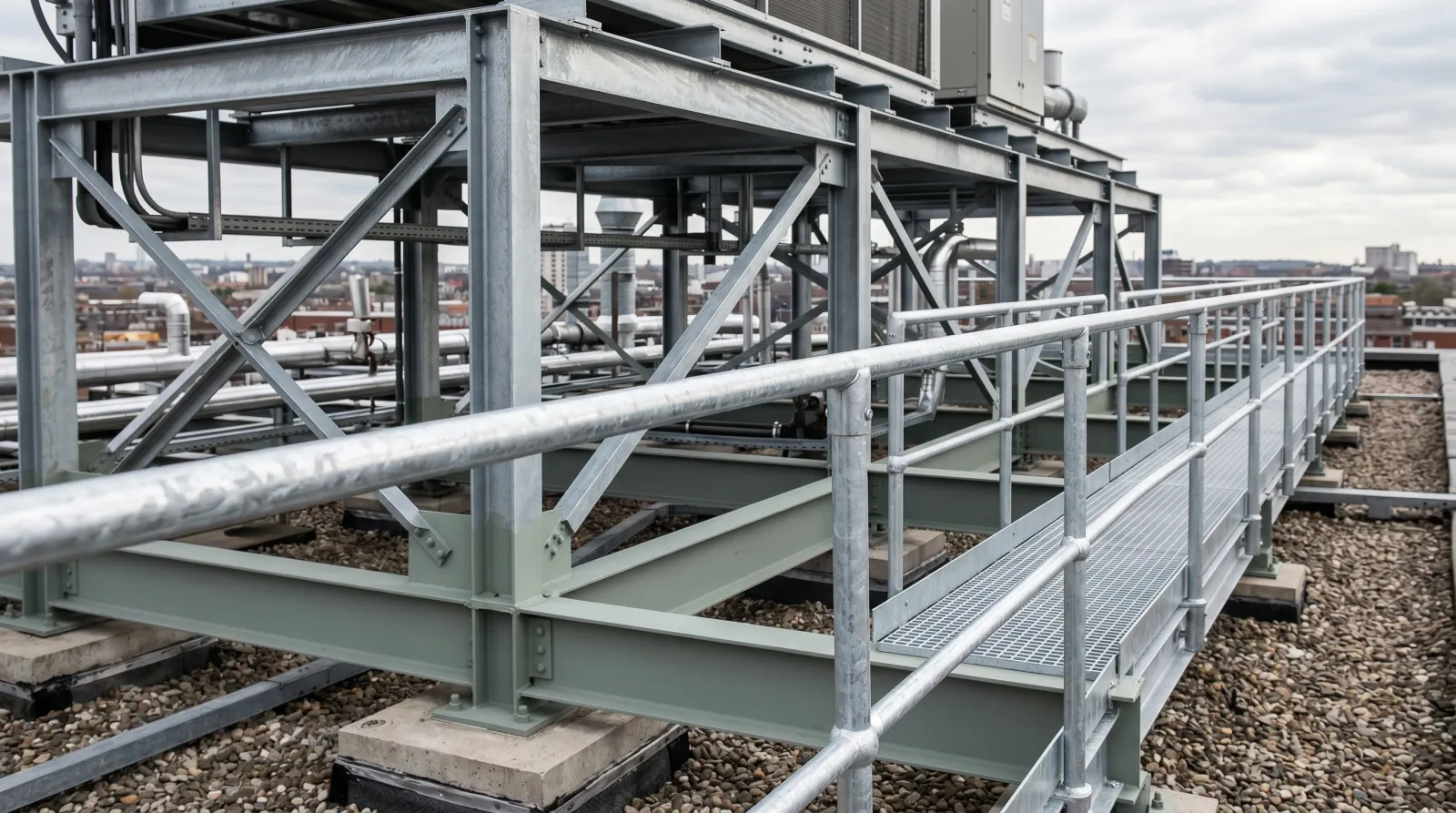
The spec gets written for handrails and guardrail, rooftop equipment screens and dunnage, light poles and sign structures, HVAC curbs and ductwork, structural steel in C4/C5 marine and industrial exposure, water-tank exteriors, agricultural and food-plant steel, and any galvanized fabrication an owner wants in a color other than dull silver. The two service drivers are corrosion category (ISO 12944 C2 through C5-M) and the aesthetic finish schedule. A C2 interior handrail painted for color needs a different system than C5-M coastal structural steel that has to survive salt fog to a 25-year inspection.
Service life of a correctly specified galvanized paint system is the duplex-coating bonus: the zinc protects the steel, the paint protects the zinc, and the two together last longer than the sum. A galvanized-plus-paint duplex system in C3 exposure delivers 1.5 to 2.3 times the service life of either layer alone, per the American Galvanizers Association data. The system fails early when the primer saponifies against the zinc, when white rust was painted over, or when the new galvanizing’s passivation layer was never removed.
Spec Requirements
The spec block, before naming product. The prep line is where galvanized work is won or lost.
| Spec | Value |
|---|---|
| Dry film thickness (DFT) — primer | 2–4 mils per coat |
| Dry film thickness (DFT) — total system | 5–10 mils with topcoat; 8–14 mils for C5-M epoxy/urethane |
| Coverage @ DFT | 250–350 sq ft/gal waterborne primer at 2.5 mils; 200–300 sq ft/gal epoxy primer |
| VOC | <100 g/L waterborne DTM (CARB / SCAQMD compliant); 250–340 g/L solvent/epoxy under industrial maintenance category |
| Standards | ASTM D6386 (prep), ASTM D7803 (continuous-line prep), ASTM D3359 / D4541 (adhesion), ASTM B117 (salt spray), SSPC-Paint 22 |
| Substrate prep — new galvanizing | SSPC-SP1 solvent clean + SSPC-SP16 brush-off blast or hand abrasion per ASTM D6386 |
| Substrate prep — weathered galvanizing | SSPC-SP1 solvent clean; white-rust removal; prime over tight zinc-carbonate patina |
| White-rust removal | Stiff nylon brush, light abrasion, or pressure wash to sound zinc before any primer |
| Service temp | -40°F to 200°F dry service (acrylic/epoxy); confirm topcoat limit |
| Cure to recoat | 1–4 hours waterborne at 75°F; 6–16 hours epoxy; full cure 5–7 days before service |
| Ambient at application | 50°F to 90°F; relative humidity <85%; substrate ≥5°F above dew point |
Three numbers and one process govern the system. The DFT is undramatic — 2 to 4 mils of primer is plenty, and over-building a galvanized primer creates internal stress that works against adhesion rather than for it. The prep is the whole game. ASTM D6386 is the standard the spec must cite by number, because it forces the bidder to address the passivation layer and the white-rust question instead of rolling primer over shiny new zinc and walking away.
The passivation layer deserves its own line. Hot-dip galvanizers apply a chromate or oil quench to new parts to stop white rust during shipping and storage. That layer is a bond breaker. It has to come off by solvent cleaning plus weathering, abrasion, or a brush blast before any primer touches the zinc. A spec that names a good primer but omits passivation-layer removal is a spec that fails at the cross-hatch test.
System Chemistry Compared
Three chemistries cover the galvanized market. The choice tracks corrosion category and budget, not preference.
| Chemistry | Pot life | Recoat window | Service temp | UV stability | $/sq ft installed | Best for |
|---|---|---|---|---|---|---|
| Waterborne acrylic DTM | N/A (single-component) | 1–4 hr at 75°F | -40°F to 200°F | 🟢 Good; chalk-resistant grades available | $1.50–3.50 | C2–C3 handrail, interior steel, light commercial, color finish |
| Waterborne / solvent epoxy primer | 2–8 hr | 6–16 hr | -40°F to 250°F | 🔴 Chalks; needs urethane topcoat outdoors | $3.00–6.00 | C4–C5 exterior, immersion, coastal, secondary containment |
| Epoxy mastic / surface-tolerant | 1–4 hr | 8–24 hr | -40°F to 250°F | 🔴 Topcoat required | $4.00–8.00 | High-build over weathered or partially prepped zinc, maintenance repaint |
Waterborne acrylic DTM is the right answer for the majority of commercial galvanized work — handrail, equipment screens, interior structural steel, anything in a C2 or C3 environment painted mostly for color. It bonds to zinc without a separate primer coat, ships under 100 g/L, and recoats in an hour. Epoxy primers carry the corrosion load for C4/C5 exterior and immersion service, but they chalk under UV and need a urethane topcoat outdoors. Epoxy mastics are the surface-tolerant choice for maintenance repaints where blasting back to white zinc is not on the table.
Recommended Systems
Three full multi-coat stacks at different corrosion-category and price points. All three use primers formulated to bond to zinc; none uses a standard oil/alkyd primer, which saponifies against galvanizing and peels.
System A — Sherwin-Williams Pro Industrial Pro-Cryl (waterborne Acrylic, C2–C3)
| Layer | Product | DFT |
|---|---|---|
| Surface prep | SSPC-SP1 solvent clean + SSPC-SP16 brush blast / ASTM D6386 | — |
| Primer | Pro-Cryl Universal Waterborne Acrylic Primer | 2.5–4 mils |
| Topcoat | Pro Industrial Acrylic or Urethane Alkyd Enamel | 2.5–4 mils |
| Total | 5–8 mils |
Service life 15–20 years in C2–C3 exposure. Pro-Cryl is the commercial standard for galvanized and mixed-metal fabrications because it bonds to bare galvanizing, aluminum, and blasted steel from one pail, which simplifies the spec on a building with mixed substrates. It ships under 100 g/L and meets every state VOC rule. Sherwin-Williams Pro-Cryl product page. For the residential-scale version of this prep sequence, see the guide to painting galvanized steel.
System B — PPG Pitt-Tech Plus DTM (self-Priming Acrylic, C3 Interior/Exterior)
| Layer | Product | DFT |
|---|---|---|
| Surface prep | SSPC-SP1 solvent clean; remove white rust; abrade glossy new zinc | — |
| Primer coat (self-priming DTM) | Pitt-Tech Plus DTM Industrial Enamel | 2.5–4 mils |
| Finish coat | Pitt-Tech Plus DTM Industrial Enamel | 2.5–4 mils |
| Total | 5–8 mils |
Service life 12–18 years. Pitt-Tech Plus is a direct-to-metal acrylic that skips the separate primer: two coats of the same product over clean galvanizing. The single-product system cuts the SKU count on a fast-track job and gives the finish coat and the bond coat identical chemistry, which removes the topcoat-compatibility question. Under 100 g/L. PPG industrial coatings page.
System C — Rust-Oleum 5400 / 9100 Epoxy (C4–C5 Exterior and Immersion)
| Layer | Product | DFT |
|---|---|---|
| Surface prep | SSPC-SP1 solvent clean + brush blast per ASTM D6386; white-rust removal | — |
| Primer | Rust-Oleum 5400 Galvanized Metal Primer or 769 Damp-Proof epoxy mastic | 2–3 mils |
| Topcoat | Rust-Oleum 9100 epoxy mastic or DTM urethane finish | 3–5 mils |
| Total | 5–8 mils |
Service life 18–25 years in C4–C5 exterior and immersion exposure. The epoxy build carries coastal salt fog, secondary containment, and water-tank exterior service that waterborne acrylic will not hold. The 769 Damp-Proof mastic is the surface-tolerant option when blasting back to bright zinc is not practical on a maintenance repaint. Pair with a urethane finish outdoors; the epoxy chalks under UV without it. Rust-Oleum high-performance coatings. For the brand’s full industrial range, see the Rust-Oleum industrial line review.
Systems Compared
| System | Total DFT | $/sq ft installed | Service life | Best for |
|---|---|---|---|---|
| A — SW Pro-Cryl acrylic | 5–8 mils | $1.50–3.50 | 15–20 years | C2–C3 handrail, interior steel, mixed-metal fabrications, color finish |
| B — PPG Pitt-Tech Plus DTM | 5–8 mils | $1.50–3.00 | 12–18 years | C3 fast-track, single-product spec, interior and sheltered exterior |
| C — Rust-Oleum 5400/9100 epoxy | 5–8 mils | $3.50–7.00 | 18–25 years | C4–C5 coastal, immersion, secondary containment, water-tank exterior |
Pricing assumes a 5,000+ sq ft scope through an industrial coatings contractor with shop or field prep included. Small handrail and punch-list scopes run 40–100% higher per square foot because mobilization and prep labor dominate. The total-cost-of-ownership case for the epoxy system is the recoat cycle: a C5 acrylic that fails at year 6 and gets stripped and recoated twice over 25 years costs more than the epoxy that goes the distance once. Match the system to the corrosion category, not the day-one bid.
Application & Contractor Path
A galvanized handrail or a small equipment screen is within reach of a skilled in-house maintenance crew, provided they run the prep by the book: SSPC-SP1 solvent clean, white-rust removal, abrasion or brush blast on new zinc, and a zinc-compatible waterborne primer. The shortcut that ruins these jobs is rolling a hardware-store oil primer over shiny new galvanizing. That system saponifies and peels inside a year, every time.
Structural steel, immersion, water-tank exterior, and C4/C5 coastal work is contractor scope. Spec a contractor with:
- SSPC-QP1 certification for industrial coatings application in the field.
- A documented ASTM D6386 prep procedure, including how they remove the passivation layer and verify white-rust removal.
- AMPP/NACE CIP Level 1 or Level 2 inspection on any immersion or C5 job where adhesion is tested to ASTM D3359 or D4541.
Two contractor-qualifying questions before signing. First: how do you remove the factory passivation layer, and how do you confirm it is gone? A bidder who has no answer will prime over the bond breaker and the system will fail the cross-hatch test. Second: what is your plan for white rust on the delivered steel? Galvanized parts stacked wet on a job trailer grow white rust in a week, and a contractor who has not planned to brush it back to sound zinc is planning to paint over it.
The manufacturer-rep network on all three systems (Sherwin-Williams, PPG, Rust-Oleum) offers a free pre-job substrate review and an adhesion mock-up on a sample of the actual galvanizing. Use it. A cross-hatch test on the real steel, run before the production coats, settles the prep argument for the price of one pint of primer.
Failure Modes
Four failures cover nearly every galvanized peel I get called to inspect.
- Saponification peel from the wrong primer. Cause: an oil or alkyd primer applied directly to zinc. The fatty acids in the binder react with the zinc to form a soap film, and the paint sheets off within 6 to 12 months. Prevention: spec a waterborne acrylic DTM or a zinc-compatible epoxy primer only. Never an oil/alkyd primer over galvanizing. This is the single most common galvanized failure and it is fully preventable at the spec line.
- Passivation-layer delamination. Cause: new galvanizing primed without removing the factory chromate or oil quench. The paint bonds to the passivation layer, the passivation layer does not bond to anything, and the whole film lifts in clean sheets. Prevention: SSPC-SP1 solvent clean plus weathering, abrasion, or brush blast per ASTM D6386 before any primer. Verify with a cross-hatch adhesion test.
- White-rust bond failure. Cause: primer applied over the bulky white zinc-oxide corrosion that grows on wet-stacked galvanizing. The primer bonds to loose corrosion and pulls off with it. Prevention: brush, abrade, or pressure-wash white rust back to sound zinc before priming, and store delivered galvanizing dry with airflow.
- Topcoat chalk and UV failure on epoxy. Cause: an epoxy primer or mastic left exposed outdoors without a urethane topcoat. The epoxy chalks, loses gloss, and degrades under UV. Prevention: topcoat every exterior epoxy with an aliphatic urethane within the recoat window. The epoxy carries corrosion; the urethane carries UV. This same chalking pattern shows up across exterior systems — the exterior paint chalking and peeling fix walks through the diagnosis.
Saponification and passivation delamination together account for the large majority of galvanized field rejections. Both are decided before the first coat goes on, in the spec and in the prep. A correct primer and a documented ASTM D6386 prep eliminate the two biggest failure modes on this substrate.
Where to Buy / Spec
| Channel | Best for | Path |
|---|---|---|
| Manufacturer-direct (S-W, PPG, Rust-Oleum reps) | Spec’d projects, adhesion mock-ups, bulk 5-gal pricing | SW Pro-Cryl · PPG industrial · Rust-Oleum HPC |
| Industrial distributor (Rawlins Paints US, Tnemec/Carboline dealers) | Multi-manufacturer projects, mixed-system bids | Distributor account with project pricing |
| Pro retail (Sherwin-Williams stores) | Local 5-gal pickup, contractor pricing | Local S-W commercial store |
| Amazon Business | Handrail and punch-list scopes, in-house maintenance stocking | Search the product line on Amazon Business |
Manufacturer-direct is the recommended channel on any galvanized project above 2,500 sq ft. The rep’s free substrate review and on-the-steel adhesion mock-up are worth more than any retail discount, because the one thing that kills a galvanized system is a prep miss the can label cannot fix.
FAQ
See the frontmatter faq block for the buyer questions answered above.