Football Field Marking Paint: Athletic Field Specifier's Guide (2026)
Bulk and aerosol football field paint compared by coverage, dry time, and turf safety. Spec the right field marking paint for natural grass, synthetic turf, and grow-back rates.

Disclosure: Affiliate links to retailers and manufacturer-direct programs. Recommendations are spec-driven, not commission-driven.
Use Case
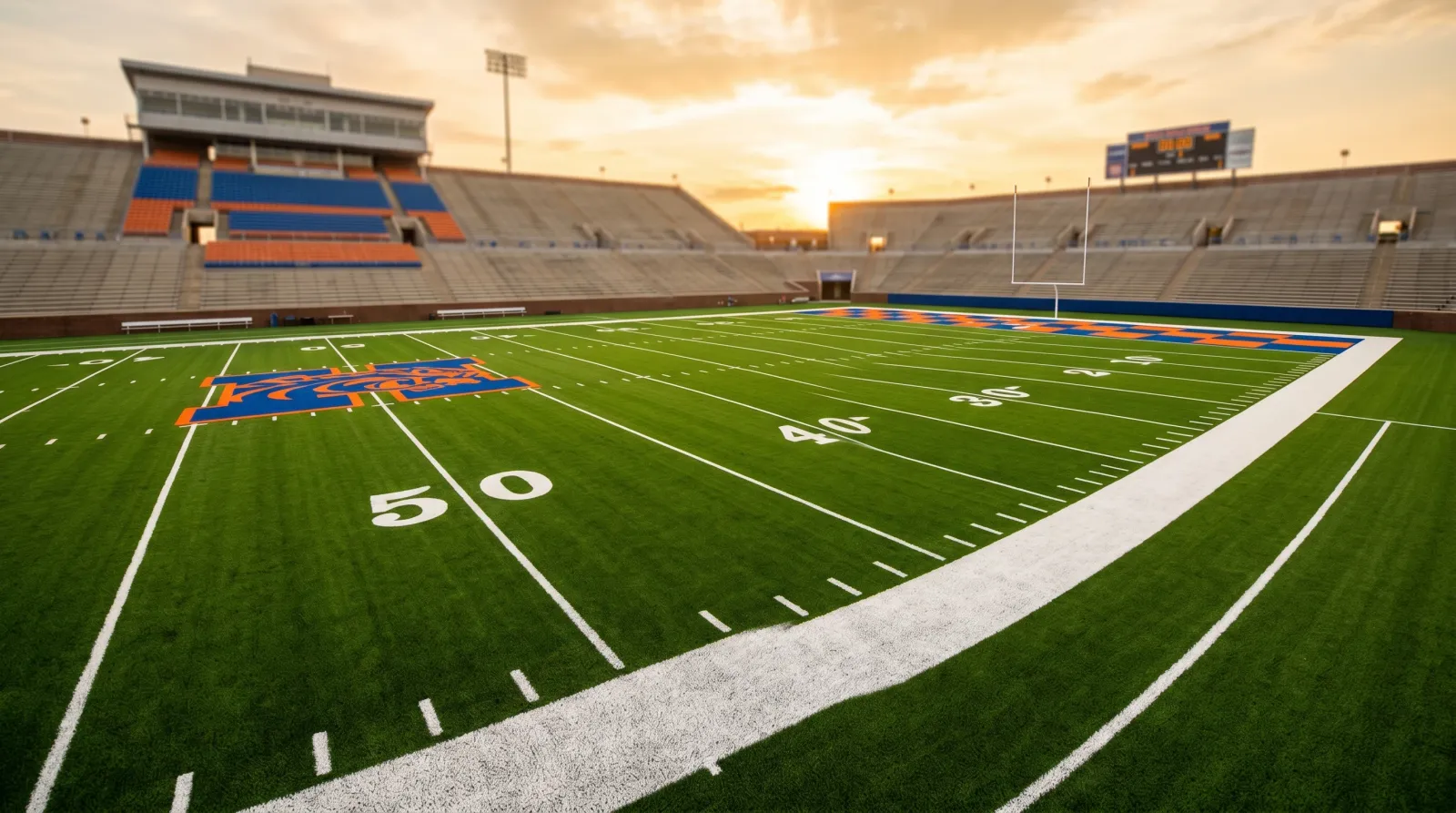
Football field marking paint has a job most athletic directors underspecify until the first washed-out line shows up on a Friday-night broadcast. The asset is a 360-by-160-foot playing surface, natural grass or synthetic turf, that has to carry crisp white lines, colored end zones, hash marks, numbers, and a midfield logo through a full season of foot traffic, mowing, irrigation, and weather. The line has to read from the press box and on camera, survive cleats and weekly play, and on grass it has to grow out without leaving the turf brown.
Service expectation is short by industrial standards and that is the point. On natural grass a painted line is a consumable. It lasts one to two weeks before it grows out under the mower, so the spec is built around fast re-striping, low cost per gallon, and turf safety, not film durability. On synthetic turf the math flips. Inlaid or permanently painted lines are expected to hold three to five years under UV before a refresh, and temporary game-specific markings (a championship logo, a visiting-team variation) have to remove cleanly without ghosting the fiber.
The buyer for this product is usually a head groundskeeper, an athletic facilities manager, or a school district grounds crew, not a coatings contractor. The decision comes down to three questions. Is the field grass or synthetic. Is it televised or stadium-lit, which drives the white brightness spec. And what is the weekly labor budget for re-striping, which drives whether you buy bulk concentrate for an airless striper or aerosol cans for a wheel-to-wheel walking applicator. Get those three right and the rest of the spec follows.
Recommendation Matrix by Field Zone
A game field is not a single surface. The line type and the paint behave differently zone to zone, and matching the system to the zone is where a clean field comes from.
| Zone | What it carries | Recommended approach |
|---|---|---|
| Yard lines and sidelines | Weekly bright-white lines | Diluted bulk waterborne, airless or wheel striper, re-stripe weekly |
| End zones (full color fill) | High-coverage colored field | Bulk concentrate at a richer dilution; expect 2x to 3x the paint of line work |
| Numbers, hash marks | Stenciled detail | Undiluted or lightly diluted concentrate through stencil for sharp edges |
| Midfield logo | Multi-color stenciled art | Premium high-TiO2 white plus colored concentrates; refresh less often than lines |
| Track apron, bleacher pad (hard surface) | Directional or safety lines | Different product entirely: OSHA 1910.144 traffic-grade waterborne, not turf paint |
The last row is the common cross-over mistake. Where a painted line leaves the turf and runs onto a concrete track apron, a press-box ramp, or a bleacher pad, it is a hard walking-working surface and turf paint will not bond to it. That line belongs to the parking lot striping paint family, a traffic-grade waterborne acrylic specified to OSHA 1910.144 color code.
Spec Requirements
Field paint is not a dry-film-thickness product. You do not build mils on a grass blade. The governing specs are dilution ratio, wet coverage in linear feet per gallon, dry-to-play time, and turf safety.
| Spec | Value |
|---|---|
| Product type | Waterborne titanium-dioxide athletic field paint; bulk concentrate or ready-to-use aerosol |
| Dilution (bulk on grass) | 1:1 with clean water typical; 2:1 to 4:1 on dense, healthy turf |
| Coverage @ working dilution | 4,000-6,000 linear feet of 4-inch line per diluted gallon on grass; less on synthetic |
| Coverage (end-zone fill) | 1 diluted gallon per 250-400 sq ft of solid color on grass |
| VOC | Under 100 g/L waterborne; high-TiO2 white concentrates under 50 g/L. No CARB / SCAQMD conflict for waterborne; solvent aerosol marking paint is restricted and is the wrong product for turf |
| Standards | ASTM D2486 (scrub), ASTM D6904 (wet adhesion), ASTM E1347 (white brightness for broadcast fields) |
| Substrate prep (grass) | Mow to 1.5-2 inch height; field dry; debris blown clear; string-line layout to NCAA / NFHS diagram |
| Substrate prep (synthetic) | Fiber clean and dry; verify manufacturer turf-safe rating and matching removal product |
| Application temp | Air and surface above 50°F and rising; turf not frozen or dormant |
| Humidity ceiling | Under 85% RH; no standing dew on the blade |
| Dry to play | 20-40 min no-track; 1-2 hr game-ready (waterborne, warm, dry); 3+ hr cool or shaded |
| Turf safety | Manufacturer-stated grow-back / turf-safe formula; never solvent-based utility marking paint |
Two of these decide whether the field looks right on camera. White brightness under ASTM E1347 separates a high-titanium-dioxide field white from a value white loaded with filler; the value white reads gray under LED stadium lighting and on a wide broadcast shot. And the dilution ratio decides turf health. Over-dilute and the line is thin and weak and you burn labor on a second pass. Under-dilute, or worse, run the concentrate neat on grass, and you smother the blade and brown the line.
The temperature and dormancy rule gets skipped in shoulder seasons. Paint applied to drought-stressed, frost-touched, or dormant turf does not grow out on schedule because the grass is not growing. The line sits and looks tired for weeks. Stripe living, irrigated, actively growing turf.
System Chemistry Compared
Athletic field paint is a narrower chemistry field than industrial coatings. The real choice is concentrate-vs-ready-to-use and pigment grade, not epoxy-vs-urethane.
| Class | Dilution | Cost basis | UV / broadcast | Best for |
|---|---|---|---|---|
| Bulk waterborne concentrate | 1:1 to 4:1 with water | Lowest per painted foot | High-TiO2 grades read true on camera | Weekly natural-grass line and end-zone work |
| Ready-to-use waterborne (jugs) | None; spray as supplied | Mid; convenience premium | Good | Small programs, low-volume fields, touch-ups |
| Aerosol athletic marking (turf-safe cans) | None | Highest per foot | Adequate | Practice fields, youth leagues, wheel-to-wheel walk applicators |
| Synthetic-turf-rated paint | Neat or light dilution per data sheet | Mid to high | UV-stable, removable | Permanent and temporary lines on artificial turf |
Bulk concentrate is the right answer for any program that stripes a full grass field weekly. The cost per painted foot is a fraction of ready-to-use, and the dilution flexibility lets the crew tune coverage to grass density through the season. The trade is equipment and labor: you need an airless or wheel-to-wheel striper and a crew that mixes to a consistent ratio.
Ready-to-use jugs and turf-safe aerosols earn their premium on low-volume fields. A youth-league or single-field high school program that lines a few times a season does not need a 5-gallon mixing operation. Aerosol cans in a walking wheel applicator also win for hash marks, numbers, and tight stencil detail where an airless gun is hard to control. Reserve aerosol for detail and low volume; it is the most expensive way to fill an end zone.
The hard line in this table is the synthetic-turf row. Grass-formula concentrate run neat on artificial fiber can leave a film that attracts dirt, dulls the surface, and resists clean removal. On synthetic turf, spec a paint rated for it with a matching removal product, every time.
Recommended Systems
System A — Pioneer Brite Stripe Bulk
The grounds-crew standard for natural-grass programs. Bulk titanium-dioxide concentrate, dilutes 1:1 with water, high brightness for stadium and broadcast fields.
| Layer | Product | Coverage |
|---|---|---|
| Surface prep | Mow to 1.5-2 in; dry-blow; string-line layout to NCAA / NFHS diagram | — |
| Base stripe coat | Brite Stripe Bulk diluted 1:1, airless or wheel striper | ~1.5 gal diluted per 6,000 lf of 4-inch line |
| Numbers / logo | Brite Stripe undiluted through stencil | richer build for sharp edges |
Brite Stripe’s brightness holds up on camera, and the dilution range gives the crew room to thin out on dense June turf and richen up on thin late-season grass. Mix to a consistent ratio batch to batch; eyeballed dilution is the leading cause of a field that reads patchy under lights.
System B — Sherwin-Williams Setfast Athletic
A waterborne athletic line from a manufacturer most facility crews already buy from, with rep support and local pickup through Sherwin-Williams pro stores. Rated for grass and synthetic with the application adjusted per data sheet.
| Layer | Product | Coverage |
|---|---|---|
| Surface prep | Mow and dry-blow; air temp above 50°F; turf dry | — |
| Stripe coat 1 | Setfast Athletic waterborne, diluted for grass or neat on synthetic | ~4,000-5,000 lf of 4-inch line per diluted gallon on grass |
The Setfast athletic system trades a little cost-per-foot against the convenience of a single-vendor account and a rep who will spec the dilution for your turf. For a school district already running Sherwin-Williams paint accounts, the consolidated purchasing is worth the small premium.
System C — World Class Athletic Field Paint (bulk concentrate)
A high-coverage bulk concentrate built for grounds crews who line on a tight labor window. Dilutes from 1:1 up to 4:1 on healthy turf, which stretches a gallon further than most concentrates.
| Layer | Product | Coverage |
|---|---|---|
| Surface prep | Mow, layout, confirm 2-hour rain-free window | — |
| Base stripe coat | Bulk concentrate diluted 1:1 to 4:1 with water | ~6,000 lf of 4-inch line per diluted gallon |
The wider dilution range is the selling point. On dense, healthy grass a crew can push to 3:1 or 4:1 and cut paint cost per field. Push the dilution only as far as the line still reads bright at full daylight; if the white starts to look washed, dial back the water.
Systems Compared
| System | Working dilution | Cost / painted foot | Refresh cycle | Best for |
|---|---|---|---|---|
| A — Pioneer Brite Stripe | 1:1 typical | Low | Weekly (grass) | Stadium and broadcast grass fields |
| B — SW Setfast Athletic | Per data sheet | Low-mid | Weekly (grass) / multi-year (synthetic) | Single-vendor school districts, grass or turf |
| C — World Class bulk | 1:1 to 4:1 | Lowest at high dilution | Weekly (grass) | High-volume grounds crews on tight budgets |
Cost per painted foot on a weekly-striped grass field is dominated by dilution and labor, not the sticker price of the concentrate. A bulk concentrate run at a sensible dilution lands well under a penny per linear foot of 4-inch line in material. The labor to lay it out and stripe it is the real annual cost, which is why crews invest in a good airless striper and accurate string-line layout.
Application & Contractor Path
This is a self-perform product for almost every program. A trained grounds crew lines its own field; you do not spec an SSPC-QP1 coatings contractor to paint grass. The skill is in layout and consistency, not certification. A crew that holds a true string line, mixes a repeatable dilution, and keeps the striper moving at a steady pace produces a sharper field than any outside vendor.
Where outside help makes sense is the midfield logo and end-zone art on a new or rebranded field. Cutting a multi-color stencil set and laying out a logo to scale is specialized, and several athletic-field service companies do logo installation as a one-time job; after that the in-house crew refreshes it. For synthetic turf, the field manufacturer or installer handles permanent inlaid lines, and the crew only paints temporary game-specific markings with the manufacturer’s approved paint and removal product. Painting permanent-looking lines on a warrantied synthetic field with the wrong product can void the turf warranty, so confirm the approved product list with the installer before the crew touches the fiber.
Equipment path: an airless field striper (Graco FieldLazer, Titan, or a Pioneer / World Class machine) for line and fill work above one field; a wheel-to-wheel walking applicator with turf-safe aerosol cans for small programs, hash marks, and detail; and a stencil set sized to your field diagram for numbers and logos. Buy the concentrate by the case from a manufacturer-direct athletics account or a turf-and-grounds distributor, not single jugs at retail markup.
Failure Modes & How to Prevent Them
Browned-out turf under the lines. The grass dies in a stripe-shaped pattern, worst on the most-repainted lines. Cause is paint smothering the blade: undiluted concentrate, repainting the exact same line every week so paint builds up, or painting dormant or drought-stressed turf that cannot grow out. Prevention is correct dilution, shifting heavy lines a fraction of an inch each week to spread the load, and only striping living, irrigated grass.
Washed-out lines after rain. A line laid down before a storm runs and ghosts. Cause is striping inside the dry window. Prevention is a 2-hour rain-free forecast minimum, flash-dry before sprinklers run, and a morning-of stripe on game day rather than relying on a line painted days earlier.
Gray, dull white on camera. Lines that look fine in person read gray under stadium LEDs and on broadcast. Cause is a value-grade white carrying filler instead of titanium dioxide. Prevention is specifying a high-TiO2 field white with measured brightness under ASTM E1347 for any televised or stadium-lit field, and reserving the value white for practice fields.
Patchy, inconsistent lines. The field reads uneven, some lines bright and some thin. Cause is eyeballed dilution that varies batch to batch and an inconsistent striper pace. Prevention is mixing to a measured ratio every batch and keeping the applicator moving at a steady walking speed.
Residue and ghosting on synthetic turf. Temporary lines on artificial turf will not remove cleanly and leave a shadow. Cause is grass-formula paint used on synthetic fiber, or skipping the manufacturer’s removal product. Prevention is a synthetic-turf-rated paint and its matching remover, applied per the turf manufacturer’s approved list. This is the same surface-compatibility logic behind why exterior paint chalks and fails on the wrong substrate: the binder has to match what it sits on.
Where to Buy / Spec
| Channel | Best for |
|---|---|
| Manufacturer-direct (Pioneer Athletics, World Class Athletic Surfaces) | Bulk concentrate by the case, stencil sets, striping equipment, athletics rep support |
| Sherwin-Williams pro stores | Setfast athletic line, local pickup, single-vendor district accounts |
| Turf-and-grounds distributor (BSN Sports, athletic supply dealers) | Mixed orders of paint, machines, and field-layout hardware |
| Amazon Business | Aerosol turf-safe cans and ready-to-use jugs for small programs and touch-ups |
Buy concentrate by the case on a direct athletics account; the per-gallon price on case quantities is well below retail jug pricing, and the rep will spec a dilution for your specific turf and lighting. Reserve Amazon Business for aerosol stocking and emergency touch-ups, not season-volume buying.