Curb Paint Colors: Federal Color and OSHA Specifier's Guide (2026)
Curb paint colors decoded by federal and OSHA code: red fire-lane, yellow no-parking, blue ADA. DFT, VOC by SCAQMD, traffic-paint systems, and the restripe cycle that survives de-icing salt.

Disclosure: Affiliate links to retailers and manufacturer-direct programs. Recommendations are spec-driven, not commission-driven.
Use Case
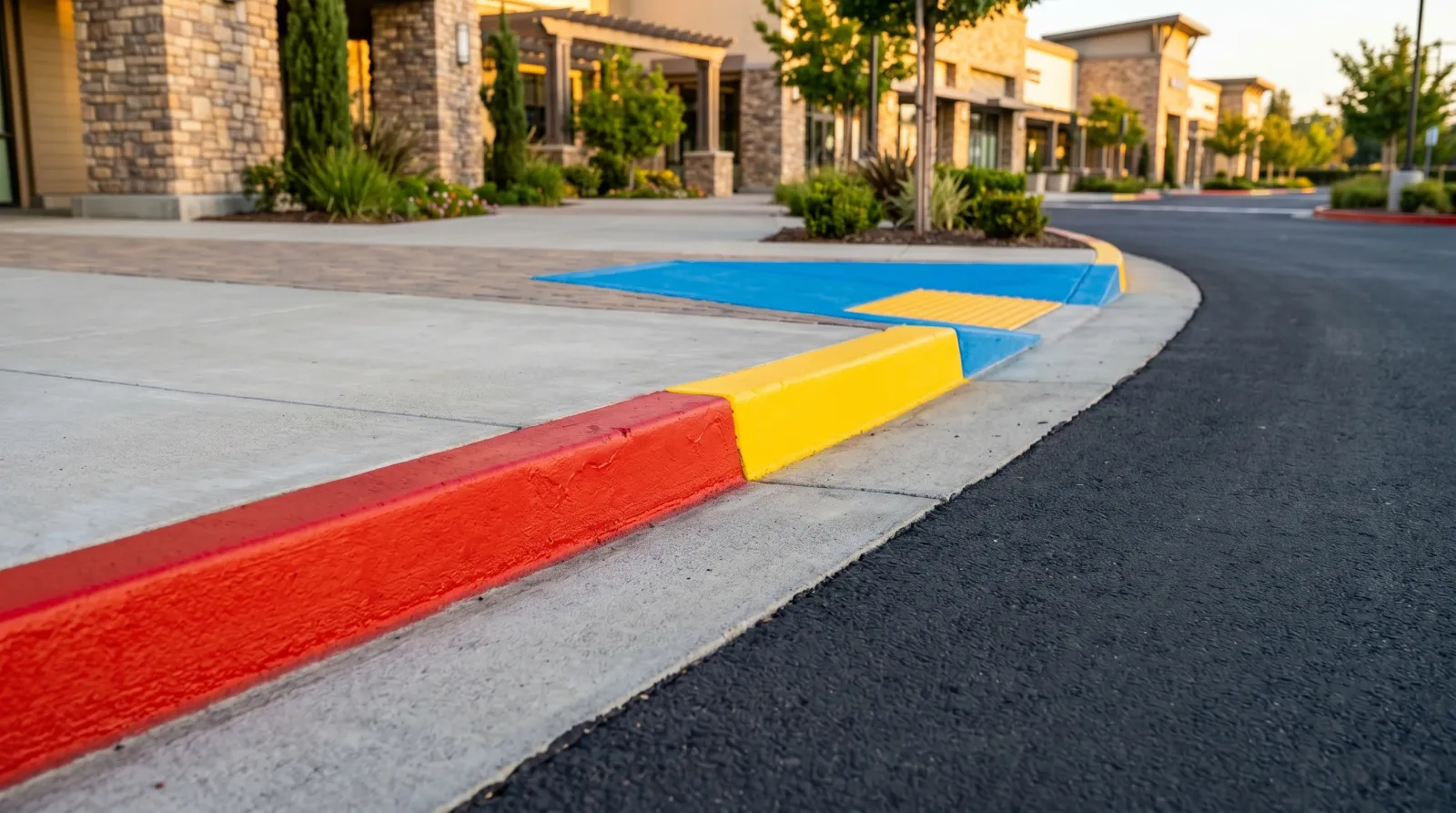
Curb paint is a code-compliance coating before it is a cosmetic one. The asset is the concrete or asphalt curb face and top at a retail center, hospital campus, school, warehouse frontage, or municipal lot, and the job is to carry a color that means something to a fire marshal, an ADA auditor, and a pedestrian reading a hazard edge. A faded red fire-lane curb is not a maintenance nuisance. It is a finding at the next fire inspection and an exposure if an emergency vehicle is blocked because nobody could read the curb. Color is the deliverable. Durability is what keeps the color legible between repaint cycles.
The environment is harsher than the stall striping a few feet away. A curb face takes direct plow scrape, salt slurry thrown off tires, dog traffic, snowmelt chemical, and the mechanical scuff of vehicles that misjudge the edge. Service life runs 12 to 18 months on a salted northern curb behind a plow route, 24 to 36 months on a dry southern curb with UV but no salt. Fire-lane red is the shortest-lived because it sits on the curb face where plows hit it, and because red pigment chalks faster under UV than yellow or blue. The spec calls for a traffic-grade waterborne acrylic carrying the Federal Standard color, applied at 4 to 6 mils dry, recoated on a spring cycle for the safety colors.
The spec writer’s job on a curb is narrower than on a floor or a tank, but the stakes are sharper. There is no W/D ratio and no moisture vapor emission test to run. There is a color that has to match a federal reference, a VOC ceiling set by the state, and a substrate prep step that decides whether the paint is still on the curb next March. Get the color code right, get the prep right, and the curb passes inspection for the price of a few gallons and a stencil set.
Curb Color Code, by Authority
Curb color meaning is set by overlapping authorities. Red and blue are effectively national. Everything past them is local ordinance, and assuming a national meaning for green or white is the most common spec error.
| Curb color | Meaning | Authority | Federal Std 595C ref |
|---|---|---|---|
| Red | Fire lane, no stopping, no parking | NFPA 1 / IFC §503; OSHA 1910.144 (danger) | 31136 safety red |
| Yellow | No parking, loading caution, hazard edge | OSHA 1910.144 (caution); local ordinance | 33538 safety yellow |
| Blue | ADA accessible parking and access aisle | ADA Standards §502; FHWA | 35180 safety blue |
| White | Loading, passenger pickup (where defined) | Local municipal ordinance | 37875 white |
| Green | Time-limited parking (where defined) | Local municipal ordinance | 34108 green |
Red and blue carry the weight. Red is read by the fire marshal against a recognizable safety red, and a curb that has chalked toward orange reads as non-compliant even if it was code-correct on day one. Blue is read by an ADA auditor at the accessible space and the access aisle, and it pairs with the painted symbol and signage, not just the curb. Yellow is the OSHA caution color and the right call for a hazard edge, a step-down, or a wheel stop under OSHA 1910.22 walking-surface rules. White and green only mean something where a local ordinance defines them, so confirm both against the municipal code before you write them into a spec. A curb painted green to mean “guest parking” in a code that reserves green for 15-minute zones is a marking that an enforcement officer will not honor.
Spec Requirements
| Spec | Value |
|---|---|
| Dry film thickness (DFT) | 10–15 mils wet, 4–6 mils dry per coat (waterborne acrylic) |
| Coverage @ DFT | 80–110 linear feet of curb face + top per gallon (6-in face) |
| VOC | under 150 g/L waterborne (CARB / OTC compliant); under 450 g/L solvent under SCAQMD Rule 1113 |
| Standards | ASTM D713 (road service), ASTM D2205 (specification), ASTM D2486 (scrub), AASHTO M-248 Type N |
| Color reference | Federal Standard 595C — red 31136, yellow 33538, blue 35180; OSHA 1910.144 safety color code |
| Substrate prep — concrete | Wire-brush laitance, degrease oil; ICRI CSP 2 profile on slick troweled curbs; new concrete cured 28 days |
| Substrate prep — old paint | Scarify loose film; shellac stain-block over old solvent before waterborne |
| Concrete surface temp at application | 50–95°F; dry, no standing moisture in the curb gutter line |
| Humidity ceiling | 85% RH; dew point at least 5°F below surface temp |
| Cure to traffic | 30–60 min no-track; 2–4 hours before plow or pressure-wash contact (waterborne, 73°F, 50% RH) |
| OSHA color code | 1910.144 — red (fire / danger), yellow (caution / hazard) |
ASTM D713 is the road-service test that separates traffic paint from porch enamel; a curb coated in hardware-store floor enamel chalks and lifts in one salt season because it was never graded for road service. ASTM D2205 governs the wet product in the pail, including freeze-thaw stability, which matters because curb work runs into cold shoulder-season weather more than stall striping does. AASHTO M-248 Type N is the line item that forecloses a cheap consumer substitution on the bid sheet. The Federal Standard 595C color call is the part curb specs usually miss. Writing “red” without the 31136 reference invites whatever red the contractor has on the truck, and the difference between safety red and an off-the-shelf red shows up the day the fire marshal walks the lot.
Concrete prep is the step that decides the repaint cycle. A new curb has a slick troweled surface and a layer of laitance that no traffic paint bonds to; wire-brush or lightly grind it to a CSP 2 profile and let new concrete cure a full 28 days. An old painted curb with loose or solvent-based film needs the loose material scarified and, where old solvent paint is staying, a shellac-based stain block so the waterborne topcoat doesn’t lift it. Skip the prep and the paint sheets off the curb face the first time a plow blade catches the edge.
System Chemistry Compared
Pick the chemistry first, then the color, then the brand.
| Class | Cure to traffic | Service life on curb | $/lf installed | Best for |
|---|---|---|---|---|
| Waterborne acrylic | 30–60 min | 12–36 mo | $0.40–0.90 | Default curb spec, all colors |
| Solvent (chlorinated rubber, alkyd) | 20–40 min | 18–30 mo | $0.50–1.00 | Cold-weather curb work where state allows |
| Epoxy / MMA two-part | 1–4 hr | 4–6 yr | $1.50–3.00 | High-abuse loading-dock and bollard curbs |
| Consumer floor / porch enamel | 2–8 hr | 4–10 mo | $0.30–0.60 | Not recommended — not road-service graded |
Waterborne acrylic is the right answer for nearly every curb. It carries the Federal colors, meets the AASHTO and TT-P specs, and stays under the 150 g/L VOC ceiling that California’s SCAQMD Rule 1113 and the thirteen OTC states enforce. Solvent dries faster in the cold and abrades a little harder, which is a real edge on a November curb job in a non-restricted state, but it is a plan-review failure to spec solvent traffic paint in California or most of the Northeast. Epoxy and MMA two-part systems belong only on the curbs that take real abuse: a loading-dock edge, a bollard base, a guardpost curb that loaders clip. They cost three to six times the waterborne per foot and need a two-part mix with a working pot life, so reserve them for the 5 percent of curb that earns it. The last row is the warning. Hardware-store floor and porch enamel is the most common wrong choice on a curb, and it is the reason a curb that looked fine in October is bare concrete by spring.
Recommended Systems
System A — Sherwin-Williams Setfast Acrylic Waterborne
The commercial curb and striping standard. AASHTO M-248 Type N, TT-P-1952F federal spec, available in safety red, yellow, blue, and handicap blue that hold the Federal Standard 595C colors.
| Layer | Product | DFT |
|---|---|---|
| Surface prep | Wire-brush laitance / scarify old paint; degrease; spot-prime bare concrete | — |
| Curb coat 1 | Setfast Acrylic Waterborne (Federal red / yellow / blue) | 10–15 mils wet / 4–6 mils dry |
| Curb coat 2 (stencil / plow face) | Setfast second pass on text and exposed faces | 10–15 mils wet / 4–6 mils dry |
Sherwin-Williams Setfast product page · Search on Amazon
Setfast’s 30-minute no-track time assumes 73°F and 50% RH. On a shaded curb face at 55°F it stretches to 90 minutes, and the curb gutter line where snowmelt pools is the last spot to dry. The second coat on stencil text and the plow-exposed face is not optional on a northern curb. A single 4-mil coat of red survives one winter on a south curb and loses the fight by March on a plowed north curb.
System B — Rust-Oleum Industrial Choice 2300 Inverted
Inverted-can aerosol for hand-layout curb work, touch-ups, and the in-house facilities crew that isn’t going to roll an airless. Right for short runs, isolated fire-lane sections, and ADA curb cuts where mobilizing a contractor isn’t justified.
| Layer | Product | DFT |
|---|---|---|
| Surface prep | Sweep and wire-brush clean; new concrete cured 28 days | — |
| Curb coat | Industrial Choice 2300 inverted aerosol (safety red, yellow, handicap blue) | 8–10 mils wet / 3–4 mils dry |
Rust-Oleum Industrial Choice 2300 product page · Search on Amazon
The 2300’s 3 to 4 mil dry build is the constraint. It carries the safety colors and lays down fast from a cart or a hand wand, but the thin film won’t hold a year of plow and salt on a fire-lane face. Plan on a touch-up every spring if this is the system, and keep cans of the matching color on the shelf. Right scope: punch-list, isolated curb runs, ADA curb cuts, and landlord touch-ups where the alternative is a contractor mobilization for 200 linear feet.
System C — PPG Aexcel-Stripe Waterborne
Federal Spec TT-P-1952F compliant, AASHTO M-248 Type N, the right call on Buy American and GSA-lease curb work where the federal line item is required. Comparable to Setfast at PPG distribution pricing.
| Layer | Product | DFT |
|---|---|---|
| Surface prep | Pressure-wash; concrete surface temp 50–95°F and dry | — |
| Curb coat 1 | Aexcel-Stripe Waterborne (Federal color) | 12–15 mils wet / 5–6 mils dry |
PPG Aexcel Pavement Markings page · Search on Amazon
Aexcel-Stripe earns its spec on federal and GSA work that needs a TT-P-1952F line on the bid. The color and durability track Setfast within a few percent. PPG’s industrial distribution thins out in the Mountain West, so verify local 5-gallon supply before you write it into a project with a hard occupancy date.
Systems Compared
| System | Total DFT | $/lf installed | Service life | Best for |
|---|---|---|---|---|
| A — SW Setfast (2-coat) | 8–12 mils dry | $0.60–1.10 | 18–36 mo | Full curb repaint, fire-lane red, ADA blue |
| B — Rust-Oleum 2300 aerosol | 3–4 mils dry | $0.40–0.80 | 10–16 mo | Touch-ups, short runs, in-house crews |
| C — PPG Aexcel-Stripe | 5–6 mils dry | $0.55–1.00 | 18–30 mo | Federal / GSA Buy American curb work |
The two-coat Setfast system is the one to write for a full repaint where the safety colors have to survive a salt winter. The 2300 aerosol is the in-house and touch-up tool, not the system you spec for a fire-lane that has to read code-correct for two years. Aexcel-Stripe is the federal-paperwork answer when the bid needs a TT-P-1952F line.
Application & Contractor Path
Curb painting is the rare traffic-marking task an in-house facilities crew can own. There is no airless striper to mobilize, the runs are short, and brush, 4-inch roller, or inverted aerosol does the work. A maintenance tech with the right Federal-color traffic paint, a wire brush, a degreaser, and a stencil set for “FIRE LANE NO PARKING” can hold a strip-mall frontage to code. The honest call: full-lot curb work on a campus, fire-marshal sign-off on red curbing, and ADA curb layout that has to survive an accessibility audit are where a striping contractor earns the spec. They carry the layout discipline, the federal-color stock, and the insurance the in-house crew doesn’t.
Where you do spec a contractor, the relevant credential is a striping and pavement-marking contractor carrying general liability at $2M aggregate, an SDS file, and a written adhesion warranty. SSPC-QP certifications are aimed at industrial steel and tank work and don’t map to curb painting; don’t write them into a curb spec where they’ll only narrow the bidder pool without buying you anything. The manufacturer rep path runs through the Sherwin-Williams or PPG industrial coatings rep who can confirm the safety-color stock, the Federal Standard match, and the AASHTO line item for the bid sheet. For the fire-lane sign-off specifically, loop the local fire marshal before the work, not after. Some jurisdictions require a specific stencil text and curb-length call that you’d rather know before the curb is dry.
Failure Modes & How to Prevent Them
Red fading toward orange by month 12. The curb still holds paint, but the safety red has chalked and shifted under UV, and the fire marshal reads it as faded. Cause is consumer-grade red without the Federal Standard 595C 31136 reference and without UV-stable traffic-paint pigment. Prevention is the spec: AASHTO M-248 Type N or TT-P-1952F in the Federal safety color, plus a spring touch-up cycle on fire-lane red specifically.
Sheeting off the curb face after the first plow season. Long sections of paint peel off the vertical face in strips while the curb top stays coated. Cause is a prep failure on the slick troweled curb face: laitance left in place, or paint laid over a curing-compound residue that repelled it. Prevention is wire-brush or grind to a CSP 2 profile, degrease, and never coat a cure-and-seal curb without breaking the seal first.
Lifting over old solvent paint. A fresh waterborne coat bubbles and lifts within days where it was laid over an old solvent-based curb. Cause is the waterborne softening and releasing the old film. Prevention is a shellac-based stain-block and bond coat over the old solvent paint, or scarify the old film off entirely before recoating.
Yellow hazard edge invisible under parking lights. The yellow curb edge that’s supposed to flag a step-down disappears under high-pressure sodium lighting at night, which is exactly when the trip risk is highest. Cause is an off-spec yellow that reads buff under warm lighting. Prevention is the Federal Standard 33538 safety yellow, which holds its chroma under sodium and LED parking lighting, applied at full two-coat build on the hazard edge.
Efflorescence pushing the coating off new concrete. White crystalline deposits form under the paint on a young curb and break the bond. Cause is coating concrete before the 28-day cure and before alkali salts have finished migrating. Prevention is the cure wait, a dry substrate, and addressing any existing bloom first. See the fix for efflorescence on concrete before coating.
Where to Buy / Spec
| Channel | Best for |
|---|---|
| Manufacturer-direct (SW Setfast, PPG Aexcel, Rust-Oleum 2300) | Federal-color stock, rep support, 5-gallon spec pricing |
| Industrial distributor (SealMaster, Pavement Supply, Brown Co) | Bulk traffic paint, stencils, curb-marking kits |
| Pro retail (Sherwin-Williams stores) | Local 5-gallon and quart pickup, contractor pricing |
| Amazon Business | Inverted-aerosol stocking for in-house touch-up crews |
Specifier’s Bid Language
“Provide and apply AASHTO M-248 Type N waterborne acrylic traffic marking paint per Sherwin-Williams Setfast specification (or approved equal: PPG Aexcel-Stripe). Curb colors to Federal Standard 595C: fire-lane red 31136, no-parking yellow 33538, ADA blue 35180, per OSHA 1910.144 and local fire code. DFT 10–15 mils wet, 4–6 mils dry per coat; two coats on fire-lane red and all stencil text. Concrete prep: wire-brush laitance, degrease, new concrete cured 28 days minimum; surface temp 50–95°F and dry; dew point at least 5°F below surface temp. ADA accessible-curb layout per ADA §502. Contractor carries $2M aggregate GL, provides SDS, and warrants 18 months adhesion on fire-lane and ADA curbing.”
The 18-month adhesion warranty is the floor on a properly prepped southern curb. On a salted northern fire-lane behind a plow, push the warranty conversation toward an annual touch-up clause instead of a long flat warranty no contractor will honor against a plow blade.