Dryfall Paint: Specifier's Guide for Open-Ceiling Spray Work (2026)
Dryfall paint drops overspray as removable powder within about 10 feet. Waterborne vs alkyd dryfall compared by DFT, VOC, MPI number, spray rig settings, and the clearance height the spec depends on.

Disclosure: Affiliate links to retailers and manufacturer-direct programs. Recommendations are spec-driven, not commission-driven.
Use Case
Dryfall paint is a fast-drying spray coating for high open ceilings, where the overspray dries into a removable powder before it lands. Spray it at least 10 feet above the floor and the mist that misses the target hits the slab as dust you sweep or vacuum up, which means the racking, conveyors, and machinery below do not have to be masked or covered.
That single property is the whole business case. Masking a 200,000 square foot distribution center ceiling in poly is a five-figure labor line before a gallon gets sprayed. Dryfall deletes it. The trade is that dryfall is a thin, flat, spray-only interior coating with modest durability, so it belongs overhead and nowhere near a wear surface.
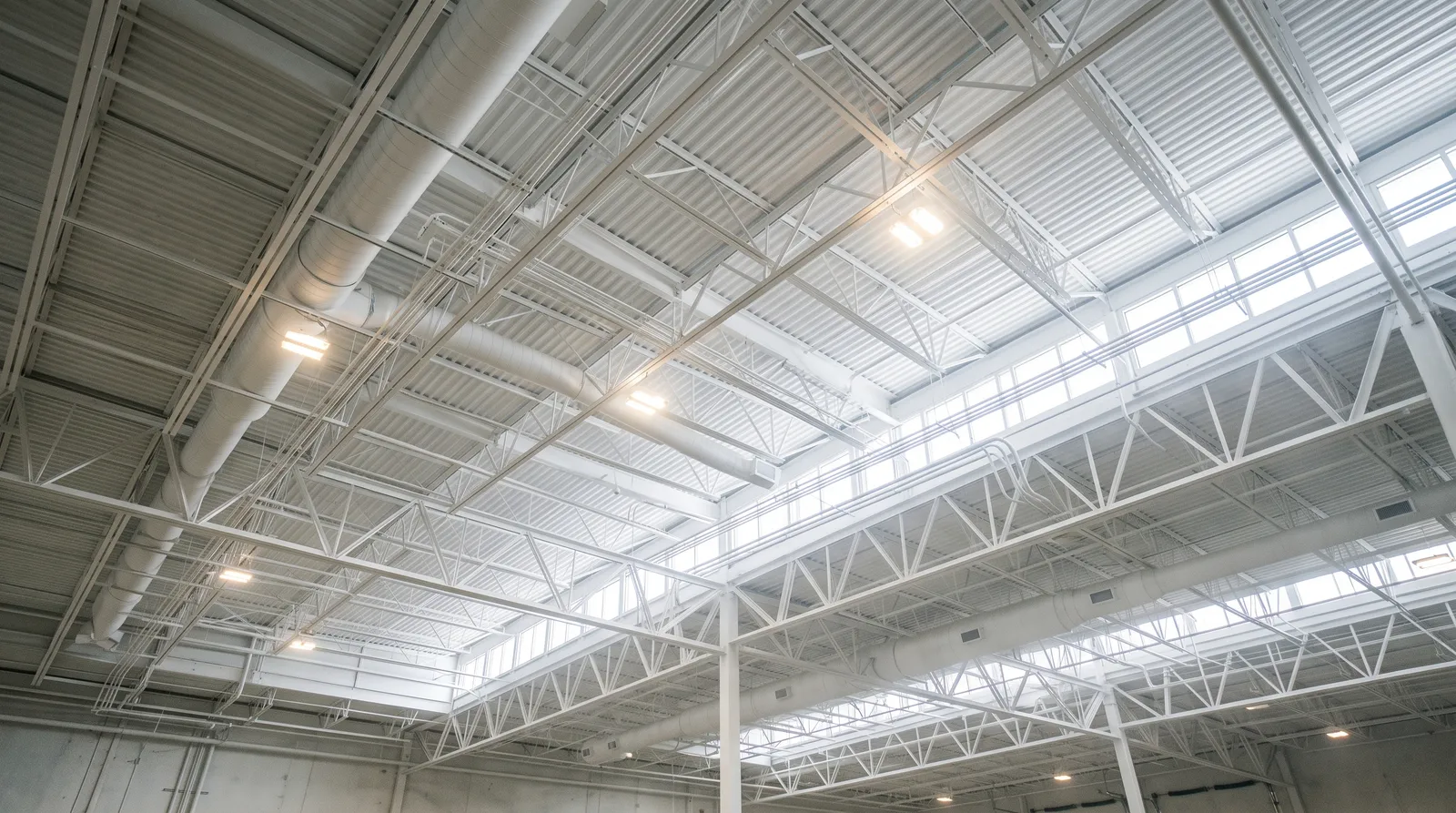
The assets are consistent: distribution and fulfillment center decks, manufacturing plant ceilings, big-box and grocery sales floors with exposed structure, gymnasiums and field houses, parking garage ceilings that are not directly weather-exposed, textile mills, hangars, and food-plant ceilings above the process line. What they share is open structure — corrugated metal roof deck, bar joists, purlins, ductwork, conduit, sprinkler pipe — and enough clear height for the fallout to work.
Service life on an interior ceiling that nothing touches runs 10 to 15 years. Dryfall rarely fails from wear. It fails from adhesion loss on unprimed steel, from flash rust on bare galvanized, and from being specified into a building that does not have the clearance the data sheet assumes.
Zoned Recommendation Matrix
A single industrial building rarely gets one dryfall spec. Clearance height, occupancy, and substrate all move the answer. The matrix for a typical distribution or manufacturing facility:
| Zone | Recommended system | Why |
|---|---|---|
| Open deck and bar joists, 20+ ft clear | System A or B (waterborne acrylic dryfall) | Full fallout distance, low VOC, high LRV for lighting efficiency |
| Ceilings 12–15 ft clear | System A, single coat, floor lightly covered | Fallout is marginal at 15 ft in humid air; cheap drop cloths as insurance |
| Ceilings under 12 ft clear | Not a dryfall job — spec a standard institutional flat | Below the fallout distance, dryfall gives no masking advantage |
| Food and beverage process ceilings | System A (USDA-acceptable waterborne) | Washdown-tolerant flat white, no solvent odor over open product |
| Unheated shell, 45–50°F surface | System C (alkyd dryfall) | Waterborne will not coalesce below 50°F; alkyd cures to 45°F |
| Occupied retail, schools, healthcare | System A or B (waterborne only) | Odor and VOC rule out alkyd in occupied space |
| Retail sales floor, black ceiling look | System A in flat black (B42BW3) | Same product family, hides ductwork and deck visually |
| Fireproofed structural steel | Mask — do not overspray | Overcoating SFRM or intumescent film can void the UL listing |
The clearance row is the one that decides whether this article applies at all. Everything else is a chemistry preference.
Spec Requirements
The spec block before any product name. Waterborne and alkyd dryfall carry different numbers, so the table splits where it matters.
| Spec | Value |
|---|---|
| DFT (waterborne acrylic) | 2.9–4.5 mils dry per coat, from 7.0–11.0 mils wet |
| DFT (alkyd) | 1.4–1.9 mils dry per coat, from 4.0–5.3 mils wet |
| Coverage (waterborne acrylic) | 145–226 sq ft/gal of coated surface; 657 sq ft/gal theoretical at 1 mil dry |
| Coverage (alkyd) | 300–400 sq ft/gal of coated surface |
| Volume solids | 41 ± 2% waterborne acrylic; 36 ± 2% alkyd |
| VOC limit | 69–100 g/L waterborne (OTC, OTC Phase II, CARB compliant; generally not SCAQMD Rule 1113); up to 400 g/L alkyd |
| Standards | MPI #118 Latex Dryfall Flat; MPI #55 Dry Fall Alkyd Flat |
| Fallout distance | 10 ft at 77°F / 50% RH; 10–20 ft at 55°F; up to 15 ft at 90% RH |
| Substrate prep (steel) | SSPC-SP2 hand tool minimum; SSPC-SP6/NACE 3 commercial blast to a 2-mil profile for best performance; primer required |
| Substrate prep (galvanized) | SSPC-SP1 solvent clean; SSPC-SP16 brush blast if a chromate or silicate passivation is present |
| Substrate prep (concrete/CMU) | SSPC-SP13/NACE 6 or ICRI 310.2R CSP 1-3; 28-day cure minimum; block filler on CMU |
| Ambient at application | 50°F to 110°F waterborne, 45°F to 90°F alkyd; surface at least 5°F above dew point |
| Relative humidity | 75% maximum |
| Dry to touch / recoat | 30 min / 1 hr at 77°F waterborne; 15 min tack free / 4 hr recoat alkyd |
| Cure to service | 4 hours at 77°F waterborne; protect from moisture 16–24 hours |
| Light reflectance | 83% LRV on standard flat white |
| Application method | Airless or conventional spray only; brush and roll not recommended |
Three numbers carry the risk. The fallout distance, because it is quoted at lab conditions and a cold, humid January warehouse is not lab conditions. The dew-point margin, because a metal roof deck runs colder than the air below it and condenses first. And the coverage figure, which is per square foot of coated surface, not floor area — an open deck with joists and ductwork runs 1.3 to 1.6 times the floor square footage.
Light reflectance is the spec item owners undervalue. Going from a dark or unpainted deck to an 83 percent LRV white ceiling measurably raises fixture efficiency, and on a large facility that shows up on the utility bill and in the lighting-retrofit calculation. Write the LRV into the spec so a contractor cannot substitute a grayer, cheaper white.
System Chemistry Compared
Four classes cover essentially all dryfall work sold in the US. Match the class to the building before comparing brands.
| Chemistry | VOC | DFT per coat | Recoat | Odor in occupied space | $/sq ft installed | Best for |
|---|---|---|---|---|---|---|
| Waterborne acrylic dryfall | 69–100 g/L | 2.9–4.5 mils | 1 hr | 🟢 low, water cleanup | $0.35–0.90 | Default spec: warehouses, plants, food, schools |
| Waterborne acrylic dryfall, eg-shel | 69 g/L | 2.5–4.0 mils | 1 hr | 🟢 low | $0.45–1.00 | Ceilings that get occasional washdown |
| Alkyd dryfall | up to 400 g/L | 1.4–1.9 mils | 4 hr | 🔴 strong solvent odor | $0.30–0.75 | Cold shells, dirty repaints, unoccupied work |
| Vinyl-acrylic economy dryfall | 100–150 g/L | 1.5–2.5 mils | 1–2 hr | 🟡 moderate | $0.25–0.60 | Budget new-construction decks, single coat |
Waterborne acrylic is the modern default and the one most specs should name. It carries the highest film build per coat, the fastest recoat, the widest substrate list, and the only VOC profile that survives an occupied-building review. Alkyd is a cold-weather and dirty-substrate tool, not a general spec. The economy vinyl-acrylics hide well on a fresh deck but thin out fast on joist webs and rarely justify their savings on a two-coat job.
One thing no dryfall does: corrosion protection. These are finish coats. On bare or rusted steel the spec has to carry a DTM or rust-inhibitive primer underneath, and that primer does not dry-fall — it has to be brushed, rolled, or sprayed with the area below covered.
Recommended Systems
Three systems at different chemistry and price-performance points. This is not a strict ladder; System A is the general spec, System B is the high-volume new-construction spec, System C is the cold-shell exception.
System A — Sherwin-Williams Waterborne Acrylic Dryfall (Waterborne, General Spec)
| Layer | Product | DFT |
|---|---|---|
| Primer, bare steel only | Pro Industrial Pro-Cryl Universal Primer | 2.0–4.0 mils |
| Finish, 1–2 coats | Waterborne Acrylic Dryfall Flat, B42W1 | 2.9–4.5 mils per coat |
| Total over primed steel | 5–9 mils |
The B42 line is the reference product most specifiers write around. Flat white at 83 percent LRV, eg-shel at B42W2, and flat black at B42BW3 for retail ceilings that want the structure to disappear. VOC is 84 g/L flat and 69 g/L eg-shel, it complies with OTC, OTC Phase II, CARB, and CARB SCM 2007, and it is listed as suitable for USDA-inspected facilities. It is flash-rust resistant, which matters when you are spraying a waterborne over steel in a humid shell. Fallout is 10 feet at 77°F. Sherwin-Williams Waterborne Acrylic Dryfall product page. Pro Industrial Waterborne Acrylic Dryfall is the same technology sold through the industrial channel.
System B — PPG Speedhide Super Tech Interior Latex Dry-Fog (Waterborne, High-Volume Decks)
| Layer | Product | DFT |
|---|---|---|
| Primer, bare or rusted steel | PPG waterborne DTM acrylic primer | 2.0–3.0 mils |
| Finish, 1–2 coats | Speedhide Super Tech Interior Latex Dry-Fog Flat, 6-725 series | 1.5–2.5 mils per coat |
| Total over primed steel | 4–8 mils |
The Speedhide Super Tech dry-fog line is the volume spec on new-construction warehouse and big-box decks. Low VOC, low odor, fast dry, and formulated with flash-rust resistance for overhead steel. It carries less film per coat than the Sherwin-Williams B42 line, so on a bare deck plan two coats rather than trying to build it in one heavy pass. PPG Speedhide Super Tech Interior Latex Dry-Fog. PPG also lists a Speedhide Interior Alkyd Dry-Fog for the same cold-shell case System C covers.
System C — Benjamin Moore Dry Fall Alkyd Flat 105 (Alkyd, Cold Shells)
| Layer | Product | DFT |
|---|---|---|
| Spot primer, bare substrate | Alkyd or acrylic rust-preventive metal primer | 1.5–2.5 mils |
| Finish, 1–2 coats | Dry Fall Alkyd Flat 105 | 1.4–1.9 mils per coat |
| Total | 3–6 mils |
Modified alkyd at 36 percent volume solids, 300 to 400 square feet per gallon, tack free in 15 minutes and recoat in 4 hours, and it will apply down to a 45°F surface where a waterborne dryfall will not form a film. That cold-weather window is the reason to spec it. VOC is under 400 g/L, so it is off the table in CARB and OTC-restricted jurisdictions and in any occupied building. It also may not be applied to uncoated galvanized metal, and the manufacturer notes plainly that the recommended primers do not dry-fall, so primed areas need covering below. Meets MPI #55. Dry Fall Alkyd Flat 105 technical data sheet.
Systems Compared
| System | DFT per coat | VOC | $/sq ft installed | Best for |
|---|---|---|---|---|
| A: SW Waterborne Acrylic Dryfall | 2.9–4.5 mils | 84 g/L flat | $0.45–0.95 | General spec, occupied buildings, food plants |
| B: PPG Speedhide Super Tech Dry-Fog | 1.5–2.5 mils | Low-VOC latex | $0.35–0.80 | High-volume new-construction decks |
| C: BM Dry Fall Alkyd Flat 105 | 1.4–1.9 mils | <400 g/L | $0.30–0.75 | Unheated shells, dirty repaints, unoccupied |
Installed pricing assumes 100,000 square feet or more of floor area, single coat, lifts and prep included, through a commercial painting contractor. Two-coat work runs roughly 70 to 90 percent higher, not double, because the mobilization and lift time are already spent. Jobs under 20,000 square feet carry a 40 to 70 percent per-foot premium, driven almost entirely by lift rental and setup.
Application and Contractor Path
Dryfall is a rig job. The equipment spec from the Sherwin-Williams data sheet is a fair template for the class: airless at 2800 psi, a 0.017 to 0.019 inch tip, 1/4-inch ID hose, and a 60-mesh filter, with no reduction of the material. Conventional spray runs a Binks 95 gun with a 63C fluid nozzle and 63PB air cap at 60 psi atomizing and 50 psi fluid. Thinning is the single most common field deviation and it directly extends the fallout distance, which is how overspray ends up wet on a conveyor.
Three application rules matter more than the rest:
- Overlap 50 percent on every pass, and cross-spray at a right angle on the second coat. Bar joist webs and deck flutes have shadow sides that a single directional pass cannot reach. Cross-spraying is what closes the holidays.
- Hold the fallout distance. Measure the actual clear drop from gun to floor at the lowest point in the spray zone, not the ridge height. Ductwork, mezzanines, and racking all shorten it.
- Protect the first 16 to 24 hours from moisture. Waterborne dryfall is sensitive to condensation during early cure. In an unconditioned shell, that means checking the roof deck surface temperature against dew point, not just the air.
The contractor path is a commercial painting contractor with high-reach experience, not a facilities crew. The reason is access, not chemistry: this is boom-lift and scissor-lift work under OSHA 1910.28 and 1926.453, with 1910.134 respiratory protection for overhead spray. The lift fleet and the trained operators are the barrier to entry.
Four qualifying questions before you sign:
- What is the measured clear height at the lowest point of the spray zone, and what fallout distance does the data sheet quote at the temperature and humidity we will actually have? A contractor who answers with ridge height has not walked the building.
- How are sprinkler heads, smoke detectors, and fire-alarm devices protected? NFPA 13 prohibits field-painted sprinkler heads. Painted heads get replaced at somebody’s cost, and you want that named in the contract.
- Is any structural steel fireproofed, and how is it masked? Overcoating spray-applied fire-resistive material or an intumescent film can void the UL assembly listing. Our intumescent steel coatings guide covers why those systems are tested as complete stacks.
- What is the primer plan for bare and rusted steel? Dryfall is a finish, not a corrosion coating. Bare steel needs a DTM or rust-inhibitive primer per SSPC-SP2 minimum, and that primer does not dry-fall.
For the sprayer side of the decision on smaller in-house work, our airless sprayer round-up covers what the rig classes can actually push at 2800 psi through a 0.019 tip.
Failure Modes and How to Prevent Them
Five failures account for nearly every dryfall claim. All five are decided in the specification or the pre-job walk, not in the field.
- Wet overspray on the floor and equipment. Cause: insufficient clear height, cold or humid air, or a thinned material, so the mist is still tacky when it lands. Prevention: verify the actual clear drop at the lowest point, hold 50°F minimum and 75 percent RH maximum, and prohibit reduction in the spec. Add drop cloths under any zone below 15 feet.
- Adhesion loss and rust bleed on bare steel. Cause: dryfall sprayed direct to mill-scaled or rusted steel with no primer. Prevention: SSPC-SP2 hand tool clean at minimum, SSPC-SP6/NACE 3 commercial blast to a 2-mil profile where the budget allows, and a DTM or rust-inhibitive primer applied within 8 hours of blast or before flash rusting. Our direct-to-metal paint guide covers the primer selection.
- Peeling off passivated galvanized. Cause: dryfall applied over chromate or silicate-treated galvanized without treatment. Prevention: SSPC-SP1 solvent clean, then a test patch left a full week before an adhesion pull. If it fails, brush blast per SSPC-SP16. The same logic applies to sheet metal, which our HVAC duct paint guide works through.
- Painted sprinkler heads flagged at fire inspection. Cause: heads left unbagged during the spray. Prevention: bag or cap every head, count them out and back in, and put replacement responsibility in the contract. NFPA 13 does not allow cleaning them and putting them back.
- Overspray fused to hot surfaces. Cause: dust landing on running motors, light fixtures, process piping, or duct heaters, where surface temperature is well above the air temperature and the powder bonds instead of sweeping off. Prevention: shut down or mask hot equipment in the spray zone, and remove any overspray from hot surfaces immediately before it adheres.
The first two produce most of the claims. The first is a pre-job measurement problem, the second is a specification problem, and neither is fixable once the rig is running.
Where to Buy / Spec
| Channel | Best for | Path |
|---|---|---|
| Sherwin-Williams Commercial / Pro Industrial rep | B42 waterborne dryfall, USDA-facility specs, full warranty | SW Waterborne Acrylic Dryfall |
| PPG commercial rep or PPG Paints store | Speedhide Super Tech dry-fog, high-volume new construction | PPG Speedhide Super Tech Dry-Fog |
| Benjamin Moore / Coronado independent dealer | Alkyd 105 dry fall for cold shells | Dry Fall Alkyd Flat 105 TDS |
| Industrial coatings distributor | 5-gallon and drum quantities, contractor accounts | Regional dealer network |
| Equipment rental (boom and scissor lifts) | Access, usually carried by the painting contractor | Local rental yard |
Manufacturer-direct is the right channel on anything above 25,000 square feet. All three of these manufacturers run free pre-bid walks, and the walk catches the two problems that kill dryfall jobs: a clear height that does not support the fallout distance, and bare steel that needs a primer line nobody budgeted. Both are cheap to solve in the bid and expensive to solve from a lift. Once the ceiling is done, the warehouse floor coating framework covers the other half of the same shell.
FAQ
See the frontmatter for the full FAQ set covering clearance height, waterborne versus alkyd selection, spray-only application, sprinkler-head code, fireproofed steel, coat count, and installed cost.
Ask a Question