Cool Roof Coatings: Energy Star Specifier's Guide (2026)
Cool roof coating systems compared by reflectance, DFT, and warranty. Energy Star and CRRC ratings, ASTM D6083 specs, substrate prep by roof type, and the certified-applicator path.

Disclosure: Affiliate links to retailers and manufacturer-direct programs. Recommendations are spec-driven, not commission-driven.
Use Case
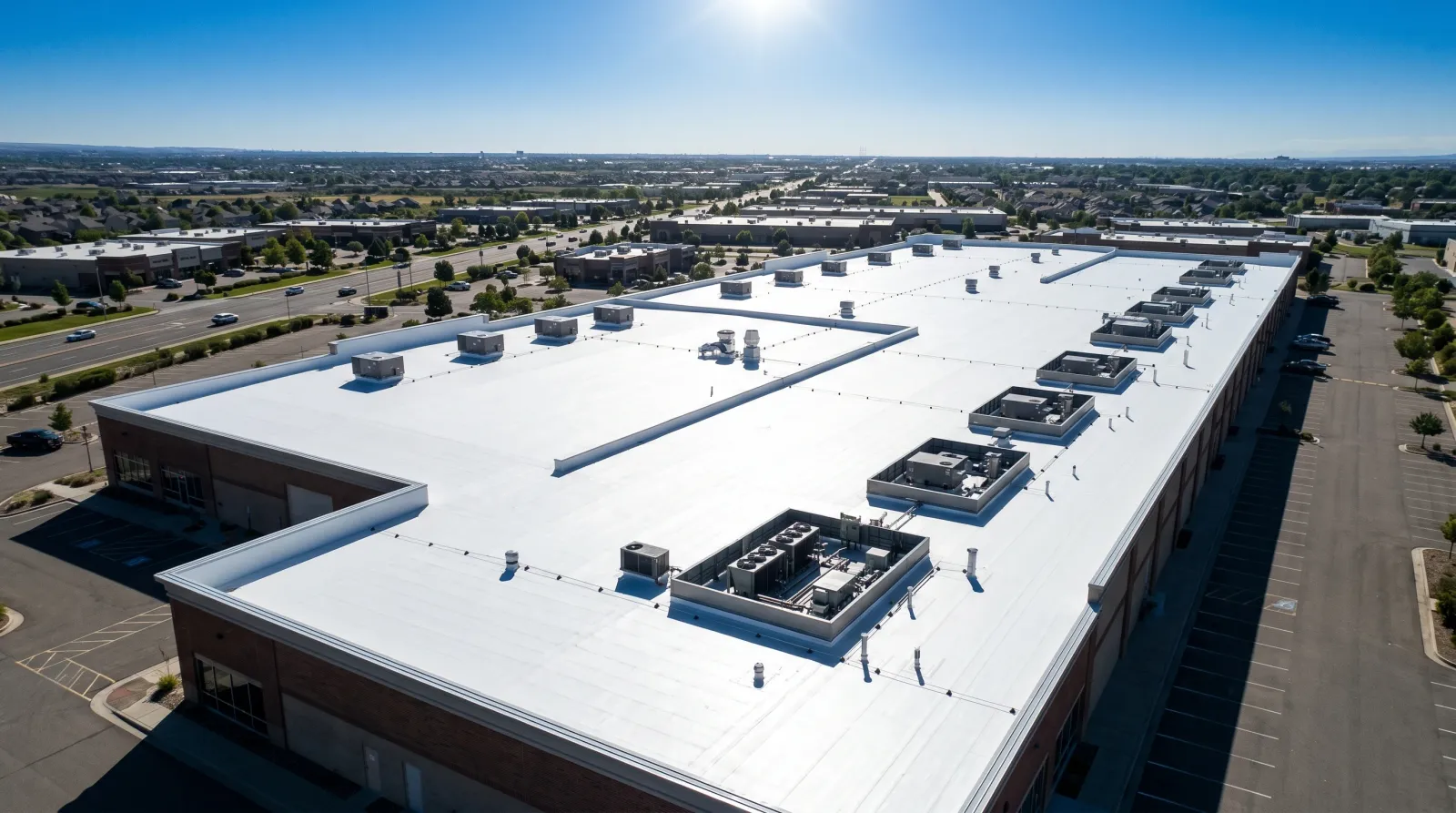
A cool roof coating is a liquid-applied, high-reflectance membrane that restores a low-slope commercial roof and reduces the heat load on it at the same time. The spec gets written for two reasons that usually arrive together. The roof is at the end of its first service life, leaking at seams and fasteners but with a sound deck, and a tear-off costs three to five times what a coating recoat costs. And the owner wants the energy and code benefit of a high solar reflectance surface. A coating answers both: it bridges the failing seams, adds a monolithic waterproof film, and reflects 80 to 88 percent of incident solar radiation back off the building.
The asset is almost always a low-slope roof under quarter-inch-per-foot to half-inch-per-foot pitch. The substrate is one of a handful of types: aged single-ply (TPO, EPDM, PVC, Hypalon), built-up roof (BUR) with a granulated or smooth cap, modified bitumen, metal panel roof, or spray polyurethane foam (SPF). Each substrate changes the primer and the chemistry, and a coating spec that ignores the substrate fails inside two seasons.
Service life is keyed to chemistry and dry film thickness. An acrylic system at 20 to 24 mils dry delivers 10 to 15 years and recoats cleanly. A silicone system at 20 to 25 mils dry delivers 15 to 20 years and shrugs off ponding water that destroys acrylic. Both buy a recoat cycle: at the end of the warranty the roof is washed, inspected, and field-coated again at a fraction of the original cost, with no tear-off and no landfill. That recoatability is the financial argument the facility manager carries into the capital meeting. The coating is not a one-time spend; it converts a roof from a replacement liability into a maintained, recoatable asset.
The energy case is climate-dependent and worth stating honestly. A reflective roof saves cooling energy in the South and Southwest and qualifies for Title 24 and utility rebates. In a heating-dominated northern climate the reflectance value is muted and the spec is driven by leak repair and roof-life extension, not the energy bill.
Spec Requirements
The spec block governs the system before any product name. Reflectance and emittance are the cool-roof-specific lines; everything else is standard liquid-applied roofing.
| Spec | Value |
|---|---|
| Dry film thickness (DFT) | 20–30 mils dry total; build to the warranty term, not a single number |
| Coverage @ DFT | Silicone: 1.5–2.0 gal/100 sq ft for 20–24 mils dry; acrylic: 2.0–2.5 gal/100 sq ft over two coats |
| Solar reflectance (initial) | ≥0.80 white per ASTM C1549; ≥0.65 three-year aged is the durable target |
| Thermal emittance | ≥0.85 per ASTM C1371 |
| Energy Star threshold | Aged solar reflectance ≥0.50 low-slope, ≥0.15 steep-slope (3-year value) |
| VOC | <50 g/L acrylic; <100 g/L high-solids silicone — both meet SCAQMD Rule 1113 and CARB SCM |
| Standards | ASTM D6083 (acrylic), ASTM D6694 (silicone), ASTM D2370 (elongation/tensile), UL 790 / ASTM E108 fire |
| Substrate prep — single-ply | Power-wash to remove chalk and dirt; rinse residual cleaner; prime per membrane (TPO/PVC need a bond primer) |
| Substrate prep — metal | SSPC-SP2/SP3 hand or power tool clean of rust and loose coating; rust-converting or metal primer; tighten fasteners |
| Substrate prep — BUR / mod-bit | Remove loose granules, repair blisters, prime smooth/aged asphalt; spud or recoat alligatored areas |
| Moisture verification | Infrared or nuclear survey on roofs >5 years; plastic-sheet test ASTM D4263; replace wet insulation by core cut |
| Seam reinforcement | Polyester fabric embedded in coating at all seams, laps, penetrations, and flashings |
| Adhesion | Pull-test ASTM D4541 or field pull-quad before full application; manufacturer minimum varies by substrate |
| Ambient at application | 50°F to 100°F air and substrate; relative humidity <85%; substrate ≥5°F above dew point; no rain 4–24 hr after |
| Cure to rain (silicone) | 1–8 hours to shed a light rain; full cure 24–48 hours |
| Cure to recoat (acrylic) | 4–24 hours between coats per humidity and temperature |
Three lines decide the job. The moisture survey decides whether the roof can be coated at all. The dry-mil build decides the warranty term. The dew-point margin decides whether the film cures or blisters. Miss the moisture survey and you seal water into the deck. Underbuild the mils and the warranty drops a decade. Coat below the dew-point margin and silicone skins over a film of condensation that never bonds.
System Chemistry Compared
Two chemistries cover almost every cool-roof spec. A third (polyurethane) shows up in high-traffic or ponding-plus-impact situations and a fourth (asphalt-based aluminum) is the legacy product that a cool-roof spec is usually replacing.
| Chemistry | Recoat / cure | Ponding water | UV stability | Reflectance retention | $/sq ft installed | Best for |
|---|---|---|---|---|---|---|
| Acrylic (waterborne) | 4–24 hr recoat; rain-sensitive while wet | Poor — re-emulsifies, blisters under standing water | Good | Good; chalks slowly, recoatable | $1.50–3.00 | Sloped low-slope roofs that drain, dry climates, budget recoats |
| Silicone (high-solids) | 1–8 hr rain-safe; one-coat capable | Excellent — unaffected by standing water | Excellent | Excellent; holds dirt, may need wash | $2.50–4.50 | Ponding roofs, humid climates, longest warranty |
| Polyurethane (aliphatic) | 2–12 hr; two-component | Good | Excellent (aliphatic) | Good | $3.50–6.00 | Foot-traffic decks, impact zones, mechanical-room roofs |
| Asphaltic aluminum (legacy) | 24 hr | Poor | Fair — oxidizes | Drops fast as it weathers | $0.80–1.50 | Not a true cool-roof system; what you’re replacing |
Acrylic is the cost answer on any roof that actually drains. It re-emulsifies under standing water, so a roof with chronic ponding from a sagging deck or undersized drains is the wrong place for it. Silicone is the answer for ponding, for humid Gulf and Southeast climates, and for the longest warranty, at a higher material cost and with a dirt-pickup tradeoff that lowers reflectance over time and sometimes needs a wash to recover. Silicone also makes recoating harder down the road, because almost nothing sticks to cured silicone except more silicone or a silicone-specific primer. Polyurethane earns its premium only where the roof takes foot traffic or impact.
Recommended Systems
Three full systems at different price-performance points. System A and B are silicone for ponding and longest warranty; System C is the acrylic two-coat for draining roofs on a budget. Verify the CRRC rating and Energy Star listing for the exact product and color before bid.
System A — GAF Unisil Silicone (Single-Coat, Ponding-Rated)
| Layer | Product | DFT |
|---|---|---|
| Primer / rust treatment (as needed) | GAF Acrylic Bleed Block Primer or metal primer per substrate | 2–4 mils |
| Detail coat | GAF Unisil reinforced with polyester at seams, laps, penetrations | embedded |
| Field coat | GAF Unisil HS silicone (one or two coats to spec) | 20–25 mils dry |
| Total | 22–29 mils |
Service life 15–20 years. Unisil is a high-solids silicone that builds the warranted mils in one or two passes and is rain-safe within hours of application, which matters on a roof you cannot tarp overnight. It handles ponding without re-emulsifying, so it is the answer on a low-slope deck with standing water the owner is not going to re-pitch. GAF’s WeatherBlanket and Diamond Pledge warranties run to 20 years through a GAF-certified Master applicator. GAF silicone roof coatings page.
System B — GacoRoof 100% Silicone (Recoat / Restoration Standard)
| Layer | Product | DFT |
|---|---|---|
| Primer (porous / weathered) | GacoFlex E5320 epoxy or A42 acrylic primer per deck | 2–4 mils |
| Seam reinforcement | GacoFlex SF2000 polyester in GacoRoof at all seams and flashings | embedded |
| Field coat | GacoRoof 100% silicone | 20–24 mils dry (1.5–2 gal/100 sq ft) |
| Total | 22–28 mils |
Service life 15–20 years. GacoRoof is the most widely stocked 100% silicone restoration coating in the U.S. and has the deepest installed track record on aged single-ply and metal. It cures fast enough to beat an afternoon shower and holds reflectance well in the Sun Belt. The single-product simplicity (one silicone for field and detail) is why smaller commercial roofers default to it. GacoRoof silicone product page.
System C — Henry 587 Enviro White Acrylic (Two-Coat, Draining Roofs)
| Layer | Product | DFT |
|---|---|---|
| Primer / bond coat | Henry 187 or substrate-specific acrylic/asphalt primer | 2–3 mils |
| Base coat | Henry 587 Enviro White acrylic + polyester at seams | 10–12 mils dry |
| Top coat | Henry 587 Enviro White acrylic | 10–12 mils dry |
| Total | 22–27 mils |
Service life 10–15 years. Henry 587 is the cost answer for a roof that drains. The two-coat acrylic build is the most budget-friendly cool roof per square foot and recoats cleanly at end of warranty, with no silicone-recoat headache. Specify it only where the roof sheds water; chronic ponding will blister acrylic inside two seasons. Henry’s reflective acrylics carry Energy Star and CRRC ratings at the white color. Henry reflective roof coatings page.
Rust-Oleum’s industrial maintenance line carries comparable acrylic and silicone roof coatings for smaller commercial buildings and is the easiest channel for a facility that already buys through that distributor. See the Rust-Oleum industrial coatings overview for the line.
Systems Compared
| System | Total DFT | $/sq ft installed | Service life | Best for |
|---|---|---|---|---|
| A — GAF Unisil silicone | 22–29 mils | $2.75–4.50 | 15–20 years | Ponding roofs, fast rain-safe cure, 20-yr warranty |
| B — GacoRoof silicone | 22–28 mils | $2.50–4.25 | 15–20 years | Aged single-ply / metal restoration, Sun Belt |
| C — Henry 587 acrylic | 22–27 mils | $1.50–3.00 | 10–15 years | Draining roofs on a budget, clean recoat |
Pricing assumes a 20,000-plus sq ft single roof through a manufacturer-certified applicator, including power wash, seam reinforcement, and primer. Small-scope work (under 5,000 sq ft) runs 30–60 percent higher per square foot because mobilization, the moisture survey, and the wash are fixed costs spread over fewer squares. Metal roofs add fastener tightening and rust treatment; budget another $0.25–0.75 per square foot for that prep.
Run the math over the warranty horizon, not the bid sheet. A silicone system at $3.50 installed across a 20-year warranty is $0.175 per square foot per year of waterproofing, before counting the recoat that extends it another 15 years at roughly half the original cost. A tear-off and re-membrane on the same roof runs $8–14 per square foot with disposal, and resets the clock to zero. The coating wins on total cost of ownership any time the deck and insulation are dry and sound.
Application & Contractor Path
A cool roof coating is not a true DIY product on any roof a building owner depends on. The build-to-warranty mil count, the moisture survey, the seam reinforcement, and the wet-mil verification during application are a documented system, not a paint-and-roll job. A maintenance crew can spot-coat a small leak or recoat a shed roof. A warranted system over a few thousand square feet goes to a certified applicator. Spec a contractor with:
- Manufacturer certification on the specific product line (GAF Master Commercial Roofer, GACO-approved applicator, Henry-trained contractor). The certification is what carries the labor warranty.
- A documented moisture survey (infrared or nuclear) and core-cut report before mobilization.
- Wet-mil gauge readings logged during application and a final dry-mil verification, so the warranted thickness is provable at closeout.
Three contractor-qualifying questions before signing:
- What moisture survey will you run, and who reads it? A contractor who wants to coat a ten-year-old roof without an IR scan is selling you a blister farm. The survey is non-negotiable on any roof past warranty age.
- What dry-mil build does the warranty term require, and how do you verify it in the field? The answer should be a wet-mil gauge cadence keyed to gallons-per-square. Vague answers mean an underbuilt roof and a warranty that won’t hold at claim time.
- Who issues the manufacturer warranty, and is it material-only or material-and-labor? The labor warranty is the one that pays for the re-coat if it fails. Material-only is the cheap path and leaves the owner holding the labor cost.
Every major manufacturer (GAF, GACO, Henry) runs a free pre-bid roof assessment through the rep network: substrate identification, adhesion pull-test, recommended primer, and the dry-mil schedule for the warranty term the owner wants. Use it. A wrong primer call on a TPO roof shows up as wholesale delamination in the first year, and the rep catches it in an afternoon on the roof.
Failure Modes
Five failures cover the bulk of cool-roof coating rejections and warranty claims.
- Blistering over trapped moisture. The film lifts in domes within a season, worst over wet insulation. Cause: coating applied over a roof with trapped moisture, no IR survey, wet insulation left in place. Prevention: infrared or nuclear moisture survey on any roof over five years; core-cut and replace wet insulation; ASTM D4263 plastic-sheet test before primer.
- Delamination from poor adhesion. The coating peels off in sheets, often on TPO or PVC where the wrong primer (or no primer) was used. Cause: skipped bond primer on a low-surface-energy membrane, or coating over a chalky unwashed surface. Prevention: power-wash to remove chalk and dirt, rinse cleaner residue, use the membrane-specific bond primer, and run a field pull-test before full application.
- Ponding-water breakdown on acrylic. The acrylic softens, re-emulsifies, and washes thin in standing-water areas while the drained field stays intact. Cause: acrylic specified on a roof that ponds. Prevention: silicone in any ponding zone, or re-pitch the deck and add drains before coating. Match the chemistry to the drainage.
- Underbuilt dry film thickness. The roof passes inspection on day one and fails in years 7–10 instead of 15–20. Cause: the crew rolled the field coat thin to stretch material, with no wet-mil gauge cadence. Prevention: gallons-per-square tracked against the warranted mil count; wet-mil readings logged; dry-mil verification at closeout.
- Reflectance loss from dirt and biological growth. The white roof goes gray and the energy and Title 24 benefit erodes, worst on silicone in humid climates where it holds dirt. Cause: no maintenance wash, north-facing low-slope areas growing algae. Prevention: a scheduled wash every 2–3 years restores most of the lost reflectance; spec a product with a published three-year-aged reflectance, not just an initial number.
Moisture-driven blistering is the failure I see most on coating jobs, and it is entirely a pre-construction problem. The IR survey costs a fraction of the recoat and settles the question of whether the roof should be coated at all. Skip it and the owner pays twice.
Where to Buy / Spec
| Channel | Best for | Path |
|---|---|---|
| GAF / GACO / Henry rep network | Warranted commercial systems, pre-bid roof assessment, certified applicator referral | Manufacturer rep + certified contractor |
| Manufacturer-direct (GAF, GACO, Henry) | Spec’d projects, warranty registration, product data and CRRC listings | Direct order through certified channel |
| Industrial / roofing distributor (ABC Supply, SRS, Beacon) | Bulk pails, primer, polyester fabric for contractor accounts | Distributor account with project pricing |
| Pro retail (Sherwin-Williams, ICI/PPG stores) | Small-roof recoats, maintenance coating, local pickup | Contractor pricing, 5-gal pails |
| Amazon Business | Maintenance recoats, small metal-roof and RV-roof work | Stocking small quantities |
Manufacturer-direct through the certified rep network is the recommended channel on any roof over 5,000 square feet. The pre-bid assessment, the substrate-specific primer call, and the warranty registration are worth more than any retail discount on the pail. The distributor channel is right for the contractor stocking a known system; retail and Amazon Business are for maintenance recoats and small metal-roof work that does not carry a system warranty.
FAQ
Answers to the questions a facility buyer asks before signing are in the spec block and the contractor section above. The frontmatter FAQ carries the procurement-meeting versions: contractor requirement, warranty terms, moisture survey, energy payback, and Energy Star / Title 24 qualification.