Rock Candy
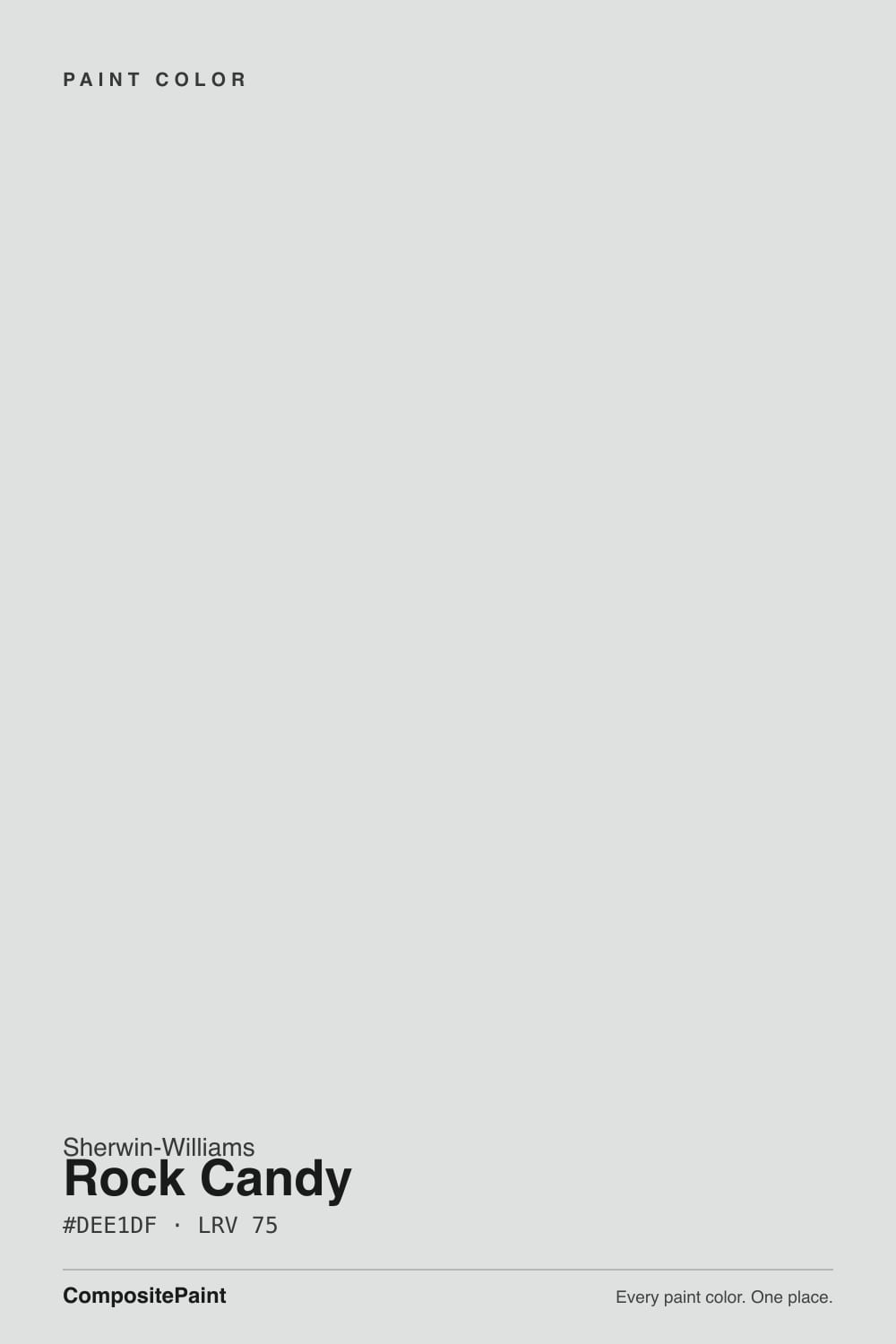
SW 6231 · #DEE1DF · LRV 75 — neutral with no strong undertone, very light — near-white, broadens small spaces.
- 1Heirloom Shade63
- 2First Star69
- 3Rock Candy75
- 4Alabaster82
- 5Chantilly Lace91
What Color Is Rock Candy, Really?
Rock Candy SW 6231 is a very light gray that lands close to white. Its hex value is #DEE1DF and its LRV is 75, which puts it in the near-white band where a color still reflects most of the light in a room. The measured hue sits at 140 degrees, on the green side of the wheel, but the saturation is only 5 percent. In practice that means no strong undertone at all, just a faint cool whisper that keeps it from reading as a cream.
People choose Rock Candy when a pure white feels too hard and a beige feels too warm. At LRV 75 it opens up small rooms, hallways, and low-ceiling spaces without the glare a near-100 white can throw, and the trace of gray gives walls a little softness so they do not look like primer.
The catch is how easily it disappears or drifts. Against bright white trim it will read as a clear gray, and in a warm south-facing room or under 2700K bulbs the faint green cool can flatten out and leave the walls looking plain. Sample it beside your trim white before you commit, because at this lightness the trim decides how gray the wall looks.
Rock Candy is about as close to undertone-free as a light gray gets. The hue reads at 140 degrees, which is technically green, but at 5 percent saturation there is almost nothing there to see. What you notice on a wall is a soft, quiet gray with a faint cool edge rather than any obvious color.
That neutrality is why context matters so much. Next to a warm cream or a beige, Rock Candy looks cool and slightly green-gray. Next to a crisp blue-white, the same paint can look warmer and softer than expected. On its own, with nothing to compare it to, most people simply call it white.
The safest test is to put a sample next to your trim, your ceiling, and any tile or stone in the room at once. Because the color has so little of its own character, the surfaces around it will define whether it reads white, gray, or faintly green.
Best Rooms and Uses for Rock Candy
At LRV 75 this is a whole-home light color. It works on walls in bedrooms, living rooms, hallways, and stairwells, and it is a good pick for small rooms and basements where you need reflectance but a stark white would look harsh. In bathrooms and laundry rooms the faint cool lean reads as clean rather than cold.
It is also a practical ceiling color. Near-white with a trace of gray keeps a ceiling from glaring against slightly darker walls, and it helps hide the shadowing that flat white ceilings can show.
On cabinets it gives a soft, modern look without the plastic feel of a bright white, and it works on trim if the walls are darker and you want the woodwork quiet rather than sharp. Outdoors it can serve as a light body color, though at this lightness dirt and staining will show, so it suits sheltered walls better than exposed ones.
How Lighting Changes Rock Candy
With an LRV of 75, Rock Candy bounces most of the light it receives, so it stays bright in almost any room. What changes is the temperature, not the brightness. In north-facing rooms the cool daylight lines up with the color's faint green-gray lean, and the walls can look slightly cold or steely, especially in winter.
South-facing rooms warm it up and neutralize the cool edge, which is where Rock Candy reads closest to a plain soft white. East rooms look coolest in the morning light and settle by afternoon. West rooms stay flat early and warm noticeably at the end of the day.
Bulbs shift it as much as windows do. Warm 2700K lamps cancel the cool lean and can make the walls look like an ordinary off-white. Bulbs at 4000K and above sharpen the gray and can push it toward clinical. Check a sample after dark before deciding.
Most complaints about Rock Candy are a light mismatch. Upload a photo of your actual room and see it on your walls — then ask for the same wall in north light or evening lamps before you buy a single sample.
Need It From Another Brand?
Any paint counter can custom-tint Sherwin-Williams SW 6231 directly. If you would rather stay in one brand's own deck, these are the closest stock matches, measured as ΔE2000. Under 2 is a difference you will not see on the wall.
| Brand | Closest color | ΔE | LRV | |
|---|---|---|---|---|
| Behr | Ancient Stone790A-2 · Behr | 0.8 | 76 | Color page → |
| Benjamin Moore | Mineral Ice2132-70 · Benjamin Moore | 1.1 | 73 | Color page → |
| Valspar | Silver Dust7004-19 · Valspar | 1.0 | 74.8 | Color page → |
| PPG / Glidden | Inverness GrayPPG1012-2 · PPG / Glidden | 1.8 | 75 | Color page → |
| Glidden | Shaded WhisperPPG0995-1 · Glidden | 2.0 | 74 | Color page → |
| Dutch Boy | Chalky Purple345-1DB · Dutch Boy | 4.7 | 76 | Color page → |
Similar Sherwin-Williams Colors
The nearest shades to Rock Candy within Sherwin-Williams's own range, ranked by perceptual color distance — useful when you want the same look a touch lighter, darker, or warmer.
WCAG 2.1: AA is 4.5 : 1 for normal text, 3 : 1 for large text, AAA is 7 : 1.
Rock Candy vs Similar Colors
Rhinestone SW 7656 at LRV 74 and hex #DEE0DE is the nearest sibling, marginally darker and even more neutral. Nebulous White SW 7063 at LRV 74 and #DEDFDC is the warmer alternative, leaning yellow-green instead of cool, and is the better pick if Rock Candy looks too steely in your light. Topsail SW 6217 at LRV 75 and #DAE2E0 pushes further toward blue-green.
Across brands, Behr Ancient Stone 790A-2 at LRV 76 is a delta E of 0.85 away and Valspar Silver Dust 7004-19 at LRV 74.8 is 1.0 away, both effectively the same color in normal room light. Benjamin Moore Mineral Ice 2132-70 at LRV 73 is 1.06 away and also visually identical on a wall.
Farrow and Ball Great White No. 2006 at LRV 74 is 3.95 away, close but visibly different side by side, since it leans warm where Rock Candy leans cool.
Colors That Go With Rock Candy
Because Rock Candy is nearly neutral, trim is the main decision. A bright white makes the walls read clearly as gray. A softer white keeps the whole room reading as one quiet near-white. Nebulous White SW 7063 at LRV 74 is a useful partner here, sitting a point lower with a warmer, yellow-green lean, so pairing the two gives a subtle warm-cool contrast between walls and millwork.
For a tonal scheme across rooms, its Sherwin-Williams neighbors sit at the same brightness with slightly different leans. Quicksilver SW 6245 at LRV 75 and Mantra SW 9631 at LRV 75 are close cousins, Topsail SW 6217 at LRV 75 runs a touch bluer, and Intrepid Grey SW 9556 at LRV 76 is a shade lighter.
For contrast and warmth, natural oak, walnut, and rattan all keep the room from feeling sterile. Brushed nickel, chrome, and black hardware read crisp against it; brass adds warmth the paint does not supply.
Coordinated palette
Generated by hue-rotating #DEE1DF in HSL space. Pair Rock Candy with one accent and one neutral — the swatches below are starting points, not final picks.
Rock Candy FAQ
Is Rock Candy warm or gray?
It is a light gray with no strong undertone. The measurement puts it at hue 140 with only 5 percent saturation, which is a barely there cool green lean rather than a real color cast. On most walls it reads as a soft neutral gray, and in warm light it can pass for a plain off-white.
What LRV is Rock Candy?
Rock Candy has an LRV of 75. On the light reflectance scale of 0 for black to 100 for pure white, that puts it in the near-white range, reflecting most of the light that hits it. It brightens small and dark rooms and makes ceilings feel higher, without the glare a near-100 white can produce.
Does Rock Candy look green?
Rarely, and never strongly. The hue is on the green side of the wheel at 140 degrees, but 5 percent saturation is not enough for most people to name it. The green whisper is most likely to show in cool north light, next to a warm cream, or under high-Kelvin bulbs. In warm light it disappears entirely.
Does Rock Candy work in a dark room?
Yes, it is one of its better uses. At LRV 75 it gives back most of the available light, so it lifts basements, interior hallways, and rooms with a single small window. The one thing to watch is that in cool, low daylight the faint gray-green lean can read a bit steely, so warm bulbs help keep it comfortable.
What white trim goes with Rock Candy?
A bright, clean white gives the most definition and makes the walls read clearly as a soft gray. If you would rather the room stay seamless, use a near-white close to the wall value instead. Nebulous White SW 7063 at LRV 74 is a warmer near-white that pairs with it for a subtle warm-cool contrast between wall and trim.
Is Rock Candy good for cabinets and ceilings?
It suits both. On cabinets the trace of gray softens the look compared with a stark white, which reads more custom and less plastic. On ceilings it is easier on the eye than a pure white, because the small step down in brightness keeps the ceiling from glaring against the walls and helps disguise shadowing.
Have you painted with Rock Candy?
Rate it — one tap helps the next reader decide.
Ask a Question