Red Barn
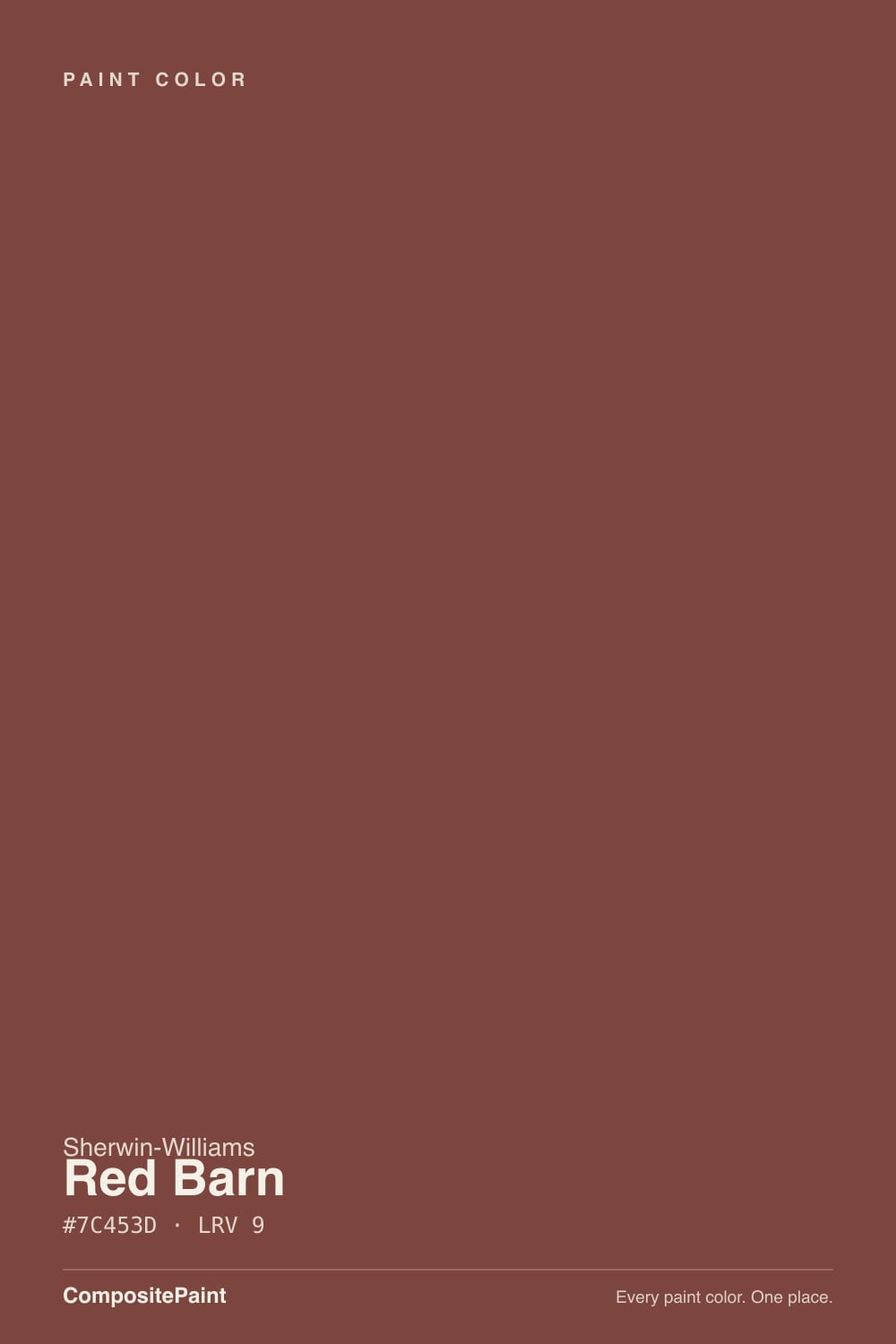
SW 7591 · #7C453D · LRV 9 — warm red tone, very dark — reads black in most rooms.
- 1Rookwood Dark Red3
- 2Red Barn9
- 3Cinnamon Slate19
- 4Rejuvenate30
What Color Is Red Barn, Really?
Red Barn (SW 7591) is a deep brick red with brown in it. Its hex value is #7C453D and its LRV is 9, which is very low, so on a wall it absorbs most of the light and reads as a dark, heavy color rather than a bright one. Saturation of 34 percent at a hue of 8 degrees is what keeps the red visible at that depth; a duller color this dark would simply read as near-black.
People pick it for exactly what the name suggests: the weathered oxide red of a farm building, a shutter, or an old front door. It is not a fire-engine red and not a wine red. The brown in it makes it look aged rather than new, which is why it sits well with stone, weathered wood, and white farmhouse trim without looking like a statement gone wrong.
The catch is the LRV. At 9 there is almost nothing coming back to your eye in low light, and in a shaded room or on a north elevation the red drains away and the color reads as a dark brown-black. It only shows its color in direct light. Look at a sample in the exact spot you plan to paint, at the time of day that spot is darkest, before you order gallons.
The undertone is warm red with clear brown underneath. At a hue of 8 degrees the color sits on the red end, just before orange, and the 34 percent saturation is high enough that the red survives the darkness. What tips it toward brick rather than crimson is the low lightness combined with that moderate saturation: the result reads as oxide, or rust, more than as pure red.
Company changes it noticeably. Against a bright white it looks distinctly red. Against warm wood or terracotta it looks browner and calmer. Against a cool gray or a blue it looks warmer and stronger, because the temperature contrast pushes the red forward.
Check it against your brick, stone, or roof if you are using it outside. Brick in particular has its own red, and two reds that are close but not aligned will look like a mistake. A large sample board held against the material tells you in a minute.
Best Rooms and Uses for Red Barn
Red Barn earns its reputation outdoors. It is a natural front door color against a white, cream, or pale gray house, and it works on shutters, barn doors, garage doors, and outbuildings. As a full body color it suits farm buildings, sheds, and rustic exteriors more than a suburban house, since at LRV 9 a whole elevation in it becomes very dark.
Indoors it is an accent color rather than a whole-room one. It suits a dining room where you want enclosure, a study, a library wall behind shelving, or a fireplace surround. On cabinets it works on an island or a lower run, especially in a kitchen with wood and warm white above.
Avoid it on large walls in rooms that are already dim, and keep trim in a separate light color so the shape of the room stays readable. On a door, a satin or semi-gloss sheen helps the red catch light instead of swallowing it.
How Lighting Changes Red Barn
An LRV of 9 means Red Barn returns almost none of the light that hits it, so light is the difference between seeing a red and seeing a dark brown. In direct south or west sun the color opens up and the brick tone is unmistakable, warm and slightly rusty. In shade or on a north-facing wall it closes down and reads as a very dark brown-black, with the red only appearing where light rakes across it.
Indoors the same rule applies. A dining room with good afternoon light will show the color; a windowless hallway will not. East rooms show it briefly in the morning and lose it after that.
Bulbs are decisive at night. Warm 2700K lamps keep the red alive and make the color feel rich. Cooler 4000K bulbs flatten it toward brown. If the room relies on artificial light most of the time, choose the bulb before you choose the paint.
Most complaints about Red Barn are a light mismatch. Upload a photo of your actual room and see it on your walls — then ask for the same wall in north light or evening lamps before you buy a single sample.
Need It From Another Brand?
Any paint counter can custom-tint Sherwin-Williams SW 7591 directly. If you would rather stay in one brand's own deck, these are the closest stock matches, measured as ΔE2000. Under 2 is a difference you will not see on the wall.
| Brand | Closest color | ΔE | LRV | |
|---|---|---|---|---|
| Behr | Fire RoastedS150-7 · Behr | 1.8 | 9 | Color page → |
| Benjamin Moore | Sienna2092-20 · Benjamin Moore | 2.6 | 10 | Color page → |
| Valspar | Red Henna1008-7A · Valspar | 1.0 | 8.5 | Color page → |
| PPG / Glidden | Sweet SpiceberryPPG1059-7 · PPG / Glidden | 0.3 | 9 | Color page → |
| Glidden | Sweet SpiceberryPPG1059-7 · Glidden | 0.5 | 9 | Color page → |
| HGTV Home by Sherwin-Williams | Red BarnHGSW 7591 · HGTV Home by Sherwin-Williams | 0.0 | 9 | Color page → |
Similar Sherwin-Williams Colors
The nearest shades to Red Barn within Sherwin-Williams's own range, ranked by perceptual color distance — useful when you want the same look a touch lighter, darker, or warmer.
WCAG 2.1: AA is 4.5 : 1 for normal text, 3 : 1 for large text, AAA is 7 : 1.
Red Barn vs Similar Colors
Within the brand, Carriage Door (SW 7594) at #6E423E and LRV 8 is browner and quieter. Fired Brick (SW 6335) at #83382A and LRV 8 is more orange and more clearly brick. Luxurious Red (SW 6314) at LRV 9 pulls toward wine, and Cajun Red (SW 8) at #8D422F and LRV 10 is the brightest and most orange of the set.
Red Barn (HGSW 7591) from HGTV Home by Sherwin-Williams shares the exact hex and LRV at deltaE 0, and Sweet Spiceberry (PPG1059-7), listed under both PPG and Glidden at deltaE 0.26 and 0.51, is effectively the same color. Redwood Forest Cathedral (DESS03) from Dunn-Edwards at deltaE 0.99 and Red Henna (1008-7A) from Valspar at 1 are indistinguishable in practice.
Saffron (CA217) from Rodda at deltaE 1.62 and Cherry Bark (ECC-15-3) from Behr at 1.97 are visually identical in normal room light. Sienna (2092-20) from Benjamin Moore at 2.65 is very close but worth sampling first. Vintage (PNT100-DP-67) from Clare at 4.43 is close but visibly different side by side, lighter and softer than Red Barn.
Colors That Go With Red Barn
A warm white or soft cream is the classic partner, on trim, siding, or surrounding walls. The bigger the gap in LRV between a 9 and the white, the more the red reads as a deliberate accent rather than a dark patch. A cooler, cleaner white works too and makes the red look sharper and less rustic.
The same-brand colors closest to Red Barn are all reds and not companions. Carriage Door (SW 7594) at LRV 8, Fired Brick (SW 6335) at LRV 8, Fireweed (SW 6328) at LRV 7, Salute (SW 7582) at LRV 7, Luxurious Red (SW 6314) at LRV 9, and Cajun Red (SW 8) at LRV 10 are alternatives to choose between, not colors to combine with it.
For the rest of a scheme, look to materials. Weathered wood, natural stone, black iron hardware, and aged brass all sit well with an oxide red. Warm greens and soft warm neutrals in the mid-range make the safest wall partners indoors.
Coordinated palette
Generated by hue-rotating #7C453D in HSL space. Pair Red Barn with one accent and one neutral — the swatches below are starting points, not final picks.
Red Barn FAQ
Is Red Barn a true red or a brown?
It is a red with brown in it. The hue sits at 8 degrees with 34 percent saturation, so the red is real, but the very low lightness of LRV 9 pulls it toward oxide and brick rather than a clean red. In bright light it reads red; in shade it reads dark brown.
What LRV is Red Barn?
Red Barn has an LRV of 9. Light reflectance value runs from 0 for black to 100 for white, so 9 is near the bottom of the scale. It reflects almost none of the light that reaches it, which is why the color needs direct sun or warm lamps to show its red rather than reading as a dark neutral.
Does Red Barn work in a dark room?
Only if you accept that it will look brown-black rather than red. At LRV 9 there is not enough reflected light in a dim or north-facing room for the color to show. If you want it in a low-light space, use it on a small surface such as a door, a fireplace, or an island, and light it with warm 2700K bulbs.
What white trim goes with Red Barn?
A warm white or soft cream gives the traditional farmhouse pairing and keeps the red looking aged rather than new. A cleaner, cooler white sharpens the contrast and makes the red read brighter. With the wall or door at LRV 9, any white in the 80s will produce a strong, clear edge.
Is Red Barn good for exteriors and front doors?
This is its strongest use. It suits front doors, shutters, garage doors, barn doors, and outbuildings, and it sits comfortably next to stone, weathered wood, and white trim. As a full body color it fits rustic and farm buildings better than a suburban house, since an LRV of 9 makes an entire elevation very dark.
How is Red Barn different from Fired Brick?
Fired Brick (SW 6335) is #83382A at LRV 8, against Red Barn's #7C453D at LRV 9. Fired Brick is more orange and more clearly brick-toned, while Red Barn holds more brown and reads softer and more weathered. Pick Fired Brick when you want the red to be obvious and Red Barn when you want it aged.
Have you painted with Red Barn?
Rate it — one tap helps the next reader decide.
Ask a Question