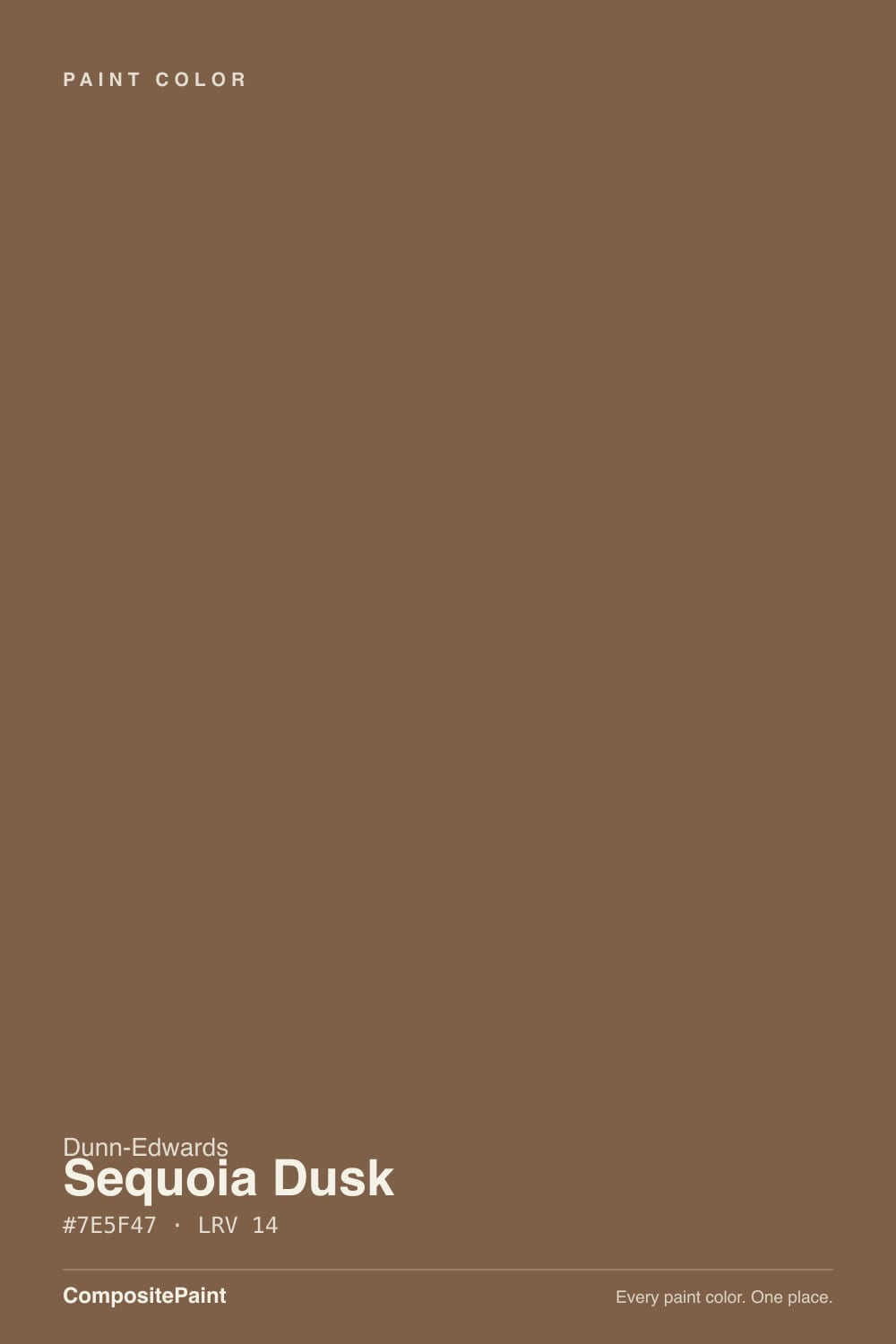
Color spec
| Brand | Dunn-Edwards |
| Name | Sequoia Dusk |
| SKU | DET668 |
| Hex | #7E5F47 |
| RGB | 126, 95, 71 |
| HSL | 26°, 28%, 39% |
| LRV | 14 |
| Undertone | warm red-orange tone |
| Family | Brown |
What Color Is Sequoia Dusk, Really?
Sequoia Dusk is a deep, earthy brown with a clear warm lean. The measured numbers put it around a reddish-orange hue at moderate saturation and low-to-mid lightness, which in plain terms reads as a rich terracotta-brown, like wet clay or aged leather rather than a cool coffee. With an LRV of 14, it sits firmly in the dark range and soaks up light instead of bouncing it back.
Dunn-Edwards markets it for southwestern interiors, and that is exactly where it shines. The warm undertone flatters adobe, wood beams, and desert light, giving a room grounded, enveloping color without going fully black or gray.
It suits people who want a moody, saturated wall or a bold cabinet and are not chasing an airy, bright feel. Think studies, dining rooms, accent walls, and homes with plenty of natural or warm artificial light to keep the depth from turning flat.
Sequoia Dusk leans warm, toward red and orange, the same range that makes terracotta and rust look inviting. Its saturation is moderate, around the high twenties, so it is not a near-neutral greige. You will actually read the warmth as color, not just a brown-gray. In practice that means the red-orange base can look almost brick-warm in strong sun and settle into a calmer chocolate in dim light.
Because the undertone is warm rather than gray or purple, test it against anything you plan to place nearby. Hold a sample next to cool grays and you will see Sequoia Dusk pull noticeably warmer and redder. Next to a true chocolate brown it looks more orange; next to terracotta it looks more brown. Paint a large sample board, move it around the room, and check it against your trim white and flooring before you commit, since the red base can clash with pink-beige or cool blue-gray surfaces.
Best Rooms and Uses for Sequoia Dusk
With an LRV of 14, this is a statement color, not a whole-home neutral. On full walls it creates a dark, wrapped feeling that suits dining rooms, studies, libraries, powder rooms, and bedrooms where you want intimacy rather than brightness. Give those rooms good natural or warm artificial light so the color stays rich instead of flat.
It is also a strong accent-wall and cabinet color. On kitchen or bath cabinets it reads as a warm, grounded alternative to black or navy and pairs naturally with wood and brass. As an exterior it fits southwestern and craftsman homes, and it makes a confident front door against lighter siding. On trim it is generally too dark for a whole room, but it can outline a lighter wall for contrast. Because it is so deep, most rooms want it on one plane or the millwork, balanced by lighter surfaces elsewhere.
How Lighting Changes Sequoia Dusk
At an LRV of 14, Sequoia Dusk is a dark color that depends on light to look its best. In north-facing rooms, where daylight is cool and soft, it turns deeper and can read almost like a shadowed brown, so it works best there as an accent or in a room you want to feel cozy and dim. South-facing rooms get long, warm light that brings out the red-orange base and keeps the color rich and full through the day.
East rooms show it warm and glowing in the morning, then muted by afternoon. West rooms do the reverse, flat early and warm at sunset. Bulb choice matters a lot here. Warm white bulbs around 2700K amplify the terracotta warmth and make the room feel enveloping. Cool daylight bulbs mute the red and can leave it looking heavier and browner. Because it absorbs light, add lamps or wall lighting so the depth reads as intentional, not gloomy.
Most complaints about Sequoia Dusk are a light mismatch. Upload a photo of your actual room and see it on your walls — then ask for the same wall in north light or evening lamps before you buy a single sample.
TEST IT IN YOUR LIGHT →Sequoia Dusk vs Similar Colors
Sequoia Dusk (LRV 14) sits in a tight cluster of warm Dunn-Edwards browns, and the differences are subtle but real. Rodeo DEA163 (LRV 12) is a shade darker and slightly less lively, so it reads a touch more like a plain deep brown and works when you want maximum depth with less orange showing.
Chestnut Brown DESS11 (LRV 13) is close in lightness but leans a hair cooler and browner, which makes it safer next to gray-based decor where Sequoia Dusk might pull too red. Handcrafted DESS15 (LRV 14) matches the lightness almost exactly but sits a little warmer and more caramel, a good pick if you want the terracotta warmth pushed further.
In short, choose Sequoia Dusk for a balanced warm brown, Rodeo for darker drama, Chestnut Brown for a cooler read, and Handcrafted for extra warmth. Always compare them side by side on a board, because at this depth small hue shifts are hard to judge from a chip.
Colors That Go With Sequoia Dusk
For trim and ceilings, pair Sequoia Dusk with a warm white so the contrast feels soft rather than stark. Swiss Coffee DEW342 (LRV 84) has a creamy warmth that flatters the brown, while Whisper DEW340 (LRV 84) is a slightly cleaner off-white if you want a touch more crispness.
For a second wall color or connecting spaces, Berkshire Beige DEC760 (LRV 50) is a warm mid-tone neutral that bridges the dark brown to lighter rooms. Stonish Beige DET625 (LRV 33) is a deeper option that keeps things earthy.
For accents, Olive Branch DET503 (LRV 22) brings a muted green that reads like desert sage against the terracotta base, and Maiden Voyage DEA178 (LRV 8) is a deep slate blue that works as a bold front door or cabinet contrast. Warm wood tones and brass or aged-bronze metals reinforce the southwestern feel.
Need It From Another Brand?
Any paint counter can custom-tint Dunn-Edwards DET668 directly — but if you would rather stay in one brand's own deck, these are the closest stock matches:
Similar Dunn-Edwards colors
closest in the Dunn-Edwards deckThe nearest shades to Sequoia Dusk within Dunn-Edwards's own range, ranked by perceptual color distance — useful when you want the same look a touch lighter, darker, or warmer.
Coordinated palette
Generated by hue-rotating #7E5F47 in HSL space. Pair Sequoia Dusk with one accent and one neutral — the swatches below are starting points, not final picks.
Accessibility (WCAG contrast)
WCAG 2.1: AA = 4.5:1 normal text · AA Large = 3:1 large text · AAA = 7:1 normal text.
The Questions Everyone Asks
Is Sequoia Dusk warm or cool?
Sequoia Dusk is a warm color. Its measured undertone falls in the red-orange range at moderate saturation, so it reads as a terracotta-leaning brown rather than a cool, gray coffee tone. In warm light and sunny rooms the red-orange base shows clearly, while cool north light and daylight bulbs mute it into a deeper, browner look.
Is Sequoia Dusk more brown or terracotta?
It is a brown with a strong terracotta character. The base color is brown by family, but the warm red-orange undertone and moderate saturation keep it from looking like a flat chocolate. Depending on light it can shift between a clay-like, rusty warmth and a richer, more grounded brown, which is why Dunn-Edwards markets it for southwestern interiors.
What trim white goes with Sequoia Dusk?
A warm white keeps the contrast soft and flattering. Swiss Coffee DEW342, at an LRV of 84, has a creamy warmth that complements the terracotta base. If you want a slightly cleaner, less yellow off-white, Whisper DEW340 (LRV 84) is a good alternative. Both are light enough to frame the dark wall clearly without looking harsh.
Does Sequoia Dusk work on cabinets and exteriors?
Yes to both. On cabinets it gives a warm, grounded look that pairs well with wood and brass and reads as a softer choice than black or navy. As an exterior it suits southwestern and craftsman homes and makes a confident front door against lighter siding. Because it is dark, balance it with lighter surfaces and good lighting.
What does an LRV of 14 mean for Sequoia Dusk?
LRV measures how much light a color reflects, on a scale from 0 to 100. At 14, Sequoia Dusk is a dark color that absorbs most light rather than bouncing it back. In practice a room painted in it will feel deep and enveloping, so it needs strong natural light or warm bulbs and added lamps to keep the color rich instead of gloomy.
How is Sequoia Dusk different from Rodeo?
Both are warm Dunn-Edwards browns, but Rodeo DEA163 has a slightly lower LRV of 12, making it a touch darker and less lively. Rodeo reads a bit more like a plain deep brown, while Sequoia Dusk (LRV 14) shows more of its red-orange, terracotta warmth. Choose Rodeo for maximum depth and Sequoia Dusk for a little more visible color.
Will It Work in YOUR Room?
No page can promise how Sequoia Dusk behaves in your light. Upload a photo and see it on your own walls in seconds — before you spend a cent on samples.
TRY SEQUOIA DUSK ON YOUR ROOM →
Ask a Question
Not sure about Sequoia Dusk in your room?
Ask Jessica below — every question gets a real reply, usually within a day.