CP

Dunn-Edwards Postwar BoomDET584 · #466F97 · LRV 16

Postwar Boom reads as a cool blue tone — dark — high drama, needs strong daylight or warm bulbs. The notes below cover the color's details, what Dunn-Edwards DET584 actually looks like under different light, and the closest matches at competing US brands.
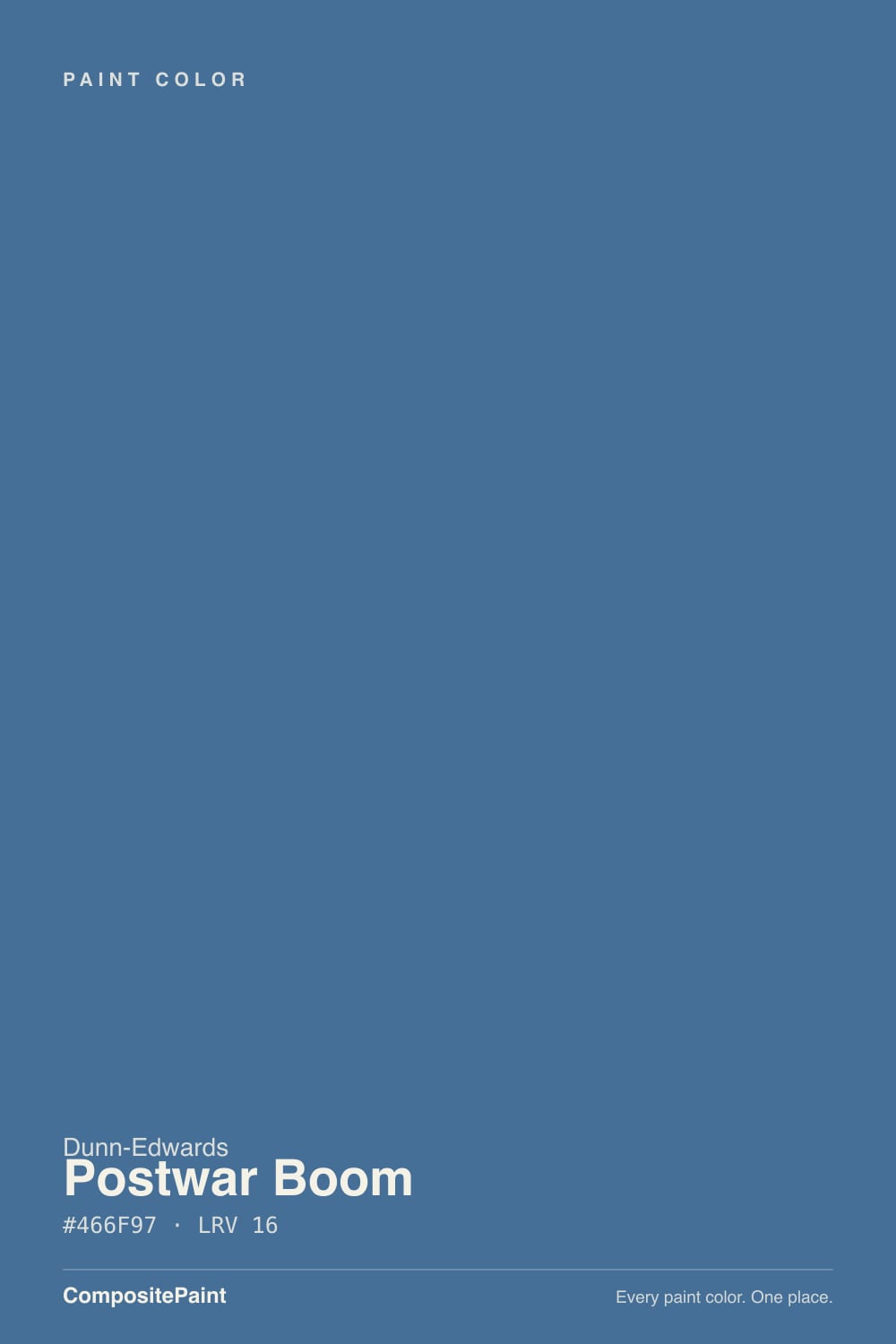
DUNN-EDWARDS POSTWAR BOOM
RGB 70, 111, 151LRV 16

Color spec

BrandDunn-Edwards
NamePostwar Boom
SKUDET584
Hex#466F97
RGB70, 111, 151
HSL210°, 37%, 43%
LRV16
Undertonecool blue tone
FamilyBlue
See Dunn-Edwards Postwar Boom on your own walls — upload a room photo.SEE IT IN YOUR ROOM →

About Dunn-Edwards Postwar Boom

With an LRV of 16, Postwar Boom is a deep, dramatic shade. It soaks up light in north-facing rooms and looks richest where strong daylight hits it. Its blue undertone is the part to watch: it gets picked up by whatever sits next to it, so test it against your trim, floor and the room's main light before committing. Warm artificial light softens it; cool LED can make it look flat, so match your bulbs to the mood you want.

Postwar Boom works best as a feature — a single wall, built-ins, a study or dining room — rather than wrapping a whole bright space. Blues calm a room, which makes them popular in bedrooms, bathrooms and home offices.

Closest matches by brand

15 brands within ΔE 5

The closest matches per brand by ΔE2000, computed against each brand's full deck. Only colors within ΔE 5 (close enough to substitute on a wall) are shown — brands with no real match are left off. Tap any swatch for its full single-color spec; tap the brand title to browse all blue from that brand.

Sherwin-Williams

1,947 colors in deck · best ΔE 2.4
All blue at Sherwin-Williams →
SW 6810 · #4E739F · ΔE 2.4 · LRV 16
SW 6530 · #4C6B8A · ΔE 2.79 · LRV 14
SW 6523 · #506B84 · ΔE 4.4 · LRV 14

Behr

5,644 colors in deck · best ΔE 2.29
All blue at Behr →
PMD-23 · #4E719D · ΔE 2.29 · LRV 16
580F-6 · #4A759C · ΔE 2.3 · LRV 17
S500-6 · #3B739D · ΔE 2.87 · LRV 16
570D-6 · #39729C · ΔE 2.88 · LRV 15

Benjamin Moore

4,068 colors in deck · best ΔE 1.85
All blue at Benjamin Moore →
804 · #40729C · ΔE 1.85 · LRV 16
CC-844 · #40729C · ΔE 1.85 · LRV 18
CSP-560 · #4E719A · ΔE 1.86 · LRV 18
776 · #3A6E8C · ΔE 5 · LRV 16

Valspar

2,858 colors in deck · best ΔE 4.18
All blue at Valspar →
4003-8B · #58739B · ΔE 4.18 · LRV 16.6
T612 · #4E7795 · ΔE 4.27 · LRV 16.9
4004-6B · #4F718A · ΔE 4.43 · LRV 15.3

PPG / Glidden

2,132 colors in deck · best ΔE 4.18
All blue at PPG / Glidden →
PPG1166-6 · #4F6A97 · ΔE 4.18 · LRV 14

Glidden

3,101 colors in deck · best ΔE 4.59
All blue at Glidden →
PPG1166-6 · #4F6997 · ΔE 4.59 · LRV 14

Dutch Boy

1,340 colors in deck · best ΔE 1.85
All blue at Dutch Boy →
139-6DB · #4771A1 · ΔE 1.85 · LRV 16
140-6DB · #346EA0 · ΔE 2.6 · LRV 14
239-6DB · #5A738F · ΔE 4.37 · LRV 16
238-6DB · #506B84 · ΔE 4.4 · LRV 14
HGSW 1392 · #4E739F · ΔE 2.4 · LRV 16
HGSW 6810 · #4E739F · ΔE 2.4 · LRV 16
HGSW 1382 · #4C6B8A · ΔE 2.79 · LRV 14
HGSW 6530 · #4C6B8A · ΔE 2.79 · LRV 14

Farrow & Ball

302 colors in deck · best ΔE 3.87
All blue at Farrow & Ball →
NO. W29 · #57779B · ΔE 3.87 · LRV 18

Diamond Vogel

1,386 colors in deck · best ΔE 2.16
All blue at Diamond Vogel →
0619 · #506F91 · ΔE 2.16 · LRV 15

Hirshfield's

1,469 colors in deck · best ΔE 2.21
All blue at Hirshfield's →
0619 · #446A8D · ΔE 2.21 · LRV 16
0591 · #597193 · ΔE 4.27 · LRV 19

C2 Paint

580 colors in deck · best ΔE 3.73
All blue at C2 Paint →
C2-746 · #536E89 · ΔE 3.73 · LRV 15

Clare

78 colors in deck · best ΔE 4.18
All blue at Clare →
PNT100-MD-41 · #427494 · ΔE 4.18 · LRV 16

Rust-Oleum

16 colors in deck · best ΔE 4.52
All blue at Rust-Oleum →
329207 · #486682 · ΔE 4.52 · LRV 12

Kompozit

1,321 colors in deck · best ΔE 2.21
All blue at Kompozit →
0619 · #446A8D · ΔE 2.21 · LRV 13
0591 · #597193 · ΔE 4.27 · LRV 16
0647 · #497A9F · ΔE 4.53 · LRV 18

Similar Dunn-Edwards colors

closest in the Dunn-Edwards deck

The nearest shades to Postwar Boom within Dunn-Edwards's own range, ranked by perceptual color distance — useful when you want the same look a touch lighter, darker, or warmer.

DET577 · LRV 15
DE5852 · LRV 13
DE5880 · LRV 16
DET583 · LRV 18
DE5810 · LRV 13
DEFD56 · LRV 18

Coordinated palette

Generated by hue-rotating #466F97 in HSL space. Pair Postwar Boom with one accent and one neutral — the swatches below are starting points, not final picks.

COMPLEMENTARY
#466F97 + #976E46
TRIADIC
#466F97 · #97466F · #6F9746
ANALOGOUS
#469796 · #466F97 · #464797

Accessibility (WCAG contrast)

Sample text on white
5.27:1AA
Sample text on black
3.98:1AA Large

WCAG 2.1: AA = 4.5:1 normal text · AA Large = 3:1 large text · AAA = 7:1 normal text.

Dunn-Edwards Postwar Boom Equivalents at Other Brands

Matching Postwar Boom from a different paint counter? Below is the single closest color in each major US deck and how close it really is. Remember that any paint store can also custom-tint Dunn-Edwards DET584 directly — these equivalents are for when you'd rather stay inside one brand's own deck.

Sherwin-Williams Equivalent of Postwar Boom

At Sherwin-Williams, the closest color to Postwar Boom is Lupine (SW 6810) — very close at ΔE 2.4, though not an exact twin. It sits at the same lightness (LRV 16 vs 16) and carries a cool blue undertone; sample both side by side if the room gets strong natural light. See the full Lupine swatch →

Behr Equivalent of Postwar Boom

At Behr, the closest color to Postwar Boom is Neptune Blue (570D-6) — very close at ΔE 2.88, though not an exact twin. It sits at the same lightness (LRV 15 vs 16) and carries a cool blue undertone; sample both side by side if the room gets strong natural light. See the full Neptune Blue swatch →

Benjamin Moore Equivalent of Postwar Boom

Benjamin Moore's nearest match is Chicago Blues (804), visually identical in normal room light (ΔE 1.85). It sits at the same lightness (LRV 16 vs 16) and carries a cool blue undertone, so it substitutes for Postwar Boom without repainting risk. See the full Chicago Blues swatch →

Valspar Equivalent of Postwar Boom

Valspar has no exact twin of Postwar Boom. The nearest is Veranda Blue (4004-6B) at ΔE 4.43 — close, but the difference shows next to trim and in side light. It sits at the same lightness (LRV 15.3 vs 16). Compare large swatches before substituting. See the full Veranda Blue swatch →

PPG / Glidden Equivalent of Postwar Boom

PPG / Glidden has no exact twin of Postwar Boom. The nearest is Blue Odyssey (PPG1166-6) at ΔE 4.18 — close, but the difference shows next to trim and in side light. It runs slightly darker (LRV 14 vs 16). Compare large swatches before substituting. See the full Blue Odyssey swatch →

Glidden Equivalent of Postwar Boom

Glidden has no exact twin of Postwar Boom. The nearest is Blue Odyssey (PPG1166-6) at ΔE 4.59 — close, but the difference shows next to trim and in side light. It runs slightly darker (LRV 14 vs 16). Compare large swatches before substituting. See the full Blue Odyssey swatch →

Dutch Boy Equivalent of Postwar Boom

Dutch Boy's nearest match is Sapphire Waters (139-6DB), visually identical in normal room light (ΔE 1.85). It sits at the same lightness (LRV 16 vs 16) and carries a cool blue undertone, so it substitutes for Postwar Boom without repainting risk. See the full Sapphire Waters swatch →

HGTV Home by Sherwin-Williams Equivalent of Postwar Boom

At HGTV Home by Sherwin-Williams, the closest color to Postwar Boom is Vital Blue (HGSW 1392) — very close at ΔE 2.4, though not an exact twin. It sits at the same lightness (LRV 16 vs 16) and carries a cool blue undertone; sample both side by side if the room gets strong natural light. See the full Vital Blue swatch →

Farrow & Ball Equivalent of Postwar Boom

Farrow & Ball has no exact twin of Postwar Boom. The nearest is Ultra Marine Blue (NO. W29) at ΔE 3.87 — close, but the difference shows next to trim and in side light. It runs slightly lighter (LRV 18 vs 16). Compare large swatches before substituting. See the full Ultra Marine Blue swatch →

Diamond Vogel Equivalent of Postwar Boom

At Diamond Vogel, the closest color to Postwar Boom is Honky Tonk Blue (0619) — very close at ΔE 2.16, though not an exact twin. It sits at the same lightness (LRV 15 vs 16) and carries a cool blue undertone; sample both side by side if the room gets strong natural light. See the full Honky Tonk Blue swatch →

Hirshfield's Equivalent of Postwar Boom

At Hirshfield's, the closest color to Postwar Boom is Honky Tonk Blue (0619) — very close at ΔE 2.21, though not an exact twin. It sits at the same lightness (LRV 16 vs 16) and carries a cool blue undertone; sample both side by side if the room gets strong natural light. See the full Honky Tonk Blue swatch →

C2 Paint Equivalent of Postwar Boom

C2 Paint has no exact twin of Postwar Boom. The nearest is Treble (C2-746) at ΔE 3.73 — close, but the difference shows next to trim and in side light. It sits at the same lightness (LRV 15 vs 16). Compare large swatches before substituting. See the full Treble swatch →

Clare Equivalent of Postwar Boom

Clare has no exact twin of Postwar Boom. The nearest is Hyperlink (PNT100-MD-41) at ΔE 4.18 — close, but the difference shows next to trim and in side light. It sits at the same lightness (LRV 16 vs 16). Compare large swatches before substituting. See the full Hyperlink swatch →

Rust-Oleum Equivalent of Postwar Boom

Rust-Oleum has no exact twin of Postwar Boom. The nearest is Coastal Blue (329207) at ΔE 4.52 — close, but the difference shows next to trim and in side light. It runs slightly darker (LRV 12 vs 16). Compare large swatches before substituting. See the full Coastal Blue swatch →

Kompozit Equivalent of Postwar Boom

At Kompozit, the closest color to Postwar Boom is Honky Tonk Blue (0619) — very close at ΔE 2.21, though not an exact twin. It runs slightly darker (LRV 13 vs 16) and carries a cool blue undertone; sample both side by side if the room gets strong natural light. See the full Honky Tonk Blue swatch →

EXPLORE MORE