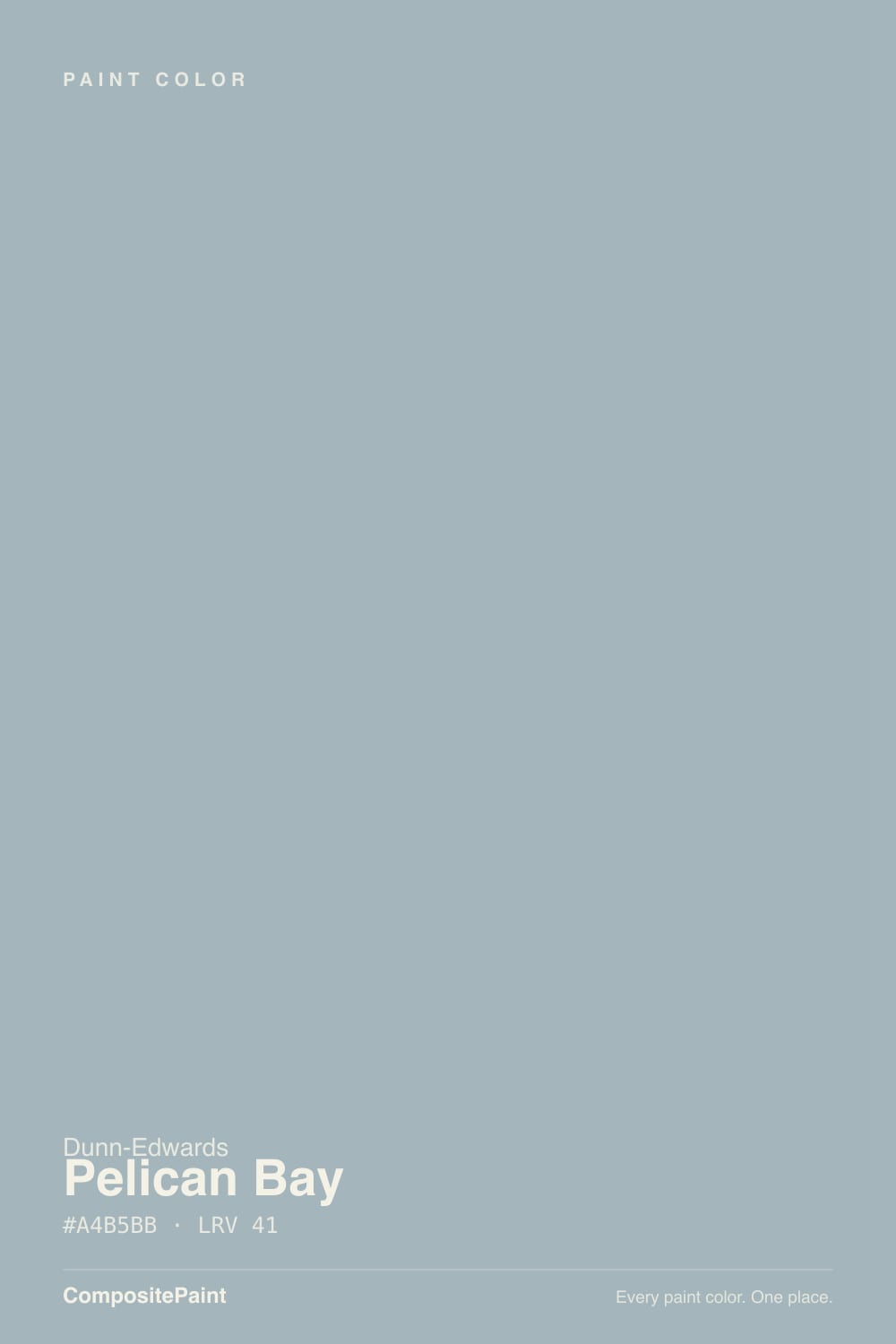
Color spec
| Brand | Dunn-Edwards |
| Name | Pelican Bay |
| SKU | DEC787 |
| Hex | #A4B5BB |
| RGB | 164, 181, 187 |
| HSL | 196°, 14%, 69% |
| LRV | 41 |
| Undertone | cool blue-green tone |
| Family | Gray |
What Color Is Pelican Bay, Really?
Pelican Bay (DEC787) is a soft blue-gray with a faint green tilt, the kind of color that reads more like weathered sea glass than a bright blue. Its hue sits at 196 degrees, right on the line between blue and cyan, but the saturation is low at 14 percent, so the color stays quiet and muted instead of loud. With an LRV of 41 it lands squarely in the mid-tone range, so it carries real color on the wall rather than washing out to a pale tint.
Dunn-Edwards describes it as a light coastal blue-gray, and it has become a bathroom favorite for exactly that reason: it feels clean and watery without going cold or clinical. It suits homes that want a bit of color and calm at once, whether that is a coastal or transitional interior, a spa-style bath, or a set of cabinets that needs something softer than a true blue.
Pelican Bay leans blue with a whisper of green underneath. At 14 percent saturation it is soft but not truly neutral, so the color reads clearly on a large wall even though it looks nearly gray on a small chip. That gap between chip and wall is normal for muted blues, and it is why Pelican Bay often surprises people once it covers real square footage.
The undertone shows most where there is a lot of it. On a big wall or in full daylight, the blue-green comes forward. In a small space or low light, it settles back toward gray. To judge it honestly, tape a sample next to a pure white and next to a true warm gray. Against the white it will look distinctly blue-green; against the gray it will look bluer and cooler. That side-by-side is the fastest way to confirm the lean before you commit.
Best Rooms and Uses for Pelican Bay
A mid LRV of 41 makes Pelican Bay versatile. It is dark enough to feel like a real color choice yet light enough to paint every wall of a room without closing it in, so you are not limited to accent walls.
It shines in bathrooms, where its watery blue-green feels clean and spa-like, and Dunn-Edwards lists it among its bathroom favorites. It also works well in bedrooms and home offices that get decent daylight. On cabinets it is a strong pick, giving vanities and kitchen islands a soft coastal color that is calmer than a saturated blue. Outdoors it makes a restful siding or body color, and it holds up nicely on a front door or shutters when you want color without high contrast.
In very dim, north-facing rooms it can flatten, so reserve those spaces for lighter companions or add warm lighting.
How Lighting Changes Pelican Bay
With an LRV of 41, Pelican Bay bounces back a moderate amount of light, so it neither glows nor turns murky. Lighting mostly pushes its temperature rather than its brightness.
In north-facing rooms the cool daylight strengthens the blue and can make it read steely or slightly flat, so it helps to pair it with warm wood or a warm white trim. South-facing rooms warm and lift the color, softening the blue and letting the gentle green undertone come through. East light in the morning keeps it cool and crisp, while west light in the late afternoon warms it noticeably.
Bulbs matter just as much. Warm 2700K lamps calm the blue toward a soft gray, which is flattering in a bedroom or bath. Cooler 3500K to 4000K bulbs push it bluer and greener and keep it feeling fresh, which is often why it works so well in bathrooms.
Most complaints about Pelican Bay are a light mismatch. Upload a photo of your actual room and see it on your walls — then ask for the same wall in north light or evening lamps before you buy a single sample.
TEST IT IN YOUR LIGHT →Pelican Bay vs Similar Colors
Marine Layer (DET599) at an LRV of 44 is a close cousin. It sits slightly lighter and reads a touch greener and grayer than Pelican Bay, so it feels more like a soft sage-gray, while Pelican Bay holds onto more visible blue. Choose Marine Layer if you want the color to lean quiet and neutral, and Pelican Bay if you want the coastal blue to register.
Overcast Sky (DE5821) at an LRV of 43 goes the other way. It is a cleaner, more clearly blue gray with less green in it, so it feels a bit cooler and crisper. Pick it when you want the color to look decidedly blue rather than blue-green.
Country Air (DET581) at an LRV of 46 is lighter and bluer still, closer to a pale sky. Use it when you want an airier, more obviously blue wall; keep Pelican Bay when you want a mid-tone with a softer, more grounded feel.
Colors That Go With Pelican Bay
For trim and ceilings, Whisper (DEW340) at an LRV of 84 is a clean, soft white that frames Pelican Bay without competing with it. If you prefer something a touch warmer next to the blue, Swiss Coffee (DEW342) works the same role with more warmth.
For a second, lighter wall color or an adjoining room, Misty (DEW364) at an LRV of 60 is a pale gray that keeps the cool family intact and lightens the transition. To ground the scheme, Iron Mountain (DET637) at an LRV of 11 gives you a deep charcoal for a vanity base, an island, or interior doors.
When you want a true accent, Maiden Voyage (DEA178) at an LRV of 8 is a deep navy that pairs naturally with Pelican Bay for a front door or cabinetry. For a softer companion in the same watery direction, Quiet Reflection (DEC783) is a light teal that layers well. Warm wood tones and brushed nickel or brass hardware both flatter the cool base.
Need It From Another Brand?
Any paint counter can custom-tint Dunn-Edwards DEC787 directly — but if you would rather stay in one brand's own deck, these are the closest stock matches:
Similar Dunn-Edwards colors
closest in the Dunn-Edwards deckThe nearest shades to Pelican Bay within Dunn-Edwards's own range, ranked by perceptual color distance — useful when you want the same look a touch lighter, darker, or warmer.
Coordinated palette
Generated by hue-rotating #A4B5BB in HSL space. Pair Pelican Bay with one accent and one neutral — the swatches below are starting points, not final picks.
Accessibility (WCAG contrast)
WCAG 2.1: AA = 4.5:1 normal text · AA Large = 3:1 large text · AAA = 7:1 normal text.
The Questions Everyone Asks
Is Pelican Bay warm or cool, and more blue or gray?
Pelican Bay is a cool color. Its hue sits at 196 degrees, on the blue side with a slight green undertone, so it reads cool and watery rather than warm. At 14 percent saturation it is a muted, grayed blue rather than a bright one, so on a small chip it can look almost gray, but across a full wall or in good daylight the blue clearly comes forward with a faint green edge.
What trim white goes with Pelican Bay?
Whisper (DEW340), with an LRV of 84, is a clean soft white that frames Pelican Bay nicely without fighting its cool tone. If you want a slightly warmer contrast against the blue, Swiss Coffee (DEW342) at the same LRV of 84 is a good alternative. Both give crisp trim and ceiling lines while keeping the overall look calm.
Does Pelican Bay work on cabinets and exteriors?
Yes to both. On cabinets it gives vanities, islands, and kitchen units a soft coastal blue that is calmer than a saturated blue, and its mid LRV of 41 keeps them from looking heavy. Outdoors it makes a restful siding or body color and holds up well on a front door or shutters when you want color without stark contrast.
What does an LRV of 41 mean for Pelican Bay?
LRV, or light reflectance value, runs from 0 for black to 100 for white. At 41, Pelican Bay reflects a moderate amount of light, placing it in the mid-tone range. That means it carries real color on the wall but is still light enough to use on every wall of a room without making the space feel closed in. In dim north light, add warm lighting to keep it from flattening.
How is Pelican Bay different from Marine Layer?
Marine Layer (DET599) has an LRV of 44, so it is slightly lighter, and it reads a touch greener and grayer than Pelican Bay. That makes Marine Layer feel more like a soft sage-gray, while Pelican Bay holds onto more visible blue. Choose Marine Layer for a quieter, more neutral wall and Pelican Bay when you want the coastal blue to show.
Should I sample Pelican Bay before painting?
Yes. Muted blue-grays like Pelican Bay shift noticeably between a small chip and a full wall, and its blue-green undertone changes with exposure and bulb color. Paint a large sample or a poster board and view it on different walls at morning, midday, and night, under both warm and cool bulbs, before committing. This is the surest way to confirm how the color will actually read in your room.
Will It Work in YOUR Room?
No page can promise how Pelican Bay behaves in your light. Upload a photo and see it on your own walls in seconds — before you spend a cent on samples.
TRY PELICAN BAY ON YOUR ROOM →Ask a Question

Not sure about Pelican Bay in your room?
Ask Jessica below — every question gets a real reply, usually within a day.