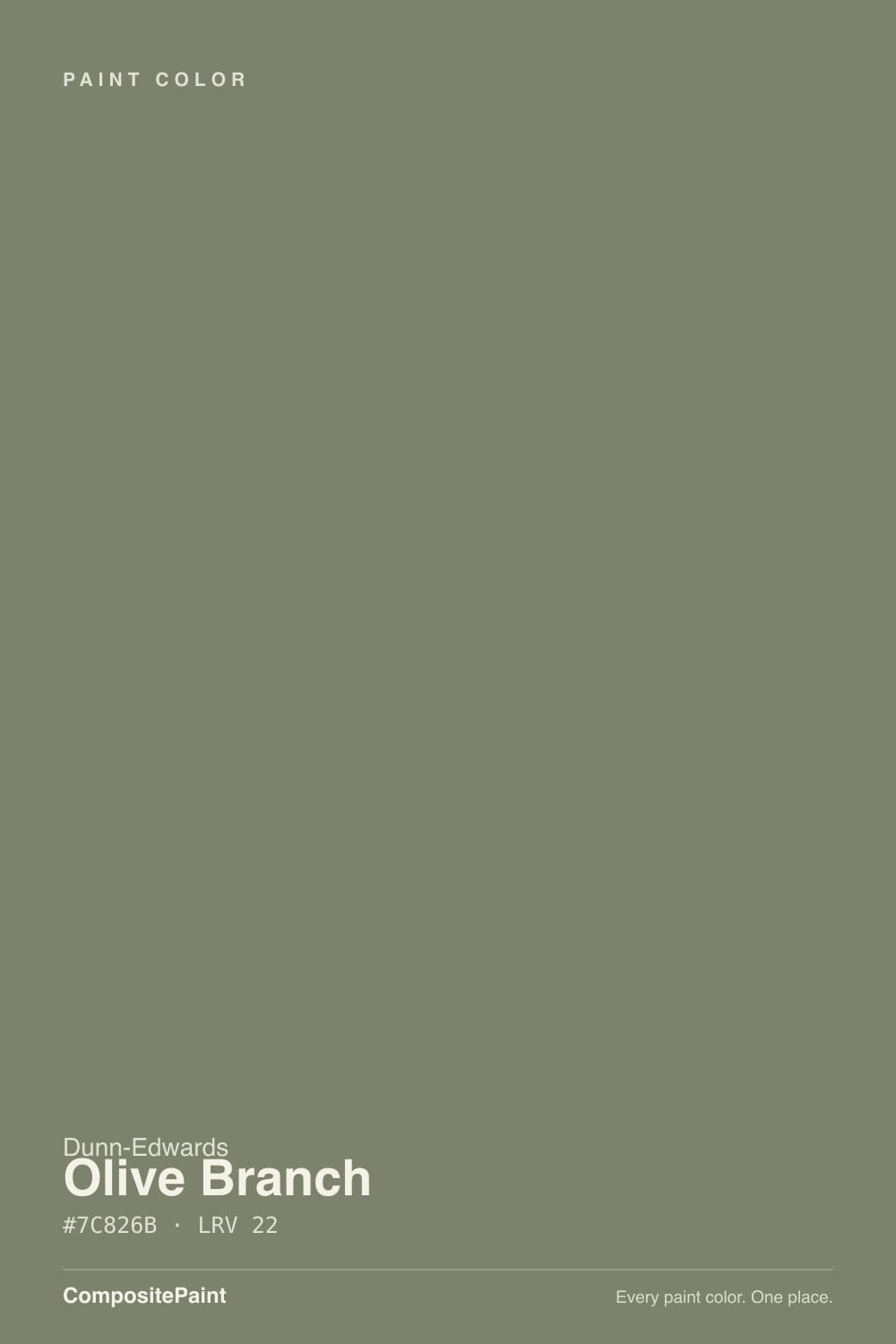
Color spec
| Brand | Dunn-Edwards |
| Name | Olive Branch |
| SKU | DET503 |
| Hex | #7C826B |
| RGB | 124, 130, 107 |
| HSL | 76°, 10%, 46% |
| LRV | 22 |
| Undertone | cool green tone |
| Family | Green |
What Color Is Olive Branch, Really?
Olive Branch (DET503) is a muted, grayed-out olive green. Its hex is #7C826B, and the numbers tell you why it can feel hard to pin down: the hue sits in the green range but the chroma is very low, so this is a soft, dusty green that slides toward gray in flat light and only reads clearly olive when the sun hits it. With an LRV of 22 it is a medium-dark color that holds real depth on a wall.
It shows up again and again in Dunn-Edwards landscape-inspired palettes because it behaves like a natural, weathered green pulled from foliage, sage, and dried leaves rather than a bright grass tone. That restraint is what makes it usable.
It suits homes that want an earthy, calm color with some weight, and owners who like nature-based, slightly moody rooms instead of pure neutrals or loud color.
Olive Branch leans green, but only just. Its saturation sits at 10 percent, which is the edge of near-neutral, so most of the time you are looking at a warm gray-green rather than an obvious olive. The green comes forward in strong daylight and next to clean whites; in dim or artificial light it can flatten toward gray or taupe.
Because the lean is so quiet, test it against things that expose it. Hold a large sample beside a pure white trim and a true gray at the same time. Next to the white, the green reads clearly. Next to a mid gray, you will see whether your eye picks up warmth or a cooler cast in your specific room.
Paint at least a foot-square swatch, view it on more than one wall, and check it morning and evening before deciding. The undertone shifts more than the color chip suggests.
Best Rooms and Uses for Olive Branch
With a mid-to-low LRV of 22, Olive Branch works best where you want depth and a grounded, nature-drawn feel. It is strong on full walls in rooms that get decent daylight, such as a living room, study, dining room, or bedroom, giving an enveloping backdrop without going as dark as a true forest green.
It is an excellent cabinet color. On kitchen or bath cabinetry, and on a built-in or island, the muted olive reads current and pairs easily with wood and warm metals. As an accent wall or the darker half of a two-tone wall it adds weight without shouting.
Outside, it suits an earthy exterior body color or a low-key front door, and it settles well into green landscaping. It is too deep to serve as a whole-home light color, so keep trim and ceilings lighter. On interior trim it works only for a deliberate tone-on-tone, low-contrast look.
How Lighting Changes Olive Branch
At an LRV of 22, Olive Branch is a medium-dark color, so light matters more than it would for a pale neutral. It reflects only about a fifth of the light that hits it, which means rooms can feel cozy and enclosed or genuinely dim depending on exposure.
In north-facing rooms and weaker morning light the green cools and grays down, and the space can read heavy. South and west light warm it up and let the olive character show, which is where this color looks its best. East rooms give you a fresh green in the morning that mutes as the day moves on.
Bulb choice pushes it either way. Warm white bulbs, around 2700K, restore the earthy olive and keep a low-light room from going flat. Cooler daylight bulbs sharpen the gray-green and can make it feel more austere. If your room is short on natural light, lean warm.
Most complaints about Olive Branch are a light mismatch. Upload a photo of your actual room and see it on your walls — then ask for the same wall in north light or evening lamps before you buy a single sample.
TEST IT IN YOUR LIGHT →Olive Branch vs Similar Colors
Dunn-Edwards has several close olives, and the differences are subtle but visible on a wall. Wreath (DE5656), at LRV 20, is a hair deeper and reads a touch greener and cooler, so it is the pick when you want the olive to be more obvious. Olive Branch stays quieter and grayer by comparison.
Moss Covered (DE6265), LRV 19, and Dried Chive (DE6272), LRV 19, both pull slightly more yellow-brown, giving a warmer, drabber olive that feels a little more vintage. Choose these if Olive Branch looks too cool in your light.
Harbor Mist Gray (DET515), LRV 20, is the most gray of the group, with the least green showing, so it is the safer choice if you fear the olive will read too strong. All four sit within a couple of LRV points, so the practical decision is about how much green versus gray you want, not about lightness.
Colors That Go With Olive Branch
For trim, ceilings, and brightening, pair Olive Branch with a soft warm white. Whisper (DEW340), at an LRV of 84, keeps things clean and crisp, while Swiss Coffee (DEW342), also LRV 84, is slightly creamier and a touch softer against the green. Either makes good trim or a ceiling.
For a second wall color or a lighter companion in an open plan, Forever Linen (DEC756), LRV 60, is a warm neutral that keeps the palette earthy without competing. Stonish Beige (DET625), LRV 33, is a deeper greige that layers well if you want more contrast than a white gives.
For accents and a front door, Cabin Fever (DET647), LRV 14, a warm brown, plays into the natural mood, and for real drama Black (DEA187) grounds the scheme on a door or trim detail. Natural wood tones and aged brass or bronze hardware also sit comfortably with this color.
Need It From Another Brand?
Any paint counter can custom-tint Dunn-Edwards DET503 directly — but if you would rather stay in one brand's own deck, these are the closest stock matches:
Similar Dunn-Edwards colors
closest in the Dunn-Edwards deckThe nearest shades to Olive Branch within Dunn-Edwards's own range, ranked by perceptual color distance — useful when you want the same look a touch lighter, darker, or warmer.
Coordinated palette
Generated by hue-rotating #7C826B in HSL space. Pair Olive Branch with one accent and one neutral — the swatches below are starting points, not final picks.
Accessibility (WCAG contrast)
WCAG 2.1: AA = 4.5:1 normal text · AA Large = 3:1 large text · AAA = 7:1 normal text.
The Questions Everyone Asks
Is Olive Branch warm or cool?
It is a muted, slightly cool green, but the lean is quiet. Its saturation is only about 10 percent, so it sits close to gray and shifts with light. Warm bulbs and south or west sun bring out an earthy, warmer olive, while north light and cool daylight bulbs make it read cooler and grayer.
What trim white goes with Olive Branch?
A soft warm white works best. Whisper (DEW340), with an LRV of 84, gives a clean, crisp trim, and Swiss Coffee (DEW342), also LRV 84, is slightly creamier and softer against the green. Both are light enough to create clear contrast with the medium-dark olive on trim, ceilings, or doors.
Does Olive Branch work on cabinets and exteriors?
Yes to both. On kitchen or bath cabinets and islands it reads current and pairs easily with wood and warm metals. Outside it makes a grounded, earthy exterior body color or a low-key front door and blends naturally with green landscaping. Its medium-dark depth gives cabinets and siding presence without going as dark as forest green.
What does an LRV of 22 mean for Olive Branch?
LRV measures how much light a color reflects, from 0 (black) to 100 (white). At 22, Olive Branch reflects only about a fifth of the light, so it is a medium-dark color that adds depth and coziness but can feel heavy in low-light rooms. Keep trim and ceilings lighter, and favor warm bulbs where daylight is limited.
How is Olive Branch different from Farrow & Ball Calke Green?
They are close relatives in the muted-olive family, both around LRV 22, so they read as similar earthy greens on a wall. Calke Green tends to show a touch more depth and green character, while Olive Branch stays quieter and grayer. If you already like Calke Green, Olive Branch is a nearby Dunn-Edwards option to sample.
Should I sample Olive Branch before painting?
Yes. Because its green lean is so low in chroma, Olive Branch shifts noticeably between rooms and bulbs, sometimes reading olive and sometimes gray. Paint a large swatch, at least a foot square, on more than one wall and check it in morning and evening light before committing. A chip is too small to show how it behaves in your space.
Will It Work in YOUR Room?
No page can promise how Olive Branch behaves in your light. Upload a photo and see it on your own walls in seconds — before you spend a cent on samples.
TRY OLIVE BRANCH ON YOUR ROOM →Ask a Question

Not sure about Olive Branch in your room?
Ask Jessica below — every question gets a real reply, usually within a day.