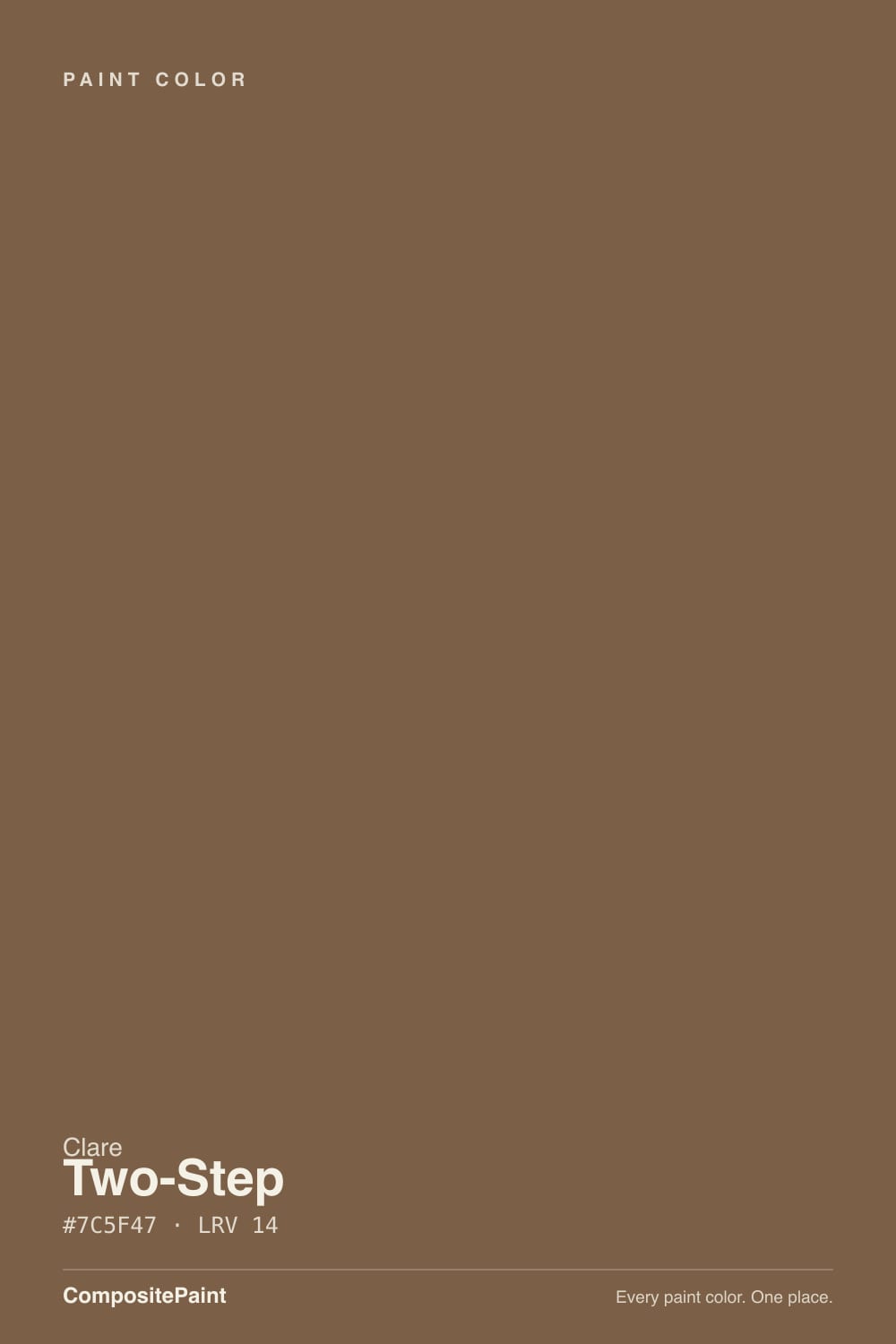
Color spec
| Brand | Clare |
| Name | Two-Step |
| SKU | Clare 15 |
| Hex | #7C5F47 |
| RGB | 124, 95, 71 |
| HSL | 27°, 27%, 38% |
| LRV | 14 |
| Undertone | warm red-orange tone |
| Family | Brown |
What Color Is Two-Step, Really?
Two-Step (Clare 15) is a warm earth-brown. At hex #7C5F47 its hue sits at 27 degrees, right in the orange-brown range, and its 27 percent saturation means it reads as a genuine brown with visible warmth rather than a washed-out taupe. With a lightness of 38 percent and an LRV of 14, it is a deep, grounded color that absorbs far more light than it bounces back.
Clare positions it as the brand's go-to deep neutral for cabinets and accents, and that is exactly where its appeal lies. It gives you the richness of a stained wood or a leather chair without going fully chocolate or black, so a room feels anchored but still warm.
It suits anyone who wants depth and coziness rather than pale minimalism: a kitchen island, a moody study, a front door, or built-ins in a home that already leans warm and natural.
Two-Step leans warm and slightly red-orange. Its hue of 27 degrees puts it just on the amber side of pure brown, and at 27 percent saturation it is well above the near-neutral threshold, so this is a color with real pigment, not a gray that happens to look brown. You will read it as an earthy, tobacco-leather brown rather than a cool taupe.
The warmth shows most on large surfaces and in direct daylight, where the red-orange base can glow. Next to a true gray or a cool white, Two-Step will look distinctly warm and a touch rusty. Next to a warm cream it settles down and reads more like a straightforward wood-brown.
Always test it against your fixed materials. Hold a sample beside your flooring, countertops and any existing wood, since Two-Step can either harmonize with warm oak and brass or clash with cooler gray-brown finishes.
Best Rooms and Uses for Two-Step
Because its LRV of 14 makes it a statement color, Two-Step earns its keep on features rather than every wall of a bright room. It is a strong choice for kitchen and bath cabinets, a kitchen island, a vanity, or built-in shelving, where the depth reads as intentional and furniture-like. Clare itself frames it as a cabinet and accent color for good reason.
As a full wall color it suits smaller, cozy spaces you want to feel enveloping, such as a study, a den, a powder room or a dining room, especially where you have decent daylight or warm lamps to keep it from going flat.
Outside, its richness holds up well on a front door or on shutters against a lighter body color, giving a warm, natural contrast. It can also work as a deep exterior body color on the right house. Keep true trim in a lighter shade so the brown stays framed.
How Lighting Changes Two-Step
With an LRV of 14, Two-Step is a dark color that depends heavily on the light it gets. In a bright south-facing room it comes alive, showing its full red-orange warmth and reading as a rich, inviting brown. In a north-facing room the same paint turns deeper and more muted, and it can start to feel almost like a soft near-black on the wall, so it works best there as an accent or on cabinets rather than covering every surface.
East light in the morning pushes the warm tones forward, then cools and flattens by afternoon. West-facing rooms do the reverse, going richest in the evening.
Bulb choice matters just as much. Warm bulbs around 2700K amplify the earthy glow and are the safest pairing. Cool daylight bulbs can drain some of the warmth and make it look grayer and heavier, which is worth checking before you commit.
Most complaints about Two-Step are a light mismatch. Upload a photo of your actual room and see it on your walls — then ask for the same wall in north light or evening lamps before you buy a single sample.
TEST IT IN YOUR LIGHT →Two-Step vs Similar Colors
Coffee Date (PNT100-DP-53, LRV 14) shares Two-Step's exact light level but not its warmth. Coffee Date is a cooler gray-brown, so if you want a taupe that stays quiet and neutral, choose it; if you want visible earthy warmth, Two-Step wins.
Vintage (PNT100-DP-67, LRV 10) is darker and pulls clearly toward red, reading almost oxblood-brown. It is the more dramatic, saturated option for a small moody room, while Two-Step stays more like natural wood and is easier to live with across a whole kitchen.
Field Trip (PNT100-DP-66, LRV 18) is lighter and shifts green-olive rather than red. It feels more like a warm khaki than a true brown. Pick Field Trip when you want an earthy tone with more lightness and a green cast, and Two-Step when you want deeper, redder wood warmth.
Colors That Go With Two-Step
For crisp trim and ceilings, pair Two-Step with a high-LRV white. Snow Day (Clare 04, LRV 92) gives the cleanest contrast, while White Light (Clare 03, LRV 86) is a slightly softer, warmer frame that flatters the brown's earthiness.
For a second, lighter wall color or a greige that bridges the room, Greige (Clare 07, LRV 50) and the warmer Dirty Chai (Clare 06, LRV 33) both sit in the same warm family and step the room up gradually from dark to light.
For accents, a muted green like Avocado Toast (Clare 08, LRV 35) or the deeper House Plant (Clare 16, LRV 22) plays to Two-Step's natural, organic side. If you want a moody partner instead of a contrast, Goodnight Moon (Clare 10, LRV 6) is a deep blue that grounds the brown. Warm woods, aged brass and unlacquered bronze hardware all sit naturally alongside it.
Need It From Another Brand?
Any paint counter can custom-tint Clare Clare 15 directly — but if you would rather stay in one brand's own deck, these are the closest stock matches:
Similar Clare colors
closest in the Clare deckThe nearest shades to Two-Step within Clare's own range, ranked by perceptual color distance — useful when you want the same look a touch lighter, darker, or warmer.
Coordinated palette
Generated by hue-rotating #7C5F47 in HSL space. Pair Two-Step with one accent and one neutral — the swatches below are starting points, not final picks.
Accessibility (WCAG contrast)
WCAG 2.1: AA = 4.5:1 normal text · AA Large = 3:1 large text · AAA = 7:1 normal text.
The Questions Everyone Asks
Is Two-Step warm or cool?
Two-Step is a warm color. Its hue sits at 27 degrees in the orange-brown range with 27 percent saturation, so it reads as a genuine earthy, red-orange brown rather than a cool gray-taupe. Against a true gray it looks noticeably warm. Warm 2700K bulbs bring out its best, while cool daylight bulbs can flatten and gray it down.
What trim white goes with Two-Step?
A high-LRV white keeps the contrast crisp. Snow Day (Clare 04, LRV 92) gives the cleanest, brightest frame around the deep brown. If you prefer a softer, warmer edge that flatters Two-Step's earthiness, White Light (Clare 03, LRV 86) is a good alternative. Keep trim and ceilings lighter than the walls so the brown stays framed and intentional.
Does Two-Step work on cabinets and exteriors?
Yes. Clare markets it as a go-to color for cabinets and accents, and its depth reads as furniture-like on islands, vanities and built-ins. Outside, it holds up well on a front door or shutters against a lighter body color, and it can serve as a deep exterior body color on the right house. Pair it with a lighter trim for definition.
What does an LRV of 14 mean for Two-Step in practice?
An LRV of 14 means Two-Step is dark and reflects only a small share of light, so it reads as a statement rather than a soft neutral. It needs strong daylight or warm bulbs to show its full warmth; in dim or north-facing rooms it deepens toward near-black. Use it on features and cozy rooms rather than every wall of a low-light space.
How is Two-Step different from Sherwin-Williams Burnished Brandy?
They are very close warm browns. Sherwin-Williams Burnished Brandy (SW 7523) sits at LRV 12, a touch darker than Two-Step's 14, and is one of many near-matches across brands. The practical difference is small, so choose based on which brand you can get tinted locally rather than expecting a dramatic change on the wall. Always compare samples in your own light.
Should I sample Two-Step before painting?
Yes, especially at this depth. Dark browns shift a lot between rooms and bulbs, so paint a large swatch or sample board and view it in morning, afternoon and evening light with your actual bulbs. Hold it against your flooring, counters and wood tones. Two-Step can glow warm in bright light or read almost black in dim north light, so testing prevents surprises.
Will It Work in YOUR Room?
No page can promise how Two-Step behaves in your light. Upload a photo and see it on your own walls in seconds — before you spend a cent on samples.
TRY TWO-STEP ON YOUR ROOM →Ask a Question

Not sure about Two-Step in your room?
Ask Jessica below — every question gets a real reply, usually within a day.