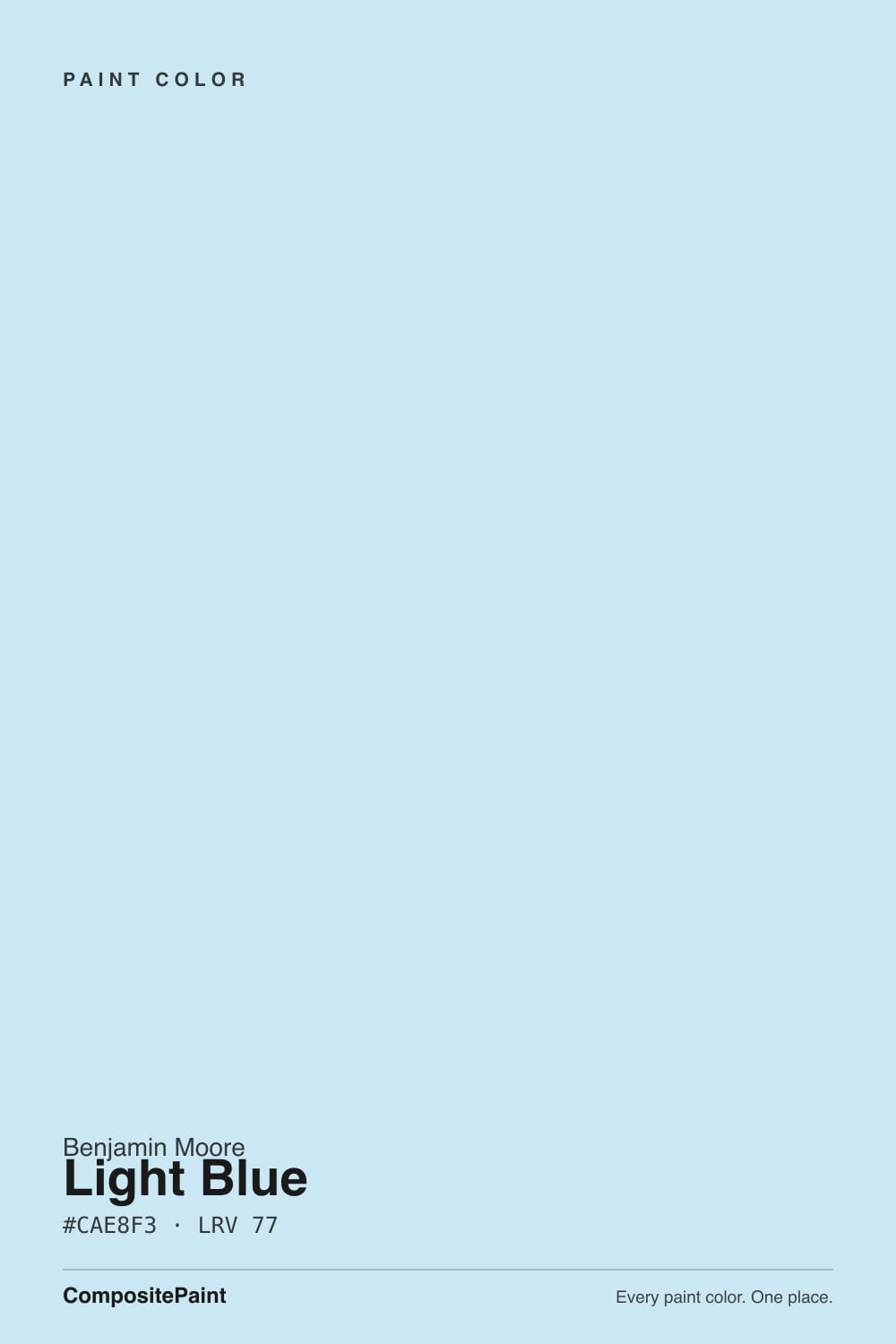
Light Blue
2066-70 · #CAE8F3 · LRV 77 — cool blue-green tone, very light — near-white, broadens small spaces.
- 1Wythe Blue48
- 2Ocean Boulevard53
- 3Light Blue77
- 4Frosty Mint83
- 5Lakeside Mist92
What Color Is Light Blue, Really?
Light Blue 2066-70 is a very pale blue. Its hex value is #CAE8F3 and its hue sits at 196 degrees, which puts it in the blue range with a slight green lean rather than a violet one. The saturation reads 63 percent but the lightness is 87 percent, so the wall result is a soft, watery tint, not a strong blue. Its LRV is 77, near-white territory, which means it reflects a great deal of light and visually broadens small rooms.
People pick it when they want the feeling of blue without committing to a blue room. At LRV 77 it behaves almost like a cool white with a tint, so it keeps ceilings high and hallways open while still adding a clear sky character. The cool blue-green undertone reads clean and slightly airy rather than icy, which is why it turns up so often in bathrooms, bedrooms, and porch ceilings.
The practical catch is that pale blues get colder than expected. In north-facing rooms the already-cool undertone has nothing to warm it, and the wall can look chilly and slightly clinical, especially against cool white trim. It is also a color that shows roller marks and wall texture, since a near-white at LRV 77 hides very little.
Light Blue has a cool blue-green undertone. At 196 degrees of hue it sits on the aqua side of blue, so there is a faint green in it, but not enough to call it teal. The high lightness of 87 percent keeps the color quiet; on a chip it can look almost white, and only on a full wall does the blue register clearly.
The green side shows most next to a true navy or a violet-leaning blue, where Light Blue can suddenly look aqua by comparison. Against a warm beige or oak it reads as a plain, clean blue and the cool cast sharpens. Next to a bright white ceiling it looks bluer than it does next to a soft white.
Check it against your trim white first. A blue-based white makes the wall feel colder and crisper, while a warm white creates a visible clash between the cool blue and the yellow in the trim.
Best Rooms and Uses for Light Blue
With an LRV of 77, Light Blue is a near-white wall color that suits bathrooms, bedrooms, nurseries, laundry rooms, and hallways. In a small bath it makes the room feel larger while still adding color, and it reads clean against white fixtures. In a bedroom it gives a calm, restful wash without darkening the space.
Ceilings are one of its strongest uses. A pale blue overhead lifts a room, and on a covered porch ceiling it is a traditional choice that reads bright even in shade. It also works on the inside of cabinets and closets, where the reflected light helps.
On full kitchen cabinetry it is a light choice rather than a statement one, and it can show wear at this lightness. Outdoors it works as a porch ceiling, a shutter accent on a white body, or a light trim color in coastal settings. Keep trim in a separate white for crisp edges.
How Lighting Changes Light Blue
At LRV 77 Light Blue is highly reflective, so it stays bright in almost any room. What changes is temperature. North-facing rooms get cool, indirect daylight that reinforces the already cool undertone, and the wall can read icy or slightly gray. That is fine in a bathroom, harder in a living room you want to feel welcoming.
South-facing rooms warm it up and the color softens toward a gentle sky tone, with the green side of the 196-degree hue more visible. East rooms look clean and bright in the morning and settle by afternoon; west rooms stay cool early and warm noticeably in late sun.
Bulb choice is the easiest lever. Warm 2700K lamps take the chill off and make it feel comfortable at night. Cooler 3500K to 4000K bulbs keep it crisp but can push it toward hospital blue after dark. Look at a large sample under your evening lighting before committing.
Most complaints about Light Blue are a light mismatch. Upload a photo of your actual room and see it on your walls — then ask for the same wall in north light or evening lamps before you buy a single sample.
Need It From Another Brand?
Any paint counter can custom-tint Benjamin Moore 2066-70 directly. If you would rather stay in one brand's own deck, these are the closest stock matches, measured as ΔE2000. Under 2 is a difference you will not see on the wall.
| Brand | Closest color | ΔE | LRV | |
|---|---|---|---|---|
| Sherwin-Williams | BubbleSW 6770 · Sherwin-Williams | 4.8 | 77 | Color page → |
| Behr | Prairie SkyS510-1 · Behr | 2.0 | 78 | Color page → |
| Valspar | River Mist5003-9A · Valspar | 2.5 | 75.9 | Color page → |
| PPG / Glidden | Diamond BluePPG1237-2 · PPG / Glidden | 2.4 | 75 | Color page → |
| Glidden | Winterscape Blue30BG 76/107 · Glidden | 1.2 | 76 | Color page → |
| Dutch Boy | Lake Breeze138-2DB · Dutch Boy | 4.3 | 76 | Color page → |
Similar Benjamin Moore Colors
The nearest shades to Light Blue within Benjamin Moore's own range, ranked by perceptual color distance — useful when you want the same look a touch lighter, darker, or warmer.
WCAG 2.1: AA is 4.5 : 1 for normal text, 3 : 1 for large text, AAA is 7 : 1.
Light Blue vs Similar Colors
Within the brand these are fine distinctions. Billowy Down 2064-70 and Caribbean Mist 2061-70 at LRV 76 sit within a point of Light Blue's 77 and differ mostly in how much green they carry. Teardrop 2060-70 at LRV 79 is the airiest and Bashful Blue 2065-70 at LRV 74 is the most present. Harbor Fog 2062-70 at LRV 75 reads grayer, which suits rooms where full blue is too much.
Across brands, Dunn-Edwards Frosty Day DE5826 at LRV 73 has a deltaE of 0.87, a true match. Glidden Winterscape Blue 30BG 76/107 at LRV 76 is 1.2 and Behr Prairie Sky S510-1 at LRV 78 is 1.96, both visually identical in normal room light. PPG and Glidden Diamond Blue PPG1237-2 at LRV 75 is 2.37 and Valspar River Mist 5003-9A at LRV 75.9 is 2.5, very close but sample first. Sherwin-Williams Bubble SW 6770 at LRV 77 is 4.75, close but visibly different side by side.
Colors That Go With Light Blue
Inside Benjamin Moore, the immediate neighbors give you a full scheme without leaving the family. Billowy Down 2064-70 at LRV 76 and Caribbean Mist 2061-70 at LRV 76 are essentially the same depth and work for adjoining rooms. Teardrop 2060-70 at LRV 79 and Cumulus Cotton 2063-70 at LRV 78 are a shade lighter, which makes them useful for a ceiling above Light Blue walls. Bashful Blue 2065-70 at LRV 74 goes slightly deeper, and Harbor Fog 2062-70 at LRV 75 is the softest and grayest of the group, good when you want less blue.
For trim, a clean bright white keeps the edges sharp; a cream white will fight the cool cast. Warm wood floors and natural rattan balance the coolness, and brass or unlacquered nickel add warmth. Polished chrome looks correct but reinforces the chill.
Coordinated palette
Generated by hue-rotating #CAE8F3 in HSL space. Pair Light Blue with one accent and one neutral — the swatches below are starting points, not final picks.
Light Blue FAQ
Is Light Blue warm or cool?
Light Blue is cool. Its undertone is a cool blue-green at 196 degrees of hue, which is on the aqua side of blue rather than the violet side. There is no warmth built in to soften it, so in north-facing rooms the color can read distinctly chilly unless you warm the room with 2700K bulbs and wood tones.
What LRV is Light Blue?
Light Blue 2066-70 has an LRV of 77. LRV runs from 0 for black to 100 for pure white, so 77 is near-white. It reflects a lot of light, brightens small or dim rooms, and makes ceilings feel higher, while still holding enough tint to read clearly as a pale blue on a full wall.
Does Light Blue work in a dark room?
Yes for brightness, with one caution. At LRV 77 it gives back plenty of light, so it will not make a dim room feel closed in. But weak, cool light leaves the blue-green undertone unbalanced and the wall can look gray and cold. Warm bulbs and wood or brass accents fix most of that.
What white trim goes with Light Blue?
A clean, bright white is the natural partner. It keeps the wall reading as a crisp pale blue and gives clear edges even though the wall itself sits high at LRV 77. Avoid a cream or yellow-leaning white, which sets up a visible warm-versus-cool clash against the blue-green undertone.
Is Light Blue good for a porch ceiling?
It is one of its best uses. A pale blue overhead is a long-standing porch tradition, and at LRV 77 it stays bright even in the shade of a covered porch. Indoors the same idea works: a Light Blue ceiling over white or pale walls lifts a room without adding weight.
Is there a match for Light Blue in another brand?
Dunn-Edwards Frosty Day DE5826 at LRV 73 is a true match at a deltaE of 0.87. Glidden Winterscape Blue 30BG 76/107 at LRV 76 sits at 1.2 and Behr Prairie Sky S510-1 at LRV 78 at 1.96, both visually identical in normal room light. Benjamin Moore sells through independent dealers, so availability may decide which you sample.
Have you painted with Light Blue?
Rate it — one tap helps the next reader decide.
Ask a Question