Baby Pink
2085-70 · #F8E3E8 · LRV 81 — near-white with a hint of color, very light — near-white, broadens small spaces.
- 1Pale Cherry Blossom61
- 2First Light76
- 3Baby Pink81
- 4Ballerina Gown87
What Color Is Baby Pink, Really?
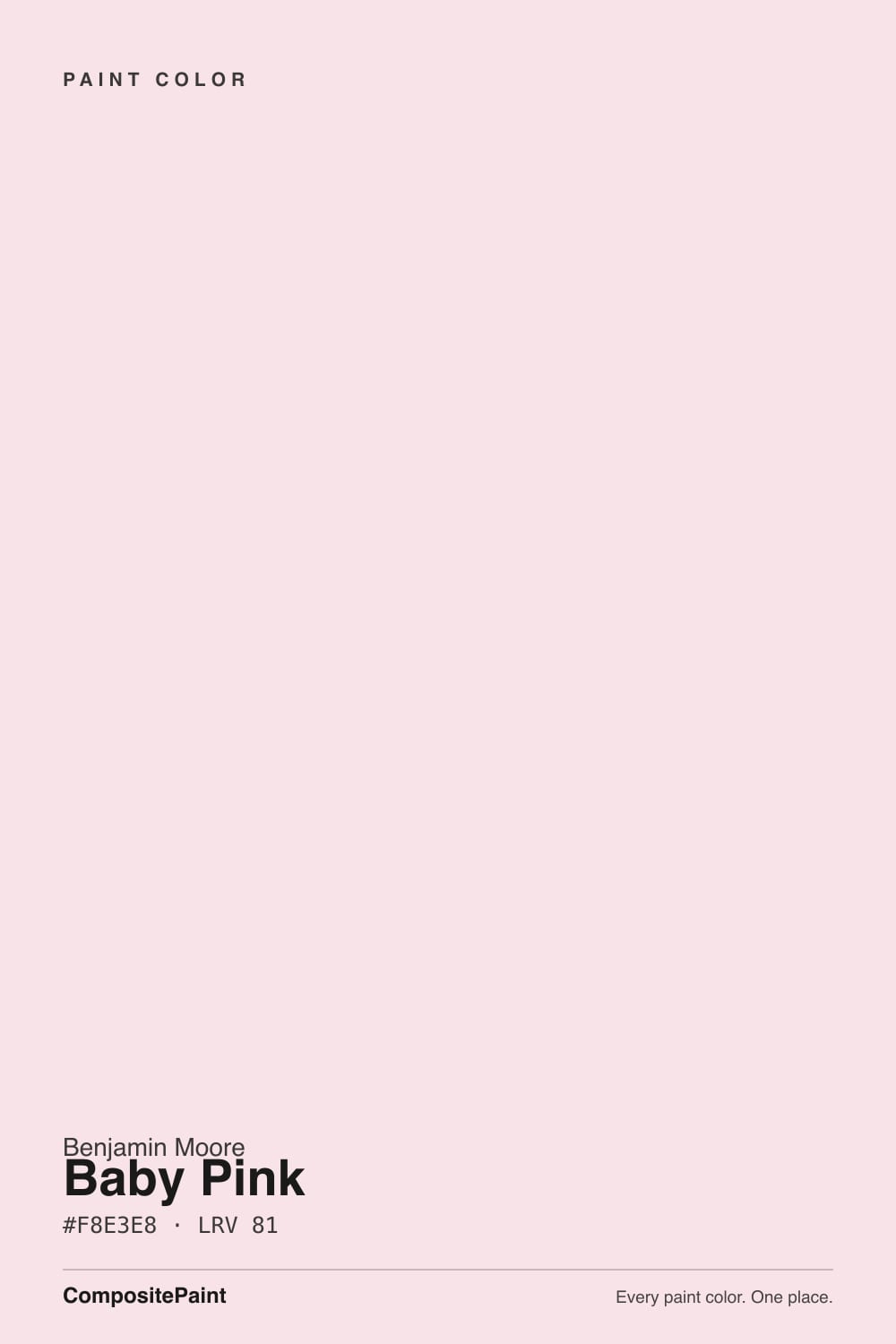
Baby Pink 2085-70 is a near-white pink. Its hex value is #F8E3E8 and its LRV is 81, which puts it at the top of the light range, so it reflects almost as much light as a soft white and makes a small room feel wider. The hue sits at 346 degrees, on the red side of pink rather than the peach side, and while the saturation reading is 60 percent, the lightness of 93 percent waters it down to a blush you notice only when you look for it.
People pick it when they want color without commitment. On a full wall it behaves like a warm white that happens to have a pulse, which is why it turns up in nurseries, bedrooms, powder rooms and dressing rooms. It gives softness rather than sweetness, and it does not fight wood floors or white trim the way a stronger pink does.
The thing to check is how little of it survives. At LRV 81 the pink can vanish on a north wall and read as plain off-white, then bounce visibly onto the ceiling in afternoon sun. Look at a large sample, not a chip, and look at it at night under your own bulbs.
Baby Pink leans blue-red rather than orange-red. A hue of 346 degrees sits just below the red-violet line, so the color has a cool edge under the blush and never reads as peach or salmon. The high lightness of 93 percent keeps that lean quiet, but it is there.
What it sits next to decides what you see. Against a crisp, blue-based white the pink comes forward clearly. Against a creamy white or a beige it can flip and look cooler, almost mauve, because the neighbor has more yellow in it. Against warm oak or a tan carpet the same wall can read gray-pink instead of pink.
Before you commit, tape a sample next to your trim white and next to your flooring at the same time. That pairing tells you whether Baby Pink stays a soft blush in your room or slides toward lavender.
Best Rooms and Uses for Baby Pink
With an LRV of 81, Baby Pink is a whole-room light color. It works best where you want calm rather than contrast: nurseries, children's bedrooms, guest rooms, dressing rooms and powder rooms. In a small or windowless space it opens things up the way a white would, but with a little more life in the walls.
Ceilings are an underrated use. A pale blush overhead warms a room without anyone naming the color, and it flatters warm wood floors.
On cabinetry it suits a small vanity or a laundry run more than a full kitchen, simply because a large mass of it can tip sweet. It is not a trim color, since it has too little contrast against most whites to read as trim. Outdoors it is limited; it works on a sheltered porch ceiling or a soffit, but as a whole exterior body color it bleaches out in full sun.
How Lighting Changes Baby Pink
At LRV 81 the color reflects a lot of light, so it never gets dim, but the light source steers its tone. North rooms get cool, indirect daylight that plays into the blue-red hue at 346 degrees, and the wall can look like a barely tinted off-white with a mauve cast. South rooms do the opposite. Strong direct sun saturates the blush and pushes pink onto the ceiling and onto white trim near the wall.
East rooms are pinkest in the morning and settle to neutral by afternoon. West rooms stay quiet until late day, then warm up quickly.
Bulbs matter as much as windows here. Warm 2700K lamps add yellow and move Baby Pink toward a soft peach-cream. Cooler 3500K to 4000K bulbs strip that warmth and leave the cool side exposed. Because the color is so pale, a bad bulb choice does not darken it, it changes which undertone you see.
Most complaints about Baby Pink are a light mismatch. Upload a photo of your actual room and see it on your walls — then ask for the same wall in north light or evening lamps before you buy a single sample.
Need It From Another Brand?
Any paint counter can custom-tint Benjamin Moore 2085-70 directly. If you would rather stay in one brand's own deck, these are the closest stock matches, measured as ΔE2000. Under 2 is a difference you will not see on the wall.
| Brand | Closest color | ΔE | LRV | |
|---|---|---|---|---|
| Sherwin-Williams | Young At HeartSW 7109 · Sherwin-Williams | 2.2 | 80 | Color page → |
| Behr | Angel Blush210C-1 · Behr | 1.3 | 80 | Color page → |
| Valspar | Pixie Dust1004-2C · Valspar | 0.7 | 80.1 | Color page → |
| PPG / Glidden | GaietyPPG1184-1 · PPG / Glidden | 3.4 | 80 | Color page → |
| Glidden | Barely Blush98RR 80/078 · Glidden | 1.8 | 80 | Color page → |
| Dutch Boy | Be Mine!101-2DB · Dutch Boy | 1.3 | 78 | Color page → |
Similar Benjamin Moore Colors
The nearest shades to Baby Pink within Benjamin Moore's own range, ranked by perceptual color distance — useful when you want the same look a touch lighter, darker, or warmer.
WCAG 2.1: AA is 4.5 : 1 for normal text, 3 : 1 for large text, AAA is 7 : 1.
Baby Pink vs Similar Colors
Gentle Blush 2084-70 at LRV 82, hex #FAE4E8, is a shade lighter and a touch cleaner. Baby Dreams 2083-70 at LRV 79, hex #F5E3EA, carries more violet, so it drifts toward lavender in cool light where Baby Pink stays pink. Aztec Lily 2080-70 at LRV 78 and Voile Pink 2000-70 at LRV 77 are both slightly deeper and easier to see on a wall.
Across brands, Diamond Vogel Hepatica 1125 at LRV 79 has a deltaE of 0.52 and Valspar Pixie Dust 1004-2C at LRV 80.1 a deltaE of 0.7, so both are effectively the same color. Behr Angel Blush 210C-1 at LRV 80 sits at 1.28 and Glidden Barely Blush 98RR 80/078 at 1.76, which reads as visually identical in normal room light.
Sherwin-Williams Young At Heart SW 7109 at deltaE 2.23 and Farrow & Ball Middleton Pink No. 245 at 2.62 are very close, but sample first. PPG Gaiety PPG1184-1 at 3.39 is the furthest of the near matches.
Colors That Go With Baby Pink
For trim, a clean white with no yellow keeps the blush honest and crisp. A creamy white will warm the wall and pull it toward peach, which is a fine choice if that is the look you want, but decide on purpose rather than by accident.
Inside Benjamin Moore's own range, the easiest partners are its close neighbors. Gentle Blush 2084-70 at LRV 82 and '50s Pink 2086-70 at LRV 81 are quiet enough to use in an adjoining room without a visible seam. Baby Dreams 2083-70 at LRV 79 and Aztec Lily 2080-70 at LRV 78 step down slightly if you want a hair more depth on one wall. Romantic Pink 2004-70 at LRV 78 and Voile Pink 2000-70 at LRV 77 do the same.
For contrast, go to something with weight: a deep charcoal, a warm mid green, or natural walnut and oak. Brass and aged bronze suit it better than bright chrome, which reads cold next to the blush.
Coordinated palette
Generated by hue-rotating #F8E3E8 in HSL space. Pair Baby Pink with one accent and one neutral — the swatches below are starting points, not final picks.
Baby Pink FAQ
Is Baby Pink warm or cool?
Baby Pink is a soft warm pink with a cool edge. Its hue sits at 346 degrees, on the blue-red side of pink rather than the peach side, so it does not read orange. In practice it feels warm on a wall in daylight but can look slightly mauve in cool north light or under cooler bulbs.
What LRV is Baby Pink?
Baby Pink 2085-70 has an LRV of 81. LRV runs from 0 for black to 100 for pure white, so 81 puts it near the top of the light range. It reflects a lot of light, brightens small rooms, and on a wall behaves much like a warm white with a faint blush in it.
Does Baby Pink work in a dark room?
Yes, and that is one of its better uses. At LRV 81 it gives back most of the light it receives, so it will not make a dim room feel closed in. The trade-off is that in weak or cool light the pink itself can disappear and the wall reads as a plain off-white.
What white trim goes with Baby Pink?
A clean white with no yellow in it gives the crispest edge and keeps the blush looking deliberate. A creamy or cream-based white will warm the wall and nudge Baby Pink toward peach, which can look lovely in a bedroom but softens the contrast. Hold both against the wall sample before choosing.
Is Baby Pink good for cabinets or exteriors?
It suits small cabinetry such as a bathroom vanity or a laundry run better than a full kitchen, because a large mass of pale pink can start to read sweet. Outdoors it is limited. In direct sun an LRV 81 blush bleaches toward white, so it works better on a sheltered porch ceiling than as a whole-house body color.
How is Baby Pink different from Gentle Blush?
Gentle Blush 2084-70 sits at LRV 82 with hex #FAE4E8, against Baby Pink at LRV 81 and #F8E3E8. Gentle Blush is a fraction lighter and a touch cleaner, while Baby Pink holds slightly more color. The two are close enough that you would not notice the difference across a hallway, so pick on the sample, not the chip.
Have you painted with Baby Pink?
Rate it — one tap helps the next reader decide.
Ask a Question