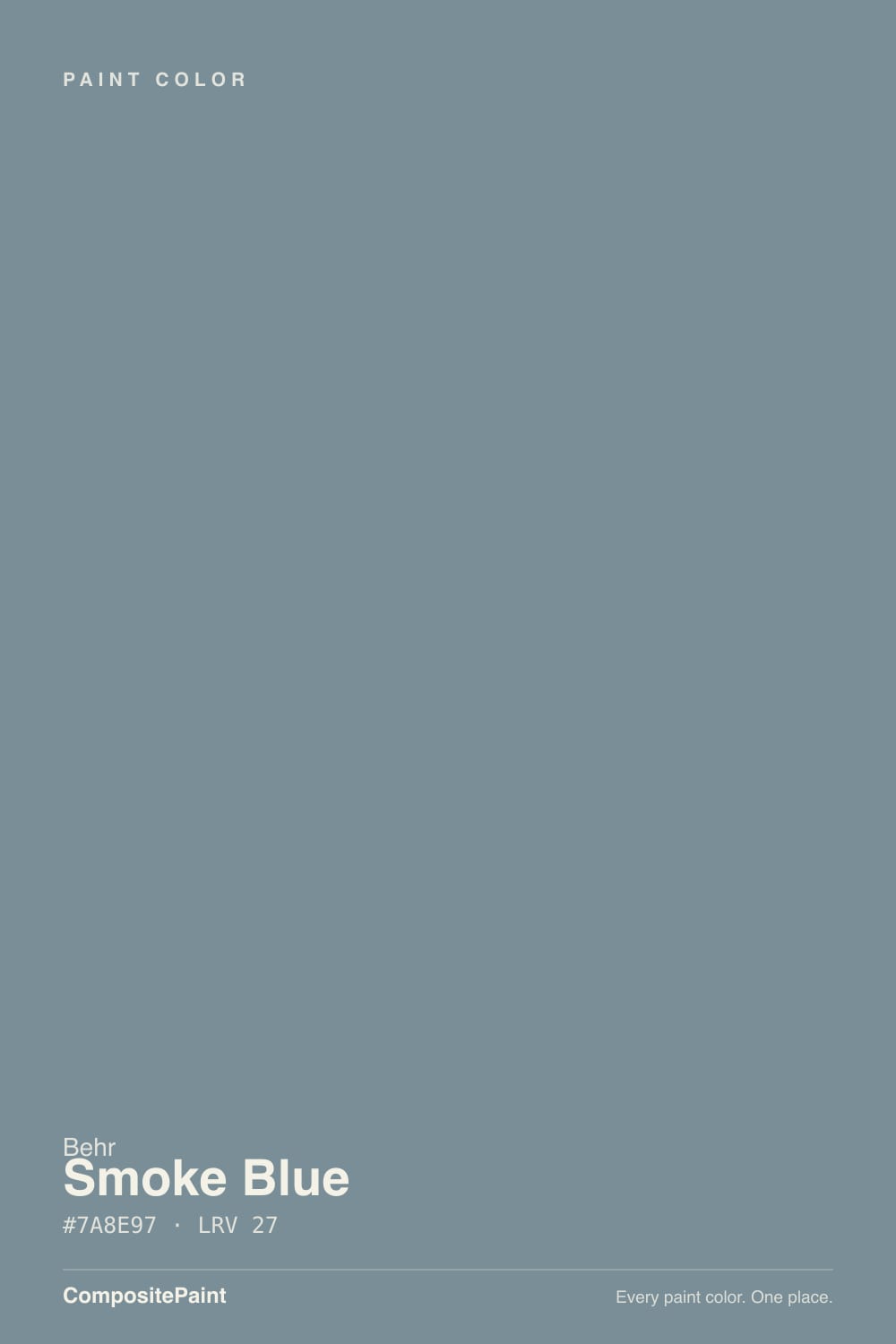
Color spec
| Brand | Behr |
| Name | Smoke Blue |
| SKU | PPU14-10 |
| Hex | #7A8E97 |
| RGB | 122, 142, 151 |
| HSL | 199°, 12%, 54% |
| LRV | 27 |
| Undertone | cool blue-green tone |
| Family | Teal |
What Color Is Smoke Blue, Really?
Behr Smoke Blue (PPU14-10) is a muted, mid-depth blue-gray. Its saturation sits at just 12 percent, so it reads more like a gray that leans blue-green than a true blue; the hue angle of 199 puts that lean on the cool, slightly teal side. With an LRV of 27 it holds real color on the wall instead of washing out, but it stops well short of navy-dark.
The reason it keeps showing up in searches is simple: it is the blue-gray most often cited as the Behr alternative to Benjamin Moore Wedgewood Gray, so people planning that dusty coastal-blue look on a Behr budget land here.
Smoke Blue suits rooms where you want calm color that still registers as color. It works for bedrooms, offices, and bathrooms in traditional, coastal, and farmhouse-leaning homes, and for anyone who finds plain gray too flat but bright blue too loud.
Smoke Blue carries a cool blue-green undertone. At 12 percent saturation it is not a near-neutral, but it is close to that line: there is enough pigment to read clearly as blue-gray, yet the color stays muted rather than saturated. The green side of the undertone is subtle. In bright daylight and next to true blues, Smoke Blue can look slightly teal or sea-glass. Next to warm woods and beige, the blue side dominates and it reads as a classic dusty blue.
Test it against whatever gray or blue it will sit near. Beside a warm greige it will look distinctly blue; beside a saturated navy it will look gray. Also hold a sample against your trim white: against a bright white like Ultra Pure White (1850) the color deepens and cools, while against a creamier white it looks softer and a touch greener.
Best Rooms and Uses for Smoke Blue
An LRV of 27 puts Smoke Blue in the versatile middle band: dark enough to define a room, light enough to run on all four walls without closing the space in. Bedrooms are its most common job, where the muted blue-gray reads restful rather than cold. It also holds up well in home offices, dining rooms, and full baths with decent light.
Beyond walls, this depth is right for kitchen and bath cabinets, where it gives color without the commitment of navy, and for built-ins and a board-and-batten lower wall with a light neutral above. Outside, it works as a full exterior body color on coastal and farmhouse-style houses with white trim, and as a front door color on white, cream, or light gray siding. Skip it for trim and ceilings; it is too mid-toned to frame lighter walls cleanly.
How Lighting Changes Smoke Blue
At LRV 27, Smoke Blue reflects roughly a quarter of the light that hits it, so the room's light source decides how heavy it feels. In a north-facing room the cool light pushes it grayer and darker; it can read close to slate by late afternoon, which works if you want a moody study but can feel flat in a small bath. South-facing rooms are the sweet spot: steady warm daylight lifts it and the blue-green character shows all day.
East light makes it look cleaner and bluer in the morning, then grayer after noon; west-facing rooms run the opposite schedule, with a warmer, softer version of the color in the evening. Under bulbs, warm white (2700K) mutes the blue and pulls it toward gray-green, while cooler 3500K to 4000K bulbs keep it recognizably blue. Sample on two walls, because this mid-tone shifts more with exposure than a lighter color would.
Most complaints about Smoke Blue are a light mismatch. Upload a photo of your actual room and see it on your walls — then ask for the same wall in north light or evening lamps before you buy a single sample.
TEST IT IN YOUR LIGHT →Smoke Blue vs Similar Colors
Behr has several blue-grays within a step of Smoke Blue, and the differences are small but visible on a full wall. Cold Steel (MQ5-20), LRV 25, is slightly darker and steelier, with less of the green softness; pick it when you want a cooler, more urban gray-blue, and Smoke Blue when you want the dustier coastal version.
Magnetic Gray (N500-5), LRV 26, leans a touch further toward green-gray, so it reads more like a gray with a sea-glass cast than a blue. It is the safer choice next to warm wood floors that fight with blue. Silent Tide (PMD-55) matches Smoke Blue's LRV 27 almost exactly but is marginally lighter-feeling and a hair bluer; between the two, sample both and judge under your own light, because on a chip they are nearly twins. Smoke Blue remains the most balanced of the group, sitting between the gray and blue extremes.
Colors That Go With Smoke Blue
For trim and doors, Ultra Pure White (1850), at LRV 92, is the crisp choice; it sharpens Smoke Blue and suits coastal and modern rooms. If that contrast feels stark, Swiss Coffee (12), at LRV 80, is a softer warm white that works on trim and adjacent walls in traditional and farmhouse homes.
For a second wall color in an open plan, Dolphin Fin (PPU18-15), a mid-light greige at LRV 47, keeps the palette quiet and lets Smoke Blue carry the color. For accents, Back to Nature (S340-4), a muted green at LRV 38, sits next to Smoke Blue the way sage sits next to sea glass and suits pillows, a bench, or a powder room. If you want punch, Cracked Pepper (PPU18-01), a soft black at LRV 5, makes a strong front door or island color against Smoke Blue walls.
Warm oak and walnut furniture keeps the scheme from going cold; brushed nickel, black, and aged brass hardware all work.
Need It From Another Brand?
Any paint counter can custom-tint Behr PPU14-10 directly — but if you would rather stay in one brand's own deck, these are the closest stock matches:
Similar Behr colors
closest in the Behr deckThe nearest shades to Smoke Blue within Behr's own range, ranked by perceptual color distance — useful when you want the same look a touch lighter, darker, or warmer.
Coordinated palette
Generated by hue-rotating #7A8E97 in HSL space. Pair Smoke Blue with one accent and one neutral — the swatches below are starting points, not final picks.
Accessibility (WCAG contrast)
WCAG 2.1: AA = 4.5:1 normal text · AA Large = 3:1 large text · AAA = 7:1 normal text.
The Questions Everyone Asks
Is Behr Smoke Blue warm or cool?
Smoke Blue is a cool color. Its undertone is blue-green, and at only 12 percent saturation it stays muted, so it reads as a dusty blue-gray rather than a vivid blue. Cool north light makes it grayer, warm bulbs and south light soften it, but it never flips warm. Pair it with warm woods or a warm white if the room needs balancing.
What trim white goes with Behr Smoke Blue?
Ultra Pure White (1850) is the standard pairing; at LRV 92 it gives crisp, clean contrast that suits coastal and modern rooms. If you want a softer, warmer frame, Behr Swiss Coffee (12), at LRV 80, works well in traditional and farmhouse spaces. Avoid mid-tone or heavily tinted whites, which can make Smoke Blue look dingy by comparison.
Does Behr Smoke Blue work on kitchen cabinets?
Yes. With an LRV of 27, Smoke Blue is in the ideal cabinet range: dark enough to hide everyday wear and read as a deliberate color choice, but lighter and softer than navy. It works on both full cabinet runs and islands, with white or greige walls around it. Use a scrubbable enamel-type finish and test a door front first, since kitchen lighting shifts the color.
What does Smoke Blue's LRV of 27 mean in practice?
LRV 27 means the color reflects about 27 percent of the light hitting it, which puts Smoke Blue in the mid-tone band. In practice, it will read as a real, visible color on the wall, not a tinted neutral, and it will darken noticeably in dim or north-facing rooms. It is still light enough to use on all four walls of an average room.
How is Behr Smoke Blue different from Behr Cold Steel?
Cold Steel (MQ5-20) is very close but slightly darker, with an LRV of 25 versus Smoke Blue's 27, and it reads a bit steelier and more urban. Smoke Blue keeps a softer blue-green, coastal quality. On a chip the gap is small; on a full wall Cold Steel feels heavier. Choose Cold Steel for a moodier gray-blue and Smoke Blue for the dustier, friendlier version.
Should I sample Behr Smoke Blue before painting?
Yes, and on more than one wall. As a mid-tone at LRV 27 with a subtle blue-green undertone, Smoke Blue shifts visibly between exposures: grayer in north light, bluer in morning east light, softer under warm bulbs. Paint two large swatches on opposite walls, or use a peel-and-stick sample, and watch them at morning, midday, and evening before committing.
Will It Work in YOUR Room?
No page can promise how Smoke Blue behaves in your light. Upload a photo and see it on your own walls in seconds — before you spend a cent on samples.
TRY SMOKE BLUE ON YOUR ROOM →Ask a Question

Not sure about Smoke Blue in your room?
Ask Jessica below — every question gets a real reply, usually within a day.