Product review · Sherwin-Williams · Updated August 7, 2026
ArmorSeal Floor CoatingsSherwin-Williams paint review
8.4/10A real floor line with complete published test data — and a line that punishes anyone who skips the grinder.
Three different chemistries wear one badge, and buying the wrong one is the most common ArmorSeal failure. 8100 for occupied buildings and damp slabs, 1000 HS for hard-use plants, Tread-Plex nowhere near a tire.

Robert Vega · Commercial Coatings Editor · Updated August 7, 2026
Twelve years in facility engineering specifying coatings for school districts, light industrial sites, and municipal assets before moving to editorial. Robert writes the floor specs that have to survive a procurement meeting and a holiday inspection. About the testing process →
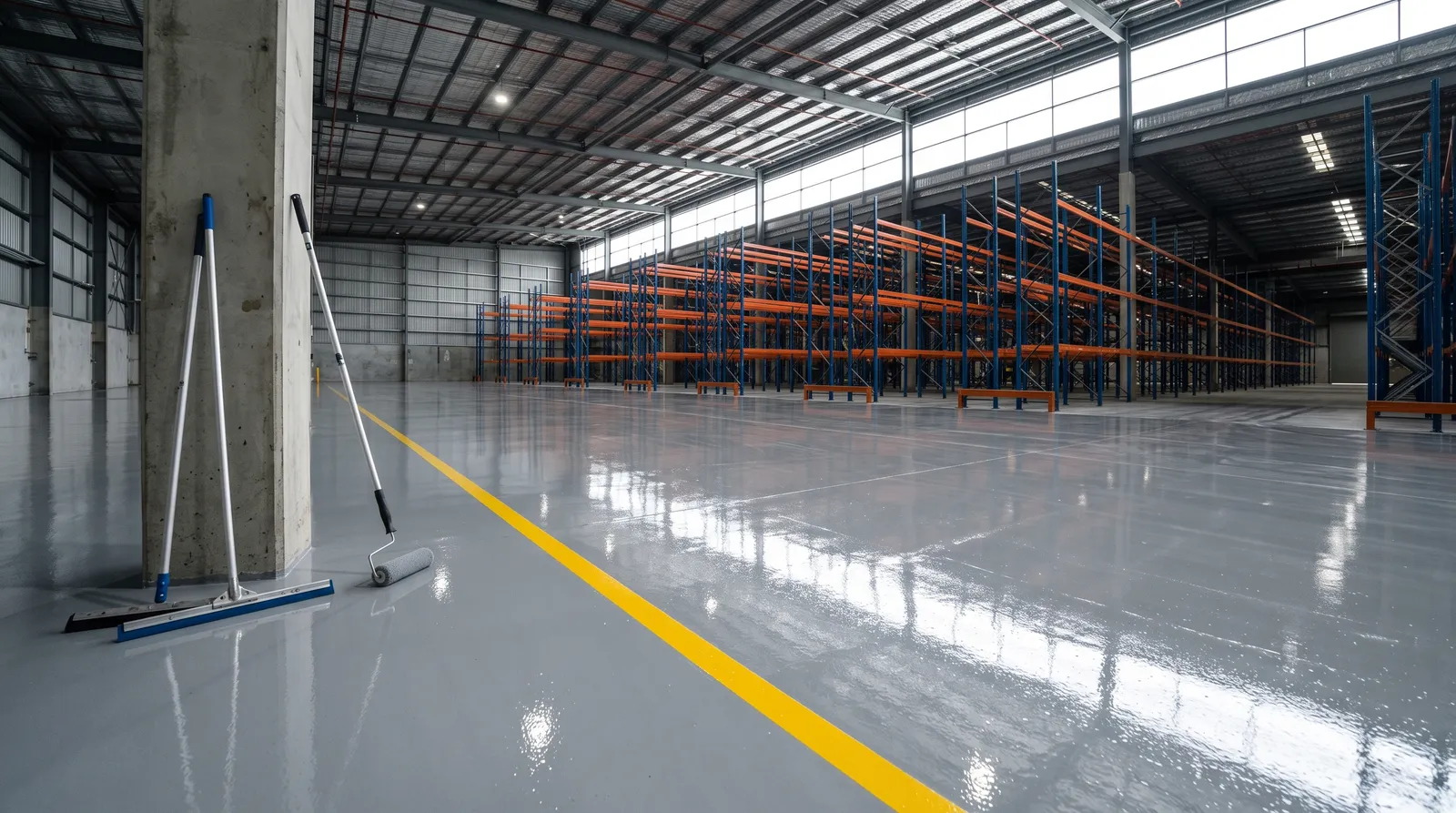
Sherwin-Williams ArmorSeal Floor Coatings3 sheens
Coverage8100 130-320
VOC8100 under 50 g/L
Sheens 8100 gloss or satin1000 HS gloss onlyTread-Plex semi-gloss
Read this first
The Fast Verdict
Spec 8100 for occupied buildings, VOC-restricted jurisdictions, and any slab with a moisture question: water-based polyamine epoxy, 41 percent solids, under 50 g/L, breathable, self-priming, and it passes hot tire pick-up at 140F. Spec 1000 HS when the building is empty and the slab is dry and the floor takes forklifts, because 64.8 mg abrasion loss is a different class of film. Spec Tread-Plex only for stairwells, aisleways, and light-traffic corridors.
Best for
Warehouses and distribution centers · Plants and vehicle shops · Showrooms · Schools and hospitals · Labs and light assembly · Stairwells and aisleways (Tread-Plex)
Skip if
You want a Saturday DIY garage kit · Your shutdown window is 24 hours · You need a self-leveling 20-mil resurfacer · You need immersion or chemical containment data · Nobody on the job owns a grinder
What it's good at
- Publishing complete, inspectable test data — abrasion, adhesion, perms, hot tire, pencil hardness
- Covering three different jobs from one supplier and one commercial counter
- 8100 over damp or vapor-driving slabs, at 2.0 to 5.0 perms with a hot tire pass at 140F
- 8100 clearing every US architectural and industrial maintenance VOC limit at under 50 g/L, with LEED v4.1 credit
- 1000 HS abrasion at 64.8 mg loss and a real 6 to 10 mil two-coat industrial build
- Tread-Plex reopening a stairwell in 8 hours and a floor to heavy traffic in 18
- Tread-Plex going over wood and sound previously painted floors, which neither epoxy does gracefully
What it's not good at
- 8100 film hardness — 150 mg abrasion loss and H pencil hardness scuff under steel wheels and dropped tooling
- 8100 scheduling — the recoat window closes at 72 hours, then you abrade
- 1000 HS compliance — under 340 g/L is illegal across a large share of the US with no compliant reducer offered
- 1000 HS over a slab pushing vapor; it is not breathable
- 1000 HS color hold — the data sheet warns epoxy may darken or yellow after cure
- Tread-Plex anywhere tires turn, and its 4-mil two-coat film marks under carts and chair casters
- Any cheap or fast route: two-coat systems, 28-day cure, mechanical prep, 7-day cure to service
Same shelf, different cans
Which ArmorSeal Are You Buying?
If a contractor quoted you ArmorSeal without a model number, get the model number. The gap between Tread-Plex and 1000 HS is the gap between a stairwell coating and an industrial epoxy.
ArmorSeal 8100 Water Based Epoxy
BaseWater-based polyamine epoxy, 2-component, 4:1, 41 percent volume solids
SheensGloss or satin
HardnessH pencil hardness · 150 mg abrasion loss (ASTM D4060)
RecoatMin 6 hr, max 72 hr at 77F; abrade past 72 hr
Buy it if
Warehouses, garages, showrooms, schools, hospitals, and any occupied building or VOC-restricted jurisdiction. Breathable at 2.0 to 5.0 perms, tolerates damp concrete, and passes hot tire pick-up at 140F.
Avoid if
Immersion service or chemical containment, or a plant where steel wheels and dropped tooling are daily events.
ArmorSeal 1000 HS Epoxy
BaseSolvent-based polyamide epoxy, 2-component, 1:1, 65 percent volume solids
SheensGloss only
Hardness64.8 mg abrasion loss — the best of the three
RecoatMin 8 hr, max 7 days at 77F
YellowingYes — the data sheet warns epoxy may darken or yellow after cure; the clear is interior only
Buy it if
Plants, shops, marine decks, and chemical spill areas where the building is empty, the slab is dry, and the floor takes real abuse. 3 to 5 mils dry per coat.
Avoid if
VOC-restricted jurisdictions, exterior UV exposure, or a slab pushing moisture vapor. There is no compliant reducer offered.
ArmorSeal Tread-Plex
BaseOne-component 100 percent acrylic, waterborne, 43 percent volume solids
SheensSemi-gloss
HardnessF pencil hardness · 132 mg abrasion loss · 702 psi adhesion
Recoat4 hr at 77F (6 hr at 55F, 30 min at 100F)
Buy it if
Stairwells, aisleways, laboratories, light assembly, hospitals, offices, and helipads. Foot traffic in 8 hours, heavy in 18, and it goes over wood and sound previously painted floors.
Avoid if
Anywhere tires turn or park. The data sheet says plainly it is not recommended for hot tire pick-up.
ArmorSeal 650 SL/RC
Base100 percent solids self-leveling epoxy
Buy it if
Slab resurfacing and 20-plus-mil builds.
Avoid if
Thin-film maintenance coats.
ArmorSeal Rexthane I
BaseMoisture-cured urethane
Buy it if
An abrasion topcoat over a cured epoxy basecoat, where forklift traffic is constant and gloss retention matters.
Avoid if
Bare concrete as a stand-alone coating.
Numbers, not adjectives
Spec Sheet
- Volume solids
- 8100 41% · 1000 HS 65% colors, 61% clear · Tread-Plex 43%
- VOC
- 8100 under 50 g/L · Tread-Plex under 100 g/L · 1000 HS under 340 g/L mixed (EPA Method 24)
- DFT per coat
- 8100 2.0-5.0 mils · 1000 HS 3.0-5.0 mils · Tread-Plex 1.5-2.0 mils
- Coverage
- 8100 130-320 · 1000 HS 206-350 · Tread-Plex 345-460 sq ft/gal per coat
- Abrasion (ASTM D4060, CS17, 1000 cycles, 1 kg)
- 1000 HS 64.8 mg · Tread-Plex 132 mg · 8100 150 mg
- Adhesion (ASTM D4541)
- Tread-Plex 702 psi · 8100 550 psi · 1000 HS 350 psi at 100 percent concrete failure
- Pot life at 77F
- 8100 5.5 hr, no sweat-in · 1000 HS 4 hr with 30 min sweat-in · Tread-Plex none, single component
- Traffic
- Foot 18/24/8 hr · heavy 48 / 48-72 / 18 hr (8100 / 1000 HS / Tread-Plex); all cure 7 days
- Hot tire pick-up
- 8100 passes at 140F · 1000 HS not published · Tread-Plex not recommended
- Surface prep
- Concrete cured 28 days minimum, SSPC-SP13/NACE 6 or ICRI No. 310.2R CSP 1-3
- Sizes
- 8100 1-gal, 4-gal, 5-gal kits · 1000 HS 2-gal and 10-gal kits · Tread-Plex gallon and 5-gallon
- Price
- Roughly $60-80/gal Tread-Plex and $85-120 per mixed gallon for 8100 and 1000 HS at single-kit retail; SW does not publish list online
Application Settings That Work
- Primer
- 8100 is self-priming over concrete and tolerates damp slabs. 1000 HS uses a reduced first coat as its own primer. Tread-Plex pairs with ArmorSeal Tread-Plex Water Based Acrylic Primer. In every case the real prep is mechanical: 28-day cured concrete, moisture tested, ground or shot-blasted to CSP 1-3, degreased first and cleaned after, with joints and cracks detailed before the field coat.
Cure to Service, Product by Product
All three cure fully in 7 days, and the numbers before that are what decide the shutdown schedule. At 77F, 8100 is 45 minutes to touch, 6 hours minimum to recoat, 18 hours to foot traffic, and 48 hours to heavy traffic. 1000 HS is 8 hours to recoat, 24 to foot, and 48 to 72 to heavy. Tread-Plex is the fast one: 4 hours to recoat, 8 to foot traffic, 18 to heavy, which is how a school stairwell gets coated Friday night and carries students Monday. Two windows bite crews. The 8100 recoat window closes at 72 hours — miss the second coat over a long weekend and you come back with grinders. The 1000 HS sweat-in time, 30 minutes at 77F, is not optional, and skipping it produces soft spots. Pot life at 77F is 5.5 hours for 8100 with no sweat-in and 4 hours for 1000 HS. Throughout application and cure, keep the surface at least 5F above the dew point or you get amine blush on the epoxies and slow film formation on Tread-Plex.
Mid-project panic
When It Goes Wrong, and How to Fix It
Coating peeling in sheets at the first pallet jack turn
Why it happens. Prep. Every ArmorSeal failure I have been asked to look at came back to the slab, not the can. The published system assumes concrete cured 28 days minimum and profiled to SSPC-SP13/NACE 6 or ICRI No. 310.2R, CSP 1-3, with laitance, curing compounds, form release, hardeners, oil, and grease removed.
The fix. Diamond grinding or shot blasting, not acid etching, which is a fallback rather than an equal. Degrease first, then grind — grinding oil in only drives it deeper. Clean per ASTM D4258 and abrade per ASTM D4259. No data sheet number rescues a floor that skipped this.
Blisters and disbondment over a slab that looked dry
Why it happens. Moisture vapor under a tight film. 1000 HS is not breathable, so a high-solids solvent epoxy over a slab pushing vapor is a disbondment claim waiting to happen. New slabs coated at 14 days trap bleed water and blister for the same reason.
The fix. Run ASTM F1869 for moisture vapor emission rate or ASTM F2170 for internal relative humidity before you open a kit, and give the slab its 28 days at 75F. If the slab is wet and you must coat it, 8100 is the product — it is breathable at 2.0 perms gloss and 5.0 satin and tolerates damp concrete.
Tread-Plex lifting in patches where cars park
Why it happens. Misuse. The Tread-Plex data sheet says plainly that it is not recommended for areas subject to hot tire pick-up. It is a one-component acrylic built for stairwells, aisleways, labs, light assembly, hospitals, offices, and helipads. Every Tread-Plex peeling complaint I have seen traces back to a garage bay.
The fix. Move to 8100 or 1000 HS wherever vehicles turn or park. 8100 is the one of the three that publishes a hot tire pick-up pass, tested at 140F. Keep Tread-Plex on foot-traffic floors and treat it as a maintenance coating on a five to seven year recoat cycle.
Second coat missed the window over a long weekend
Why it happens. 8100 has a maximum recoat of 72 hours at 77F. Past that the first coat is no longer chemically open to the next one, and the bond depends on mechanical profile instead.
The fix. Abrade before the next coat, and schedule the two coats inside the window in the first place. If the job cannot be sequenced that tightly, 1000 HS has a 7-day maximum recoat at 77F, which is a more forgiving calendar.
Amine blush or a soft, slow-forming film
Why it happens. Dew point, or a skipped sweat-in. Surface temperature has to be at least 5F above dew point during application and cure. On 1000 HS, 30 minutes of sweat-in at 77F between mixing and application is a real step, not a suggestion.
The fix. Check surface temperature against dew point before every coat and stop the job when the margin closes. Time the sweat-in with a clock, scaling it with temperature: 2 hours at 50F, 30 minutes at 77F, 10 minutes at 120F.
Side by side
8100 vs 1000 HS vs Tread-Plex: The Numbers That Decide It
Read down the VOC row first — in a California district or an OTC state that row eliminates 1000 HS before you reach performance. Read the hot tire row second, because it eliminates Tread-Plex from every vehicle floor. What is left usually answers itself.
| ArmorSeal 8100 | ArmorSeal 1000 HS | ArmorSeal Tread-Plex | |
|---|---|---|---|
| Volume solids | 41% | 65% | 43% |
| VOC (g/L) | Under 50 | Under 340 | Under 100 |
| DFT per coat | 2-5 mils | 3-5 mils | 1.5-2 mils |
| Abrasion loss | 150 mg | 64.8 mg | 132 mg |
| Foot traffic | 18 hr | 24 hr | 8 hr |
| Hot tire pick-up | Passes, tested at 140F | Not published | Not recommended |
| Breathable | Yes, 2-5 perms | No | Partially |
| Components | 2 (4:1) | 2 (1:1) | 1 |
| Finish options | Gloss, satin | Gloss | Semi-gloss |
Volume solids
ArmorSeal 810041%
ArmorSeal 1000 HS65%
ArmorSeal Tread-Plex43%
VOC (g/L)
ArmorSeal 8100Under 50
ArmorSeal 1000 HSUnder 340
ArmorSeal Tread-PlexUnder 100
DFT per coat
ArmorSeal 81002-5 mils
ArmorSeal 1000 HS3-5 mils
ArmorSeal Tread-Plex1.5-2 mils
Abrasion loss
ArmorSeal 8100150 mg
ArmorSeal 1000 HS64.8 mg
ArmorSeal Tread-Plex132 mg
Foot traffic
ArmorSeal 810018 hr
ArmorSeal 1000 HS24 hr
ArmorSeal Tread-Plex8 hr
Hot tire pick-up
ArmorSeal 8100Passes, tested at 140F
ArmorSeal 1000 HSNot published
ArmorSeal Tread-PlexNot recommended
Breathable
ArmorSeal 8100Yes, 2-5 perms
ArmorSeal 1000 HSNo
ArmorSeal Tread-PlexPartially
Components
ArmorSeal 81002 (4:1)
ArmorSeal 1000 HS2 (1:1)
ArmorSeal Tread-Plex1
Finish options
ArmorSeal 8100Gloss, satin
ArmorSeal 1000 HSGloss
ArmorSeal Tread-PlexSemi-gloss
8100 is the one worth defending in a procurement meeting: it clears every VOC limit in the country, breathes over a questionable slab, is self-priming, and passes hot tire. Give up ground on hardness and accept a shorter recoat interval or a Rexthane topcoat in a heavy plant. 1000 HS is still the abrasion champion and the right call in an empty building on a dry slab where the local air rule allows it. Tread-Plex is a fast maintenance coating for foot traffic on a five to seven year cycle, and it is not a floor for vehicles at any price.
If not this one
Honest Alternatives
BP
Behr Premium 1-Part Epoxy Concrete and Garage Floor PaintA fraction of an ArmorSeal kit
For a residential garage or a basement where the owner is doing the work, a self-priming one-part epoxy from the home center is honest about being a maintenance coating. It will not survive a commercial floor.
RO
Rust-Oleum Concrete Saver / 9100 SystemBid-comparable to ArmorSeal
Rust-Oleum's industrial floor line covers the same jobs with comparable published data and is easier to source outside a Sherwin-Williams metro. Worth a bid comparison on any project over a few thousand square feet.
PA
PPG Amercoat or Tnemec Series 237 SBAbove ArmorSeal
When the spec calls for chemical containment, secondary containment, or immersion, you are past ArmorSeal's published limits. Both lines publish immersion data that 8100 and 1000 HS do not.
AR
ArmorSeal Rexthane IAn added topcoat line item, not a substitution
A moisture-cured urethane over a cured epoxy basecoat adds abrasion and chemical resistance and holds gloss longer. Where forklift traffic is constant, two coats of epoxy plus one of urethane outlives either product alone.
Questions people actually ask
ArmorSeal Floor Coatings Questions, Answered
What is the difference between ArmorSeal 8100 and 1000 HS?
8100 is a water-based polyamine epoxy at 41 percent volume solids and under 50 g/L VOC. It is breathable, self-priming, tolerates damp concrete, and comes in gloss or satin. 1000 HS is a solvent-based polyamide epoxy at 65 percent volume solids and under 340 g/L VOC. It builds a thicker film per coat, has better abrasion numbers, and comes in gloss only. Pick 8100 for occupied buildings, VOC-restricted jurisdictions, and slabs with moisture questions. Pick 1000 HS for hard-use industrial floors where the building is empty and the slab is dry.
Is ArmorSeal 8100 good for a garage floor?
Yes, and it is one of the few floor coatings that publishes a hot tire pick-up pass on its data sheet, tested at 140F. It is self-priming over concrete, tolerates a damp slab better than a solvent epoxy, and works as a stand-alone floor or as the receiver coat for a chip floor. Prep is still the whole job: 28-day cured concrete, ground or shot-blasted to ICRI CSP 1-3, and a moisture test before you open a kit.
Can ArmorSeal Tread-Plex go in a garage?
No. The Tread-Plex data sheet says it plainly: not recommended for areas subject to hot tire pick-up. It is a one-component acrylic built for stairwells, aisleways, laboratories, light assembly areas, and commercial office floors. Park a car on it and the tires will lift it. Use 8100 or 1000 HS where vehicles turn.
How long does ArmorSeal 8100 take to cure?
At 77F and 50 percent relative humidity, 45 minutes to touch, 6 hours minimum to recoat, 18 hours to foot traffic, 48 hours to heavy traffic, and 7 days to full cure. The recoat window closes at 72 hours — past that you abrade before the next coat. Pot life is 5.5 hours at 77F, dropping to 3.5 hours at 120F, with no sweat-in time required.
What surface prep does ArmorSeal need on concrete?
The spec calls for SSPC-SP13/NACE 6 or ICRI No. 310.2R, CSP 1-3. Concrete must be cured at least 28 days at 75F and free of laitance, dust, curing compounds, form release agents, and hardeners. Diamond grinding or shot blasting is the reliable route; acid etching per ASTM D4260 is the fallback where mechanical prep is impossible. Run a moisture vapor emission test per ASTM F1869 or a relative humidity probe per ASTM F2170 first.
Is ArmorSeal 1000 HS legal in my state?
Check before you order. Mixed VOC is under 340 g/L, which fails the tighter architectural and industrial maintenance limits in California districts, the Ozone Transport Commission states, and several metro non-attainment areas. Sherwin-Williams lists no reducer for VOC-restricted areas on the 1000 HS data sheet. Where the limit bites, 8100 at under 50 g/L is the drop-in answer.
How many coats of ArmorSeal do you need?
Two, in every published system. The 8100 test system is two coats at 2 to 4 mils dry each. The Tread-Plex test system is two coats at 4 mils dry total. 1000 HS is tested as one reduced coat as its own primer plus one full coat at 3 to 5 mils dry. Single-coat floor jobs fail at the pinholes and the roller laps.
Which ArmorSeal is hardest?
1000 HS, and it is not close. Abrasion loss is 64.8 mg against 150 for 8100 and 132 for Tread-Plex on the same taber test. Its 350 psi adhesion figure looks weak next to 8100's 550 until you read the footnote: 100 percent concrete failure, meaning the substrate gave up before the coating did. That is the best result an adhesion pull can produce.
Will an ArmorSeal epoxy floor yellow?
The 1000 HS data sheet warns that epoxy coatings may darken or yellow after cure, and the clear version is interior only. If a white or light-colored floor under skylights matters to the owner, top it with a urethane such as Rexthane I or spec a different product.
Where do I buy ArmorSeal, and what will it cost?
Through a Sherwin-Williams commercial store rather than a general-line branch — Part A and Part B must be bought together, and the hardener is a separate SKU a homeowner-facing counter may not stock. Expect roughly $60 to $80 a gallon for Tread-Plex and $85 to $120 per mixed gallon for 8100 and 1000 HS at single-kit retail, with contractor pricing well under that at five kits and up. Sherwin-Williams does not publish list prices online, so get a written quote against your square footage and target DFT.
Keep exploring
Sherwin-Williams brand guide and product lineupWarehouse epoxy floor systems and DFT specsCommercial garage floor coating systemsBest garage floor paint, tested and rankedMil thickness explained: wet mils, dry mils, and why it matters
We may earn a commission when you buy through the retailer link above. It never changes the score or the verdict.
Ask a Question