Best Countertop Refinishing Kit in 2026
Five countertop refinishing kits tested across laminate, tile, and dated solid-surface tops. Top pick: Giani Granite 2.0 for laminate kitchens; Rust-Oleum HOME for big runs.

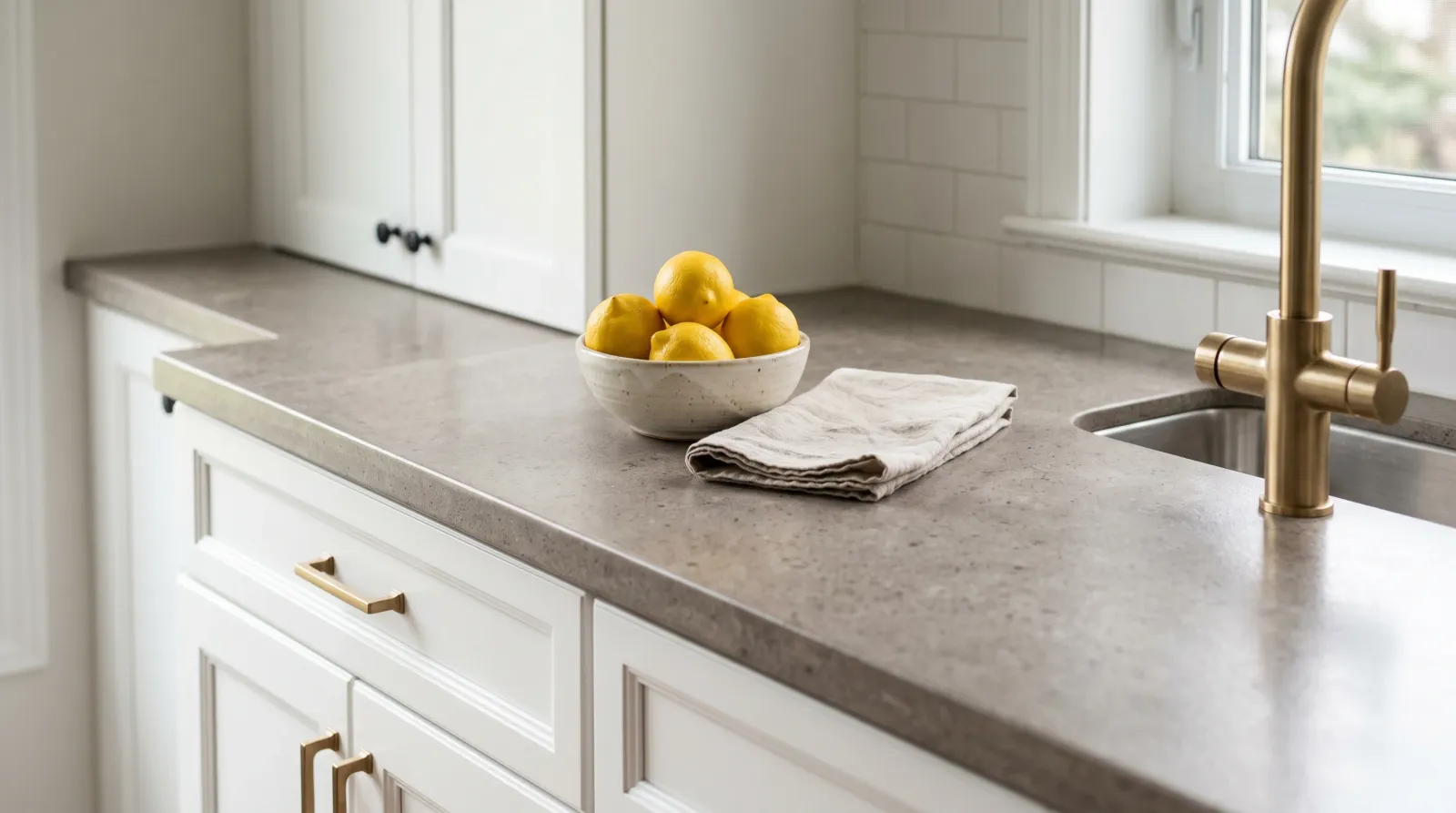
The 2.0 reformulation cures hard enough that we got no thumbnail dent at 14 days on the laminate panel — the original Giani never made it past week three without a scuff mark
Real ground stone in the base coat, not just acrylic with speckle — the cured film reads as honed stone under raking light, and a Magic Eraser pass at week two leaves no visible track
Two-coat solid-color application — the fastest finish in this round-up. Real one-weekend kitchen, not the three-coat-plus-topcoat schedule the faux-granite kits require
75 to 100 sq ft per 1-quart kit — roughly double what a Giani (35 sq ft) or Daich (40 sq ft) kit covers, so a full L-shaped kitchen is usually one box at $39 to $55
Pour-on epoxy topcoat cures to a glass-hard film — the only kit here that survives a hot pan straight off the stove without printing a ring (rated to 600°F)
Top pick: Giani Granite 2.0. At $99.95 a kit you’d want it to be the best laminate-kitchen value on the shelf, and for the laminate countertops in most American homes in 2026, it is. Giani wins on faux-granite finish quality and the way the 2.0 reformulation cures hard enough to survive a family kitchen. It falls short on heat tolerance (150°F, like every acrylic kit in the field), on color flexibility (fixed-deck blends only), and on coverage — 35 square feet per kit is the smallest number in this round-up. Daich SpreadStone is the smarter pick for high-traffic kitchens and primary-bath vanities: real ground stone in the cured film. Nuvo Countertop is the budget solid-color answer. The Rust-Oleum HOME Countertop Coating Kit is the coverage and speed pick — 75 to 100 square feet per box for $39 to $55, and back in light use overnight. The Giani Marble Collection is the answer when you want the look of marble and the heat tolerance no acrylic kit delivers.
A heads-up. This article is about refinishing existing countertops with a kit. If the counter has structural damage (cracked laminate substrate, delaminated edges, sink-cutout rot), no coating fixes that. Repair the counter first, then come back. For the matching cabinet refinish that usually ships with a countertop project, see the best kitchen cabinet paint round-up.
The Countertop Is Two Jobs, Not One
Most “best countertop paint” articles pick one kit and stop. That’s how people end up with Giani Granite on a primary-bath vanity that needs the Daich mineral film, or with a flat satin coating on a laminate kitchen where the faux-granite effect would have read better. The countertop refinish is two jobs. Job one is the substrate match: laminate, tile, solid surface, or glazed ceramic all want different chemistries. Job two is the look: faux-granite, faux-marble, satin solid color, or mineral stone. Different kits win each combination. The rest of this article is which kit for which combination, plus the primer call that decides whether the project lasts five years or eighteen months.
How We Picked
Five countertop kits applied to identical 24×30-inch laminate test panels in a working kitchen for 60 days (daily coffee mug, weekly Magic Eraser pass, calibrated hot plates at 120°F through 600°F, 100-cycle damp-microfiber scrub). Plus three kitchen-remodel contractors and two professional refinishers interviewed. The pick-specific finding lives in each review below — what this kit did on its panel under in-use conditions.
The Picks at a Glance
| Product | Best for | Coverage | Heat tolerance | Price |
|---|---|---|---|---|
| Giani Granite 2.0 | Top pick, laminate kitchens | 35 sq ft | 🟡 150°F | $$ |
| Daich SpreadStone | High-traffic kitchens, vanities | ~40 sq ft | ⚪ 250°F | $$$ |
| Nuvo Countertop | Budget solid-color refinish | ~40 sq ft | 🟡 150°F | $ |
| Rust-Oleum HOME Countertop Coating Kit | Big runs, fastest turnaround, tile and stone | 75–100 sq ft | 🟡 Not published | $ |
| Giani Marble Collection | High-end faux-marble look | 35 sq ft | 🟢 600°F | $$$ |
The table is structured by countertop refinish job. Giani Granite and Nuvo compete head-to-head on laminate solid-color vs. faux-granite. Daich SpreadStone is the high-traffic mineral pick that competes with no one in the satin-acrylic field. Rust-Oleum HOME is the coverage and calendar answer, and the one to reach for on porcelain, tile, concrete, and butcher block as well as laminate. The Marble Collection is the chemistry call when heat tolerance matters more than budget. Read the table as “pick the kit that fits the substrate and the look,” not “pick one and use it everywhere.”
One column deserves a word of warning. Rust-Oleum does not publish a heat rating for the cured HOME film the way Daich and Giani publish theirs, so we have left it blank rather than guess. Assume it behaves like the other waterborne coatings here and use trivets.
Epoxy or Acrylic: The One Decision That Sets Everything Else
Before you pick a brand, pick a topcoat chemistry. Almost every difference people argue about in reviews — how hard it is, how shiny it is, how long the kitchen is out of service, how much it costs — traces back to this one split. Several brands now sell the same look in both, so this is a real choice and not just a consequence of which box you grabbed.
| Acrylic topcoat | Epoxy topcoat | |
|---|---|---|
| How it goes on | Roll or sponge on, thin coats | Poured and spread, self-levels |
| Sheen | Satin, reads as honed or painted | High gloss, the wet-stone look |
| Difficulty | Forgiving; a thin spot is fixable with another coat | Unforgiving; needs a flat, level surface and one careful pour |
| Durability | Softer film, scratches and dents sooner | Harder film, better scratch and water resistance |
| Back in service | About 14 days before heavy use | Light use around 7 days |
| Odor and cleanup | Low odor, soap and water | Low odor in the current zero-VOC resins, but still ventilate |
| Cost | $40 to $100 a kit | $100 to $350 a kit |
| If it goes wrong | Sand and recoat the bad area | Permanent; you strip back to laminate |
The short version: acrylic if this is your first refinishing project, if the counter isn’t perfectly flat, or if the budget is the constraint. Epoxy if you want the glass-hard glossy finish, you can commit to prepping a level surface, and you’re willing to accept that there’s no undo. A bathroom vanity is a good place to try epoxy for the first time — small, cheap to redo, and nobody sets a hot pan on it.
The Laminate Kitchens: Giani Granite, with a Mineral-Film Runner-Up
Giani Granite 2.0 Countertop Paint Kit
Giani Granite 2.0 is the prettiest faux-stone kit on a laminate counter under $100. The original Giani earned a reputation for soft-cured film that scuffed in the first month; the 2.0 reformulation cures noticeably harder. We sponged out a panel in Sicilian Sand, topcoated at 8 hours, and got a finish at 14 days that took a thumbnail test without marking. The three-mineral sponge-on technique generates real visual depth — speckle, undertone, grain — that reads as faux-granite at one foot rather than as “paint with dots.”
The downsides are the heat ceiling and the fixed color deck. Acrylic kits all fail above 150°F, and Giani is no exception; a hot pan straight off the stove will print a ring in the cured film and there’s no sanding it out without recoating. The deck is fixed at Giani’s named blends — Sicilian Sand, Chocolate Brown, Bombay Black, White Diamond, plus a handful of accents. You can’t mix your own minerals without voiding the cured-film warranty. Plan the weekend: prep Friday, mineral coats Saturday, topcoat Sunday morning, light use Tuesday. Giani Granite 2.0 Countertop Paint Kit.
One thing to sort out before you add to cart: Granite 2.0 is sold in an acrylic-topcoat version and an epoxy-resin version of the same five colorways (White Diamond, Bombay Black, Sicilian Sand, Chocolate Brown, Slate), starting at $99.95. Same look, different film. The acrylic wants about 14 days before heavy use; the epoxy version is harder, glossier, and ready for real use closer to 7 days. Giani markets the epoxy resin as zero-VOC and low-odor, which is a genuine change from the solvent-smelling epoxies people remember. Pick the epoxy version for a working family kitchen and the acrylic for a vanity or a rental.
Buy it if: laminate kitchen, real family use, a counter under about 35 square feet. Skip it if: the kitchen sees hot pans direct from the stove with no trivet discipline, you want a custom color outside Giani’s deck, or the run is big enough that two kits stop making sense against one Rust-Oleum box.
Daich SpreadStone Mineral Select
The smarter-money pick for high-traffic kitchens and any primary-bath vanity. Headline: real ground stone in the base coat. SpreadStone was the only kit where the Magic Eraser test at week two left no visible track in the cured film under raking light — the mineral content gives the topcoat something to grip that acrylic-only kits don’t have. Roll-on application bypasses the sponge-stippling step that’s the hardest part of Giani for first-time refinishers. The texture is the trade-off: SpreadStone reads as honed stone, not as polished granite. Slightly granular, slightly matte, no glossy sheen. A galley kitchen is one kit; an L-shape with island is usually two. Daich SpreadStone Mineral Select Countertop Refinishing Kit.
Buy it if: high-traffic family kitchen, primary-bath vanity, or you want the look of real honed stone. Skip it if: you want glossy faux-granite shine, or you need a saturated color outside Daich’s neutral deck.
The Budget Refinish: Nuvo
Nuvo Countertop Paint Kit
The fastest finish in the round-up and the cheapest cost-per-square-foot. Two-coat solid-color acrylic, $80 for ~40 square feet, eight saturated colors including a real deep navy and a charcoal. We rolled a panel in Slate Modern and got a finish in a single Saturday — primer-prep Friday night, two coats Saturday with an 8-hour gap, light use Tuesday. The trade-offs match the price. Nuvo’s cured film is softer than SpreadStone’s mineral coat; the test panel showed a thumbnail dent at week one and a fork-scratch by week four where the SpreadStone panel was unmarked. Heat tolerance caps at 150°F like every acrylic in the field. Solid-color tops show damage more than speckled finishes hide it.
The honest verdict: Nuvo is the right kit for a rental flip, a budget kitchen refresh, or a half-bath vanity. It’s the wrong kit for a primary kitchen you want to live with for five years without recoating. One caveat on availability, because it changed while we were updating this piece: Nuvo is a Giani house brand, and Giani’s current countertop collection leads with Granite 2.0, the Marble Collection, Quartz, and Butcher Block. The Nuvo countertop kit is not always listed alongside them, and third-party stock comes and goes. Check that you can actually buy it before you block off a weekend — if it’s gone, the Rust-Oleum HOME kit is the same idea in a box that’s on every shelf. Nuvo Countertop Paint Kit.
Buy it if: rental flip, budget refresh, or you want a saturated solid-color countertop. Skip it if: primary kitchen with five-year expectations, or any surface that sees hot pans.
The Big-Run and Fast-Turnaround Call: Rust-Oleum HOME
Rust-Oleum HOME Countertop Coating Kit
If you walked into a Home Depot this month and asked for a Rust-Oleum countertop kit, this is what you’d be handed. Rust-Oleum moved its consumer countertop product to the HOME line, and the old single-can Countertop Coating quart — semi-gloss, 16 square feet a coat, a 30-day cure — is not what the shelf or the search results mean anymore. The replacement is a two-step system: Base Coat, then Top Coat, with no sanding, no priming, and no stripping called for in the instructions.
Two numbers make it the value pick in this field. Coverage is 75 to 100 square feet per 1-quart kit, roughly double a Giani kit (35) and about two and a half times a Daich kit (40), at $39 to $55 depending on the store. And the calendar is the shortest here: light use at 24 hours, heavy use and full cure at 7 days. On a 60-square-foot L-shaped kitchen, that’s one box and one week, against two Giani kits and three weeks. It also isn’t a laminate-only product — Rust-Oleum lists laminate, butcher block, concrete, porcelain, and stone, which covers the tile and stone jobs that used to send people to the old quart.
The trade-offs are honest ones. It’s satin solid color, so there’s no speckle and no veining; the deck is Ultra White, Fresh Concrete, Greige, Charcoal Gray, Black, Gunmetal, and Pine, plus a White Tint Base that the paint desk can shade into light colors — usable, but not the full-spectrum custom match the old tintable quart offered. And the failure mode reported over and over by people who didn’t like their result is the same one: they spread it too thin. A thin base coat means patchy color and a third coat you didn’t plan for; a thin top coat means scratches inside the first month. Load the roller, work in sections, and check coverage in raking light before you call a coat done. Rust-Oleum HOME Countertop Coating Kit at Home Depot — the 72-fl-oz Marble kit is the Amazon SKU (384964) if you want the veined version instead of a flat color.
Buy it if: a big counter run, a tight calendar, a tile or butcher-block substrate, or the lowest cost-per-square-foot in the category. Skip it if: you want faux-granite depth, a deep saturated custom color, or a published heat rating you can plan around.
The High-End Look: Giani Marble Collection
Giani Marble Collection Countertop Paint Kit
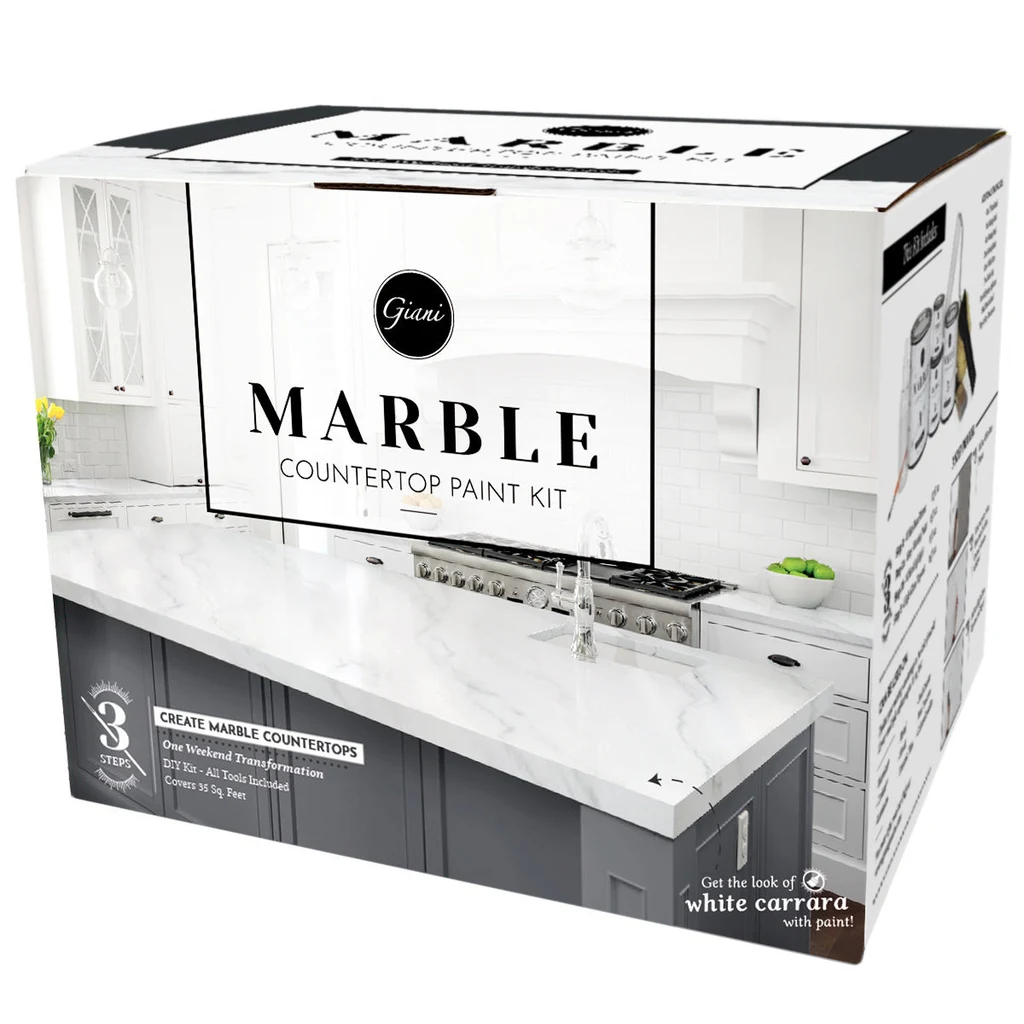
Giani renamed and repriced this one, so check the box before you check the price. What used to sell as the Marble Epoxy kit is now the Marble Collection at $199.95, with a 20-square-foot Small Project Kit at $109.95 for a vanity or an island top. The colorways moved too — alongside the Carrara-style white you’d expect, there’s Emperador Grey and Belgotta Black. Same technique, same epoxy pour, new names on the storefront.
The kit earns a slot for a reason no other kit can match: heat tolerance. The cured epoxy film is rated to 600°F. We placed a 500°F pan straight off a hot burner on the test panel for 30 seconds and saw no print, no discoloration, no surface damage. Every other kit in the field would have ring-printed at half that temperature. The other reason is the look. Hand-veined marble effect reads as real stone from across the room — the kit ships with veining brushes, white and grey tint bottles, and a video tutorial that walks the technique through a heat-gun pass that triggers the veins to flow.
The trade-offs are real. Veining a 30-square-foot kitchen on the first try is how people end up with a counter that reads as “paint streaks.” Practice on cardboard or a scrap piece of laminate before you commit to the kitchen. On fumes, one correction to what this article said before: Giani’s current epoxy resin is a zero-VOC, low-odor formula, not the eye-watering solvent epoxy of a decade ago. That doesn’t make ventilation optional — you’re still working with a curing resin in a closed room for hours, so open windows, run a fan, and keep small kids and pets out of the space while it cures. It does mean you don’t need to evacuate the house. Once the epoxy is poured and cured, mistakes are permanent — no sanding back to fix a bad vein. Giani Marble Collection countertop kits.
Buy it if: you want the look of marble, you have the patience to practice the technique, and you want a finish that survives a hot pan. Skip it if: first-time refinisher, no way to ventilate the room, or the kitchen needs to be back in service before next weekend.
The Rest of the Giani Deck, Since the Storefront Moved
Giani’s countertop lineup is wider than the two kits in this round-up, and shoppers cross-checking prices deserve the current list. Granite 2.0 starts at $99.95 in five colorways, in acrylic and epoxy-resin versions. The Marble Collection is $199.95, or $109.95 for the Small Project Kit. There are two Quartz kits — Venetian Gold at $199.95 (159 fl oz) and White Glass at $149.95 (113 fl oz) — for the flecked engineered-stone look rather than a veined marble. And there’s a Butcher Block kit at $199.95 for going the other direction, warm wood tones instead of stone. Coverage is 35 square feet across the whole line, so the math is the same whichever look you pick: light use around 7 days on the epoxy versions, 14 on the acrylic ones.
What’s Actually in the Box, and What the Weekend Looks Like
Kit marketing sells a finished photo. What you need before Friday night is the contents list and a clock. Daich SpreadStone is the useful example, because it ships the most complete box in this field: one base coat, two cans of stone coat, one clear coat, a roller handle with three covers, a brush, two sheets of sandpaper, and a mini tray, in eleven colors. Everything except the degreaser, the tape, and the drop cloth is in there.
Here’s the real schedule for that kit, hour by hour, so you can plan around it:
- Friday evening. Degrease, scuff-sand, wipe, tape, mask the cabinet faces and the sink.
- Saturday morning. Two base coats, about 30 minutes apart.
- Saturday, rest of the day. Two stone coats, about 2 hours apart.
- Saturday, four hours after the last stone coat. Sand the dried surface smooth. This is the step first-timers skip and then wonder why it feels gritty.
- Sunday. Two clear coats, about 4 hours apart.
- Monday. Leave the tape on for a full 24 hours after the last clear coat, then pull it.
That’s roughly three days from start to a usable counter, with the film continuing to harden over the following week. Every kit here follows the same shape — prep day, color day, clear day, wait — with the totals shifting by chemistry. Rust-Oleum HOME compresses it hardest at two coats and 24 hours to light use.
Now the number that makes people do this at all. A countertop kit is under $200 for a typical kitchen, and often well under. A DIY epoxy system runs $100 to $350. A full kitchen remodel with new counters runs $15,000 to $20,000, and even counters alone are a four-figure job on a laminate-sized kitchen. Refinishing is not a cheap version of replacement — it’s a different decision, one that buys you three to five years and a completely different-looking kitchen for the price of a weekend and a couple of boxes. The realistic durability expectation backs that: a SpreadStone kitchen tracked from 2020 through 2023 came out of three years of family use with no peeling and no chipping, and one permanent coffee stain as the only real mark against it.
Building Your Stack: Substrate + Look + Cure Window
| Countertop scenario | Kit | Cure window |
|---|---|---|
| Laminate kitchen, faux-granite look | Giani Granite 2.0 | 21 days full cure |
| Laminate kitchen, real-stone look | Daich SpreadStone | 14 days full cure |
| Laminate kitchen, solid color, budget | Nuvo Countertop | 21 days full cure |
| Laminate kitchen, big L-shaped run | Rust-Oleum HOME | 7 days full cure |
| Laminate kitchen, faux-marble + heat | Giani Marble Collection | 30 days full cure |
| Tile countertop, glazed ceramic, or porcelain | Rust-Oleum HOME | 7 days full cure |
| Butcher block or concrete top | Rust-Oleum HOME | 7 days full cure |
| Primary bathroom vanity | Daich SpreadStone | 14 days full cure |
| Half-bath or powder-room vanity | Nuvo Countertop | 21 days full cure |
| Rental flip, fastest turnaround | Rust-Oleum HOME | 7 days full cure |
| Outdoor bar or grilling surface | Giani Marble Collection | 30 days full cure |
The case the table doesn’t capture: a countertop with active substrate damage. Delaminated edges, sink-cutout rot, cracked particleboard core — no coating fixes those. Repair the underlying substrate or replace the counter. A refinishing kit on top of failing material is a $100 mistake and a wasted weekend.
Where Countertop Refinishes Go Wrong
The most common failure isn’t kit failure. It’s prep failure.
- Topcoat peeled in sheets at month three. Skipped the degrease step. Every kit in this round-up assumes a TSP-degreased, 220-scuff-sanded, tack-cloth-wiped surface. Skip degrease, the topcoat lifts off the silicone residue from the last batch of cooking grease.
- Ring print at the burner-side corner. Acrylic kit, no trivet discipline. Repaint with an epoxy-topcoat kit if heat is the persistent issue, or commit to trivets.
- Knife marks across the cutting area. No kit in the round-up is knife-rated. Use a cutting board.
- Faux-granite reads as speckled paint. Rushed the mineral coats, skipped the topcoat, or used a bristle brush instead of the sea sponge. Follow the kit instructions; the sponge technique matters.
- Discoloration around the sink at month six. Standing water under a wet sponge for 12+ hours. Acrylic kits don’t love sustained water contact even after full cure. Wipe the counter dry.
- Yellowing on a white solid-color finish at month nine. Low-light kitchen, oil-modified topcoat. Switch to a waterborne acrylic kit next cycle, or step up to the UV-stable epoxy film in the Giani Marble Collection.
- Scratches in the first month on a brand-new Rust-Oleum HOME counter. Almost always a top coat spread too thin. The two-step system is generous on coverage, which tempts people to stretch it further than they should. Lay it on properly and check the film in raking light before you stop.
Three things move outcomes more than the kit you bought. Degrease with TSP, not dish soap. Scuff-sand to 220-grit, not 400 — the topcoat needs a profile to bite. Respect the full-cure window. Light use at 48–72 hours doesn’t mean cleaning-product use. Wait the full 7 to 30 days, depending on the kit, before any aggressive cleaning.
Food Safety and Living With the Finish
Two questions come up every time someone considers this project, and both deserve a straight answer.
Is a painted countertop food safe? Once it’s fully cured, a topcoat from a reputable kit is formulated for incidental food contact. A grape that rolls off the cutting board, a plate set down straight on the counter, a bit of flour dust — none of that is a problem. What it is not is a food-prep surface. Don’t cut on it, don’t knead dough on it, don’t rest raw chicken on it. Keep a board on the counter and the distinction takes care of itself. The other half of the answer is timing: none of this applies until full cure. That’s 7 days for Rust-Oleum HOME and for the epoxy-topcoat kits, 14 days for the acrylics, and up to 30 days for legacy coatings and the Marble Collection epoxy. Until then, treat the counter as wet paint that happens to look finished.
How do I clean it? Mild dish soap on a soft cloth or sponge. That’s the whole routine, and it’s the routine for the life of the finish, not just the first month. What ruins these films:
- Abrasive pads and scouring powder. They burnish satin acrylic into shiny patches and haze epoxy gloss. Magic Eraser counts as abrasive — SpreadStone’s mineral film shrugged it off in our testing, but the acrylics didn’t.
- Bleach and ammonia cleaners. Both attack waterborne films. Every all-purpose spray in the cabinet under the sink is one of the two. Read the label.
- Standing spills. Coffee, red wine, turmeric, and beet juice will stain a cured film if they sit. Blot them when they happen. The one documented failure in that three-year SpreadStone kitchen was a coffee stain that was left to sit.
- Anything hot, ever. Trivets. Every kit, every chemistry, every time.
Sheen by Surface, Not by Kit
Countertop sheens read differently than wall sheens.
- Satin (Giani Granite acrylic, Daich SpreadStone, Nuvo, Rust-Oleum HOME): the right call for most kitchens. Hides minor surface texture, doesn’t telegraph fingerprints, cleans well.
- Semi-gloss (Giani Acrylic Topcoat, Daich LuxROCK): a step up in shine without going full mirror. Reads as a sealed coating rather than as honed stone.
- High gloss (Giani Marble Collection, Granite 2.0 epoxy version): the only finishes that convincingly read as polished stone from across the room. Unforgiving on prep mistakes; every imperfection in the base coat telegraphs through.
The kitchen counter sheen choice is mostly determined by the kit chemistry — acrylic kits ship satin, epoxy ships gloss. The exception is the Giani Acrylic Topcoat, which ships in satin and semi-gloss; layering the semi-gloss on top of Giani Granite gets you a slightly shinier faux-granite at the cost of more visible fingerprints. For the deep version of the sheen call, see the sheen guide.
Primer Scenarios That Decide the Project
The most common countertop refinish failure isn’t paint failure. It’s primer failure on the wrong substrate.
| Substrate | Primer | Why |
|---|---|---|
| Glossy post-2000 laminate | Insl-X Stix or the kit’s own primer | Modern laminate is harder to bond to than 1980s textured laminate; Stix bites where the kit primer slides. |
| Glazed ceramic tile or porcelain | Rust-Oleum HOME Base Coat; Stix as added insurance | Rust-Oleum lists porcelain and stone as approved substrates and asks for no primer; for any other kit on tile, Stix is required. |
| Factory-sealed solid surface (Corian, etc.) | Insl-X Stix | The factory sealer defeats every kit’s self-priming claim, no-prep labels included. |
| Sound laminate with kit’s own primer | No additional primer | Giani’s black primer, Daich’s base coat, the Marble Collection’s white basecoat, and Rust-Oleum HOME’s Base Coat are the bonding layer. |
| Cracked or delaminated substrate | No primer fixes this | Repair or replace the counter; coating over failing substrate is wasted money. |
See the best no-sand cabinet paint round-up for the parallel decision on cabinet doors with factory finishes.
The countertop-specific failure is glossy post-2000 laminate with the kit’s primer applied straight to the surface, no Stix, no scuff-sand to 220-grit. Modern laminate has a harder surface profile than older textured laminate, and most “self-priming” claims were written for the older surface. A thin coat of Stix under the kit primer adds an hour and saves the project.
Also Tested, Also Passed Over
- Daich LuxROCK Solid Surface Granite Countertop Kit. Not really a paint kit, which is why it sits here rather than in the picks — LuxROCK builds up an actual solid-surface layer with real granite-look depth and a semi-gloss finish, and it took a Platinum ADEX award in 2023. It is the answer for people typing “countertop resurfacing kit” who mean a rebuilt stone surface rather than a coating. Pricing: the 20-square-foot kit is $149.99 direct and $178.95 at Home Depot; the 40-square-foot kit is $229.99 direct and $332.77 at Home Depot. It’s stocked at both Lowe’s and Home Depot. Against its own stablemate: buy SpreadStone if you want an honest honed-stone look at kit prices, and LuxROCK if you want thickness, depth, and a finish closer to a real solid-surface top — and are willing to pay roughly double for it. Buy direct if you can; the retail markup on the 40-square-foot kit is over $100.
- Beyond Paint Countertop Kit. Decent finish, but the cured film softens at lower heat than Daich SpreadStone and the color deck is the shallowest in the field.
- Stone Coat Countertops epoxy. The other name that owns the “countertop resurfacing kit” search, and it deserves more than a dismissal. Stone Coat sells 64-ounce Carrara kits through Home Depot with thousands of reviews behind them, plus one of the deepest free video libraries in the category — the technique instruction is genuinely better than what ships in most boxes. It’s a real alternative to the Giani Marble Collection. We kept Giani in the pick slot because its kit carries a complete basecoat-to-topcoat system at a lower price per square foot for a typical kitchen, but if you’re already watching Stone Coat’s tutorials and want to work the way they teach, buy theirs.
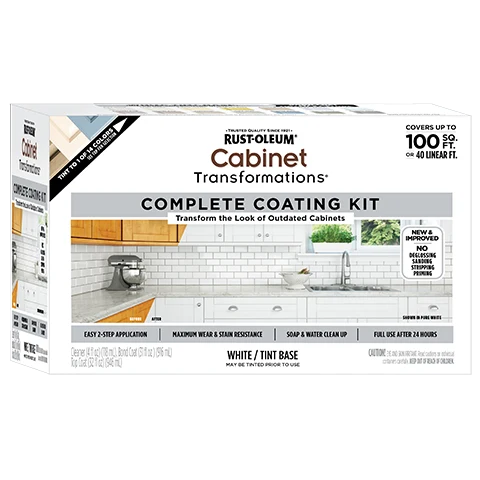
- Rust-Oleum Cabinet Transformations. Wrong product class — engineered for cabinet doors and frames, not countertops. The cured film is too soft for daily counter abuse.
- Behr Granite Grip. Concrete-floor coating, sometimes recommended for counters online. Don’t. The cured film is non-food-safe and not engineered for kitchen-counter scrub cycles.
- Generic chalkboard paint. Wrong product class entirely. Scratches in a week.
Companion Guides
For the matching cabinet refinish that usually ships with a countertop project, see the best kitchen cabinet paint round-up. When the cabinet doors are factory-finished and you want to skip the sanding step, the no-sand cabinet paint round-up. When the backsplash and floor tile need refinishing too, the best tile paint round-up. For the sheen call, the sheen guide.
Full comparison
| Product | Best for | Yellowing | Price |
|---|---|---|---|
| 🥇Giani Granite 2.0 Countertop Paint Kit | Top pick — laminate kitchen countertops | Low (waterborne acrylic topcoat) | $$ |
| Daich SpreadStone Mineral Select Countertop Refinishing Kit | Best for high-traffic kitchens and bathroom vanities | Very low | $$$ |
| Nuvo Countertop Paint Kit | Best for solid-color countertops and budget kitchens | Medium on light tones in low-light kitchens | $ |
| Rust-Oleum HOME Countertop Coating Kit | Best coverage per kit and fastest return to service | Low on the factory satin colors | $ |
| Giani Marble Collection Countertop Paint Kit | Best for high-end faux-marble look | Very low (UV-stable epoxy) | $$$ |
Reviews
Pros, cons, and specs for each pick.
1. Giani Granite 2.0 Countertop Paint Kit
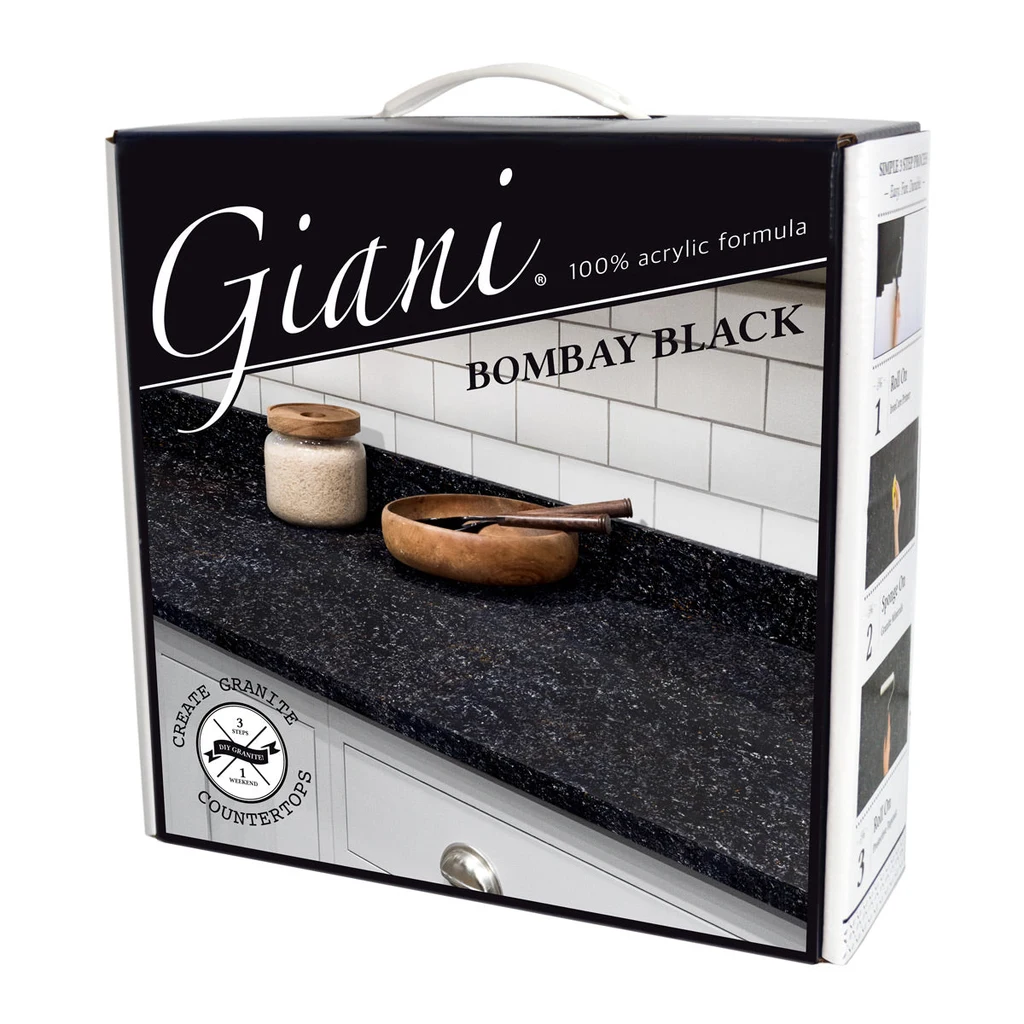
| Coverage | Up to 35 sq ft per kit |
|---|---|
| Sheens | Satin (kit topcoat) · semi-gloss available as separate Giani Acrylic Topcoat |
| Dry / Recoat | Recoat 4h between mineral coats · topcoat at 8h |
| Full cure | 21 days |
| VOC | <100 g/L (waterborne acrylic) |
| Yellowing risk | Low (waterborne acrylic topcoat) |
| Primer | Black primer included in kit |
| Price tier | $$ |
- The 2.0 reformulation cures hard enough that we got no thumbnail dent at 14 days on the laminate panel — the original Giani never made it past week three without a scuff mark
- Three-mineral sponge-on process actually reads as faux-granite at one foot, not as speckled paint; the kit ships with the topcoat tinted to match
- Covers 35 sq ft of countertop in a single kit from $99.95 brand-direct — and the same colorway is sold in both an acrylic-topcoat and an epoxy-resin version, so you pick the chemistry without changing the look
- Color deck is fixed at the named blends (White Diamond, Bombay Black, Sicilian Sand, Chocolate Brown, Slate); you cannot mix-and-match minerals outside Giani's recipes without losing the cured-film warranty
- Heat tolerance is rated to 150°F — a hot pan straight off the stove will print a ring. Trivet discipline is not optional
- Three-coat process plus topcoat means a full kitchen is a real Saturday-and-Sunday project; rushing the inter-coat dry windows is the #1 failure mode we saw
2. Daich SpreadStone Mineral Select Countertop Refinishing Kit
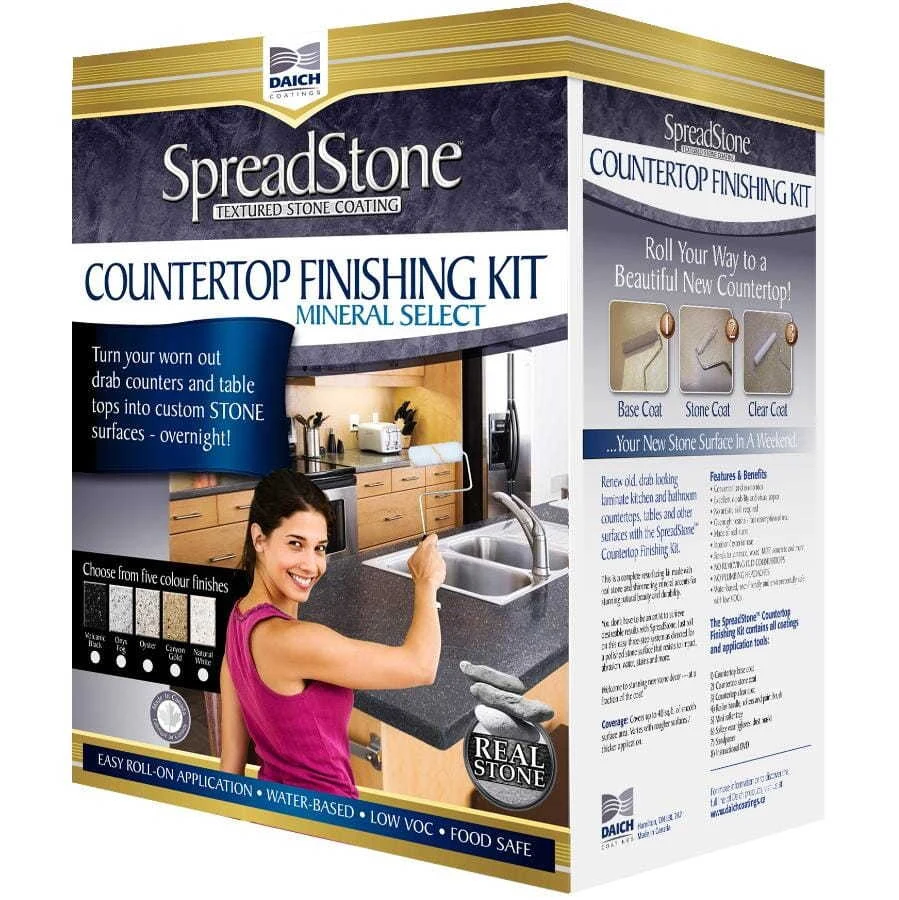
| Coverage | ~40 sq ft per kit |
|---|---|
| Sheens | Satin (mineral sealer) |
| Dry / Recoat | Recoat 4h · sealer at 8h |
| Full cure | 14 days |
| VOC | <100 g/L |
| Yellowing risk | Very low |
| Primer | Base coat included in kit (no separate primer) |
| Price tier | $$$ |
- Real ground stone in the base coat, not just acrylic with speckle — the cured film reads as honed stone under raking light, and a Magic Eraser pass at week two leaves no visible track
- Roll-on application bypasses the sponge-stippling step that's the hardest part of Giani Granite for first-time refinishers
- Heat tolerance rated to 250°F (vs. Giani's 150°F) — a hot pan still wants a trivet, but a hot mug at 180°F won't print a ring
- Color deck is shallow next to the faux-granite kits — a dozen mineral blends, mostly warm neutrals and cool greys, no saturated tones or deep blacks
- Slightly granular texture telegraphs through the satin sealer; the look is honest-stone, not glossy reglaze. If you want polished-granite shine, this is the wrong call
- Kit covers ~40 sq ft at full thickness — a generous galley kitchen is one kit, an L-shape with island is usually two ($240+ before shipping)
3. Nuvo Countertop Paint Kit
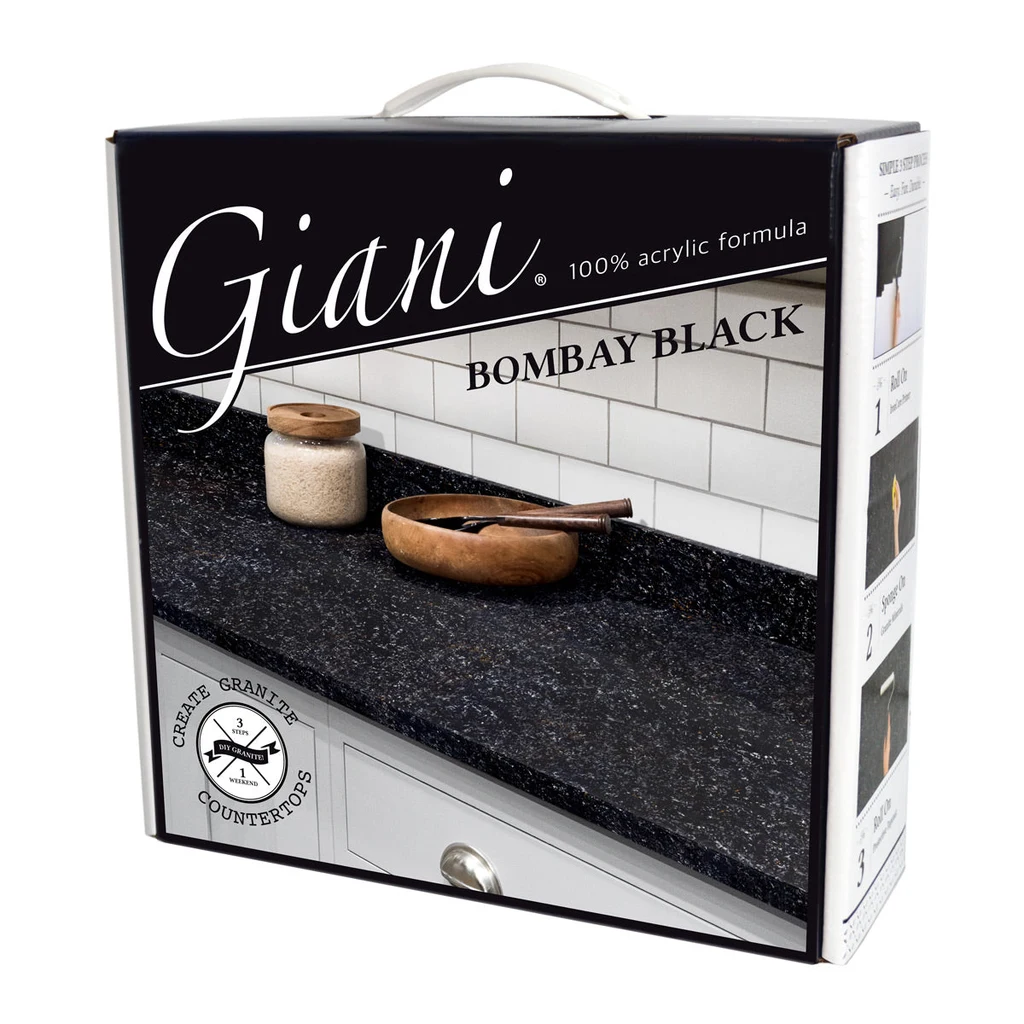
| Coverage | ~40 sq ft per kit |
|---|---|
| Sheens | Satin (built into topcoat) |
| Dry / Recoat | Recoat 8h · topcoat 24h after final color coat |
| Full cure | 21 days |
| VOC | <100 g/L |
| Yellowing risk | Medium on light tones in low-light kitchens |
| Primer | Self-priming on clean, scuff-sanded laminate |
| Price tier | $ |
- Two-coat solid-color application — the fastest finish in this round-up. Real one-weekend kitchen, not the three-coat-plus-topcoat schedule the faux-granite kits require
- Eight saturated colors in the deck (Coconut Espresso, Titanium Infusion, Slate Modern, Cocoa Couture); the only kit here that gets you a real deep navy or charcoal countertop
- $80 covers ~40 sq ft — cheapest cost-per-square-foot of any kit in the field once you include all the components
- Heat tolerance rated to 150°F like Giani Granite — a hot pan prints a ring inside ten seconds. Solid-color shows the damage more than a speckled finish hides it
- Acrylic film is softer than the SpreadStone mineral sealer; we got a thumbnail dent at week one and a fork-scratch in the test panel by week four
- Two-coat finish reads as paint, not as stone — fine for a rental flip or a budget refresh, less convincing for a primary kitchen you live with for five years
4. Rust-Oleum HOME Countertop Coating Kit
| Coverage | 75 to 100 sq ft per 1-quart kit |
|---|---|
| Sheens | Satin |
| Dry / Recoat | Top coat over base coat per label · light use at 24h |
| Full cure | 7 days |
| VOC | Low (waterborne 2-step system) |
| Yellowing risk | Low on the factory satin colors |
| Primer | None required — Base Coat is step one on a clean, degreased surface |
| Price tier | $ |
- 75 to 100 sq ft per 1-quart kit — roughly double what a Giani (35 sq ft) or Daich (40 sq ft) kit covers, so a full L-shaped kitchen is usually one box at $39 to $55
- Two steps only, Base Coat then Top Coat, with no sanding, priming, or stripping called for on the label — the lowest-prep system in this round-up
- Light use at 24 hours and full cure at 7 days is the fastest return to service here; it also goes onto laminate, butcher block, concrete, porcelain, and stone from the same box
- Applying either coat too thin is the failure people report — a thin film scratches early, and darker or patchy laminate often needs a third base coat for even color
- Satin solid color only, no faux-granite speckle or veining; the fixed deck is Ultra White, Fresh Concrete, Greige, Charcoal Gray, Black, Gunmetal, and Pine, plus a White Tint Base that only takes light colors
- Rust-Oleum publishes no heat rating for the cured film, so treat it like every other coating here — trivets under anything off the stove
5. Giani Marble Collection Countertop Paint Kit
| Coverage | Up to 35 sq ft per kit |
|---|---|
| Sheens | High gloss (epoxy) |
| Dry / Recoat | Topcoat self-levels 30 min · tack-free 8h · light use ~7 days |
| Full cure | 30 days |
| VOC | Zero-VOC epoxy resin per Giani — low odor, still ventilate |
| Yellowing risk | Very low (UV-stable epoxy) |
| Primer | White basecoat included in kit |
| Price tier | $$$ |
- Pour-on epoxy topcoat cures to a glass-hard film — the only kit here that survives a hot pan straight off the stove without printing a ring (rated to 600°F)
- Hand-veined marble effect reads as real stone from across the room; the kit ships with veining brushes, white and grey tint bottles, and a video tutorial that walks the technique
- Self-leveling epoxy hides minor laminate seams and small chips the other kits telegraph through, and the epoxy resin is marketed zero-VOC and low-odor rather than solvent-heavy
- Steep learning curve — veining a 30-square-foot kitchen on the first try is how people end up with a counter that reads as paint streaks, not marble. Practice on a piece of cardboard first
- Full-size Marble Collection kit is $199.95 (the 20-sq-ft Small Project Kit is $109.95) — the most expensive way into 35 sq ft in this round-up
- Once the epoxy is poured and cured, mistakes are permanent — there's no sanding back to fix a bad vein. Sand and start over means stripping to laminate
Insl-X Stix Waterborne Bonding Primer
The countertop substrates that defeat self-priming claims — glossy laminate post-mid-90s, factory-sealed solid-surface, glazed ceramic tile — are exactly what Stix is engineered to bite. A thin coat under Giani Granite or Nuvo adds two hours to the project and eliminates the early-peel failure mode that kills most countertop refinishes inside 18 months. Skip it on Daich SpreadStone (the kit's own base coat does the same job) and on the Giani Marble Collection (the included white basecoat is the bonding layer). Rust-Oleum HOME says no priming is required, and that holds on sound degreased laminate; on factory-sealed solid surface or glazed tile, a coat of Stix under the Base Coat is cheap insurance. For everything else, Stix is the right primer.
BUY ON AMAZONFrequently asked questions
What's actually the best countertop refinishing kit — one answer?+
Will any of these kits actually last on a kitchen counter?+
Can I refinish a bathroom vanity countertop with these kits?+
Do I need a separate primer for these kits?+
Is Giani Granite 2.0 worth $99.95 over a $45 Rust-Oleum HOME kit?+
How long before I can use a freshly refinished countertop?+
Can I cut directly on a refinished countertop?+
What's the deal with Nuvo — is it still being made?+
How long does a painted countertop actually last?+
Are painted countertops food safe?+
What's the difference between a countertop paint kit and an epoxy resurfacing kit?+
How do I clean a refinished countertop without wrecking the finish?+
- Best kitchen cabinet paint — the matching cabinet refinish for the kitchen
- Best no-sand cabinet paint — when prep budget is the constraint
- Best tile paint — when the backsplash and floor need refinishing too
- Sheen guide — matte, eggshell, satin, semi-gloss, gloss
- Rust-Oleum brand review — the specialty-coating leader