Best Telescoping Ladders for 2026
Five telescoping ladders tested on 9-foot ceilings, two-story soffits, and a stairwell. Top pick: Werner TS1250 for the controlled retraction that keeps your fingers out of the rungs.

Disclosure: Some links below are affiliate links. We earn a commission if you buy through them, at no extra cost to you.
Top pick: the Werner TS1250. About $400, 12.5 feet extended, 35 inches collapsed, Type IA 300-pound rating. It wins on the thing that actually hurts people, which is retraction: the speed-controlled lowering drops the sections in sequence instead of guillotining the whole stack toward your hands. It falls short on weight, at 33 pounds the heaviest 12.5-footer here, and on price. If you want the same height for $100 less and 8 fewer pounds, the Xtend+Climb 770P+ is the homeowner buy. For a ladder that opens and closes a dozen times a day, the Telesteps 1600EP has the widest rungs in the category. For second-story soffit, the Xtend+Climb 785P+ reaches 15.6 feet. For a stairwell, no telescoping ladder works and the Little Giant Velocity M17 is the answer.
A telescoping ladder is a storage decision before it’s a climbing decision.
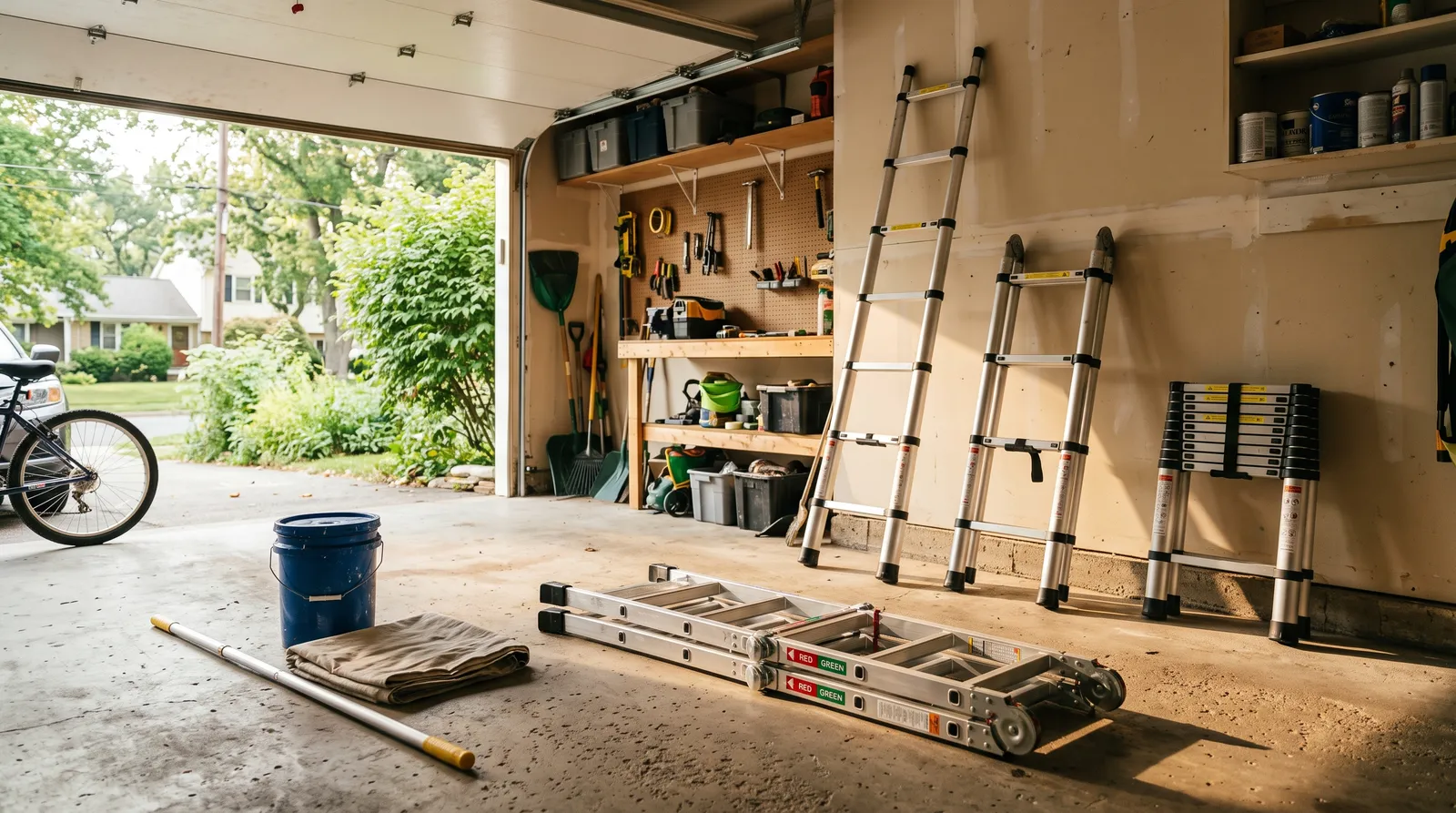
That’s the whole reason the category exists. Nobody pays $400 for 12.5 feet of aluminum because it climbs better than a $150 extension ladder. They pay it because 12.5 feet of aluminum has to live behind the coats in a hall closet.
Why These Five Made the Cut
We bought all five at retail, the same way a homeowner or a painter would, and put them through four jobs over five weeks.
A whole-house interior repaint with 9-foot ceilings and crown molding in two rooms, which meant roughly 30 repositions a day. Soffit, fascia, and gable-end trim on a two-story colonial, worked from a sloped asphalt driveway and from a lawn. A stairwell wall and the ceiling above a 13-tread run. And five weeks of living in a garage with 32 inches of clear wall, plus rides in the back of a mid-size SUV.
Every ladder got extended and collapsed at least 60 times, including partial extensions, because partial extension is where locking problems show up. On paper every telescoping ladder locks the same way. In practice the feel of the lock varies enormously between a $230 ladder and a $500 one.
Six axes, weighted in this order: lock confidence at partial extension, retraction safety, rung comfort during a long cut-in, weight across repeated repositions, collapsed footprint against real storage, and foot behavior on wet concrete and damp turf.
We didn’t load-test to failure. Every duty rating quoted here is the manufacturer’s published ANSI number.
The Three Ways Telescoping Ladders Go Wrong
The rung that looks locked. Each section locks independently, which is the feature and the hazard. Pull a section up too slowly, or catch it partway, and you get a rung sitting at half engagement that feels solid until you put a foot on it. Werner’s answer is a red-and-green indicator on every rung; Telesteps and Xtend+Climb use tabs you can see from the ground. Look at every rung before you climb, then pull-test with two hands. Every time. This takes four seconds.
The retraction. This is where the injuries live. A telescoping ladder holds a stack of aluminum sections under its own weight, and when you release them all at once, they fall. Cheap ladders drop the whole stack. The TS1250 lowers under speed control, the Telesteps 1600EP does the same from a single button press, and both are worth paying for if anyone else in the house is going to use the ladder.
Grit in the rails. Nested aluminum sections are a dirt trap. Sand off a driveway, dust off a soffit, and a few dried paint drips will make sections bind inside a season. The ladders don’t fail. They just get sticky, then sticky becomes stuck, and a stuck section is the thing people force until something bends.
Flex is the fourth item and it isn’t a defect. Every telescoping ladder sways more at full extension than a comparable extension ladder does, because it’s a stack of joints rather than two continuous rails. Work from the middle third and it never matters.
Reading the Spec Sheet Before You Pay
Duty rating. Type IA is 300 pounds. Type 1 is 250. Type 2 is 225 and doesn’t belong on a paint job. Your load is your body weight plus everything you carry, and a full gallon is about 11 pounds before you add a tray, a pole, and a tool belt. If you weigh 190 and carry paint up the ladder, Type 1 is not the rating you want.
Reach height vs extended height. Extended height is aluminum. Reach height adds about 3.5 to 4 feet on the assumption that a person roughly 5 feet 9 inches tall reaches overhead from the ladder. Those are two very different numbers and manufacturers put the flattering one on the box.
Collapsed length. 29 to 36 inches across this field. Measure your closet, your trunk, or your van shelf first. This is the spec that decides whether you use the ladder or resent it.
Weight. Eight pounds of difference feels like nothing in the aisle. On the twentieth reposition of a crown cut-in it’s the difference between finishing the room and finishing tomorrow.
Rung width. Round rungs about 1 inch across cut into your arch inside ten minutes. The wide steps on the Telesteps 1600EP run roughly 3.1 inches deep, and the Werner uses a wide-step design too. If you stand still on a ladder for long stretches, this is the spec that decides whether you’re comfortable.
If you paint interiors only and nothing else, the 10.5-foot Xtend+Climb 760P+ at about $230 and 20.5 pounds is enough ladder for 9-foot ceilings, and it’s the lightest thing in the category worth owning.
Side by Side
| Model | Extended | Reach height | Collapsed | Weight | Duty rating | Price |
|---|---|---|---|---|---|---|
| Werner TS1250 | 12.5 ft | 16 ft | 35 in | 33 lb | Type IA, 300 lb | ~$400 |
| Xtend+Climb 770P+ | 12.5 ft | 16.5 ft | 32 in | 25 lb | Type 1, 250 lb | ~$300 |
| Telesteps 1600EP | 12.5 ft | 16 ft | 32 in | 28 lb | Type IA, 300 lb | ~$500 |
| Xtend+Climb 785P+ | 15.6 ft | 19.6 ft | 36 in | 35 lb | Type 1, 250 lb | ~$430 |
| Little Giant Velocity M17 | 9–15 ft | 18 ft | Folded, bulky | ~30 lb | Type IA, 300 lb | ~$330 |
1. Werner TS1250, Top Pick
The TS1250 is the telescoping ladder I’d hand to someone who has never used one.
Retraction is the reason. Press the release and the sections come down in order, slowed by the mechanism rather than by your grip. Every other straight ladder in this test asks you to manage the drop yourself, either rung by rung with a thumb release or all at once. The Werner takes that judgment call away from you, and the person most likely to get hurt on a telescoping ladder is the person who hasn’t developed that judgment yet.
The lock indicators are the second reason. Red and green at each rung, readable from the floor. You don’t have to trust the click.
Wide steps make it livable. Standing on a 1-inch round rung for a 40-minute crown cut-in is a specific kind of misery, and the TS1250’s steps are wide enough that you stop thinking about your feet. Combine that with the Type IA 300-pound rating and you have a ladder you can work from with a full gallon in one hand.
The trade-off is mass. 33 pounds is the heaviest 12.5-footer here, and moving it 30 times in a day is a workout that the 25-pound Xtend+Climb isn’t. It collapses to 35 inches, which stands fine in a closet and won’t lie flat in a sedan trunk. And $400 is a lot for a homeowner who paints one bedroom a year.
| Spec | Value |
|---|---|
| Extended / reach | 12.5 ft / 16 ft |
| Collapsed | 35 in |
| Weight | 33 lb |
| Duty rating | Type IA, 300 lb |
| Retraction | One-click unlock, speed-controlled |
| Approx. price | $400 |
Buy it if: you want the safest retraction in the category, you’ll be carrying paint up the ladder, and the ladder gets shared with people who aren’t careful. Skip it if: you’re moving it constantly and every pound counts, or you need it to fit a car trunk.
2. Xtend+Climb 770P+, Best Value
Same height as the Werner, 8 pounds lighter, $100 cheaper, and it collapses 3 inches shorter. For most homeowners that’s the better trade.
25 pounds is the number that matters. You can carry this ladder up a staircase in one hand with a paint tray in the other, which you cannot do with the TS1250 and shouldn’t try. It folds to 32 inches and disappears into a hall closet. On a whole-house interior repaint it moved faster than anything else in the test, and speed of repositioning is most of what makes an interior job pleasant.
Where it gives ground is the rating and the retraction. ANSI Type 1 at 250 pounds sounds generous until you add a 190-pound person, a gallon, a tray, and a belt. And retraction is rung by rung with a thumb release, so the ladder asks you to control the drop. It’s fine once it’s habit. The first ten closings feel twitchy, and I wouldn’t hand it to a teenager without standing there.
Buy it if: you’re a homeowner painting interiors and occasional single-story exterior, you weigh under about 200 pounds with gear, and closet storage is the deciding factor. Around $300.
3. Telesteps 1600EP, Best for Daily Professional Use
The Telesteps is the one the pros in this test kept walking toward, and it’s also the one nobody wants to pay for.
Wide rungs at roughly 3.1 inches deep are the reason. Spend six hours a day standing on a ladder and rung depth stops being a comfort spec and becomes a fatigue spec. The 1600EP is the only ladder here that felt like standing on a step rather than perching on a bar. The one-touch retraction closes the entire ladder from a single press with your hands off the rails, which on a service route you’ll do fifteen times a day. Pivoting silicone feet sit flat on a sloped driveway instead of standing on one corner, and they held on damp turf better than the flat pads on the Xtend+Climb models.
It’s Type IA at 300 pounds, OSHA compliant, and built like it expects abuse.
Then there’s the price. About $500, which is more than double the 760P+ and $100 over the Werner. At 28 pounds it isn’t light either. For a homeowner painting one room a year, this is the wrong ladder and buying it is buying a feature set you’ll never wear out.
Buy it if: the ladder comes out of a van every morning. Skip this if it lives in a garage and comes out twice a year.
4. Xtend+Climb 785P+, Best for Reach
15.6 feet of ladder that folds to 36 inches is a genuinely useful thing to own, and it’s the reason this one is here.
On the two-story colonial, this was the only straight telescoping ladder that reached the gable-end trim. Second-story soffit and fascia work is where most homeowners hit the wall with a 12.5-footer, and the fix is either scaffolding, a 24-foot extension ladder that has nowhere to live, or this. It still stores in a golf-bag footprint.
Now the honest part. Flex above 13 feet is noticeable, and the top two rungs are somewhere you reach from, not somewhere you work from. At 35 pounds it’s top-heavy collapsed and carrying it one-handed across a lawn is a wrestle. And the 250-pound Type 1 rating is thin for a ladder people buy specifically to do heavy exterior work with a gallon in hand. That combination is my one real complaint about the whole category: the tallest ladders often carry the lower rating, which is backwards from how people actually use them.
If your exterior job runs six hours a day for a week, buy a real extension ladder and use the money you saved on better exterior paint. If you need to reach a gable four times a year and have nowhere to store 24 feet of aluminum, this is the ladder. Around $430.
5. Little Giant Velocity M17, Best for Stairwells
This one isn’t a telescoping stick and I’m including it anyway, because the category has a hole in it and this fills it.
Stairwells break telescoping ladders. Two equal rails, two feet landing on different treads, and the whole thing racks. There is no accessory that fixes this properly. The Velocity sets up as a staircase ladder with two legs long and two short, and it does it in about 20 seconds with the Rock Lock adjusters. Ratchet leg levelers handle sloped driveways and flower beds without shims, which also solves the second-worst setup problem in exterior painting.
It adjusts from 9 to 15 feet, runs Type IA at 300 pounds, and converts to A-frame, extension, and 90-degree positions. Two of them plus a plank gets you a real work platform for a hallway ceiling, which beats moving a ladder 40 times.
What it costs you is compactness. It folds, but it folds bulky, and it stores against a garage wall rather than in a closet. Reconfiguring takes longer than extending a telescoping ladder, so it loses on quick touch-ups. Roughly $330 and up.
Verdict: the second ladder, not the first. If your house has a stairwell you’ll eventually paint, you’ll own something like this or you’ll hire out that one wall.
Ladders We Looked At and Passed On
- Xtend+Climb 760P+. Good ladder, 10.5 feet, 20.5 pounds, about $230. It didn’t get a slot only because 14.5 feet of reach caps you at single-story exterior. For interior-only painting it’s the smart buy and I said so above.
- Telesteps 1600EKP Kevlar. Non-conductive rails, Type IA, and the right call if you work near a service drop. It’s roughly $700, which puts it outside what this article is for.
- Sub-$150 unbranded 15.5-footers. There are dozens on Amazon with 330-pound claims. The claims are printed, not certified by anyone you can look up, and the lock tabs on the two we handled had visible play. Not worth the savings when the failure mode is a fall.
- Werner MT-22 multi-position. Excellent ladder, 22 feet of range, and completely wrong for anyone whose problem is storage. It weighs about 47 pounds.
- Telescoping ladders with bolt-on work platforms. The platform cantilevers load off the rails in a direction the rails weren’t designed for. Use a pole and stay off the top.
Setup, Grit, and Keeping the Rails Clean
Telescoping ladders don’t wear out. They seize up.
After every exterior job, wipe each section with a damp rag while the ladder is fully extended, then dry it before you collapse it. Sand and driveway grit are what score the rails, and a scored rail binds forever after. This takes two minutes and it’s the whole maintenance routine.
Paint drips on the rails are worse than dirt. Wet paint on an aluminum section becomes dried paint inside the nest, and dried paint is what turns a smooth ladder into a fight. Wipe drips immediately. If a section already binds from dried paint, extend it fully, scrape the film off with a plastic putty knife, and don’t force the collapse.
Lubricant. Check the manual, because manufacturers differ. Most call for a dry silicone spray or nothing at all. Never use grease or a heavy oil; it collects the same grit you were trying to keep out.
Storage. Stand it upright, collapsed, against a wall, not lying flat under things that get stacked on it. And never store it in an open truck bed rolling around loose, which is how the feet get chewed up. The over-molded feet are the wear item on every ladder here; when they harden or tear, grip drops off fast, and on a wet driveway that’s the difference between a stable base and a slide.
Realistic life for any of these, used a few weekends a year and kept clean: a decade or more. Used daily out of a van: five to eight years before the feet and the lock tabs want replacing, which is why the Telesteps price stops looking silly.
Mistakes That Put People on the Ground
- Climbing the top two rungs. Flex is highest there and the ladder was never rated for it. Buy the taller ladder instead.
- Trusting the click. Locks engage by feel and by sound and both can lie at partial extension. Look at the indicators, then pull-test with two hands.
- Fingers on the rails during retraction. Hands on the rungs or on the release, nowhere else. This is the single most common telescoping ladder injury.
- Setting up on a slope without leveling. The pivoting feet on the Telesteps buy you a couple of degrees. Past that you need levelers or a different ladder. A ladder standing on one corner walks sideways under you.
- Collapsing it wet or gritty. You’re grinding sand into the rails. Wipe, dry, then close.
- Buying on reach height. Reach is a marketing number that assumes a 5-foot-9 person with an overhead reach. Buy on extended height and subtract if you’re shorter.
- Using a ladder where a pole would do. Most ceiling work is a job for a good extension pole, not a ladder. Every hour you’re not on a ladder is an hour you can’t fall off one.
What I’d Actually Buy
A homeowner with a two-story house, a garage, and a couple of paint weekends a year: the Werner TS1250 for $400. It’s the ladder that handles ceilings, stairwell landings from the floor above, and single-story soffit, and it’s the one I’d trust a spouse or a teenager on. Add a 15-foot extension pole and you’ll stay off it half the time you’d otherwise be climbing.
Apartment or small house, interiors only, closet storage: the Xtend+Climb 760P+ at about $230. Twenty pounds, 29 inches folded, and enough reach for a 9-foot ceiling.
Painting your own two-story exterior: the Xtend+Climb 785P+ for the soffit and fascia, and go in knowing that before you climb anything you should be reading the exterior wood prep guide and dealing with any peeling paint at ground level first. Half of exterior painting happens with your feet down.
Working out of a van: the Telesteps 1600EP. It costs $500 because it’s built to be opened and closed 3,000 times, and it’s the only one here with rungs your feet forgive after six hours.
And if there’s a stairwell in your future, the Little Giant Velocity M17 is the ladder that makes that wall paintable. No telescoping stick will.
Ask a Question