Best Cabinet Door Drying Racks in 2026
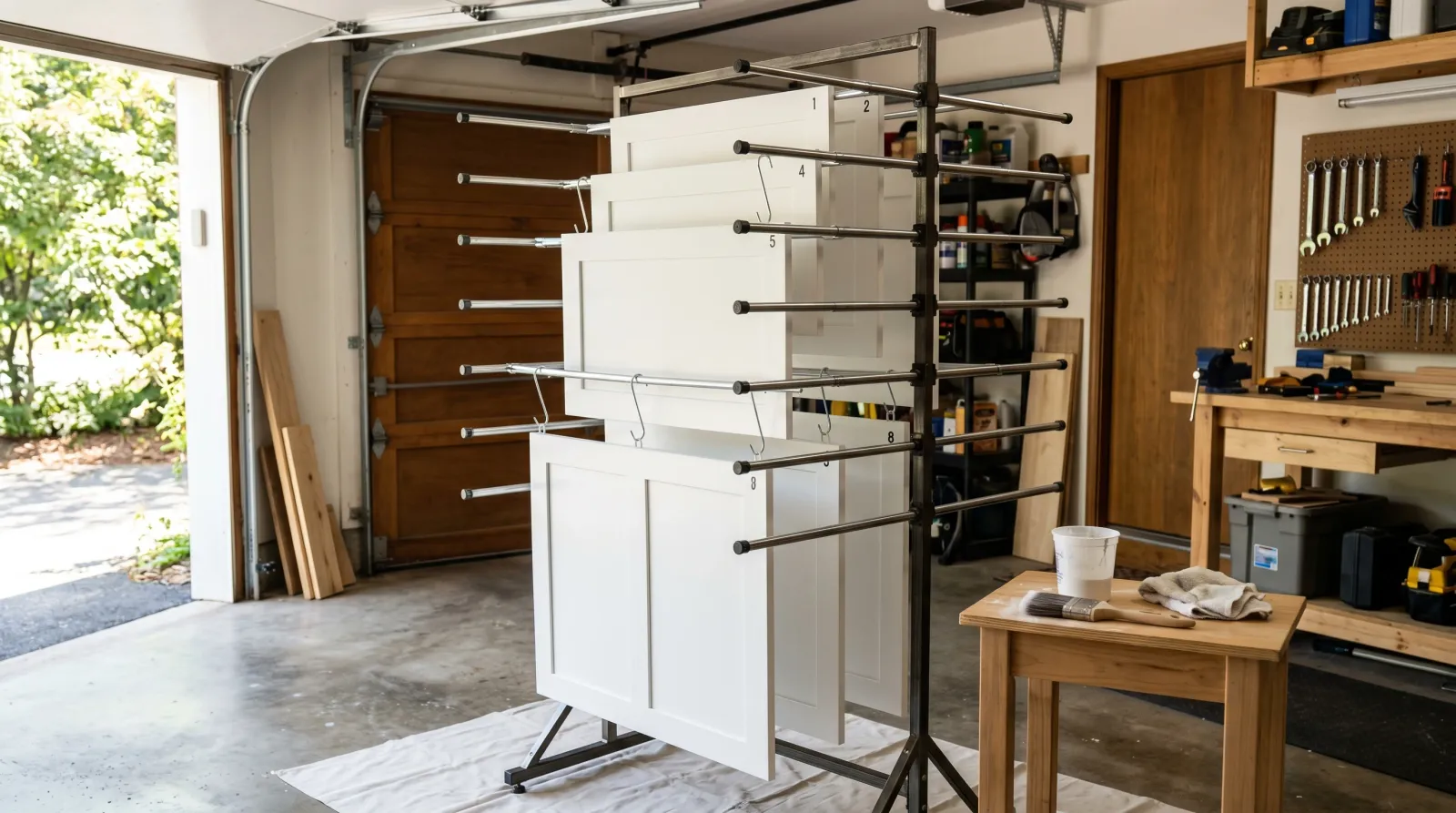
Five cabinet door painting racks tested across kitchen, vanity, and shelf batches. Top pick: Coleshome 10-arm telescoping rack for batch throughput and both-face same-session drying.

Disclosure: Some links below are affiliate links. We earn a commission if you buy through them, at no extra cost to you.
Top pick: the Coleshome 10-arm telescoping rack. Painting both faces of ten cabinet doors in a weekend is a logistics problem first and a paint problem second, and the Coleshome solves the logistics — ten doors hang by their bottom edges in the footprint of a card table, both faces dry in one session, the back face never touches a pyramid tip. It falls short on portability (assembled, it lives in the garage) and on load capacity at full arm extension (a 25-pound solid-oak door needs the arm centered). The Custom Shop wall-mounted rack is the smarter pick for a tight garage where the floor is already full. Under six doors, skip the rack entirely — Painter’s Pyramids at $12 for ten are the cheaper math. Bench Cookies win when sanding and priming share the bench. The FastCap 3rd Hand earns a slot for the crown moulding and the spindles the rack won’t hold.
A heads-up. This round-up is the cabinet-door batch tool. If your project is under six doors or a single bookshelf, the painter’s pyramid stand round-up covers the cheaper math. If the question is the paint going on the door rather than the rack holding the door, the best paint for kitchen cabinets is the right page.
The Rack Is the Schedule
Most kitchen-cabinet repaint posts skip the rack and tell you to buy pyramids. That’s correct advice for a four-door bathroom vanity. It’s the wrong advice for a twelve-door lower-cabinet kitchen. Forty-eight pyramids on a garage floor means stepping over wet finishes for three days and a flip-and-recoat cycle that doubles the calendar. One rack in a card-table footprint means both faces of every door dry in one session, the back face has zero visible contact, and the kitchen comes back online a week sooner. The math flips at door seven. The rest of this article is which rack for which kitchen, plus where pyramids still win.
How We Picked
Five stand systems, three weekends, two real cabinet repaints. A twelve-door white-shaker lower-cabinet refresh in Benjamin Moore Advance semi-gloss, and a six-door solid-oak vanity restain in General Finishes High Performance Topcoat. Each system supported the same door styles through prime, coat one, sand-between, and coat two. Throughput logged per session; floor footprint measured per door; back-face transfer marks photographed under raking LED at 24 hours; load capacity measured against a 28-pound solid-oak raised-panel test door. Pricing as of May 2026.
The Picks at a Glance
| System | Best for | Throughput | Footprint per door | Price |
|---|---|---|---|---|
| Coleshome 10-Arm Rack | Top pick, 8+ doors | 🟢 10 doors / session | 🟢 1 card-table total | $$$ |
| Custom Shop Wall-Mount Rack | Tight garages, 6–8 doors | 🟢 6–8 doors / session | 🟢 0 floor footprint | $$$ |
| Rockler Bench Cookies | Sand-then-paint, ≤6 doors | ⚪ 4 doors / session | 🟡 Bench-sized | $$ |
| FastCap 3rd Hand HD | Trim, mouldings, spindles | 🔴 1 piece / clamp | 🟢 Workbench edge | $$ |
| Trillanes Painter’s Pyramid 10-pack | Under 6 doors, shelves | 🟡 4 doors / session | 🔴 1 floor space / door | $ |
The table reads by door count. Past seven doors, the racks dominate. Under six, pyramids still win on cost. Bench Cookies handle a sanding workflow no other system tries to solve. The FastCap is a specialty pick for the parts a rack physically cannot hold.
The Three Decisions That Pick the System
Door Count
The single number that decides every other call. Under six doors, a Trillanes pyramid 10-pack at $12 holds the whole project with twenty-four pyramids and four backup. Past six doors, the math inverts: forty-plus pyramids consume the garage and you’re stepping over wet finishes for three days. The Coleshome rack lives in one footprint and lets both faces dry same-session. Count the doors first. Buy the rack only if the number lands at seven or higher.
Footprint and Storage
A freestanding rack assembled is 24 inches deep, 30 inches wide, and 60 inches tall. That fits in most US garages alongside one car or against a wall in a basement workshop. The Custom Shop wall-mount folds flat to about 4 inches deep against the studs between projects. The Coleshome breaks down to a flat-pack in about ten minutes if you tag the bolt positions on the first assembly. Pyramids stack into a coffee mug. Decide where the rack lives the other fifty weeks of the year before you buy.
Door Weight
A 15-pound MDF shaker door sits on any system in this round-up without issue. A 25-pound solid-oak raised-panel door at full Coleshome arm extension showed visible arm flex in the test — center the door, drop the extension by an inch, the flex disappears. The Custom Shop rack’s heavier-gauge steel arms held the same door at three-quarter extension without movement. For all-MDF kitchens, the Coleshome’s lower price is the right call. For solid-wood vanities or oak raised-panel kitchens, the Custom Shop or Wooster pyramids both handle the load better.
1. Coleshome Cabinet Door Painting Rack — Top Pick
The rack most cabinet painters end up with after one kitchen project on pyramids. Ten telescoping arms hold ten doors hanging by their bottom edges; both faces of every door dry exposed to air; the whole assembly lives in the floor footprint of a single door laid flat. On the twelve-door white-shaker kitchen test, the Coleshome ran the full project across two rack loads (ten doors plus the two pantry doors on a second cycle). Pyramid alternative for the same project: forty-eight pyramids across the floor, two days of flip-and-recoat, two days more on the calendar.
Assembly is twenty minutes the first time. The included instructions are translated and not great; the listing photos do the job better. The arms are aluminum-tube telescoping with a friction-lock collar; extension is smooth, hold is reliable, and at full extension under a 25-pound oak door the arm shows about a quarter-inch of flex. Centering the door inside three-quarter extension fixes it. Doors contact only at the bottom edge, so a small bead of paint collects there during the first hour of drying — wipe with a dry foam brush at 30 minutes if it bothers you. That edge sits against the cabinet box once the door is rehung. Nobody sees it.
| Spec | Value |
|---|---|
| Arm count | 10 telescoping |
| Max door width | 30 inches (lower-cabinet standard) |
| Footprint assembled | ~24” × 30” × 60” tall |
| Load per arm | ~25 lbs at three-quarter extension |
| Approx. price | $70–$100 |
Buy it if: the project is eight or more cabinet doors, plus drawer fronts. Skip it if: under six doors, or your shop space won’t hold a freestanding rack between projects.
Buy Coleshome Cabinet Door Painting Rack on Amazon
2. Custom Shop Telescoping Door Painting Rack — Best Wall-Mount
The pick for the garage where the floor is already full of a car, a workbench, and three bins of paint. The Custom Shop rack mounts to two lag screws into studs and folds flat against the wall between projects, taking roughly 4 inches of garage depth when stored versus the Coleshome’s permanent footprint. Telescoping arms extend out from the wall by about 30 inches; doors hang on the arms the same way they hang on the Coleshome.
Heavier-gauge steel arms than the Coleshome’s aluminum — held the 28-pound oak vanity door at three-quarter extension without the flex the Coleshome showed on the same door. The trade is door count: six to eight doors per rack load depending on configuration, versus the Coleshome’s ten. For a full kitchen, that’s one extra cycle. For most vanity and powder-room projects, six arms covers the whole job in one pass. The single real con: it needs studs, which means renters and temporary shops are using the Coleshome instead. Available through automotive-refinish retailers (TCP Global, Eastwood) and on Amazon under “Custom Shop” or “TCP Global” listings — not stocked at Home Depot or Lowe’s.
| Spec | Value |
|---|---|
| Arm count | 6–8 telescoping |
| Max door width | 30 inches |
| Footprint stored | ~4” deep against wall |
| Load per arm | ~30 lbs at three-quarter extension |
| Approx. price | $80–$110 |
Buy it if: the garage floor is full and the rack needs to disappear between projects. Skip it if: you’re renting, or the doors come in batches of ten-plus.
Buy Custom Shop Telescoping Rack on Amazon
3. Rockler Bench Cookie Plus Master Pack — Best for Sanding Plus Painting
A different tool that solves the rack problem on the prep side, not the drying side. Bench Cookies are 3-inch round non-slip grippers with rubber on both faces. Set a cabinet door on four cookies, orbital-sand it without clamping, the door stays put. The same four hold the door for the prime coat and the sand-between. The stackable risers in the Master Pack lift the door 3 inches off the bench, enough clearance to brush all four edges without hand-cramping.
Where cookies fail is the final coat. A 3-inch contact patch in semi-gloss leaves a visible matte ring on the back face that one coat doesn’t fully erase. Use them through prime and sand-between; switch to pyramids or the Coleshome for the finish coat. At $35–$45 the Master Pack is 4× a Trillanes pyramid pack — the paying-for-sanding logic, not the paying-for-drying logic. Throughput caps at four doors per session, so a kitchen project also needs a rack or a pyramid set running in parallel.
Buy it if: sanding and painting share a bench in your workflow and you’d rather not clamp every panel. Skip it if: you don’t own an orbital sander, or the project is past four doors.
Buy Bench Cookie Plus Master Pack on Amazon
4. FastCap 3rd Hand HD — Best for Trim and Mouldings
A specialty pick that earns its slot because nothing else in this round-up does its job. A drying rack is the wrong shape for a 4-inch piece of crown moulding, a chair spindle, a 24-inch baseboard offcut, or a decorative dowel rod from a cabinet face. The 3rd Hand HD is a small benchtop clamp with a single thin aluminum pin that supports a narrow workpiece vertically off the bench. You finish all four sides in one session because the piece is held by a single point at the bottom.
Most kitchen cabinet jobs include some face-frame moulding, crown over the upper cabinets, or a decorative dowel between the doors. The 3rd Hand handles those in a way no rack can. It tips anything wider than 6 inches — wrong tool for the doors themselves, right tool for everything adjacent. The pin is soft aluminum; over-tightening on a heavy workpiece bends it. Pack a spare if you’re refinishing a full trim set.
Buy it if: the cabinet project includes crown, spindles, baseboards, or any narrow vertical workpiece. Skip it if: the project is flat doors and shelf panels only.
Buy FastCap 3rd Hand HD on Amazon
5. Painter’s Pyramid Stands 10-Pack — Best for Under Six Doors
The cheaper math when the project doesn’t need a rack. Four pyramids hold one door corner-inset by 2 inches. Six doors needs twenty-four pyramids, fits in a $12 ten-pack plus backup, and costs roughly an eighth of the Coleshome’s price. The Trillanes 10-pack has the sharpest tip of any pyramid we’ve tested (about 0.7mm at the contact point), which means the back-face transfer mark disappears under coat two even on a satin sheen.
The honest limit: past six doors the math flips. Forty pyramids on the floor of a one-car garage consume every square foot, you step over wet finishes for three days, and the flip-and-recoat cycle doubles the project calendar against the Coleshome. The pyramid is the right call when the project is a bathroom vanity, a freestanding bookcase, a small built-in. Wrong call for a full kitchen. For the deep version on which pyramid (Trillanes vs Wooster vs Bench Cookies), the painter’s pyramid stand round-up is the page.
Buy it if: the project is six doors or fewer, or you need backup for the racks above. Skip it if: the kitchen is ten doors plus drawers.
Buy Painter’s Pyramid 10-Pack on Amazon
Racks We Tested and Dropped
- Generic Amazon cabinet door racks under $50. Thinner steel, arms that flex visibly under a 15-pound MDF door, lock collars that slip. The Coleshome is the floor on quality below which a rack costs you more than it saves.
- Wire shelving converted to a drying rack. A rolling restaurant wire shelf will hold doors flat with cardboard interleaves. Works once, the doors slide on the wire, dust collects between coats.
- Sawhorse plus 2x4 spans. Functional, costs $35 in lumber, holds two doors per span. The math beats pyramids on space but you’re still on a flip-and-recoat sequence because both faces can’t dry simultaneously.
- Conduit-and-pipe DIY rack from YouTube. Builds in an afternoon, costs $40–$60 in EMT and clamps, holds eight doors. Same logistics win as the Coleshome; the build is the trade-off. Skip if you don’t enjoy the build.
The Workflow That Makes the Rack Earn Its Keep
Three habits move outcomes more than the rack brand.
Hang doors with their bottom edge down, not their top edge. The bottom edge of a cabinet door is hidden against the cabinet box when rehung; a small paint bead there is invisible. The top edge faces the eye when you open the cabinet, so any paint pooling on that edge shows. Always orient bottom-edge-down on the arm.
Wipe the rack arm with the same paint you’re using. A clean aluminum arm against a wet door edge can show a thin metal-on-paint stripe under raking light. Two minutes with a foam brush and the topcoat paints the arm-contact line into the same color as the door edge.
Spray, don’t brush, between racked doors. Once the rack is loaded with eight doors, brushing the back face is reach-around work. Sprayers (HVLP or fine-finish airless) shoot both faces of a loaded rack from a single station, cutting the per-door time from twenty minutes brush-and-roll to about three minutes spray. For the spray side, the fine-finish HVLP round-up is the right page.
Care, Cleanup, and Reuse
The Coleshome and Custom Shop racks both clean up with a damp rag at end of session — paint contact is at the arm and the bottom of the door, both small areas. Cured paint on the aluminum arms wipes off with mineral spirits or a Magic Eraser; the racks shouldn’t need more than annual deep cleaning across a normal cabinet-project schedule.
Realistic life: both racks run years across a homeowner’s cabinet lifetime, decades for a contractor. The friction collars on the Coleshome are the wear point — they hold tight through dozens of projects but eventually need a drop of light oil. Bench Cookies last decades. Pyramids run three to five doors before paint buildup changes the contact geometry. The FastCap pin lasts until you over-tighten and bend it once.
Common Mistakes
- Buying a rack for a four-door bathroom vanity. Pyramids cost a fifth the price and do the job. Save the rack money for the kitchen.
- Hanging two doors on one arm. The back door’s wet face touches the front door. The rack loses its single advantage over pyramids. One door per arm, always.
- Pushing the Coleshome arm to full extension under a heavy oak door. Arm flex, door sags, wet drips run sideways. Center the door, drop to three-quarter extension.
- Loading the rack before coat one of the first door is tacky. Doors swing on the arm when you walk past, wet faces collide. Wait for the first door to skin over (about 20 minutes) before loading door two.
- Skipping the bottom-edge bead wipe. A heavy bead at the bottom of the door dries into a visible ridge that telegraphs through the next coat. Wipe with a dry foam brush at 30 minutes.
- Spraying in a garage with the bay door fully open during pollen season. Doors that hung overnight in a rack collect dust in the wet film. Close the bay door for the first hour after each coat; ventilate after the surface skins.
The Stand Kit That Earns Its Keep
For a homeowner doing a one-time eight-door kitchen refresh plus a four-door vanity: one Coleshome rack ($90) for the kitchen, one Trillanes pyramid 10-pack ($12) for the vanity and shelf boards. About $102. Both kitchens come back online in a single weekend each.
For a tight-garage homeowner with the same project: one Custom Shop wall-mount rack ($100) that disappears between projects, one Trillanes pyramid 10-pack ($12). About $112. The garage stays usable; the rack folds flat.
For a contractor running cabinet jobs as a regular service: one Coleshome ($90), one Custom Shop wall-mount on the truck wall ($100), one Trillanes 10-pack ($12), one Bench Cookie Master Pack ($40) for the sanding station, one FastCap 3rd Hand ($20) for the trim sets. About $260, pays back inside the second project.
The rack is the cheapest part of a kitchen-cabinet repaint and the part that decides whether the project takes one weekend or three. Buy the rack that matches the door count and the floor space. Hang the doors bottom-edge-down. Spray, don’t brush, once the rack is loaded.
Ask a Question