Best Painter's Pyramid Stands and Cabinet-Door Racks in 2026
Five painter's pyramids and cabinet-door racks tested across cabinet doors, shelves, and small furniture. Top pick: Painter's Pyramid Trillanes 10-pack for tip transfer and stack height.

Disclosure: Some links below are affiliate links. We earn a commission if you buy through them, at no extra cost to you.
Top pick: the Painter’s Pyramid Trillanes 10-pack. On the only test that matters for a paint stand, the tip transfer mark left on the back face of a freshly coated cabinet door, the Trillanes pyramids beat every other stand in the round-up. The sub-1mm point disappears under one coat where wider stands leave a matte ring you can see at arm’s length. They fall short on load capacity. A 30-pound solid-oak raised-panel door splays the plastic tips, and Wooster’s four-pack is the smarter pick when the doors are heavy. Bench Cookies win when sanding and painting share a workflow. The FastCap 3rd Hand is the specialty pick for crown moulding and chair spindles. And if you’re running ten or more doors through one weekend, skip the pyramids entirely and buy the Coleshome rack.
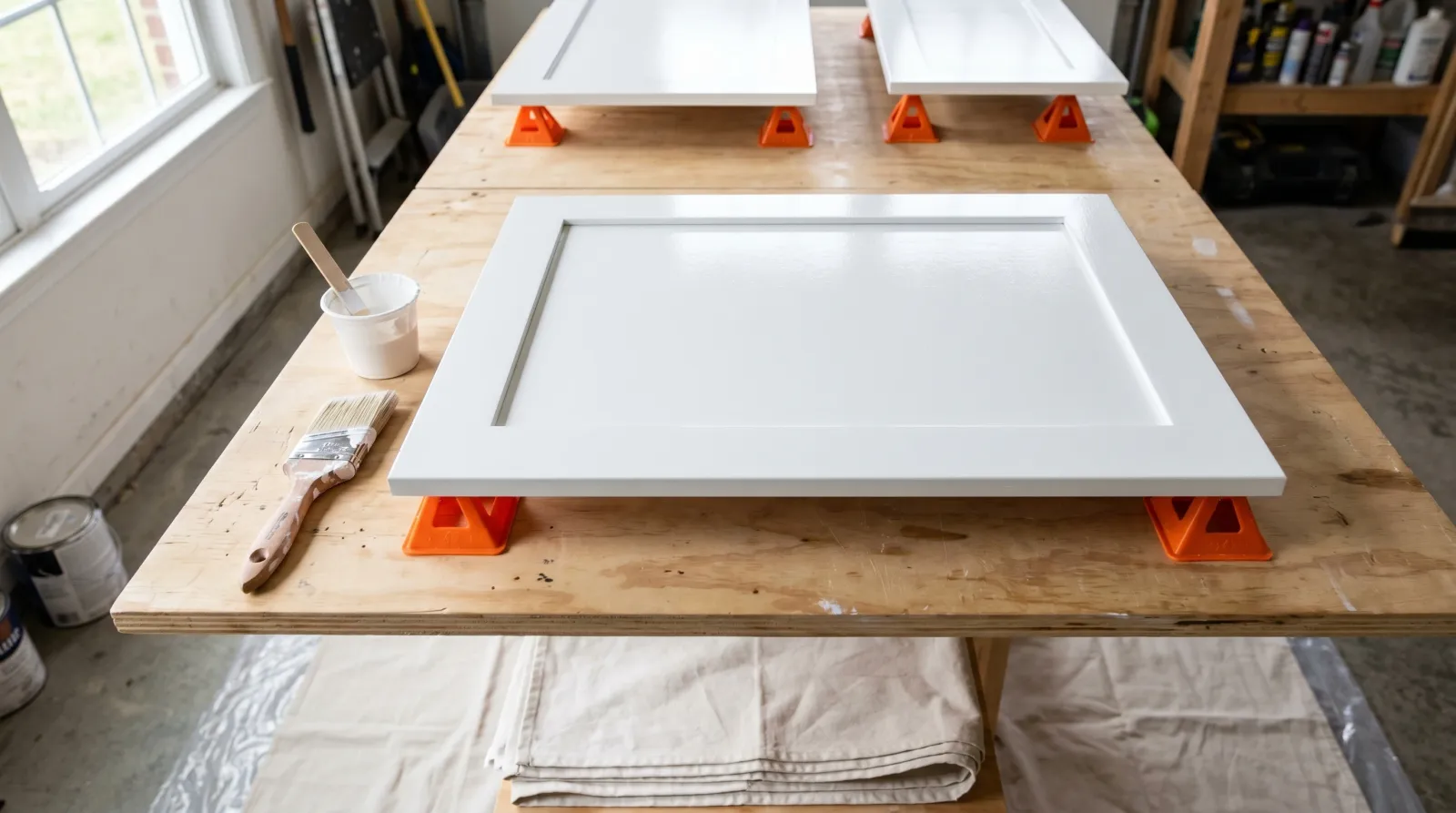
Painting both sides of a cabinet door is the moment most kitchen-cabinet repaints go sideways. The wet face sticks to whatever you set it on, the second coat ghosts the fabric of the drop cloth, and you finish with eight doors that all look fine until the under-cabinet LED hits them. Three dollars of plastic pyramids fixes it. The right three dollars matter more than people think.
What a Paint Stand Actually Has to Do
A paint stand lifts the workpiece off the bench so the wet face stays clean, supports it on the smallest possible contact area so the back-face transfer mark hides under one coat, and stays put under a 28-pound oak door. Most stands fail at least one of the three. The five below each pass their slice; the pyramid you pick is the slice that matches your work.
For the cabinet repaint itself, see the kitchen cabinet repaint project.
How We Picked
Five stand types, three weekends, two real cabinet repaints. A twelve-door white-shaker lower-cabinet refresh in Benjamin Moore Advance semi-gloss, and a six-door solid-oak vanity restain in General Finishes High Performance Topcoat. Each stand supported the same door styles through prime, coat one, sand-between, and coat two. Tip transfer marks photographed under raking LED at 24 hours; load capacity measured against a 28-pound oak raised-panel test door.
The Picks at a Glance
| Stand | Best for | Tip transfer | Load capacity | Price |
|---|---|---|---|---|
| Trillanes Pyramid 10-pack | Top pick, general use | 🟢 Invisible after coat 2 | ⚪ Light–medium doors | $ |
| Wooster Painter’s Pyramid 4-pack | Heavy solid-wood doors | ⚪ Visible until coat 2 | 🟢 Up to 200 lbs / set | $ |
| Rockler Bench Cookies | Sand-then-paint workflow | 🟡 Visible matte ring | 🟢 Heavy panels | $$ |
| FastCap 3rd Hand | Narrow trim, mouldings | 🟢 Single pin prick | 🔴 Narrow parts only | $$ |
| Coleshome Door Rack | 10+ door batches | 🟢 Edge-contact only | 🟢 Cabinet doors | $$$ |
The table reads by what the job needs. A shaker-door batch wants tip sharpness. A solid-oak vanity door wants load capacity. A moulding refinish wants a single vertical hold. Ten doors in a weekend want a rack.
The Three Decisions That Pick the Stand
Tip Contact Area
The only specification that matters for a final coat on a back face. A sub-1mm point leaves a transfer mark the next coat erases. A blunter point leaves a matte ring visible on satin and semi-gloss until two more coats. A 3-inch bench cookie leaves a visible circle every time. Trillanes is sharpest; Wooster is one step blunter. Bench cookies are wrong for the final coat. Use them in prep stages and switch to pyramids for the finish.
Base Stiffness and Load Capacity
A pyramid is a tripod made of one plastic part. The tip carves the load; the base webbing decides whether the tip stays vertical or splays sideways. Wooster’s published 200-lb rating across a four-pack is the only number in this category. A 28-pound oak door sat dead flat on four Woosters in the test. The same door splayed two of four Trillanes points by about 5 degrees, enough to leave a visible transfer mark.
Stack Logistics
Twelve doors is a different problem from four. Twelve doors on pyramids means forty-eight pyramids on the floor and you’re stepping over wet finishes for three days. The Coleshome rack flips that math: doors hang by their bottom edge, both faces dry untouched, ten doors live in the footprint of a card table. The math tilts past six doors.
1. Painter’s Pyramid Trillanes 10-Pack — Top Pick
The pyramids most cabinet painters end up with after trying the alternatives. The point is sharper than anything else in the round-up: about 0.7mm at the contact, vs around 1.5mm on the Wooster and roughly 1mm on most Amazon knockoffs of the same shape. On a freshly painted shaker-door back face in BM Advance semi-gloss, the transfer mark photographed at 24 hours under raking LED, and the coat-two pass made it disappear at arm’s length. Coat one alone, you’d see four faint dots; coat two, you don’t.
The trade is load capacity. On the 28-pound oak vanity door test, two of four Trillanes points splayed about 5 degrees outward and the resulting mark was visible at arm’s length until the third coat hid it. Same door on four Wooster pyramids sat dead flat. Tips also collect cured paint after three or four uses; wipe while tacky with water (latex) or mineral spirits (oil), or snap the tip off with pliers and call it a Wooster-class wider-point pyramid for prime coats.
| Spec | Value |
|---|---|
| Count | 10 per pack |
| Tip contact | ~0.7mm |
| Load (rated) | None published; ~10–15 lbs per pyramid in practice |
| Stack height | 10 pyramids stack into ~6 inches |
| Approx. price | $10–$13 |
Buy it if: you’re painting shaker-style or lightweight cabinet doors, shelf boards, drawer fronts, trim offcuts. Skip it if: the doors are solid-wood raised-panel and weigh more than 20 lbs each.
Buy Painter’s Pyramid 10-pack on Amazon
2. Wooster Painter’s Pyramid 4-Pack — Best for Heavy Solid-Wood Doors
The pyramid you buy when the doors are real wood. Wooster’s molded version has thicker base webbing than the Trillanes (triangle struts roughly 40% wider) and the tip sits one step blunter. The wider base resists splay under load; the tip carves enough to keep a small contact; the back-face mark is one step bigger but disappears under coat two anyway.
Wooster’s 200-lb published rating across the four-pack is the only number in this category. On the 28-pound oak door test, four Wooster pyramids held the door dead flat, no splay, mark smaller than the Trillanes’ on the same door. Stocked at Home Depot and most independent paint stores. The catch is the per-unit math: $9–$12 for four puts the unit cost roughly double the Trillanes ten-pack.
Buy it if: the doors are solid wood and heavy, or you’d rather buy a four-pack at the local paint store on the way to the job than wait two days for Amazon. Skip it if: the doors are light shaker-style MDF or you need more than eight pyramids in one trip.
Buy Wooster Painter’s Pyramid on Amazon · Find at Home Depot
3. Rockler Bench Cookie Plus Master Pack — Best for Sand-Then-Paint Workflows
A different tool that solves the same problem on the prep side. Bench Cookies are 3-inch round non-slip grippers with rubber on both faces. The bottom grips the bench; the top grips the workpiece. Set a cabinet door on four cookies, orbital-sand it, the door stays put without clamps. The same four hold the door for the prime coat and the sand-between. Then switch to pyramids for the finish.
The Master Pack adds stackable risers that lift a door 3 inches off the bench, enough clearance to brush all four edges without hand-cramping. Where cookies fail is the final coat: a 3-inch contact patch in semi-gloss leaves a visible matte ring that doesn’t fully disappear under one coat. $35–$45 is 4× the Trillanes ten-pack. You’re paying for the sanding feature, not the painting one.
Buy it if: you sand and paint on the same bench and you don’t want to clamp every panel. Skip it if: you’re a pyramid-and-go painter who doesn’t own an orbital sander.
Buy Bench Cookie Plus Master Pack on Amazon
4. FastCap 3rd Hand HD — Best for Narrow Trim and Mouldings
A specialty tool that earns its slot because nothing else does its job. A pyramid is the wrong shape for a 4-inch piece of crown moulding, a chair spindle, or a 24-inch piece of baseboard. The 3rd Hand HD is a small benchtop clamp with a single thin aluminum pin that supports a narrow workpiece vertically off the bench. You finish four sides in one session because the workpiece is held by a single point at the bottom.
Not a daily driver for cabinet doors. The single-pin hold tips anything wider than 6 inches. For trim millwork, spindles, dowels, and balusters, it’s the only stand in the round-up that lets you finish all four sides without flipping into a wet face. The pin is soft aluminum; over-tightening on a heavy workpiece bends it. Pack a spare.
Buy it if: you refinish crown moulding, spindles, balusters, or any narrow vertical workpiece. Skip it if: your project is cabinet doors and shelf boards.
Buy FastCap 3rd Hand HD on Amazon
5. Coleshome Cabinet Door Painting Rack — Best for 10+ Door Batches
The pick most homeowners skip and most cabinet painters end up buying. The Coleshome rack is a freestanding stand with ten telescoping horizontal arms. Doors hang from their bottom edge across the arms; both faces dry untouched; the rack lives in the footprint of a card table. For a twelve-door lower-cabinet repaint, that’s the difference between a one-weekend project and a three-weekend project.
The rack runs $70–$100, steep next to a $12 pyramid pack. The math flips at six doors: same footprint as one door, both sides painted same-session, no flip-and-recoat sequence. Telescoping arms wobble at full extension under heavy solid wood, so center the door and don’t push the arm to its limit. Assembly is twenty minutes the first time and the included instructions are translated; the listing photos are the better guide.
Buy it if: you’re painting ten or more cabinet doors and you want both faces dried same-session. Skip it if: the job is four doors and you’ll never run another cabinet project.
Buy Coleshome Cabinet Door Painting Rack on Amazon
Stands We Tested and Dropped
- Generic painter’s pyramids from Amazon bulk listings. Same shape as the Trillanes, half the base webbing, splay under any door heavier than 10 lbs. The transfer mark is also blunter; the tip-injection mold is cheaper.
- Wire cone stands (cheap conical metal points). Rust onto a fresh coat. The point is fine; the body is wrong.
- Cardboard pyramid templates sold for stencil work. Marketed for the same job by listing optimization; cardboard collapses under any wet paint weight.
- Painter’s tripods on a long rope. A drying solution for doors hung against a wall. Works for prime coats; the bottom edge always beads.
The Workflow That Makes the Pyramid Earn Its Keep
Three habits move outcomes more than the pyramid brand.
Inset 2 inches from each corner. The corner is the part of the door most likely to drip and pool; the inset gives the overhang room to drip clean. For doors over 30 inches tall, add two more pyramids at midheight along the long edges.
Wipe the tips between coats. Cured paint at the tip raises the contact area on the next door and leaves a chunk-mark on the back face. Wipe while tacky with water for latex or mineral spirits for oil. Missed the window? Snap the tip off with pliers and use it on prime coats where the transfer mark doesn’t matter.
Back face first, then flip and paint the front. The back-face mark from coat two shows; the back-face mark from coat one hides under coat two. Coat one on the back, flip, coat one on the front, fresh or wiped pyramid set, coat two on the back, flip, coat two on the front. No wet face ever lands on a wet pyramid tip.
For the paint side of the workflow, the best paint for kitchen cabinets covers what’s actually on the brush; the no-sand cabinet paint round-up is the bonding-primer call for melamine and laminate doors.
Care and Reuse
Latex on a Trillanes tip wipes off with a damp rag inside the first hour. After 24 hours you’re chiseling. Oil cures harder and faster; wipe at 30 minutes or use mineral spirits at end of session. Wooster pyramids clean up similarly, slightly easier because the blunter tip has more contact area to wipe.
Realistic life: Trillanes pyramids run 3–5 cabinet doors before paint buildup changes the contact geometry. Wooster pyramids run 5–7. Coleshome rack runs years (door rests on its bottom edge, no visible-face contact). Bench Cookies last decades. FastCap pin lasts until you over-tighten and bend it.
Common Mistakes
- Centering a pyramid under the door. The middle of the door is the part most likely to flex; supporting it there fish-tails the cure. Inset from corners; midpoints only on tall doors.
- Using bench cookies for the finish coat. The 3-inch contact ring shows on satin and semi-gloss. Cookies for sanding and prime; pyramids for the finish.
- Skipping the back-face first sequence. Front face coat one, flip, back face coat one means the back has a wet-paint contact on the pyramid; you transfer paint into the tip and then transfer it back out onto the front of the next door.
- Painting four doors and stacking the cured ones on top of each other on the pyramids. The pyramid supports one door per slot. Build a second pyramid layer with risers, or wait for coat one to set before pulling a door off.
- Reusing a pyramid with cured paint on the tip. Chunk-marks on the back face. Wipe between uses; snap the tip if it’s gone hard.
- Buying ten pyramids for a six-door job and a rack at the same time. Pick the tool for the door count. Six doors on the rack; under six on pyramids.
A Cabinet-Painter’s Kit That Earns Its Keep
For a homeowner doing a one-time eight-door kitchen refresh: one Trillanes 10-pack ($12), one Wooster 4-pack ($10) as backup for the two heaviest doors, a paint comb ($4). About $26. Both faces of every door cure without contact.
For a contractor or anyone repeating cabinet work: the Coleshome rack ($90) plus a Trillanes 10-pack ($12) for shelf boards and the doors that don’t fit. About $100, repays itself on door three of project two. Add a Bench Cookie Master Pack if sanding is part of the workflow.
The pyramid is the cheapest part of a cabinet repaint and the part that decides whether the back face looks like a kitchen or like a garage. Pick the stand that matches the door count, wipe the tips between coats, paint the back face first.
Ask a Question