Best Airbrushes for Miniatures
Five airbrushes tested on minis, terrain, and primer. Top pick: Iwata Eclipse HP-CS for the 0.35-millimeter all-rounder that primes and zeniths without a tip swap.

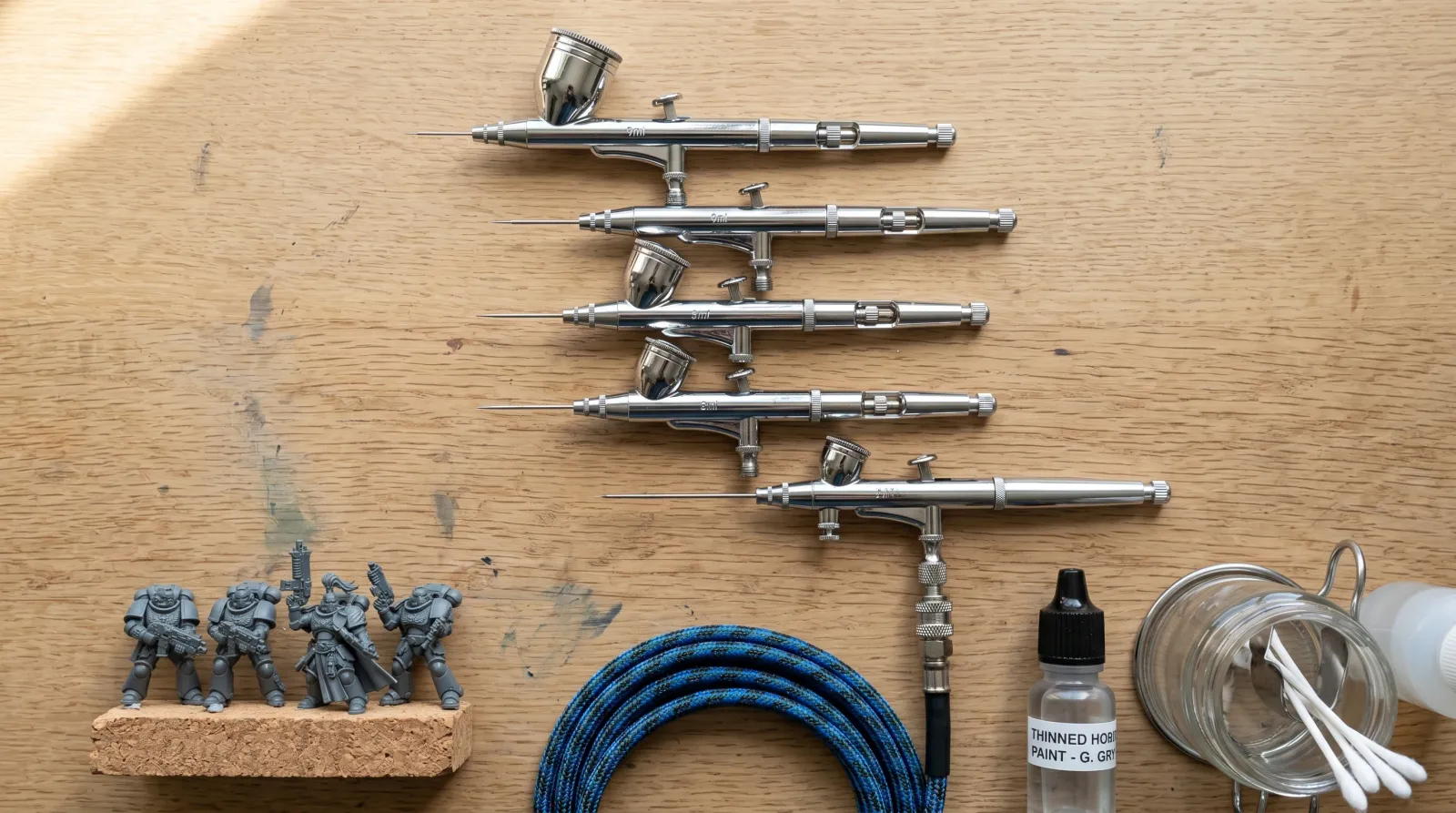
Disclosure: Some links below are affiliate links. We earn a commission if you buy through them, at no extra cost to you.
Top pick: Iwata Eclipse HP-CS. It runs about $150 to $180, and for most miniature painters it’s the one airbrush that does everything. The 0.35-millimeter nozzle sprays unthinned primer and thinned zenithal highlights without a single tip swap, which is the whole game on a hobby bench. It wins on versatility, clog resistance, and how forgiving it is to clean. It falls short on the finest freehand line, where the Harder & Steenbeck Infinity 2024 CRplus and its 0.25-millimeter titanium nozzle pull crisper detail. For a USA-made workhorse at half the Iwata’s price, the Badger Patriot 105 primes and base-coats all day. If you’re brand new, the Harder & Steenbeck Ultra 2024 is built to keep you from making beginner mistakes. And if you’re not sure airbrushing is for you yet, the Master Airbrush G22 is a real dual-action body for about $30.
There is no single right airbrush for every painter.
Most hobbyists do fine with one: an Eclipse HP-CS for priming, basing, and highlighting the whole army.
The Shortlist and Why These Five
I primed, based, and highlighted my way through six weeks and a lot of plastic to settle this list. Sixty-plus 28-millimeter infantry, a unit of resin characters, two 1:48 terrain pieces, and enough zenithal priming to learn each trigger’s personality. Same paints across every airbrush: Vallejo Game Air straight from the bottle, Game Color cut with Vallejo Airbrush Thinner, and two primers (Stynylrez and Badger’s own) at 18 to 28 PSI off a regulated compressor with a moisture trap.
The Iwata and the Badger I’d already lived with for years. The Infinity, the Ultra, and the Master G22 I ran fresh against them on the same bench, same compressor, same paints.
Five things mattered, weighted in this order: atomization at low pressure, trigger smoothness, low-flow control for highlights, clog resistance with primer, and how fast each one tears down to clean. The use case anchors the role. A 0.5-millimeter Badger is never going to out-detail a 0.25 Infinity, and a 0.25 Infinity is never going to spray primer as happily as the Badger. That’s not a flaw in either. It’s why you match the nozzle to the job.
I also asked three miniature painters who airbrush every week which body they’d hand a friend buying their first one. Two said Iwata Eclipse. One said the Ultra 2024 for the trigger limiter. None said anything under $30. That set the floor for the budget slot.
How the Testing Actually Ran
Same routine per airbrush. Prime ten minis at 25 PSI with unthinned Stynylrez, watching for the first clog. Zenithal: pure white from straight overhead at 18 PSI, judged on how soft and controlled the fade landed on a curved space-marine shoulder pad. Base-coat a five-mini squad in thinned Game Air. Spray a terrain wall at 28 PSI to push volume through. Then a full strip-and-clean, timed from “stop spraying” to “needle back in, nozzle soaking.”
I counted clogs by how many times I had to stop and pull the needle during a ten-mini prime session. I judged highlight control by eye under a daylight lamp at six inches, the distance you actually paint at. Trigger smoothness is subjective, so I had a second painter rank the five blind by feel alone.
I tested the airbrushes that come up over and over in hobby forums, in mini-painting Discords, and on the benches of painters who actually finish armies.
Picking an Airbrush, in Three Decisions
Nozzle Size: The One Spec That Matters Most
Nozzle size sets what an airbrush is good at. Smaller pulls a finer line and clogs faster; larger sprays primer and volume and can’t choke down to a hairline.
0.2 to 0.25-millimeter — fine detail. Freehand camo, fine zenithal work, competition-level blending. The Infinity CRplus lives here. The trade is constant attention to thinning; heavy primer fights you.
0.3 to 0.4-millimeter — the all-rounder. Fine enough for highlights on a 28-millimeter mini, open enough to spray primer thinned a little or not at all. The Iwata (0.35), the Ultra (0.4), and the Master G22 (0.3) sit in this band. If you buy one airbrush for minis, buy from here.
0.5-millimeter and up — prime and base. Pushes primer and base coats fast, never clogs, won’t pull a crisp fine line. The Badger Patriot 105 is the workhorse. It’s the second airbrush a lot of painters add so they’re not cleaning primer out of their good detail brush.
Trigger and Needle: Where the Money Goes
Dual-action is non-negotiable for minis. Press down for air, pull back for paint, and the two work independently so you can feather a highlight in. Every pick here is dual-action gravity feed.
What separates a $30 body from a $200 one is how smooth that trigger pull is and how true the needle runs. The Infinity has the lightest, most progressive trigger in the test, and that’s exactly what lets you fade a zenithal highlight instead of blotching it. The Master G22’s trigger is usable but notchy by comparison. You feel the difference most on slow, low-flow work, which is the work that makes minis look painted.
Cleaning and Parts: The Spec That Decides If You Keep Airbrushing
More new airbrushers quit over clogs than over price. A nozzle you can pull and soak in 30 seconds, and a replacement tip you can buy for a few dollars when you bend one, is what keeps the tool on the bench instead of in a drawer.
The Iwata’s drop-in nozzle has nothing to cross-thread, so beginners can’t wreck it during cleaning. The Infinity strips by hand with no tools. Badger parts are cheap and stocked everywhere in the US. The Master G22’s parts are generic and the tolerances loose, which is fine at $30 and frustrating at any higher price.
At-A-Glance Comparison
| Brand / Model | Nozzle | Cup | Best for | Price tier |
|---|---|---|---|---|
| Iwata Eclipse HP-CS | 0.35 mm | 0.24 oz / 7 ml gravity | Everything: prime, base, highlight | Premium |
| Harder & Steenbeck Infinity 2024 CRplus | 0.25 mm titanium | 2 ml + mini cup | Fine detail, freehand, smooth fades | Premium |
| Badger Patriot 105 | 0.5 mm | 1/3 oz gravity | Priming, base coats, volume | Mid |
| Harder & Steenbeck Ultra 2024 | 0.4 mm | 5 ml gravity | Beginners, learning trigger control | Mid |
| Master Airbrush G22 | 0.3 mm | 1/3 oz gravity | Testing the hobby on a budget | Budget |
1. Iwata Eclipse HP-CS, Best Overall
The Eclipse HP-CS is the airbrush you reach for when you don’t want to think about which airbrush. The 0.35-millimeter nozzle is the reason it’s on more hobby benches than anything else: it sprays unthinned Stynylrez primer at 25 PSI without choking, then drops to 18 PSI and lays a soft zenithal highlight on a curved shoulder pad, all from the same setup. No tip swap, no second airbrush, no fighting the tool. Through a full ten-mini priming session I never once stopped to pull the needle.
The high-flow head is what does it. Iwata calls it high-flow for a reason; it atomizes thicker paint and primer with less thinning than a finer nozzle needs. Metallics that gum up a 0.25 airbrush spray cleanly here. For a painter who primes, bases, and highlights a whole army, that range out of one nozzle is worth the price on its own.
Cleaning is where it earns trust. The nozzle drops in instead of threading, so there’s no fine tip to cross-thread and crack while you learn. Pull the needle, drop the nozzle in cleaner, reassemble, and you’re done in under a minute. I’ve owned mine for years and never replaced the nozzle.
Where it gives ground: the 0.35 won’t pull the crispest hairline. For freehand camo or competition-level fine work, the Infinity’s 0.25 nozzle is sharper. And this body is 0.35-millimeter only. You can’t swap to a finer or coarser head the way you can on the Harder & Steenbeck line, so the day you want finer detail, you’re buying a second airbrush.
| Spec | Value |
|---|---|
| Nozzle | 0.35 mm, drop-in |
| Cup | 0.24 oz / 7 ml gravity feed, with lid |
| Best for | Priming, base-coating, and zenithal highlights from one nozzle |
| Approx. price | $150–$180 |
Buy it if: you want one airbrush that primes, bases, and highlights a whole army and is forgiving to clean. Skip it if: your main work is competition-grade freehand detail. Pay up for the Infinity’s finer nozzle.
2. Harder & Steenbeck Infinity 2024 CRplus, Best for Fine Detail
When the work is fine, the Infinity is the airbrush. The 0.25-millimeter titanium nozzle pulled the crispest controlled line of anything I tested, and the trigger is the lightest and most progressive in the group. That trigger is the whole point. Low-flow control is what separates a smooth zenithal fade from a blotchy one, and the Infinity lets you feather paint in so gradually that the transition is hard to see where it starts and stops. On a resin character’s face, it laid highlights I couldn’t get cleanly from any other body here.
The 2024 redesign added a tool-free back end. You pull it apart by hand to clean, no spanner, which matters because fine nozzles need cleaning more often. The 2-in-1 version ships with both a 0.25 and a 0.44 head, so you can swap to the wider nozzle when you need to spray primer or push volume, then drop back to the fine head for detail.
The trade is what every fine nozzle costs you: it clogs faster with heavy primer. Run thinner primer or swap to the 0.44 head for priming, and the problem goes away. It’s also the most expensive airbrush here, and the price climbs once you add the second head set.
Buy it if: you do freehand detail, fine zenithal work, or competition painting and want the finest line and smoothest trigger. About $190–$230 for the 2-in-1.
3. Badger Patriot 105, Best Value and Made in USA
The airbrush I hand someone who wants to prime and base an army without babysitting clogs. The 0.5-millimeter needle is wide open by mini standards, and that’s the feature: it sprays primer and base coats all day and never chokes. Through the same ten-mini priming run that made finer airbrushes stutter, the Patriot didn’t clog once. It’s the workhorse a lot of painters add as a second airbrush specifically so their detail airbrush never has to touch primer.
It’s made in the USA, and the replacement needles and nozzles are cheap and stocked everywhere. When a new airbrusher bends a needle (everyone does), a Badger needle costs a few dollars and ships overnight. That parts availability is underrated until the day you need it.
The 0.5 tip won’t pull a fine highlight line. This is a prime-and-base airbrush, not a freehand one; ask it to do detail and it’ll fight you. The trigger is also a touch stiffer out of the box than the Iwata or Infinity, though it loosens with use.
Verdict: the value pick and the army-priming workhorse. About $90–$110. Pair it with a finer airbrush for detail.
4. Harder & Steenbeck Ultra 2024, Best for Beginners
The Ultra is built to keep a beginner from the two mistakes everyone makes: over-pulling the trigger and dumping too much paint, and cross-threading the nozzle during cleaning. The trigger limiter caps how far back you can pull, so you physically can’t flood a mini while you’re still learning the feel. The self-centering nozzle threads in without the fragile cross-threading that kills cheaper airbrushes in the first month.
The 0.4-millimeter nozzle is forgiving. It atomizes thinned hobby paint cleanly and sprays primer without much fuss, which is exactly the range a beginner needs before they know what they want. And because the Ultra shares the Harder & Steenbeck modular system, upgrade parts and finer heads from the Infinity line drop in later, so the airbrush grows with you instead of getting replaced.
The 0.4 tip won’t pull the crispest freehand line, and you’ll likely outgrow it for fine detail. It’s also a single nozzle size, no quick head swap like the Infinity offers. For a first airbrush that teaches good habits, that’s an acceptable ceiling.
Buy it if: this is your first airbrush and you want German build quality with guardrails. About $110–$140.
5. Master Airbrush G22, Best Budget
The airbrush I hand someone who isn’t sure they’ll stick with airbrushing. About $30 for a real dual-action gravity-feed body with a 0.3-millimeter nozzle, and it atomizes thinned Vallejo Game Air better than the price has any right to. For priming and base-coating a starter army while you figure out whether the hobby is for you, it does the job.
The catch is tolerances. Expect to fettle the needle or nozzle out of the box; mine needed the nozzle reseated before it sprayed straight. The trigger is notchy next to the premium bodies, and the parts are generic. None of that matters much at $30. It matters a lot if you pay more.
Verdict: the right call to test the waters. Learn to clean on it without panicking over a bent needle, and upgrade to the Iwata or Badger once you know you’re staying.
Airbrushes I Tried and Dropped
- Iwata HP-C Plus. Finer 0.3 nozzle, lovely airbrush. The Eclipse HP-CS does more for less money for most mini work.
- Badger Sotar 20/20. A genuine fine-detail airbrush, but it’s a specialist’s tool and fragile in new hands. The Infinity covers the same need more durably.
- Master Airbrush all-in-one compressor kits. The G22 body is fine; the bundled compressors are loud and lack a tank. Buy the body, buy a real compressor separately.
- Generic Amazon no-name airbrushes. No parts support. When you bend a needle, you’re buying a whole new airbrush.
Care, Cleaning, and Keeping It Alive
The airbrushes above last for years if you clean them and die in a month if you don’t. Dried paint in the nozzle is what kills airbrushes and confidence.
Between colors. Empty the cup, add airbrush cleaner or thinner, and spray it through until it runs clear. Twenty to thirty seconds once you have the routine. Back-flush (cap the nozzle, pull the trigger) to bubble cleaner up into the cup and loosen paint in the body. Don’t tear down between every color; flush and move on.
End of session. Full strip. Pull the needle, wipe it clean (front to back, never back to front, or you’ll spread paint into the body). Drop the nozzle in a cap of cleaner to soak. Run a cleaning brush through the cup and body. Reassemble. Five minutes. The Iwata’s drop-in nozzle and the Infinity’s tool-free back end both make this faster; the Master G22 takes the longest because the parts fit loosely.
When something clogs mid-session. Stop. Don’t crank the PSI to blast through it; that drives paint deeper. Pull the needle, soak the nozzle, reassemble. Two minutes saves you an hour of frustration.
Realistic life: all five bodies last for years of regular use. The consumables are the needle and nozzle. Iwata, Badger, and Harder & Steenbeck all stock cheap replacements; the Master’s generic parts are hit-or-miss. Replace the needle when the tip bends and won’t true up, the nozzle when it cracks. A bent needle is the most common failure and the cheapest fix.
Mistakes I Still See
- Buying a 0.2-millimeter airbrush as a first airbrush. It clogs constantly on primer and punishes beginners. Start at 0.3 to 0.4.
- Running rattle-can primer through an airbrush. It’s not milled fine enough and clogs the nozzle solid. Use airbrush-ready primer (Stynylrez, Vallejo Surface Primer) only.
- Skipping the moisture trap. Compressed air carries water; without a trap it spits onto your mini and wrecks the coat. A trap is $15 and mandatory.
- Cranking PSI to clear a clog. Drives paint deeper and can split the nozzle. Stop and clean instead.
- Not thinning enough. Most mini paint needs thinning to the consistency of milk before it’ll atomize. Paint sprayed too thick spatters and goes gritty. When in doubt, see how to thin paint for spraying.
- Wiping the needle back to front. Pushes paint into the seals and the trigger mechanism. Always wipe from the body toward the tip.
A Starter Setup That Earns Its Keep
For someone starting out: an Iwata Eclipse HP-CS ($165), a quiet compressor with a tank and regulator ($120–$160), a moisture trap ($15), airbrush cleaner and a cleaning-brush set ($20), and a bottle of Vallejo Airbrush Thinner ($8). About $330 all in, and it’ll prime and paint armies for years.
On a tighter budget, start with the Master G22 ($30) and the same compressor, and upgrade the airbrush once you know you’re committed. The compressor outlives every airbrush you’ll bolt onto it, so that’s where the money is best spent first.
The airbrush is the cheap part. Don’t economize on the compressor and fight spatter for a year.
FAQ
What nozzle size is best for airbrushing miniatures? 0.3 to 0.4-millimeter is the sweet spot. Fine enough for zenithal highlights, open enough to spray primer without constant clogs. Go 0.5 (Badger) for prime-and-base only, 0.25 (Infinity) for fine freehand. If you own one, make it a 0.35 to 0.4.
Do I need a dual-action airbrush? Yes. Dual-action lets you control air and paint separately, which is what makes smooth highlight fades possible. Single-action only sprays flat coverage. Every pick here is dual-action gravity feed.
Can I spray primer through it? Yes, with airbrush-ready primer (Stynylrez, Vallejo Surface Primer) and a 0.3 to 0.5-millimeter nozzle. Never rattle-can or hardware-store primer; it clogs the nozzle solid.
Is an expensive airbrush worth it? A $30 Master G22 primes and bases minis fine. The jump to a Badger or Iwata buys a smoother trigger, easier cleaning, and cheap stocked parts. Above the Iwata, you’re paying for fine nozzles most painters never need.
Ask a Question