What Is Vinyl Matte Paint?
Vinyl matte is a PVA-bound flat wall paint that hides drywall on a contractor budget. Here's the chemistry, the UK history, and why it burnishes faster than acrylic.

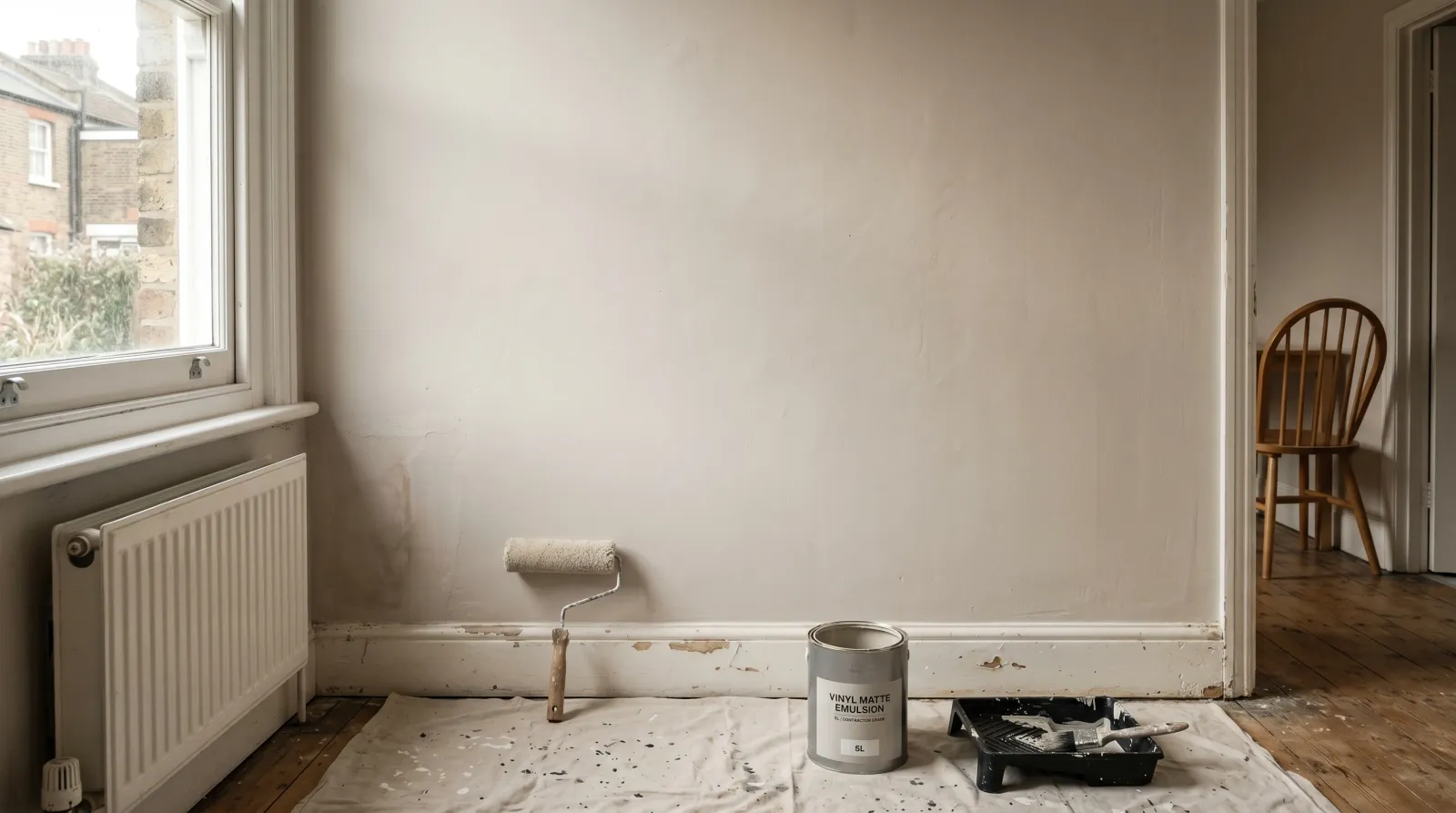
Walk into almost any rented flat in Britain and run your hand across the wall. It feels slightly chalky, slightly soft, and the colour goes patchy the first time a sofa back rubs against it. That’s vinyl matte, and it covers more interior wall surface in the UK rental stock than every other finish put together. The reason isn’t aesthetic. It’s a binder choice and a pigment ratio, both made for the contractor and not for you.
Vinyl matte is a water-based interior wall paint built on a polyvinyl acetate binder (PVA or a vinyl-acrylic copolymer) with a pigment volume concentration pushed up to roughly 50–60%, which gives a matte sheen of 2–7 gloss units at 85 degrees and dry coverage of 350–400 sq ft per gallon (about 12–14 m² per litre). It dries to recoat in two hours and reaches a usable film in 14 days. The same chemistry that lets it hide an imperfectly skimmed plaster wall on one coat is what makes it burnish the first time anything wipes it.
Where the Name Comes From
The word “vinyl” on a paint tin points to the binder, not the surface. Polyvinyl acetate crossed into architectural coatings in the 1950s as a cheaper alternative to the alkyd oil binders that dominated interior work at the time. British paint companies (ICI Dulux, Crown, Leyland) adopted PVA emulsion through the 1960s and shipped it as “vinyl matt emulsion,” which stuck. American formulators went the same route and called the same product “latex flat,” a misnomer (there’s no rubber latex in the can) that British painters still find funny.
In the UK, “vinyl matt” became the default interior wall finish and the words travel together on the tin. In the US, “flat latex” became the default and the binder gets named only on the technical data sheet. The chemistry is broadly the same vinyl acetate copolymer, sometimes blended with a small fraction of acrylic to firm up the film. The labelling habits diverged and never came back together.
Why the Binder Matters
The reason for that is what PVA does in the film. A binder’s job is to fuse together as water evaporates and lock the pigment particles into a continuous polymer matrix. PVA fuses easily at room temperature, accepts a high pigment load without losing adhesion, and stays cheap because the monomer is one of the lowest-cost vinyl chemistries in industrial production. Those three properties are what put it under almost every contractor’s roller.
The trade-off is hardness. A PVA film is softer than a 100% acrylic film once both have cured. Drag a fingernail across each at the same age and the PVA marks first. Push that softness into the pigment-volume math and you get a film that hides drywall beautifully on day one and scuffs visibly the first time a backpack brushes it.
Why It Hides So Well on One Coat
Vinyl matte sits well above the critical pigment volume concentration. Above the CPVC, the binder runs short of what’s needed to fully encapsulate every pigment grain, tiny air voids form between the particles, and the dried film goes microscopically porous. That porosity scatters light diffusely in every direction, which is what your eye reads as a flat, even sheen with no shine to outline bumps or seams.
The same porosity also gives the film exceptional hiding power per litre. Light hitting the wall bounces off pigment grain after pigment grain before it can escape, and the substrate underneath stops contributing to the reflected colour after surprisingly little film thickness. A good vinyl matte hits opacity at 80–100 microns wet, which is half what a satin needs over the same dark base.
Why It Burnishes Worse Than Acrylic Matte
Burnish is what happens when friction crushes the high points of a porous matte film into a smoother, shinier patch. Vinyl matte loses this fight faster than acrylic matte for a stacked reason. The PVA binder deforms under load at a lower threshold than acrylic, and the air voids that give the matte its hiding power collapse the first time they’re compressed. Wipe a vinyl matte wall once with a damp cloth and the rubbed spot reflects light more coherently than the surrounding film. You see a glossy smudge exactly where you tried to clean.
A premium “scrubbable” vinyl matte (Dulux Diamond Matt, Crown Clean Extreme, Johnstone’s Aqua) fights this with a vinyl-acrylic copolymer binder, a finer pigment grind, and a tighter PVC. The scrub rating jumps from about 1,000 cycles on trade vinyl matte to 10,000+ on the premium tier. Same chemistry family, closer to a US-market premium matte than to the contractor tin next to it on the shelf.
When to Use Vinyl Matte
Use it for:
- Low-touch interior walls where hiding power matters and washing doesn’t — bedrooms, formal lounges, hallways with adult-only traffic.
- Newly skimmed plaster where the surface still wants to drink and a porous mist coat reads as a feature, not a problem.
- Rental turnovers and contract jobs where the cost-per-litre and the one-coat hide are doing the work.
- Ceilings where nobody scrubs and the priority is no flashing under afternoon sun.
When Not to Use Vinyl Matte
Don’t use it for:
- Kitchens, bathrooms, or any room where moisture, splatter, or a wipe-down sponge is on the table — step up to a vinyl silk or an acrylic eggshell.
- High-touch corridors with kids, dogs, or backpack shoulders — the burnish marks read as dirt to anyone walking through.
- Skirting, doors, or trim — vinyl matte was never formulated for woodwork. Use an acrylic eggshell or a water-based satin trim paint.
- Hand-grease zones around light switches and door pulls — the embedded skin oil won’t blot out and the film around it burnishes the first time you try.
How Vinyl Matte Compares to Its Neighbours
| Vinyl matte | Acrylic matte | Vinyl silk | Flat (US) | |
|---|---|---|---|---|
| Binder | PVA / vinyl-acrylic | 100% acrylic | PVA / vinyl-acrylic | Vinyl-acrylic |
| Sheen at 85° | 2–7 GU | 5–10 GU | 15–25 GU | 0–5 GU |
| PVC | 50–60% | 45–55% | 30–40% | 50–65% |
| Scrub cycles | 1,000–10,000 | 5,000–20,000 | 10,000+ | 50–10,000 |
| Best room | Bedroom, ceiling | Family room | Kitchen, bath | Bedroom, ceiling |
For the full ladder across finishes, see the sheen guide. For the head-to-head against the next finish up, see flat vs eggshell.
Common Mistakes
- Spec’ing trade vinyl matte for a family kitchen because the tin says “matte” and matte hides well. The first dinner-prep splatter burnishes a halo around the cooker. Use a vinyl silk or an acrylic eggshell. The hiding power loss is real, but you can actually clean it.
- Touching up a two-year-old vinyl matte wall with the leftover tin. PVA films pick up airborne dust and a slight colour drift over time. Your touch-up reads cooler and shinier than the surrounding wall. Either touch up corner-to-corner or repaint the whole wall.
- Skipping the mist coat on fresh plaster. New plaster still draws water; rolling neat vinyl matte over it pulls binder out of the first coat and you get a powdery film that crumbles. Thin the first coat 10–20% with water and let the wall drink it.
- Wiping a stain with a Magic Eraser. The melamine foam is mildly abrasive and burnishes a polished oval at exactly the size of your hand pressure. Blot a fresh stain instead, and accept the touch-up if the stain is dry.
Where to Buy
For verified SKUs across the matte category — premium scrubbable vinyl matte, mid-tier trade vinyl matte, US-market flat alternatives — see the best interior paint round-up. On the tin, look for the PVC range on the technical data sheet and the scrub rating in cycles, not on the marketing word on the front. A “luxury matte” with no scrub rating printed is a trade vinyl matte with a higher markup.
Pick the binder grade to match the room. Vinyl matte in a bedroom is the right tool. Vinyl matte in a kitchen is the next tenant’s repaint.
Ask a Question