What Is Flat Paint?
Flat paint hides drywall imperfections because its pigment volume concentration sits above 45%. Here's the chemistry, and why it burnishes the moment you wipe it.

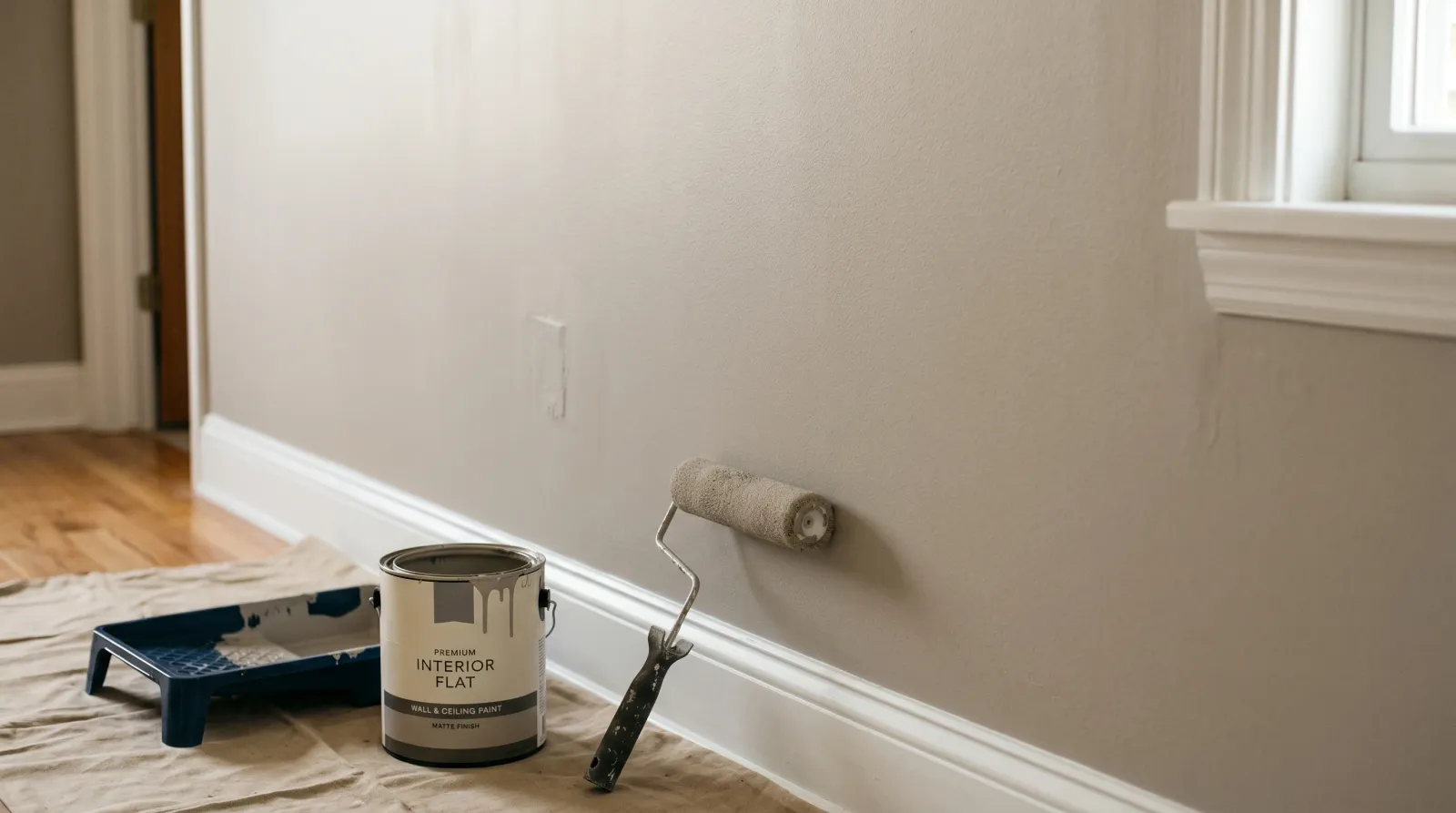
Run your hand across a freshly painted flat wall and it feels almost chalky. Wipe a smudge off the same wall a month later and you leave a glossy patch you can see from the doorway. Both of those things come from the same number on the can. Pigment volume concentration, usually written PVC on the data sheet. Above 45%, you get flat. Below 35%, you get something shinier. The whole sheen ladder is set by that one ratio.
Flat paint is paint formulated with a PVC above roughly 45%, meaning the dried film contains more pigment particles by volume than the binder can fully wet out and encapsulate. The result is a microscopically rough surface that scatters light in every direction instead of reflecting it as a coherent sheen. Gloss units measured at 85 degrees come in at 0–5 for a true flat, 5–10 for a “matte” (which is just a slightly less-flat flat, sold at a premium), and dry coverage runs 350–400 sq ft per gallon. The film cures in 14–30 days like any latex, but the porosity that gives it the hiding power also gives it the wipe-down problem.
Where That 45% Number Comes From
PVC is the volume ratio of pigment to total solids in the dried film. A glossy enamel runs 15–25% PVC. The binder is the dominant ingredient by a wide margin, every pigment grain gets fully coated, and the dried surface is smooth and reflective. An eggshell sits around 30–40%. A flat pushes above 45%, sometimes as high as 65% in cheap ceiling paint.
There’s a specific cliff in the chemistry called the critical pigment volume concentration. Below the CPVC (typically around 45% for an interior wall paint), the binder is in excess and the film is continuous and non-porous. Above the CPVC, the binder runs short. Pigment particles start touching each other instead of being held apart by polymer. Tiny air voids form between them. The film stops being continuous and goes microscopically porous.
That porosity does two things at once. It scatters light diffusely, which is what your eye reads as “flat.” And it lets liquids penetrate slightly into the surface instead of beading on top. Hiding power comes with porosity as a package. You don’t get to pick one.
Why It Hides Drywall So Well
A bad drywall seam is geometry. There’s a low spot where the tape sits, a high spot where the mud builds up, and a transition between them. Under a sheen finish, the high spot bounces light at one angle and the low spot bounces it at another — your eye picks up the discontinuity and reads it as a defect. Paint a sheen finish over a marginally taped wall and every seam telegraphs through.
A flat film breaks that. Every patch of the wall scatters light in all directions equally. The high spot and the low spot are still there, but they reflect the same diffuse light, so the discontinuity disappears optically. The bump is invisible until you look at it under a flashlight held at a raking angle. This is why painters spec flat for new construction, for repaired walls, and for any ceiling that took a recent patch.
The trade-off is that the same porosity that scatters light also catches dirt. Coffee splatter hits a flat wall and the liquid wicks slightly into the surface before it dries. Now the stain isn’t sitting on top of the paint where you can wipe it; it’s embedded a fraction of a millimeter into the film. A damp sponge can lift the surface dirt and burnish the spot (the wiping pressure smooths the microscopic roughness into a shinier patch), but the embedded stain often stays.
The Burnish Problem
Burnish is the word for what happens when you scrub a flat finish. The mechanical friction crushes the high points of the microscopically rough surface, leveling them out. Locally, the PVC effectively drops because you’ve compressed the air voids out of the top layer. The crushed patch reflects light more coherently than the surrounding wall. You see a glossy smudge exactly where you tried to clean.
Premium flats fight this with harder binders and finer pigment grinds. Benjamin Moore Aura Matte and Sherwin-Williams Emerald Matte are rated to about 300 scrub cycles before the film breaks down. A builder-grade contractor flat from a five-gallon bucket might last 50 cycles. You can wash a premium flat a few times with a soft sponge and get away with it. Wash a contractor flat once with a Magic Eraser and you’ll have to repaint the whole wall.
Ceiling Flat vs Wall Flat
These are not the same product. Ceiling flat runs higher PVC, often 55–65%, because nobody scrubs a ceiling and the priority is hiding roller laps under raking sunlight. The binder is cheaper, the film is softer, the can costs less. It’s tuned for one job. Dry uniformly overhead without flashing. It does that well.
Wall flat sits at 45–55% PVC and uses a better binder so the film tolerates occasional dusting. Use ceiling paint on a ceiling and wall paint on a wall. Painters swap them on budget jobs and it looks fine for six months. Then the wall paint scuffs from a chair back, or the ceiling paint flashes around a vent. The shortcut shows.
What This Means When You’re Standing in the Aisle
If the wall is in a low-touch room (a bedroom, a formal dining room, a primary ceiling) and the drywall job behind it isn’t perfect, buy a flat. The hiding power earns its keep and nobody will scrub it. If the wall is in a kitchen, a bathroom, a hallway, or a kids’ room, do not buy a flat. Step up to eggshell or satin and let your tape-and-mud guy redo the seams if they bother you. The sheen guide covers the full ladder if you’re choosing between two adjacent options. For the head-to-head version, see flat vs eggshell.
And don’t confuse “flat” with “cheap.” A premium flat from Benjamin Moore or Sherwin-Williams runs $70–90 a gallon and earns it with binder quality. A builder-grade flat runs $18 and hides almost as well on day one. The difference shows up at month six, when the premium can still gets dusted and the builder-grade goes patchy the first time somebody leans a coat against it.
Common Mistakes
- Painting a hallway in flat because it looked good in the bedroom. Hallways are the highest-touch low-attention surface in a house — shoulders, backpacks, dog tails. Eggshell minimum, satin if there’s a kid.
- Cleaning a fresh stain with a damp paper towel. The towel burnishes a glossy spot bigger than the stain. Blot, don’t wipe. If it leaves a mark, plan to touch up the wall.
- Touching up a flat wall with the same gallon two years later. The original film has dust, UV exposure, and color drift baked in. Your touch-up will read slightly cooler and slightly shinier than the surrounding wall. Either touch up corner-to-corner or repaint the whole wall.
- Using ceiling flat on the wall to save money. It hides well for a month, then scuffs from anything that touches it. The forty-dollar savings turns into a repaint.
Where to Buy
For the verified SKU list — premium flat, mid-tier flat, contractor flat, by use case — see the best interior paint round-up. Don’t buy flat off a brand name alone. Read the gloss units on the data sheet and pick the binder grade to match the room.
Frequently asked questions
Is flat paint washable?+
Why does flat paint hide drywall imperfections?+
What's the difference between flat and matte paint?+
Does flat ceiling paint differ from flat wall paint?+
- Sheen guide
- Flat vs eggshell paint
- Best interior paint