Gloss Units Explained: How Sheen Is Actually Measured
A gloss unit is a number from a meter, not a marketing word. Here is how the meter works, what the ranges mean, and where brand labels start to lie.

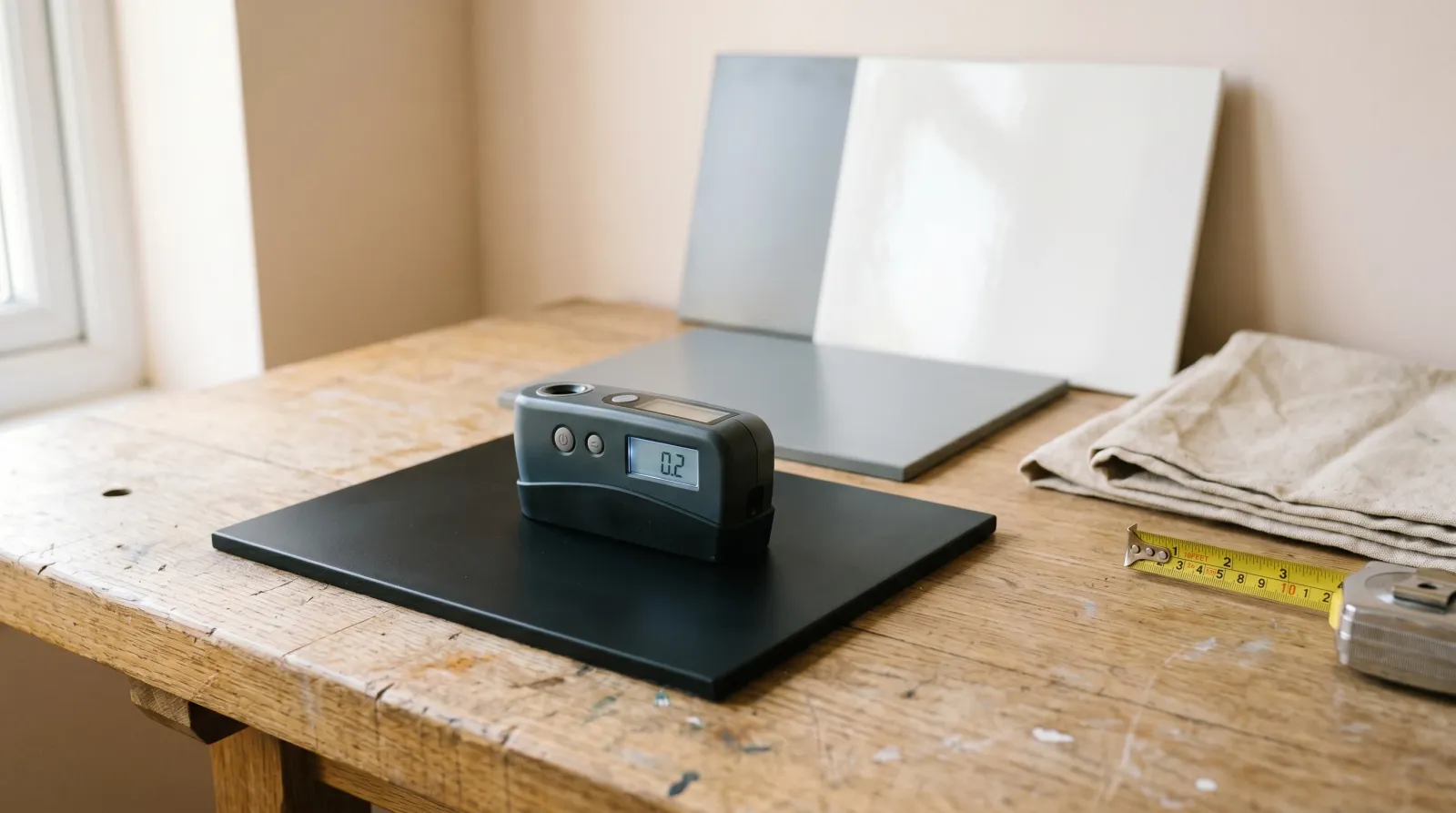
Most people meet gloss units the same way: someone says a paint reads 25 on a meter, and they nod like they know what that means. The reason for that is the gloss unit number gets quoted everywhere (data sheets, spec sections, blog posts) without the meter, the angle, or the geometry behind it ever getting explained. So the number floats free, and brands take advantage of that.
Here is the working definition. A gloss unit (GU) is a calibrated reading from a glossmeter aimed at a dry paint film at a fixed angle, expressed against a reference black-glass standard that is set to 100. Zero is a perfectly diffuse, no-shine surface. One hundred is the reference glass. Real finishes land between them. The standard is ASTM D523 in the US and ISO 2813 internationally, and the two methods are functionally identical.
How the Meter Actually Reads a Wall
A glossmeter is a small handheld box with a light source on one side and a detector on the other, separated by a known angle. You set it on a flat, dry, cured panel. The lamp fires a narrow beam at the film. Some of that light scatters in every direction (diffuse reflection, which gives a wall its color). Some bounces off at the mirror angle on the opposite side (specular reflection, which gives a wall its shine). The detector only counts the light coming back at the specular angle. That count, normalized against the black-glass reference, is your gloss unit number.
Three standard angles exist, and the angle is part of the spec.
- 60° is the default. It is the one you should assume any quoted GU number is referring to unless the spec says otherwise. Sixty degrees separates eggshell, satin, and semi-gloss cleanly because the geometry is sensitive in the 10–70 GU range where most architectural finishes live.
- 85° is the low-gloss angle. Below about 10 GU at 60°, the specular beam is so weak the meter struggles to resolve differences. Switching to 85° (a grazing angle) amplifies the reading because shine becomes more visible the closer you get to looking along the surface. Flat, matte, and dead-flat ceiling paints are measured at 85°.
- 20° is the high-gloss angle. Above about 70 GU at 60°, the readings start to compress against the 100 ceiling. Twenty degrees re-spreads the high end so you can tell a 78 GU semi-gloss from a 92 GU gloss enamel.
If a TDS reports “60° gloss: 28 GU” that is satin. If it reports “85° sheen: 8 GU” that is a flat ceiling paint. Same product, different angle, different number, and you cannot compare across angles.
What the Numbers Look Like on the Wall
These are real-world ranges measured at 60° on freshly cured panels.
| Category | 60° GU | 85° sheen | What the wall does |
|---|---|---|---|
| Dead-flat / ceiling | 0–5 | 0–4 | Light scatters in every direction, no shine angle |
| Matte | 0–10 | 4–10 | Soft, chalky read; raking light still hides imperfections |
| Eggshell | 10–25 | 10–20 | Faint glow when you angle your head; wipes okay |
| Satin | 25–35 | 20–35 | Quiet pearl; you can see direction of light on the wall |
| Semi-gloss | 35–70 | — | Hard shine; every brushstroke and roller texture reads |
| Gloss / high-gloss | 70–95 | — | Mirror-bright; will reflect a window outline |
| Reference black glass | 100 | — | The calibration standard, not a wall finish |
Above 100 is possible. Mirror-polished metal, glass, and certain piano-finish lacquers will read 110–130 GU at 20°. No wall paint gets there.
Where the Brand Labels Start to Lie
Each brand sets its own internal GU ranges per sheen name, and the ranges overlap at the edges. We measured the spread on freshly cured panels, same brand of meter, same operator.
| Brand & line | “Eggshell” | “Satin” | “Semi-gloss” |
|---|---|---|---|
| Benjamin Moore Regal Select | 12 | 27 | 45 |
| Sherwin-Williams Cashmere | 9 | 22 | 38 |
| Behr Marquee | 14 | 31 | 52 |
| Valspar Reserve | 11 | 26 | 40 |
Look at the satin column. BM reads 27, SW reads 22, Behr reads 31. The Behr satin is measurably closer to a Sherwin semi-gloss (38) than to a Sherwin satin (22). Behr is not breaking the rules. There is no rule. The label is a category the brand chose, and the brand chooses where to draw the line. If you switched from SW Cashmere satin to Behr Marquee satin and the new walls suddenly read harder under your kitchen light, this is why.
The pattern shows up at the bottom of the range too. A “matte” from a brand that ships eggshell-grade product under the matte label (7–10 GU) will look entirely different on a north-facing bedroom wall than a true 3 GU matte from another brand.
How Coalescence Shifts the Number After You Roll It
The TDS number is from a controlled draw-down on a glass plate. Your wall is not a glass plate, and that matters chemically.
Gloss is set by the surface smoothness of the dried film. When a latex paint dries, water evaporates and the binder particles coalesce into a continuous skin. If they coalesce fully and pack tight, the surface is microscopically smooth and reads at the spec GU number. If anything interrupts coalescence (cold temperature, low humidity, a porous substrate that yanks water out too fast, a roller nap that leaves stipple), the film cures with microscopic surface roughness. That roughness scatters the specular beam and the gloss reading drops.
Practical version: a satin paint that should read 28 GU can come in at 18 GU on the wall if you rolled it at 50°F over an unprimed drywall patch. The paint is fine. The film just did not get to lay down smooth. This is why a finish can look duller in one area of a wall than another. The local gloss number actually changed.
Common Mistakes
- Quoting a GU number without the angle. “It reads 8” is meaningless. Eight at 60° is matte. Eight at 85° is dead-flat ceiling. The angle is half the number.
- Comparing sheens across brands by name. Buy by GU range when the data sheet gives it. The label categories do not align.
- Measuring a wet or under-cured film. Gloss readings drift for the first week after application as the binder finishes coalescing. Manufacturers spec on a 7-day cured panel; so should you.
- Reading gloss on a textured wall. The meter assumes a flat surface. Orange-peel, knockdown, or roller stipple all scatter the specular beam and give artificially low readings. Use a smooth sample panel pulled from the same can.
Where to Buy
For SKU picks by sheen category:
- For trim and cabinets at the high-GU end, see the best semi-gloss paint round-up.
- For the eggshell-vs-satin decision in the middle of the range, see the eggshell vs satin comparison.
- For the room-by-room sheen map, see the full sheen guide.