Can Paint Freeze? Storage Temperature Explained
Can paint freeze? Yes, water-based paint freezes around 32°F and can be ruined. Here is the chemistry, the safe storage range, and how to tell if a can survived.

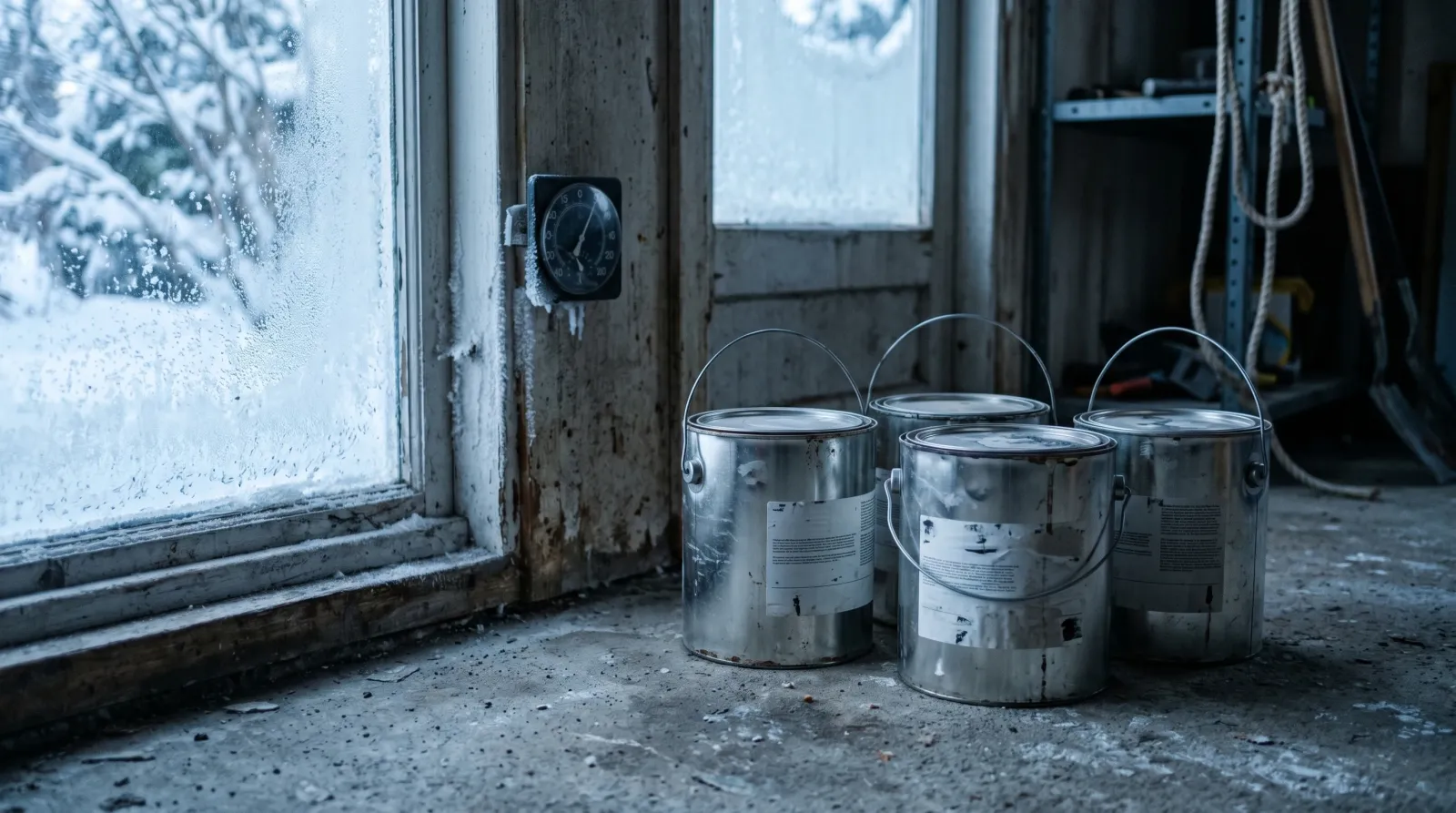
Yes, paint freezes, and water-based paint does it at about 32°F because water is the thing doing the freezing. Latex and acrylic paints are roughly 30–50% water by volume, and that water expands as it turns to ice. A can left on a 25°F garage floor overnight can come out thickened, grainy, or curdled past saving. Oil-based paint behaves differently. Its carrier is solvent, not water, so it does not truly freeze near 32°F, though it gets sluggish and should still stay above 40°F. The safe storage window for any paint is 50°F to 80°F.
The damage is not the cold itself. It is what the cold does to the way the paint is built.
TL;DR
- Water-based paint freezes around 32°F. Latex and acrylic both, because water is the carrier.
- Freezing can break the emulsion permanently. Once the binder coagulates, no amount of stirring brings it back.
- Oil-based paint does not freeze at 32°F but thickens; keep it above 40°F anyway.
- Thaw slowly, then stir and test. Smooth and uniform after stirring means usable. Grainy or lumpy means trash.
- Store at 50°F–80°F, off cold floors, in a heated space. Cold concrete is the usual culprit.
Why Water-Based Paint Freezes (and What Breaks)
A latex paint is an emulsion. Microscopic particles of binder (the acrylic or vinyl resin that becomes the dried film) float dispersed in water, kept evenly apart by surfactants so they do not clump before you want them to. Pigment particles ride along in the same suspension. The whole system is a stable standoff, and water is the medium holding everyone at arm’s length.
When that water freezes, ice crystals grow inside the can. As they grow, they physically shove the binder and pigment particles together and squeeze the surfactant films between them. Push two binder particles close enough, hard enough, and they fuse. That fusion is exactly what is supposed to happen later, on your wall, during film formation. It is not supposed to happen in the can.
The reason that matters: once binder particles coalesce into lumps inside the liquid, the dispersion is broken. You get grit, stringiness, or a curdled cottage-cheese texture. Those clumps will not re-disperse. Stir all you want; the resin has already crossed the line from suspended to solid.
A shallow freeze that barely forms ice may only stress the system. A hard, deep freeze that turns the whole can to a block almost always wins. Cheaper paints with thinner surfactant packages fail sooner, which is part of why a premium acrylic can survive a cold snap that ruins a bargain-bin gallon.
Does Oil-Based Paint Freeze?
Not at the temperature water does. Oil-based and alkyd paints carry their binder in mineral spirits or similar solvents, and those have far lower freezing points. What you get in the cold instead is thickening. The paint turns stiff and hard to stir, and very low temperatures can cause some separation, but it is usually reversible once the can warms back to room temperature.
Keep oil-based paint above 40°F anyway. Cold solvent paint brushes out poorly and can sag or hold brush marks if you try to use it straight from a frigid garage. For the broader differences in how these two paint families behave, see oil vs water-based paint.
How to Tell if Frozen Paint Is Still Good
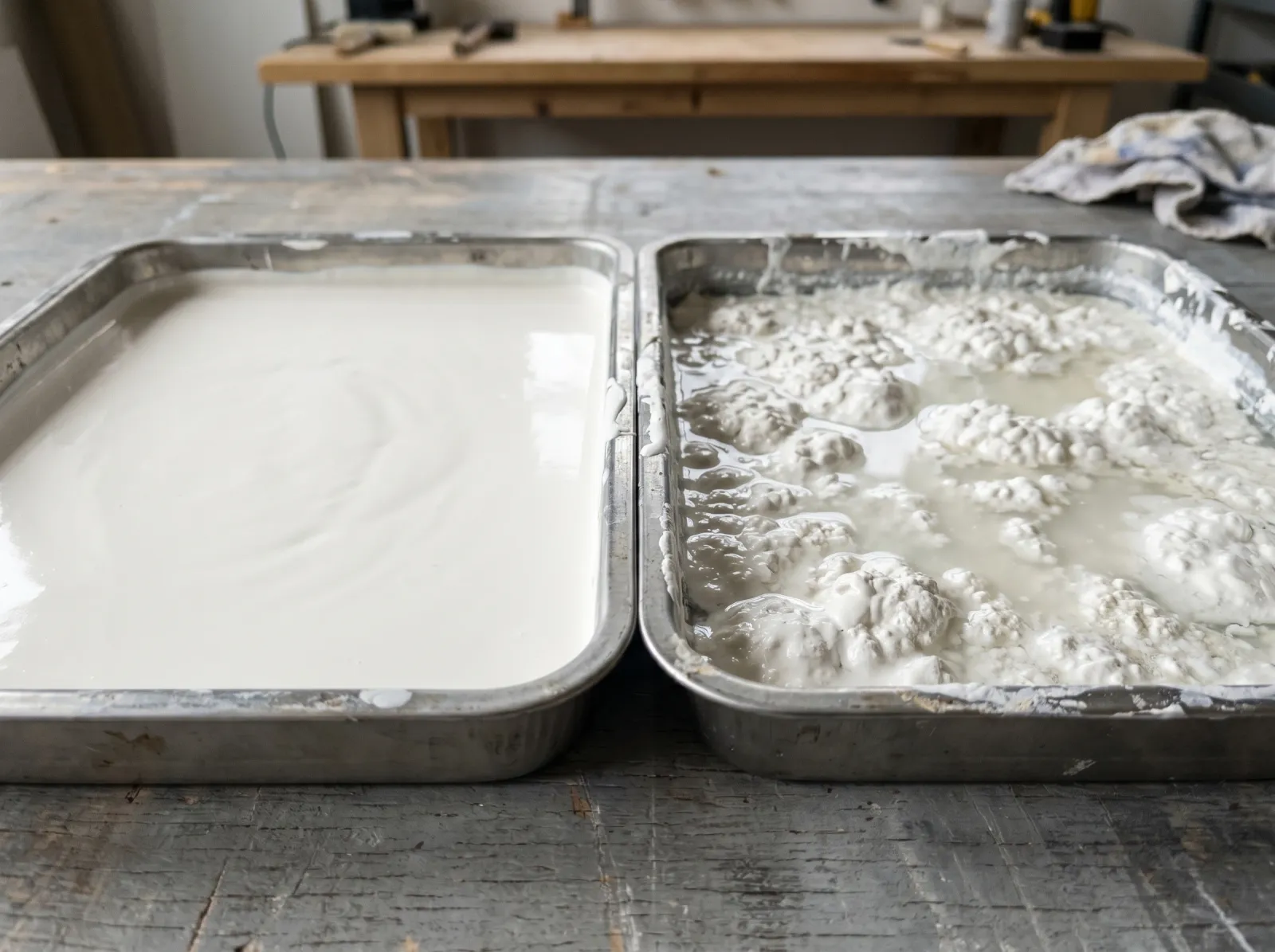 Left: a healthy latex film still smooth and uniform. Right: a broken emulsion after a hard freeze, with separated water and rubbery clumps that will not re-blend.
Start by thawing the can slowly. Bring it indoors to a room-temperature spot and leave it 24 to 48 hours. Do not put it near a heater, on a radiator, or in hot water. Fast, uneven heating stresses the emulsion the same way the freeze did.
Once it is fully at room temperature, open it and stir, slowly and thoroughly, for a few minutes. Then read the result:
- Stirs back to a smooth, uniform liquid? It survived. Brush a little on cardboard to confirm it flows out clean.
- Stays grainy, stringy, or full of soft rubbery lumps? The emulsion broke. The paint is done.
- Has a skin or a little settled pigment but blends in smoothly? That is normal settling, not freeze damage. Use it.
The cardboard test is the honest one. Coagulated binder shows up as grit and drag under the brush even when the can looks acceptable. If the film is gummy or bitty, no wall deserves it.
When to Throw Frozen Paint Out
Some signs mean the can will never paint right again, no matter how long you stir:
- A cottage-cheese or curdled texture that will not blend back to liquid.
- Hard or rubbery clumps that catch in the brush.
- A separated layer that re-forms within minutes of stirring.
- A sour or strongly “off” smell beyond the usual paint odor, which can also signal a separate problem (spoiled biocide from age).
Trashing a $50 gallon stings, but using ruined paint costs more. A broken emulsion will not form a continuous film. It can flake, peel, or fail to bond, and then you are repainting anyway. The downstream version of that failure is the kind of bond loss covered in our guide to fixing peeling paint.
How to Store Paint Through Winter
Storage is mostly about two things: temperature and the floor.
- Keep it between 50°F and 80°F. A conditioned closet, a basement that stays above freezing, or an interior utility room all work.
- Get cans off the concrete. Cold slabs pull heat out of a can faster than the surrounding air, so floor-level cans freeze first. A shelf even a foot up helps.
- Seal the lid tight. Tap it down all the way around. A loose lid lets water evaporate and a skin form, which is a different way to lose a gallon.
- Store cans upside down once sealed. The paint forms its skin against the bottom (now the top), keeping the bulk fresh. Only do this with a verified-tight lid.
- Do not trust an unheated garage or shed in a cold climate. If your winters drop below freezing, that gallon you saved from the kitchen job will not survive February out there.
For an apartment with no good cold-safe storage, the simplest move is to keep leftover paint indoors in a closet rather than a balcony or unheated storage unit.
Common Mistakes
- Heating a frozen can to thaw it faster. Hot water or a space heater drives uneven coalescence and can finish off paint that a slow thaw would have saved. Patience is the fix.
- Assuming the can survived because it looks fine on top. Freeze damage hides in the body of the paint. Stir fully and brush a sample before committing it to a wall.
- Storing paint on the garage floor “just for the winter.” The floor is the coldest surface in the room. This is the single most common way good paint freezes.
- Painting in the cold, not just storing in the cold. Most latex needs surface and air temperatures above 50°F to form a film correctly. Cold application causes poor coalescence, the same root failure as freezing, even if the can never froze. The same logic explains why low-VOC paints behave oddly in cold rooms; see what VOCs actually do in paint.
Where to Buy
You do not buy “freeze-proof” paint, because no water-based paint is. What you can buy is quality. Premium acrylics from Benjamin Moore, Sherwin-Williams, and Behr carry stronger surfactant and binder packages that tolerate a shallow freeze-thaw better than bargain lines, though none are immune. If a can mattered enough to keep, it matters enough to store above freezing.
Ask a Question