How to Paint Mobile / Manufactured-Home Aluminum Siding
Pressure-wash the chalking, TSP and bleach the mildew, self-etching primer on bare spots, DTM acrylic topcoat. Stick to light colors or the panels warp by August.

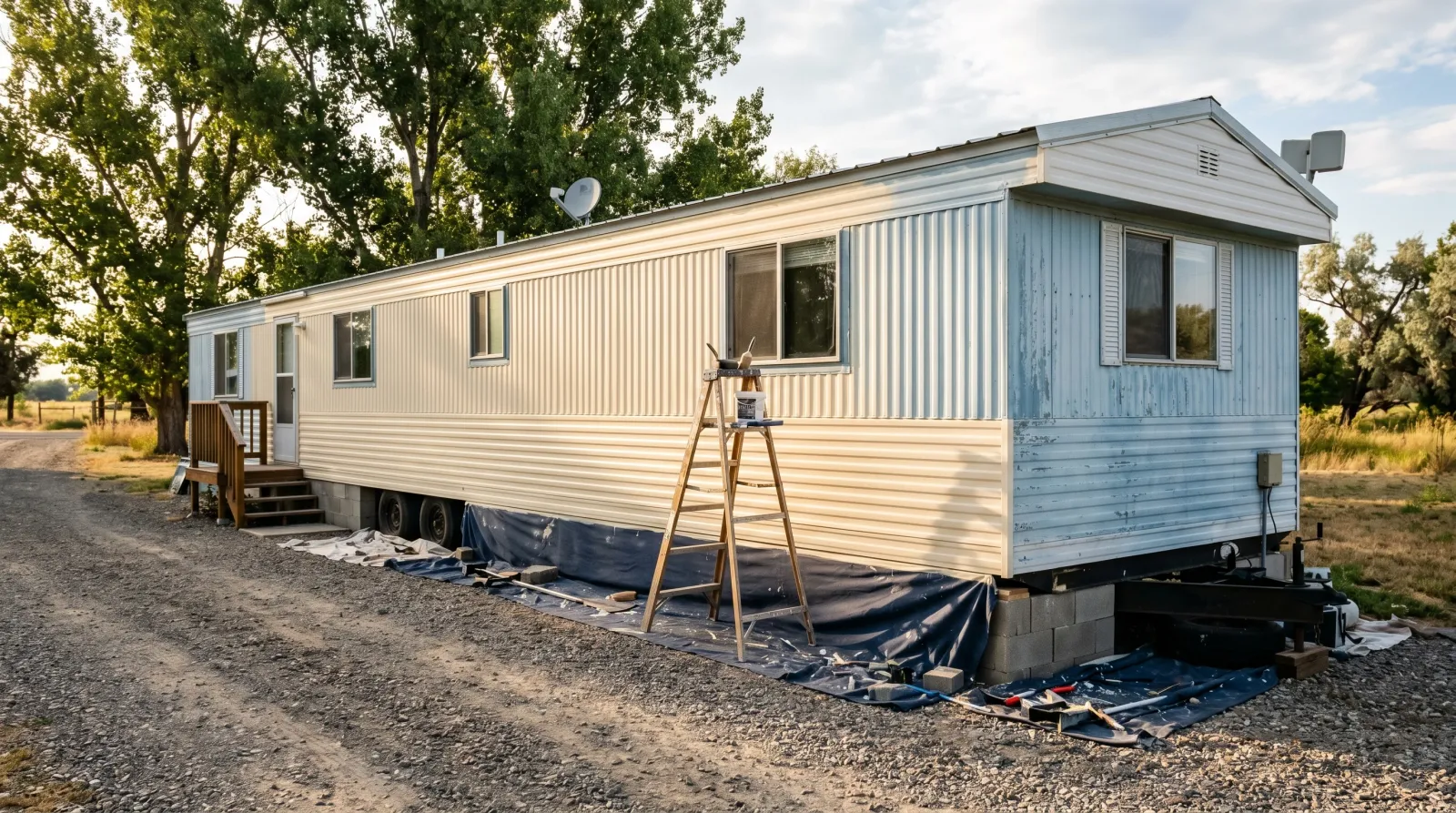
Mobile-home siding from the 80s? Same rules as house aluminum, thinner metal, less margin.
The aluminum on a manufactured home isn’t the same stuff as the aluminum lap on a stick-built ranch. It’s about two gauges thinner, the factory enamel was cured at a lower temperature, and most coaches sat on a lot in full sun for ten years before anyone owned them. By the time a repaint is on the table, the south wall is chalking, the seams have walked, and somebody has hung a wreath on a tack and torn paint off the panel underneath. The job isn’t repainting metal. It’s rebuilding the coating system without dimpling the substrate underneath.
TL;DR
- Wash: TSP plus 1:10 bleach, soft pole brush, 1,200 PSI rinse with a 40-degree tip
- Wipe-test: clean white cloth on the south face. Gray cloth means chalk and a bonding primer
- Bare-spot primer: Rust-Oleum Self-Etching Primer aerosol on scratches and dings cut through to silver
- Wall primer: Zinsser Peel Stop Triple Thick over chalky enamel; INSL-X Aqua-Lock on sound non-chalking siding
- Topcoat: DTM 100% acrylic exterior. Behr Premium Plus Exterior (budget) or BM Aura Exterior (premium). Two coats
- Color limits: LRV 50+ on south and west walls. Mobile-home aluminum warps faster than house aluminum
- Cure: 30 days before the first pressure wash of the new finish
- Skill: medium. Same system as house aluminum, less margin on every step
What Mobile-Home Aluminum Siding Actually Is
Sheet aluminum, usually 26 or 28 gauge, pressed into ribbed or smooth horizontal panels and attached to the framing with concealed nails through the upper flange. The factory finish is a baked acrylic or polyester enamel applied at the coil mill. On a 1975–1995 coach, that finish was sold as 20 years. It usually delivered 12 to 18, and the wall you’re looking at is past it. Thinner gauge than house-grade aluminum lap (24), longer unsupported panel runs on a single-wide elevation. That combination is why mobile-home aluminum dents under a leaned-in roller and dimples if the pressure washer gets closer than two feet.
Tools and Materials
Materials
- DTM acrylic exterior topcoat: Behr Premium Plus Exterior at Home Depot, or Benjamin Moore Aura Exterior at a BM dealer
- Dechalk bonding primer: Zinsser Peel Stop Triple Thick for chalky enamel, or INSL-X Aqua-Lock for sound siding
- Self-etching primer: Rust-Oleum Self-Etching Primer (aerosol) for scratched-through bare spots
- TSP or TSP substitute (Krud Kutter Original) plus household bleach for the wash
- Light-body Bondo for dings; the auto-body kind, not wood filler
- Stretchy elastomeric caulk (Sashco Big Stretch) for trim and corner-stud seams. Not the laps themselves
Tools
- Pressure washer at 1,200 PSI ceiling, 40-degree tip
- Soft-bristle car-wash brush on an extension pole
- 2-inch angled sash brush, 9-inch roller frame, 3/8-inch microfiber covers
- 220-grit sanding sponges
- Clean white cotton rags for the chalk wipe-test
- 411 tip airless sprayer if you’re going the spray-and-back-roll route
- Drop cloths, masking film, painter’s tape
- P100 respirator and eye protection
Why Mobile-Home Aluminum Is Trickier Than House Aluminum
Three things that don’t apply to a stick-built home.
The metal is thinner. 26-28 gauge versus 24. Thinner metal heats faster, expands further, and deforms easier under any pressure. Substrate’s more like a beer can than a barn.
The wall framing is on 16-inch centers but the panels span the whole elevation. Unsupported sections flex when you press on them. Lean into a roller in the middle of a 14-foot run and the panel creases. Pressure-wash too close and you get a permanent dimple.
Color tolerance is tighter. A south-facing dark color on house aluminum warps panels. On mobile-home aluminum it warps them faster and worse. LRV 50+ on sunny walls isn’t a guideline; it’s the limit. Black skirting and trim are fine. Black walls bow the studs.
Read the Wall Before You Buy a Thing
Same three checks as house aluminum. Each one takes ten minutes and changes the materials list.
Chalk wipe-test. Clean white cotton rag, dry. Rub a hand-sized circle on the south wall in direct sun. Cloth comes back clean: sound substrate, you’re on the easier path. Cloth comes back gray or wall-colored: chalk, and you’re committed to dechalking primer wall-wide. Heavy color transfer means two wash cycles and probably two primer coats.
Bare-spot survey. Walk the whole coach. Look for scratches, gouges, or tack holes where the factory enamel is gone and you’re staring at silver aluminum. Every one of those spots needs self-etching primer before the wall-wide primer goes on. Skip the etch and the topcoat fails at those spots first, usually as bubbles the second summer.
Panel-press test. Press the face of a panel between studs with two fingers. Sound aluminum springs back. Soft, deformed, or oil-canning spots mean the metal has stretched and isn’t coming back flat. Filler over a stretched panel telegraphs through the topcoat as a visible scar. If the wall is heavily oil-canned, the paint job won’t hide it. Plan to live with it or replace panels.
Step 1: Wash the Coach
Mix TSP at label dilution. Add a cup of household bleach per gallon for the shaded north and east walls. Bleach kills mildew; TSP cuts chalk. Scrub bottom-up with a soft-bristle pole brush so the dirty runoff doesn’t bake into dry siding above the work line.
Pressure-wash to rinse. 1,200 PSI ceiling, 40-degree tip, two feet off the wall. Lower pressure and wider fan than a house aluminum job because mobile-home metal dimples easier. Closer than two feet and the dimples show in raking morning sun for the rest of the wall’s life.
Wipe-test the south wall once it’s dry. Still graying? Wash again. The wash is the job. Cutting it short is why most repainted mobile homes look fine in October and peel by July.
48 hours of dry weather before primer.
Step 2: Repair, Etch, and Feather
Dings get a feather of light-body Bondo and a 30-minute sand at 220 grit. Aluminum is soft, Bondo bonds fine, sands easy. Real dents — anything punched past the field of the panel — get a panel replacement, not filler. Hide a dent under topcoat and it comes right back through as a shadow.
Scuff-sand spots where the old enamel shows hairline curls. 220 sponge, very light pressure. You’re breaking the gloss, not removing material.
Bare spots next. Every scratch, every tack hole, every nail scar where you can see silver metal: hit it with Rust-Oleum Self-Etching Primer aerosol. The acid in the etching primer micro-roughens the aluminum oxide and bites in. Two light coats, 10 minutes apart. Skip the etch and the wall-wide primer is sitting on slick mill aluminum at those spots, and the topcoat lifts there first.
Tack-cloth the dust. Damp-rag the wall. Hour to dry.
Step 3: Prime the Whole Wall
Match the primer to what the wipe-test told you.
Chalky enamel (most 1975-1995 coaches). Zinsser Peel Stop Triple Thick. It’s a high-build acrylic that penetrates light chalk, binds the loose pigment underneath, and leaves a sound surface for topcoat. On heavily chalked walls, two coats. The product is forgiving on mobile-home substrates because the build film handles slight irregularities in the old enamel without requiring you to sand the whole coach.
Sound non-chalking enamel. INSL-X Aqua-Lock. 100% acrylic waterborne DTM primer that bonds on the slick factory mill surface. Faster recoat than Peel Stop, and it handles older but still-sound siding without the high-build film thickness.
Don’t use oil-based primer. Aluminum oxide is alkaline. Alkaline substrates saponify oil binders into literal soap, and the primer turns chalky and lets go inside a year. Same chemistry that wrecks oil paint on fresh masonry. Waterborne acrylic only on aluminum, every time.
Brush the lap underside with a 2-inch angled sash. Roll the face with a 3/8-inch microfiber on a 9-inch frame. Light pressure on the roller. Touch dry 4 hours, recoat 16. Watch the laps in raking light before you call the coat done.
Step 4: First Topcoat
DTM 100% acrylic exterior. Behr Premium Plus Exterior is the budget pick. Solid film, decent UV package, at every Home Depot. Benjamin Moore Aura Exterior is the premium pick. Best chalk resistance I’ve seen on aluminum, longest service life on south walls, color stays where the can says. The premium hurts going in and pays back at year ten.
Color matters on mobile-home aluminum more than on any other exterior substrate. LRV 50 or higher on south and west walls. Soft creams, pale sage, light gray, warm beige all work. Black, deep navy, charcoal: fine on skirting and trim, dangerous on the field of the wall. A west-facing dark wall on a single-wide in Phoenix hits 175°F surface temperature in August and oil-cans the metal between studs into waves you can’t sand out.
Brush the lap underside with the 2-inch angled sash, roll the face with the 3/8-inch microfiber. Keep the roller loaded so you’re laying paint, not pressing it. Don’t lean into the cover.
Spraying the whole coach: 411 tip airless, steady pace, back-roll every band. Spray-only on mobile-home aluminum leaves a film on top of the surface instead of in it, and the lap edges blur within a year.
Step 5: Second Topcoat
Sixteen hours after the first. Same method. Same color from the same gallon mix. Mobile-home aluminum shows slight color shifts between coats because the ribbed face catches raking light from every angle. One pre-mixed pot for the whole coach if you can swing it.
Watch the wall in early-morning sun before you pack up. Holidays show as dull patches on the lap face. Touch up with a brush from the same can while the paint is still in the can.
Dry, Recoat, Cure
- Touch dry: 1–2 hours at 70°F
- Recoat: 16 hours minimum
- Full cure: 30 days
What you can’t do during that 30 days: pressure-wash the new finish, scrub it, hang anything heavy on a tack, or wash the windows with anything stronger than dish soap and water. The film is in the can, on the wall, dry to the touch, but it’s still chemically curing. Full hardness lands at day 30.
Common Mistakes
- Skipping the bare-spot self-etch. The single most common failure mode I see on repainted mobile homes. Self-etching primer on every scratch and tack hole before the wall primer. Skip it and the topcoat lifts off those spots within 18 months.
- Pressure-washing too close. 1,200 PSI ceiling, 40-degree tip, two feet off the wall. Closer than that and you dimple the face. Dimples in raking morning light show up the second the paint cures and never go away.
- Oil-based primer on aluminum. Saponifies into soap inside a year. Waterborne acrylic only.
- Dark color on a south or west wall. LRV under 40 on mobile-home aluminum on a sunny elevation oil-cans the panels into permanent waves. Stick to LRV 50+. Save the dark colors for the skirting and the front door.
- Heavy roller pressure. Mobile-home aluminum dents easier than house aluminum. Light hand. 3/8-inch microfiber, not 1/2-inch. Keep the cover loaded.
- One topcoat instead of two. Cheap repaints try to get away with a single heavy coat. Doesn’t work. Aluminum needs the full mil thickness of two coats for the topcoat to chalk evenly across the wall.
Failure Modes to Watch For
- Peel-from-chalking. Big sheets of topcoat coming off the wall, clean back of the paint, no primer pulled with it. Cause: chalk wasn’t dechalked before priming. Fix: strip the failed area, wash with TSP, dechalk-prime, recoat.
- Bubble-and-lift at bare spots. Small bubbles or quarter-sized lifts at scratch points, nail heads, or old tack holes. Cause: self-etching primer was skipped. Fix: scrape the lift back to sound paint, self-etch the bare spot, prime, topcoat.
- Warp-from-heat. Visible waves in the panel face on south or west walls after the first hot summer. Cause: dark color on a sunny elevation, thin substrate. Fix: lighten the color or replace the warped panels. You can’t sand a warp out of mobile-home aluminum.
- Dimple-from-pressure-wash. Hundreds of small pock marks in the lap face under raking light. Cause: pressure washer was too close or too hot during the wash. Live with it or replace panels. Won’t fail the paint job, just looks bad in morning sun.
Maintenance and Longevity
A properly washed, dechalked, etched, primed, and two-coated mobile-home siding job runs 8 to 12 years on north and east walls, 6 to 8 on south and west. The original factory enamel was selling 20 years and most of those walls delivered 15. No field-applied coating matches a baked finish. Don’t expect to beat the factory.
Wash annually with a soft pole brush and dish soap. No pressure washing in the first year of cure; after that, 800 PSI on a 40-degree tip is the ceiling. Touch up dings the season they happen with a small bottle of the topcoat color, labeled and stored under the kitchen sink. South-wall chalk wipe-test at year five. If it grays the cloth at year five, you’ve got two summers before a refresh.
The thing that’ll bite you in two years isn’t a brand of paint or a brand of primer. It’s the spots you skipped: the bare aluminum you didn’t etch, the chalk you didn’t wash twice, the dark color you put on the south wall because the brochure photo looked good. Get the prep honest and the wall holds. Cut corners on prep and the wall tells on you the next time the morning sun hits it sideways.
Ask a Question