Painting MDF vs Plywood: Which Substrate Paints Better?
Head-to-head on edges, sealing, sanding, and final finish. Pick the right sheet for built-ins, shelves, cabinets, and trim in 60 seconds.

The 30-Second Answer
For a glass-smooth painted finish on something that stays dry, MDF wins. For anything that takes a bump, carries weight, or might see moisture, plywood wins. Cabinet doors and shelf faces lean MDF. Cabinet boxes, structural shelves, and built-ins around sinks lean plywood. Most kitchen jobs use both — MDF for the show-face parts, plywood for the carcass.
At a Glance
| MDF | Plywood | |
|---|---|---|
| Surface smoothness | 🟢 glass | 🟡 grain shows |
| Edge behavior | 🔴 fuzzy, needs sealing | 🟢 clean |
| Moisture tolerance | 🔴 swells, permanent | 🟢 handles wet |
| Sanding effort | 🟢 minimal | 🟡 grain fill needed for glass |
| Cost (¾ in, 4×8) | 🟢 $35–55 | 🔴 $55–110 |
How to Tell Which You’ve Got
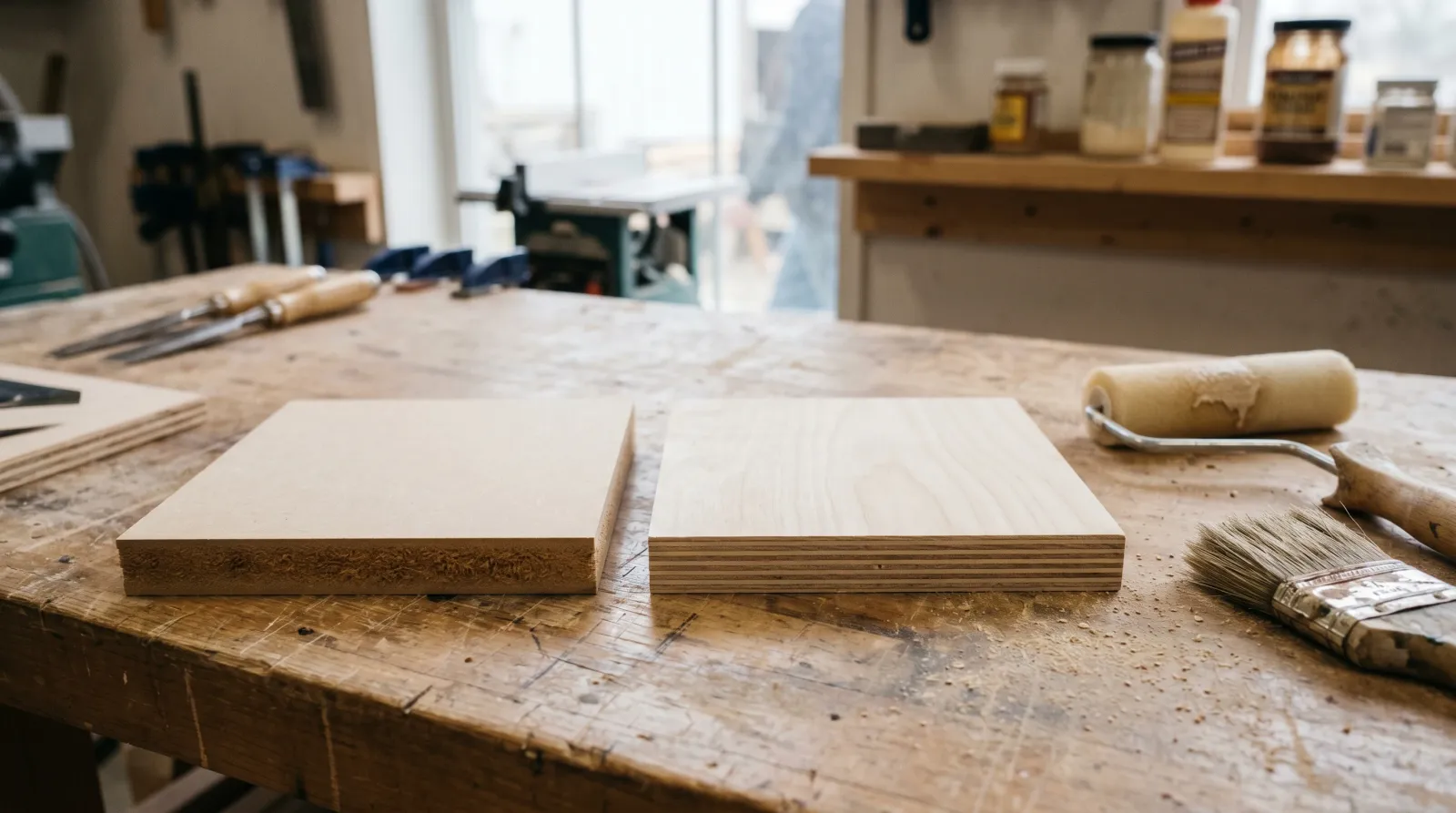
Flip the panel over and look at the edge. MDF reads as one solid tan color all the way through, like dense cardboard. Plywood shows stacked layers — five, seven, or nine plies depending on grade. Weight is the other tell. A sheet of ¾-inch MDF runs about 95 lb. The same sheet of ¾-inch birch ply runs about 65 lb. Lift one corner. MDF feels like a dead body. Plywood feels like wood.
Surface and Edges
This is the whole game. MDF’s face is uniform, perfectly flat, and takes paint like glass. No grain to telegraph through the topcoat, no knots, no wild fiber direction. A roller leaves a finish that looks sprayed if you keep a wet edge.
Plywood’s face shows grain. Even cabinet-grade birch or maple ply has long-grain figure that prints through paint, especially in raking light. You can fill the grain (drywall compound, two passes, sand flat) and get close to MDF smoothness, but it’s an extra day of work.
The edges flip the comparison. Plywood edges look like wood — a clean stripe of plies. Paint them and they read fine. MDF edges are raw compressed fiber. Out of the box, they suck up paint, dry fuzzy, and show a halo around the part even after topcoat. You either seal them (BIN, two coats, sanded) or you cover them with edge banding or trim. There’s no shortcut.
Winner: MDF on face, plywood on edge.
Sealing and Primer
MDF’s face is sealed enough at the factory that a standard water-based primer covers it. The cut edges need real attention. Three working options, ranked by reliability:
- Two coats of Zinsser BIN shellac primer, sanded between with 220-grit. Locks down the fiber, dries in 45 minutes, sands to powder. The pro answer.
- Drywall compound thinned to a pancake-batter consistency, wiped onto the edge with a finger, sanded flat once dry, then primed. Cheap and effective on flat edges, awful on routed profiles.
- Two coats of high-build oil primer (Cover Stain). Works, takes overnight per coat. The middle option.
Plywood is friendlier to a single-coat workflow. A bonding water-based primer (Stix, Insl-X Cabinet Coat primer) on a sanded surface holds without drama. If your plywood has knots or you’re working with fir, jump to an oil-based stain blocker — knots bleed through latex primer in two to four weeks. BIN handles knots too, and at that point you’re using the same can on both substrates.
Winner: Plywood on simplicity. Either substrate can land a perfect prime, but plywood lets you skip the edge ritual.
Sanding and Prep
MDF arrives smoother than any sanded wood surface you’ll ever produce. A scuff with 220-grit on the face is enough for primer adhesion. The face barely needs sanding between coats either — a quick pass with 320 between primer and topcoat and you’re done. The dust is fine, gets everywhere, and you want a respirator on. Wear one.
Plywood asks for more sandpaper. Even cabinet-grade ply ships with mill marks, faint scratches, and slightly fuzzy grain after the production sander. Start at 150-grit, work to 220, hit it with 320 after primer. If you want plywood to look as smooth as MDF, you’re filling grain — that’s another pass with thinned compound and another sanding cycle.
Winner: MDF. Less sandpaper, less time, less judgment.
Final Finish
A primed MDF panel rolled with a quality foam roller and a self-leveling waterborne alkyd (BM Advance, SW Emerald Urethane) looks sprayed. The substrate is dead flat, the paint flows over it, and there’s nothing for the eye to catch. This is why every Shaker cabinet door at every big-box store is MDF — the painted finish is what sells the part.
Plywood’s grain telegraphs through paint forever unless you fill it. Even three coats of premium enamel won’t hide the long-grain figure of birch or maple in raking light. Some people read that as warmth. Some people read it as cheap. If you want the look of painted wood, plywood. If you want the look of lacquered cabinet, MDF.
Both substrates take topcoat the same way. Foam roller on flat panels, brush in the recesses, two coats minimum, respect the recoat window on whatever can you bought.
Winner: MDF. A clean glass finish is what makes painted cabinetry look like cabinetry.
Cost and Workability
MDF is cheaper. A ¾-inch 4×8 sheet runs $35–55 at the big box. The same sheet in cabinet-grade birch plywood runs $55–110 depending on grade and how the import tariffs are behaving that month. Across a kitchen’s worth of cabinet doors, MDF saves real money.
But MDF cuts slow, dulls blades fast, and is brutal on lungs and shop air. The dust is fine enough to hang in the air for hours. A dust extractor on the saw is mandatory. Plywood cuts cleaner, splinters where MDF wouldn’t, and the dust falls instead of hanging. Plywood also holds screws and fasteners where MDF strips out — you can’t run a long screw into the end-grain of MDF and expect it to hold under any real load.
Winner: Split. MDF on sticker price; plywood on shop workability and structural performance.
Verdict by Use Case
- Pick MDF if: you’re building cabinet doors, drawer fronts, shelf faces, wainscoting, or trim that’s going to be painted and stays out of standing water. The painted finish is the whole reason to use this material.
- Pick plywood if: the part carries weight, gets bumped, lives near a sink or tub, or needs to hold a screw at an edge. Cabinet carcasses, kitchen island sides, bookshelf shelves over 30 inches wide, anywhere a hinge or drawer slide is mechanically loaded.
- It’s basically a tie when: you’re building a piece of bedroom furniture that stays dry, sees light use, and you want it painted. Both work. Buy whichever’s cheaper at the lumberyard that day.
Top Picks by Substrate
Going with MDF? See the MDF substrate guide for the full edge-sealing playbook, and the best paint for MDF for verified topcoats that lay flat on a primed face.
Going with plywood? See the plywood substrate guide for grain-fill technique, and the kitchen cabinet paint round-up for self-leveling enamels that work on both substrates.
FAQ
Can I paint MDF and plywood with the same primer? Sometimes. BIN shellac and Cover Stain handle both. If you only buy one can for a mixed-substrate job, buy BIN — it locks MDF fuzz and blocks plywood knots in the same coat. Standard water-based primer is fine on plywood faces but leaves you doing the edge ritual on MDF anyway.
Which one swells if it gets wet? MDF, and it’s permanent. A water droplet sitting on raw MDF for an hour leaves a raised bump you can feel forever. Sealed MDF resists short exposure but isn’t waterproof. Plywood handles short wet exposure and dries back to shape. This is why bathroom cabinet boxes lean plywood even when the doors are MDF.
Do I really need to seal MDF edges? Yes. Skip it once and you’ll never skip it again. The fuzz halo around every edge is what separates a homeowner-painted MDF panel from a factory-finished one. Two coats of BIN, sand between, prime, paint. Takes an extra hour. Saves the whole job from looking amateur.