Matte vs Flat — Are They the Same Thing?
No — flat and matte are not the same paint. Gloss-unit ranges, the Behr flat-vs-matte answer, a room-by-room table, and the furniture call — a jobsite verdict, not a Pinterest one.

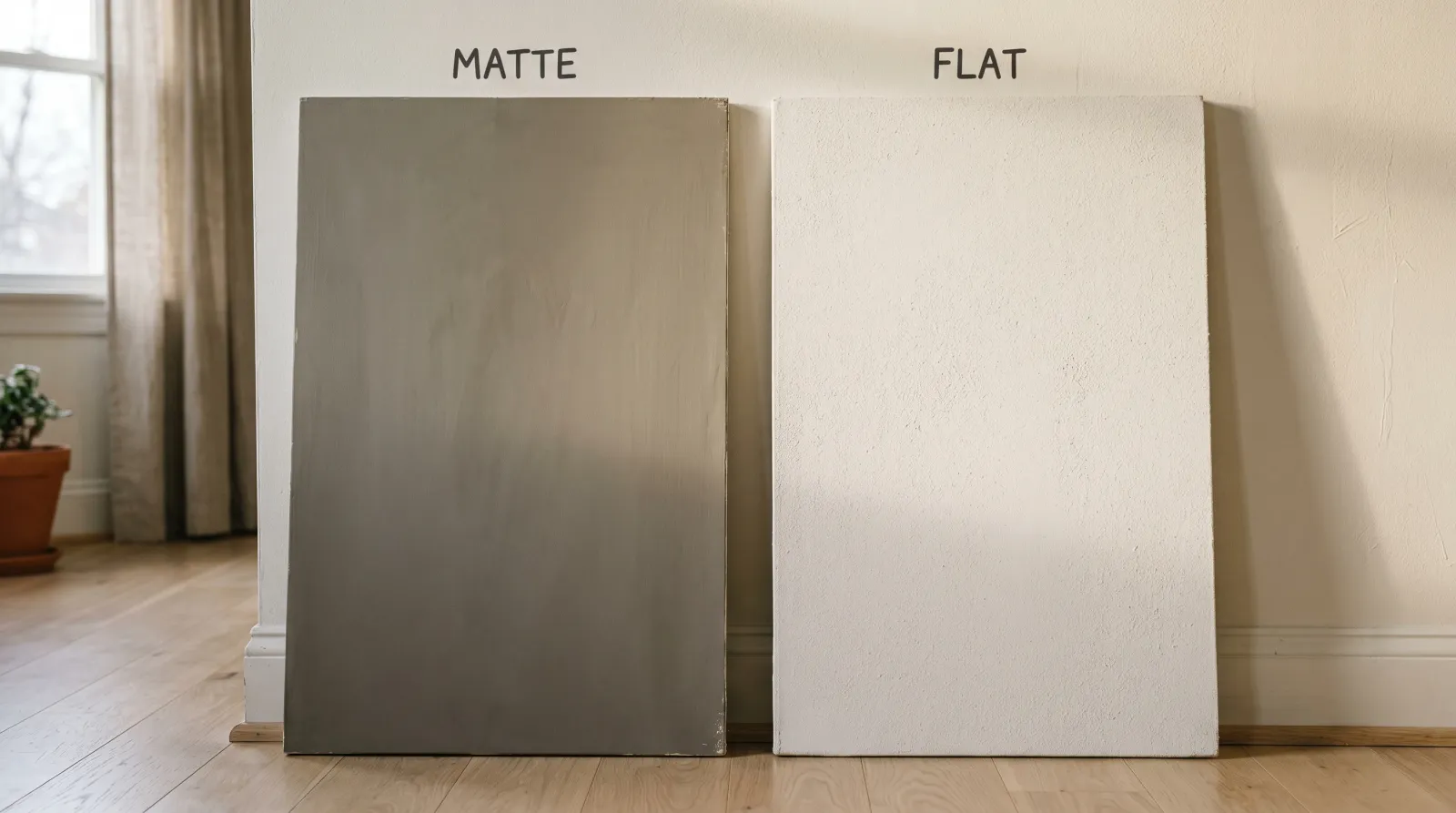
The 30-Second Answer
No, flat and matte are not the same paint. They used to be the same thing. They aren’t anymore. Flat is the chalky, dead-zero-shine, high-pigment film your grandfather rolled on a ceiling. Matte in a modern premium line is a washable, burnish-resistant velvet finish that lives one notch above flat on the gloss curve. The label “matte” and the label “flat” overlap on the cheap end of the deck. They split on the premium end. Aura Matte is matte. Builder’s-grade ceiling white is flat. Pick flat for ceilings, closets, and rooms nobody touches. Pick matte for living-zone walls, but read the data sheet before you assume your brand’s matte behaves like the next brand’s matte.
Where They Sit on the Sheen Ladder
Matte is one step above flat, and flat is the bottom rung. The whole ladder, shiniest to dullest:
- High-gloss — mirror-level reflection
- Semi-gloss — trim, doors, baths
- Satin — kitchens, hallways, wet zones
- Eggshell — the all-purpose wall sheen
- Matte — very low gloss, reflects very little (3–10 GU at 60°)
- Flat — zero gloss, reflects essentially no light (0–5 GU at 60°)
That’s the entire difference in one line: flat reflects nothing, matte reflects almost nothing. Everything else in this comparison comes from what the manufacturers do to the binder to get there. The full sheen guide walks all five levels if you’re picking from scratch.
At a Glance
| Matte | Flat | |
|---|---|---|
| Gloss units (60°) | 3–10 | 0–5 |
| Hides drywall flaws | 🟢 Very good | 🟢 Best in class |
| Scrub resistance | 🟢 Good (premium) / 🟡 Weak (builder) | 🔴 Poor |
| Burnishes when wiped | 🟡 Sometimes / 🟢 Aura no | 🔴 Lifts and streaks |
| Touch-up appearance | 🟢 Clean | 🟢 Clean |
| Best surface | Living-zone walls | Ceilings, closets, low-touch walls |
| Cost per gallon | $$ | $ |
How to Tell Which One You Already Have
The flashlight test works on this one. Hold a flashlight at a 45-degree angle six inches off the wall. Matte gives you a soft pool of light with a faint edge. Flat gives you almost no bounce at all — the light dies into the wall. The fingertip test works too. Matte feels velvety and slightly waxy. Flat feels powdery, sometimes a little chalky, and a fingernail edge will leave a faint scratch line on a true flat film.
The kill test is a damp sponge. Wipe a small spot. If the wall stays the same color, you have a washable matte. If the wall now has a darker wet ring that dries chalkier than the rest, you have flat. If you pulled a faint smear of pigment off onto the sponge, you have builder-grade flat and you should plan on a repaint.
Hiding Under Raking Light
Both win here. That’s the whole reason these sheens exist.
A 2 GU flat film scatters light in every direction it can. A taped seam, a feathered patch, a slight bow in the framing — they all read as part of one continuous plane. Drywall hides better under flat than under any other paint sold for interior walls. That’s why landlords roll flat in apartments, why ceiling paint is always flat, and why a 30-year-old plaster wall with a hundred small dings looks acceptable under flat and terrible under satin.
Matte is one or two GU above that, depending on the brand. The hiding gap between a 3 GU matte and a 2 GU flat is real but small. Most homeowners can’t see it without holding a sample board next to it. The gap between matte and eggshell is the gap that actually shows up in a room. The gap between matte and flat is one a contractor argues about and a homeowner doesn’t notice.
Winner: Flat, by a sliver.
Burnishing and Wipe-Down
This is the dimension that ended the era when matte and flat meant the same thing.
A traditional flat film is mostly pigment with just enough binder to hold the pigment to the wall. Run a damp sponge across it and you do two things. You flatten the surface texture where you pressed — that’s burnishing, the glossy spot. And you lift pigment straight off the wall — that’s the chalk mark on the sponge. Both happen at once on a true flat. The wall is worse after you cleaned it.
A modern premium matte has a tighter binder pack and a tougher film. Benjamin Moore Aura Matte, built on Color Lock, will take a damp magic eraser without burnishing or pigment lift. Behr Marquee matte and Sherwin-Williams Cashmere low-lustre wipe almost as well. The cheap end of the matte deck — contractor-grade and store-brand mattes — will still burnish, but they won’t usually lift pigment.
A flat finish doesn’t survive a wipe. Period. If a wall is going to get touched once a year, flat fails. If a ceiling is going to get hit with a roller pole and never touched again, flat is the right answer.
Winner: Matte, by a country mile.
Gloss Numbers and the Brand-Naming Trap
The label tells you the bucket. The TDS tells you the number. Here’s what some real premium-line cans actually read at:
| Brand & line | Stated sheen | Actual 60° GU |
|---|---|---|
| Benjamin Moore Aura | Matte | 3–7 |
| Benjamin Moore Regal Select | Matte | 5–10 |
| Sherwin-Williams Cashmere | Low Lustre | 8–12 |
| Sherwin-Williams ProMar 200 | Flat | 0–3 |
| Behr Marquee | Matte | 4–8 |
| Behr Premium Plus | Flat | 0–4 |
| Farrow & Ball Estate Emulsion | Estate Emulsion | 2 |
| Valspar Reserve | Flat | 2–5 |
| Glidden Premium | Flat | 0–3 |
Read that table twice. Cashmere “Low Lustre” hits eggshell numbers. Behr Marquee matte and Behr Premium Plus flat are separated by a few GU. Farrow & Ball calls their lowest-sheen wall paint “Estate Emulsion,” which is a true flat that burnishes if you breathe on it wrong.
If somebody at the store hands you a can labeled “matte” and tells you it’s the same as flat, they’re working off a 20-year-old script. They’re also wrong on most modern premium lines.
Winner: Nobody. The labels are unreliable, the numbers aren’t.
Behr Flat vs Behr Matte
This is the version of the question people actually type, so here’s the direct answer.
Behr’s own sheen chart calls flat a non-reflective finish that touches up well and hides minor imperfections, rates it medium-low on durability, and recommends it for low-traffic walls and ceilings only. It calls matte a low-luster reflective finish, rates it medium on durability, calls it easy to clean, and recommends it for family rooms, living rooms, kids’ rooms, dining rooms and even bathrooms. So on Behr’s own terms: flat is a hiding finish, matte is a living finish.
The part nobody tells you at the paint desk is that the two sheens don’t live in the same product tier.
| Behr interior line | Lowest sheen offered | Reads as |
|---|---|---|
| Premium Plus | Flat | Budget wall paint |
| Premium Plus Ultra | Extra Durable Flat | Mid-tier, no matte in the line |
| Marquee | Matte | Premium washable, no interior flat |
| Dynasty | Matte | Premium washable, no interior flat |
Read the last two rows. Marquee and Dynasty don’t sell an interior flat at all — matte is the floor. Premium Plus doesn’t sell a matte — flat is the floor. Which means at Behr you can’t actually compare flat and matte inside one can family. Choosing Behr matte over Behr flat is choosing a more expensive, more washable product tier, and the sheen label is just the side effect.
The practical read: if you’re standing in the aisle deciding between a Premium Plus flat gallon and a Marquee matte gallon for a living room, you’re not really picking a sheen. You’re picking whether the wall survives being cleaned. Buy the matte. If it’s a ceiling, buy the flat and keep the difference. The Premium Plus vs Ultra breakdown covers what the tier jump buys beyond sheen.
Every brand does some version of this. Benjamin Moore’s flat and matte sit in different lines too, and Sherwin-Williams runs its own naming. Behr just gets asked about most because the sheens are split across the widest price gap.
Touch-Up Appearance
Both touch up well. That’s part of why they survived as categories. A feathered patch on either finish disappears under most lighting because diffuse reflection swallows film-thickness variation.
The catch on flat is the wipe-induced burnish from someone trying to clean the wall before patching. If a spot got sponged a year ago, it now reads slightly shinier than the surrounding flat, and your touch-up will sit against that burnished area and look obvious. The catch on matte is brand-mixing. A Behr matte patched onto an Aura matte will read as a different sheen forever.
If the wall is honest and unwiped, both touch up clean.
Winner: Tie.
Cost and Coverage
Flat is cheaper. Almost always. Builder-grade flat lands around $20–35 per gallon and a premium flat tops out around $55. Matte from the same brand usually runs $5–15 more per gallon because the film tech costs more — tighter binder, better leveling, more washability additives.
Coverage is a wash. Both bury at 350–400 square feet per gallon on smooth drywall. Flat sometimes hides a previous color in one coat where matte takes two — pigment volume is higher in flat, and a higher pigment load means more opacity. Not a reason to choose flat for living walls, but it’s a real budget edge for ceilings and closets.
Winner: Flat, on price.
Room by Room — Flat or Matte
This table answers flat or matte only. If eggshell and satin are also on the table, some of these calls change — a hallway with kids in it wants eggshell, not either of these. See matte vs eggshell for that fork.
| Room | Pick | Why |
|---|---|---|
| Ceiling | Flat | Nobody touches it, and flat buries mud lines and roller texture overhead |
| Living room | Matte | Daily life, occasional fingerprint, needs to survive a wipe |
| Dining room | Matte | Chair-back rubs and the odd splash behind a seat |
| Hallway | Matte | Shoulders and sleeves hit this wall more than any other in the house |
| Kids’ room | Matte | Crayon, hand smudges, and a parent who will try to clean them |
| Home theater or media room | Flat | Zero screen glare off the side walls, and nobody scrubs a theater |
| Primary bedroom | Flat is fine | Low touch, raking morning light, hiding matters more than washing |
| Home office | Matte | Soft read behind a monitor, wipes when a chair scuffs the wall |
| Textured or beat-up plaster | Flat | Maximum hiding on a wall with a hundred small sins |
| Closet, garage interior, basement storage | Flat | Cheap, hides everything, never gets touched |
| Powder room, no shower | Washable matte | Low steam, high fingerprint count |
| Full bathroom with a tub or shower | Neither | Step up to eggshell or satin — see best bathroom paint |
Bathrooms and Humidity
Flat has no business in a bathroom. The film is porous by design — that’s what gives it the hiding power — and porous means it drinks steam, soap splatter, and toothpaste spray straight into the pigment matrix. Then you wipe it, and you lift paint. Two winters of that and the wall above the towel bar is a different color than the wall beside it.
Matte is a more interesting case, and this is where most guides stop too early. A premium washable matte is genuinely fine in a powder room — the half-bath with a toilet and a sink and no shower in it. There’s no sustained steam, but there are hands on the wall next to the light switch every day, and a washable matte handles that better than flat ever will.
A full bathroom is different. Shower steam condenses on the wall every day, and the cleaning is real cleaning, not a fingerprint wipe. Step up to eggshell or satin and stop arguing about it. The picks are in the bathroom paint round-up.
Flat vs Matte on Furniture
Different question, different answer, and a lot of people land here looking for it.
Chalk-style flat paint is the furniture version of flat, and it’s a genuinely great finish for the right piece. It goes on powdery and velvety, it hides dings in old wood, and it sands back at the edges into a distressed look nothing else fakes convincingly. It also scuffs if you look at it wrong and stains if a wet glass sits on it. Chalk paint on a working surface without a topcoat — wax or a water-based poly — is a mistake you make once. The chalk paint round-up covers which brands sand back cleanest.
Matte all-in-one furniture paints — the mineral and acrylic formulas with the topcoat built into the can — sit one step up. They take light cleaning out of the box and don’t need a separate sealing pass. That’s what you want on a dining table, a coffee table, a kid’s dresser, anything hands land on daily. See the best paint for furniture for the durable end of that field.
The rule of thumb: flat for pieces you look at, sealed matte for pieces you touch. A hallway console that holds a lamp can be chalk-flat forever. A kitchen island gets the matte with the topcoat in it, or it gets chalk paint plus a real poly on top.
Verdict by Use Case
- Pick matte if: It’s a wall in a room someone lives in. Bedrooms, living rooms, dining rooms, hallways, kid rooms, home offices. You want the hiding of flat but you also want to be able to wipe a fingerprint without lifting paint off the wall. Spend the extra $10 a gallon for a real premium matte and don’t look back.
- Pick flat if: It’s a ceiling, a closet interior, the inside of a garage, a rental repaint where the lease ends in six months, or a plaster wall so beat up that you need the maximum hiding power of a 2 GU film. Don’t put it where a human hand or a damp sponge will touch it.
- It’s basically a tie when: The matte you can afford is builder-grade. A cheap matte and a cheap flat behave roughly the same once you wipe them. If the choice is a store-brand matte versus a store-brand flat for a hallway, save the money and put it toward an extra gallon — you’re going to repaint either one in two years. Note that at Behr you can’t even set up that comparison, because the budget line has no matte and the matte lines have no flat.
Top Picks by Side
Going matte? See the best wall paint round-up — Aura Matte runs the top of that list because it’s the only matte on the US market that genuinely behaves like an eggshell when you wipe it.
Going flat? See the best ceiling paint round-up — flat lives on ceilings, and the picks there are tuned for spatter resistance, hiding, and dead-zero sheen.
What’ll Bite You in Two Years
Rolling a builder-grade flat on a hallway because the can said “no shine, hides everything.” Year one, fine. Year two, every shoulder rub has lifted a chalky stripe at hip height, every sponge wipe has burnished a glossier patch, and the wall reads worse than before you painted it. The fix isn’t a touch-up. The fix is sanding, priming the burnished spots, and repainting the whole wall in matte. Buy the matte the first time. Save the flat for the ceiling.