Cabinet Paint vs Wall Paint — Why You Can't Use the Same Can
Cabinet paint cures hard and self-levels for trim and doors. Wall paint stays softer and matte. Use the wrong one and you'll see fingerprints by month six.

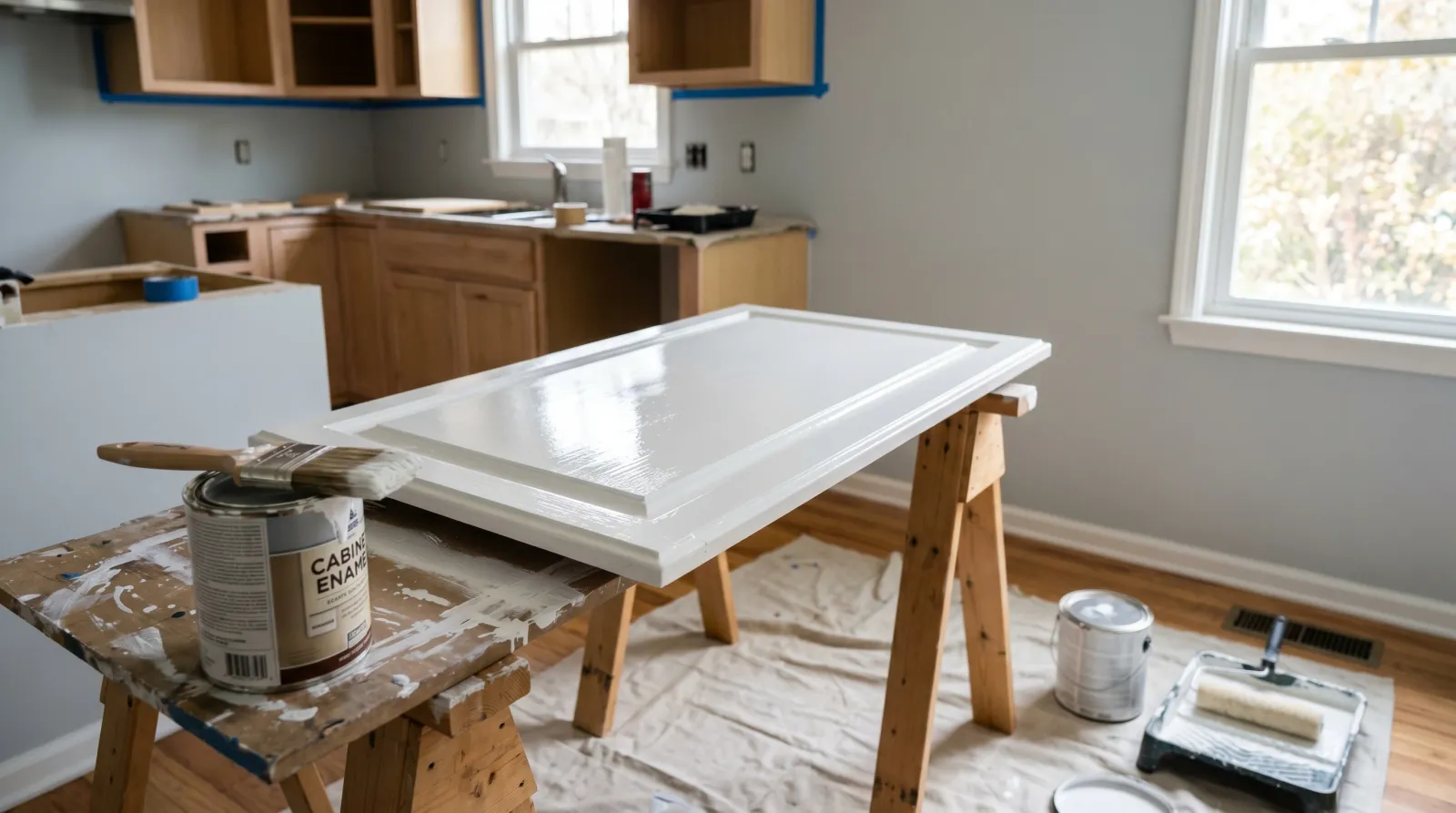
The 30-Second Answer
Cabinet paint and wall paint solve opposite problems. Cabinet paint cures to a hard film that takes fingernails, dish edges, and degreaser without scratching. Wall paint stays softer on purpose so it breathes, hides, and brushes out smooth on drywall. Put wall paint on a cabinet door and you’ll see thumbprints around the pulls by month six. Put cabinet enamel on a long living-room wall and the sheen will catch every taping flaw under raking light. Use both. They cost about the same per square foot once you account for coverage.
At a Glance
| Cabinet paint | Wall paint | |
|---|---|---|
| Cured film hardness | 🟢 | 🔴 |
| Self-leveling (brush marks) | 🟢 | ⚪ |
| Scrubbability | 🟢 | 🟡 |
| Forgives wall imperfections | 🔴 | 🟢 |
| Cost per gallon | 🔴 ($65–95) | 🟢 ($35–65) |
How to Tell What’s Actually on Your Cabinets
Bought the house, don’t know what the previous owner rolled on the kitchen. Two field tests, neither destructive.
Fingernail test. Find a hidden spot on a door edge or the back of a stile. Press your thumbnail into the paint film, hold for a second, lift. Cabinet enamel resists the indent and the mark disappears in a minute. Wall paint takes a permanent dent. If you can write your name in the paint, that’s wall paint and you’re looking at a strip-and-repaint.
Sheen-bounce test. Stand off to one side and look down the cabinet face under your kitchen lighting. Cabinet enamel bounces a soft, even sheen — satin or semi-gloss with no peaks or valleys. Wall paint at eggshell looks dull and slightly chalky, especially around the handles where skin oil has darkened the film.
Cured Film Hardness
This is the whole reason cabinet paint exists. A urethane-modified acrylic (Benjamin Moore Advance, SW Emerald Urethane Trim Enamel) or a waterborne alkyd (PPG Breakthrough, BM Command) cures to a film that takes 7–14 days to reach full hardness — long after it’s dry to the touch. Once it cures, it tolerates a fingernail edge, a wooden spoon dropped against it, the side of a coffee mug sliding across the door front.
Wall paint cures soft on purpose. The acrylic resin is tuned for hide and elasticity, not abrasion. Two weeks after rolling, it’s still soft enough that a kitchen towel pressed into it leaves a fabric print.
Winner: Cabinet paint. Not close.
Self-Leveling and Brush Marks
Cabinet enamel flows. Brush a 2.5-inch sash brush across a door rail in two passes and the marks vanish as it sets. Some lines (Advance, Emerald Urethane) take this further with a long open time — twenty minutes or more — so you can come back and tip off without lap marks. That’s how a brushed door ends up looking sprayed.
Wall paint dries faster on purpose. Quick recoat windows let you knock out a room in a morning. The trade-off: brush it onto a cabinet door and you’re locked in with whatever stipple the brush left, because the surface skinned over before the marks could level out. Roller stipple shows up the same way.
Winner: Cabinet paint. Self-leveling is what you’re paying for.
Scrubbability
Both products clean. The difference is what they tolerate.
Wall paint at eggshell or satin survives the ASTM D2486 scrub cycle in the hundreds — enough to wipe handprints off the entry-hall wall without burnishing. Use a degreaser around a stove backsplash and the sheen will dull where you scrubbed.
Cabinet enamel shrugs off degreaser. Bona, Krud Kutter, dish soap with a sponge — none of them mark the film once it’s cured. Skin oil around the pulls wipes off with water. This is the property that makes the price worth it.
Winner: Cabinet paint on a cabinet. Wall paint is plenty washable for a wall.
Sheen and Look
Cabinet paint comes in satin and semi-gloss because doors and drawer fronts are flat panels that read better with a soft bounce of light. Anything below satin (matte or flat cabinet enamel exists, mostly for designer specs) starts showing finger oil within weeks even with the harder cure.
Wall paint runs flat through gloss. The honest range on a real wall is matte to eggshell. Anything higher and the drywall imperfections come out. A satin wall paint on a hallway wall under a wall sconce will show every taping seam by month one.
Winner: Different jobs. Tie, because each sheen range is correct for its surface.
Cost and Coverage
A premium cabinet enamel runs $65–95 a gallon and covers 300–400 sq ft per coat. You typically need two coats over a primer. A standard set of kitchen cabinets (roughly 200–300 sq ft of painted face) takes about a gallon, two if the boxes are getting painted too.
A premium washable wall paint runs $35–65 a gallon and covers 350–400 sq ft. Two coats on a bedroom (~420 sq ft of wall) is two gallons.
Per square foot, the math is closer than the per-gallon prices suggest. The cabinet paint costs more because it has to. The resin system is more expensive.
Winner: Wall paint on price. Cabinet paint earns its premium on the cabinet.
What’s Actually in the Can
Pop a lid on BM Regal Select wall paint and a lid on BM Advance cabinet enamel side-by-side. The wall paint looks like heavy cream. The cabinet enamel is denser, almost glossy in the can, with a faint solvent smell even though it’s waterborne. Stir both for thirty seconds — the wall paint flows back to flat immediately, the Advance holds a slight ridge from the stick before settling.
The Advance has a hybrid alkyd-acrylic resin that crosslinks as it cures. Crosslinking is what builds the hard film. Wall paints don’t crosslink — the acrylic just dries by water evaporation and stays flexible. Soft and flexible is right for drywall, where the substrate moves with humidity. Hard and crosslinked is right for a door that gets hit with a backpack twice a day.
Verdict by Use Case
- Pick cabinet paint if: the surface gets touched, cleaned, or knocked into. Kitchen and bath cabinets, doors, door trim, window casings, baseboard in a hallway with kids, banisters, built-in shelves people lean on, a desktop, a vanity top.
- Pick wall paint if: the surface is drywall or plaster and stays mostly hands-off. Bedrooms, living rooms, ceilings (in the right flat ceiling paint — see the ceiling vs wall paint comparison), hallway walls above hand height.
- It’s basically a tie when: you’re painting interior doors that don’t slam shut. A premium wall paint in semi-gloss will survive there. Pure cabinet enamel is overkill on a closet door that never gets degreased.
A note on bathroom vanities: a bathroom vanity is a cabinet. Use cabinet paint, not bathroom wall paint. The vanity sees water, hand soap, and toothpaste — degreaser-grade cure matters more there than mildew-resistance.
Top Picks by Side
Painting cabinets? See the kitchen cabinet paint round-up for the urethane and alkyd enamels ranked.
Painting walls? See the best wall paint round-up for the scrubbable interior finishes by sheen.