Ceiling Paint vs Wall Paint — Why You Can't Just Use One
Ceiling paint is a high-hide flat that doesn't drip. Wall paint scrubs. Swap them and you get stippled drips or streaks on touch. Pick by surface.

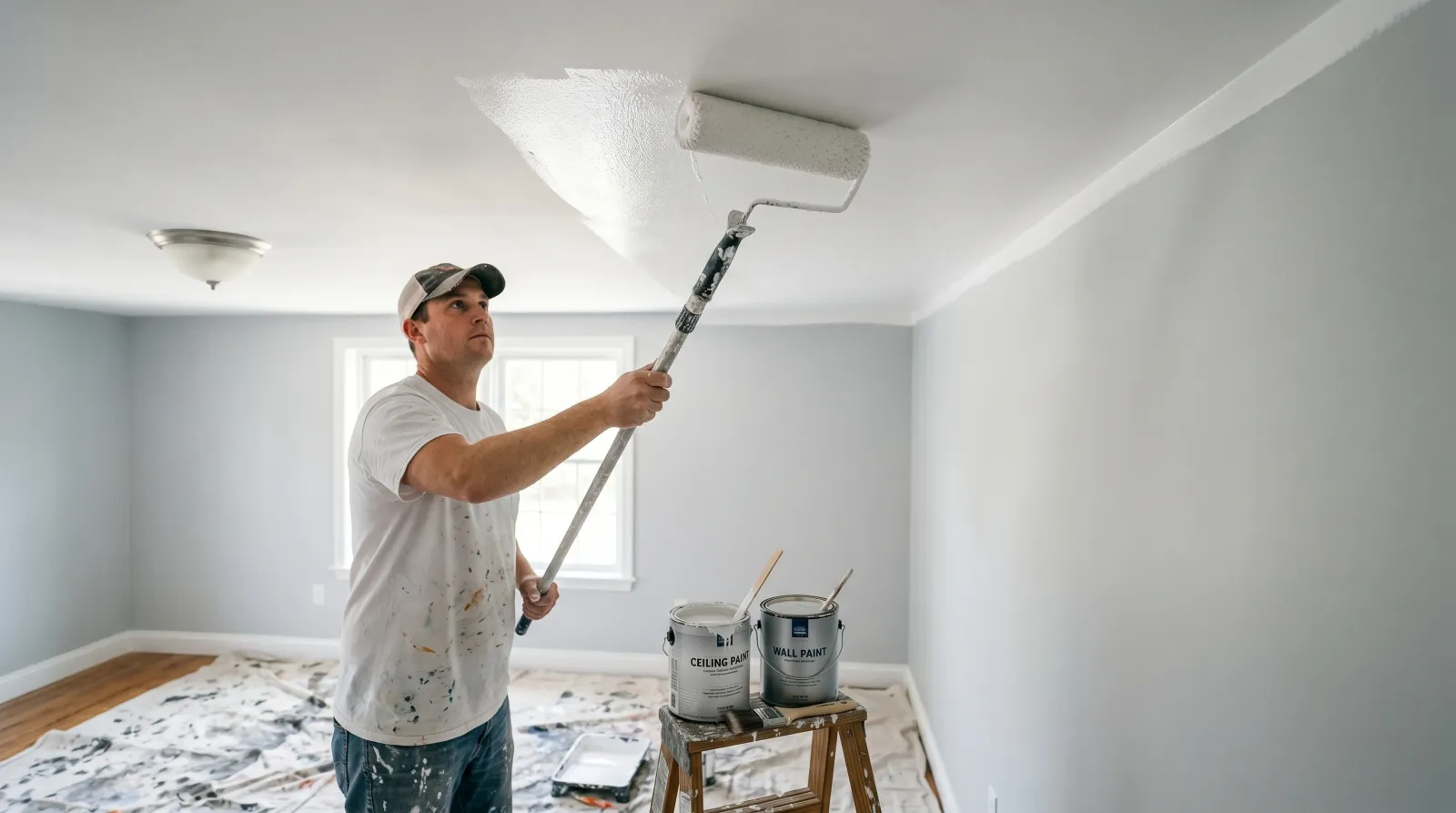
The 30-Second Answer
Ceiling paint goes on ceilings. Wall paint goes on walls. They’re formulated for opposite problems. Ceiling paint is a high-hide dead flat that doesn’t spatter off the roller and doesn’t drip down your arm when you reach overhead. Wall paint is a scrubbable finish in a sheen you can wipe a fingerprint off. Swap them and you get drips on your floor or handprints on your wall. Use both, one gallon each, done.
At a Glance
| Ceiling paint | Wall paint | |
|---|---|---|
| Hide on one coat | 🟢 | ⚪ |
| Spatter and drip resistance | 🟢 | 🔴 |
| Scrubbability | 🔴 | 🟢 |
| Available sheens | 🟡 (flat only) | 🟢 (flat → gloss) |
| Cost per gallon | 🟢 ($20–35) | ⚪ ($35–80) |
How to Tell What You’ve Got Up There
Already-painted ceiling, can’t remember if it’s actual ceiling paint or just leftover wall paint someone rolled up there. Two tests.
Raking-light test. Stand in the doorway with a flashlight held flat against the wall and shine it across the ceiling. Real ceiling-flat reads uniformly dull. Wall paint someone used on the ceiling shows roller lap marks and slight sheen variation in the raking beam.
Damp-rag test. Dampen a white rag and wipe a small spot near the closet. Ceiling-flat will burnish slightly and may transfer a tiny bit of pigment. Wall paint (eggshell or satin) cleans up without a mark. If pigment transfers and the spot now looks shinier than the rest of the ceiling, that’s flat. If the wipe leaves no trace, it’s wall paint and the previous owner cheaped out.
Hide
Ceiling paint is engineered around one job: cover the old color, the patches, and the water rings in one coat from a wet roller, without you having to look up for a third pass. It’s loaded with titanium dioxide and clay extenders so the wet film is thick and opaque. Premium ceiling paints (Benjamin Moore Waterborne Ceiling Paint 508, SW ProMar Ceiling) hit 95%+ contrast hide on a single coat over a primed surface.
Wall paint has to do hide, color depth, and scrub resistance at the same time. The formula compromises. Two coats are the rule on walls. One coat on a ceiling with wall paint and you’ll see the patch outlines through the dry film.
Winner: Ceiling paint.
Spatter and Drip Resistance
This is the one most DIYers learn the hard way. Wall paint loaded onto a roller, rolled overhead, throws a fine spatter every time the nap releases. You’ll find dots on the windowsill, the floor, the top of the fridge, your forearms, your glasses. Ceiling paint is thickened with rheology modifiers (the cans literally market it as “no-drip” or “spatter-resistant”) so the wet film stays on the roller until it touches the surface.
Drips are the second half. Wall paint dripping down a brush handle while you cut in around a vent, that’s a Saturday morning. Ceiling paint’s thicker body resists running long enough to cut in clean.
Winner: Ceiling paint. Not close.
Scrubbability
The trade-off for that thick, matte, no-drip body is zero washability. Touch a fresh ceiling-paint surface with a wet finger and it burnishes. Try to wipe a cobweb-mark off and the paint comes off with the cobweb.
Wall paint at eggshell or satin scrubs through hundreds of cycles in the ASTM D2486 test. That’s the whole reason it exists. Your trim sheen on a doorframe survives a kid’s peanut-butter hand because of this property.
If you put ceiling paint on a wall, the first month you’ll notice every fingerprint near the light switch. By month six, the wall has a halo of dirt at hand height that won’t clean off because the dirt is now embedded in the paint film.
Winner: Wall paint. Don’t put flat ceiling paint on a hallway.
Sheen and Forgiveness
Ceiling paint comes in dead flat. There’s a reason: flat hides imperfections. Ceilings are the worst-lit surface in a house (mostly raking light from windows, then point sources from fixtures) and they show every drywall seam, every nail pop, every taping flaw if there’s any sheen. Flat eats the imperfections.
Wall paint runs flat through matte, eggshell, satin, semi-gloss, and gloss. Each step up the sheen ladder adds washability and subtracts forgiveness. Walls in a bedroom: matte or eggshell. Hallway and kids’ bath: satin. Doors and trim: semi-gloss. See the sheen guide for the long version.
Winner: Different jobs. Tie, technically, because each is correct for its surface.
Cost and Coverage
A gallon of midrange ceiling paint runs $20–35 and covers 350–400 sq ft per coat (one coat). A gallon of midrange wall paint runs $35–80 and covers 350–400 sq ft per coat (two coats).
Run the math on a 12×14 bedroom. Ceiling is 168 sq ft, half a gallon, one coat. Walls are about 420 sq ft, two gallons, two coats. The ceiling line item is the cheap one. Trying to use leftover wall paint on the ceiling to “save a gallon” saves you $25 and costs you a Saturday of cleaning spatter off the floor.
Winner: Ceiling paint for the ceiling job. The wall job needs wall paint either way.
What’s Actually Different in the Can
Pop the lid on a gallon of Benjamin Moore Waterborne Ceiling Paint 508 and a gallon of Regal Select wall flat side-by-side and you can see the difference before you stir. The ceiling paint is thicker, closer to pancake batter than the wall paint’s heavy cream. Stir both for thirty seconds and the ceiling paint holds the stir-stick channel for a second before closing up. Wall paint flows back immediately.
That’s the rheology modifier doing its job. Ceiling paint is engineered to be high-viscosity at rest (so it stays on the roller) and shear-thin under the roller pressure (so it lays out smooth). The fancy term is thixotropy. The practical translation: less spatter and longer working time on the cut-in.
Solids load also runs higher on ceiling paint, 38–45% by volume vs 32–38% for a typical wall flat. That’s where the one-coat hide comes from. More titanium dioxide and clay extender per gallon, thicker dry film at the same wet mil.
Pro Tricks That Don’t Save You from Using the Right Paint
Three things contractors do that homeowners hear about and try to copy.
Tinting ceiling paint slightly off-white. Painters often shoot for a custom “warm white” ceiling that ties to the wall color. Most brands tint ceiling paint up to medium values without issue. Past that, the colorant load thins the body and the no-drip property goes with it. If your ceiling color is darker than “navajo white,” use a regular wall paint in flat and accept the spatter.
Adding Floetrol to wall paint to use it on a ceiling. Works partially. Floetrol extends open time and reduces spatter slightly. It does not turn wall paint into ceiling paint. You still get drips on the cut-in and you still don’t get the one-coat hide. Buy the ceiling paint.
Using a flat wall paint instead of dedicated ceiling paint. Closest substitute. A premium interior flat (BM Regal Select Flat, SW Cashmere Flat) will work on a ceiling, better than eggshell would. You’ll still spatter more and pay more per gallon. Dedicated ceiling paint exists for a reason.
Verdict by Use Case
- Pick ceiling paint if: the surface is overhead. Flat drywall ceilings, soffits, garage ceilings, basement joists you’ve painted white, popcorn texture you don’t want to knock off. The thick body and dead-flat finish are doing real work there.
- Pick wall paint if: the surface is vertical or gets touched. Walls, halls, stairwells, mudrooms, bathroom walls, anywhere a hand, shoulder, mop, or dog might land.
- It’s a tie when: the “ceiling” is actually a sloped attic-bedroom wall under 30° from vertical that people lean against. Use wall paint in matte. Pure ceiling-paint flat will burnish where heads rest.
A note on mildew-resistant ceiling paint: bathroom ceilings get steam, and most premium ceiling lines (Benjamin Moore 508, Behr Premium Plus Ceiling) include a mildewcide. Worth using over a shower. For the wall around the shower, use a dedicated bathroom paint. See the best bathroom paint round-up.
Top Picks by Side
Doing the ceiling? See the best ceiling paint round-up for the no-drip, one-coat picks.
Doing the walls? See the best wall paint round-up for the scrubbable interior finishes ranked by sheen.