School Paint: K-12 Classroom & Corridor Specifier's Guide (2026)
School paint specified by scrub rating, low-VOC GREENGUARD Gold compliance, and block-filler prep. Classroom, corridor, restroom, and gym systems compared with DFT and summer-shutdown recoat windows.

Disclosure: Affiliate links to retailers and manufacturer-direct programs. Recommendations are spec-driven, not commission-driven.
Use Case
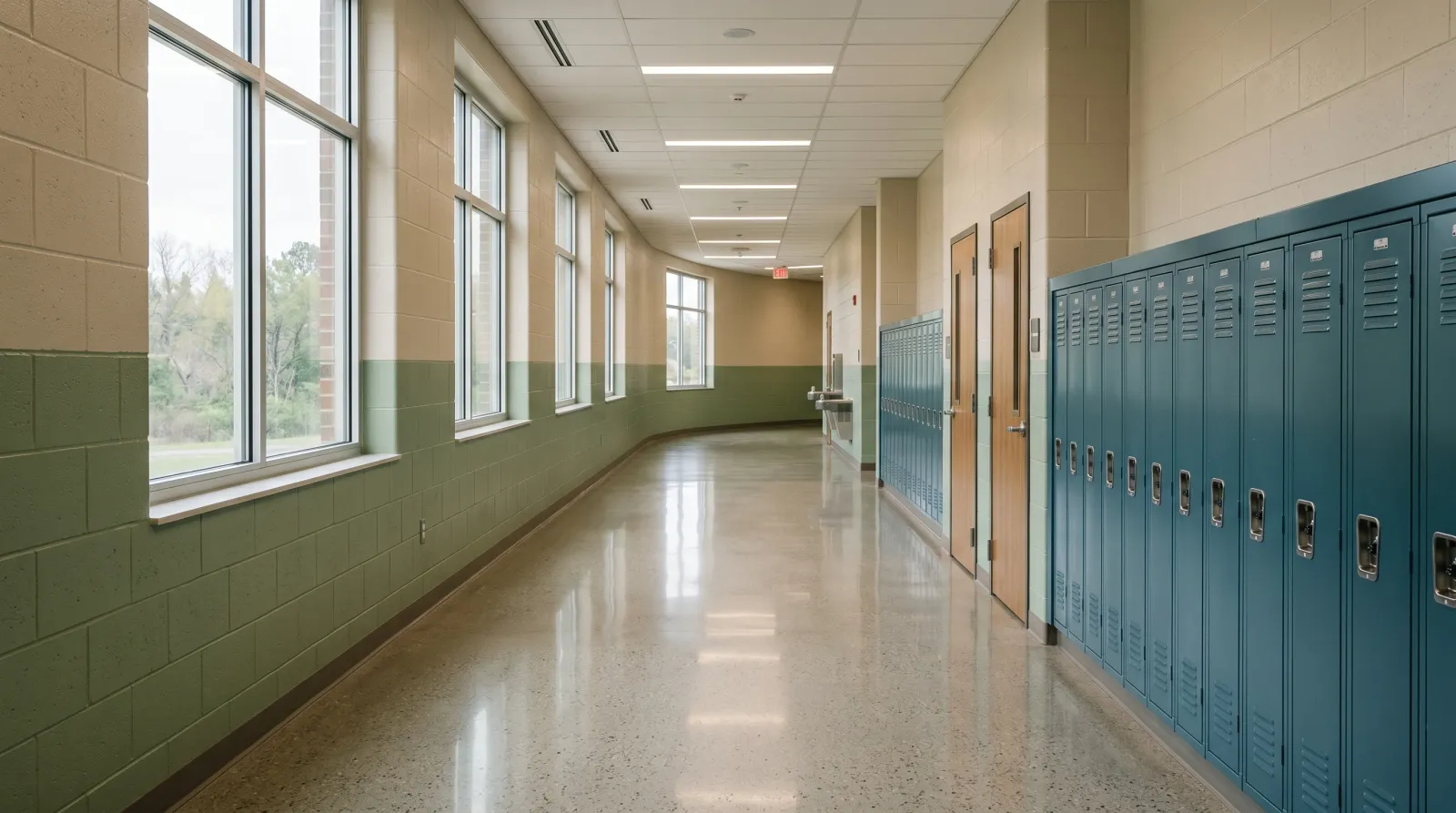
School paint is an institutional interior coating that has to survive a population of students, a custodial washdown schedule, and an indoor-air-quality standard that no commercial office faces. The asset is the building envelope on the inside: classroom walls, corridors, restrooms, locker rooms, gymnasiums, cafeterias, stairwells, and the doors, frames, and CMU that take the most contact. The substrate is rarely one thing. A typical K-12 building runs painted concrete masonry unit (CMU) in corridors and stairwells, gypsum drywall in classrooms and offices, and ferrous and galvanized metal on doors, frames, and railings. Each substrate changes the prep and the primer, even when the finish coat is the same.
Service life is the number that drives the spec. A district painting on a cost-driven flat latex gets 2 to 4 years on a high-traffic corridor before burnishing, scuff, and washed-out marker force a repaint. A pre-catalyzed waterbased epoxy or a scuff-resistant institutional latex holds 7 to 10 years in the same corridor under the same abuse. The maintenance budget is a multi-year line item, so the coating decision is a total-cost-of-ownership decision, not a price-per-gallon decision. Repainting a 100,000 sq ft building costs labor, mobilization, furniture moves, and a summer-shutdown window that competes with HVAC and roof work for the same eight weeks. Stretching the cycle from 4 years to 9 cuts the lifetime repaint count roughly in half.
The IBC and the state fire marshal set the floor that price cannot override. Interior wall and ceiling finishes in corridors and exit access in Group E (educational) occupancies require a Class A flame-spread rating under ASTM E84 (flame spread index 25 or less, smoke developed 450 or less). Standard architectural latex meets Class A, but it is a line item the spec writer confirms, not assumes, especially on any thick-film or specialty coating.
Zoned Recommendation Matrix
A school is not a single-zone asset. The corridor that takes a thousand backpacks a day is a different exposure from a kindergarten reading nook, and the restroom is a different exposure again. Map the system to the zone.
| Zone | Exposure | Recommended system | Sheen |
|---|---|---|---|
| Classroom walls (drywall) | Hand soil, tape, marker, moderate washing | System B scuff-resistant latex (or System A epoxy at chair-rail height) | Eggshell |
| Corridors, stairwells, lockers (CMU) | Heavy contact, daily washdown, graffiti | System A pre-catalyzed waterbased epoxy | Eg-shel to semi-gloss |
| Restrooms, locker rooms | Moisture, mildew, aggressive cleaning | System A epoxy, mildew-resistant film, ASTM D3273 | Semi-gloss |
| Gymnasium, cafeteria, multipurpose | Ball impact, scuff, high-volume cleaning | System A epoxy on CMU; ceiling flat acoustic-rated | Semi-gloss walls |
| Doors, frames, railings (metal) | Impact, hand contact | DTM acrylic or waterborne alkyd enamel | Semi-gloss |
| Ceilings (drywall / acoustic) | Low contact, light-reflectance | Zero-VOC flat institutional ceiling paint | Flat |
The single most common spec error is running one flat latex across the whole building to simplify the bid. The corridor and restroom pay for that decision inside two years. Write the matrix into the bid so the high-abuse zones carry the durable film and the low-touch ceilings carry the cheap flat. The cost delta on a 100,000 sq ft building is small because the high-abuse zones are a fraction of the square footage.
Spec Requirements
The spec block before any product name. The categories hold across manufacturers; the exact numbers move with the product data sheet.
| Spec | Value |
|---|---|
| DFT — finish on smooth drywall | 3.0–4.0 mils dry total (2 coats at 1.5–2.0 mils each) |
| DFT — block filler on CMU | 8–12 mils dry, fill voids flush, before finish coats |
| Coverage @ DFT | 300–400 sq ft/gal finish on sealed drywall; 75–125 sq ft/gal block filler on CMU |
| VOC | 0–50 g/L interior latex; CARB SCM and SCAQMD Rule 1113 cap at 50 g/L flat and non-flat |
| Low-emitting certification | GREENGUARD Gold (UL 2818) or CDPH Standard Method v1.2; required for occupied-building work |
| Scrub resistance | ASTM D2486 — 2,000+ cycles for corridor/restroom film; 500+ for classroom latex |
| Wash resistance | ASTM D4828 |
| Mold / mildew (wet zones) | ASTM D3273 rating 10 (no growth) for restroom, locker, kitchen |
| Surface burning | ASTM E84 Class A: flame spread ≤25, smoke developed ≤450 |
| Substrate prep — new CMU | SSPC-SP13/NACE 6 surface, then latex or acrylic block filler before finish |
| Substrate prep — patched drywall | Sand smooth, spot-prime to MPI Level 4 finish minimum (Level 5 under semi-gloss) |
| Substrate prep — ferrous metal | SSPC-SP2/SP3 hand or power tool clean; rust-inhibitive or DTM primer |
| Substrate prep — galvanized | SSPC-SP1 solvent clean; waterborne acrylic DTM, no alkyd direct |
| Ambient at application | 50°F–90°F substrate; RH below 85%; substrate ≥5°F above dew point |
| Recoat window | 2–4 hours at 77°F / 50% RH (pre-catalyzed waterbased epoxy) |
| Cure to service / full wash | 7 days for full scrub and chemical cure |
Two prep specs decide whether the job lasts. On CMU, the block filler is not optional and it is not a primer substitute. Concrete masonry is full of pinholes and voids that wick air and moisture; an unfilled block wall coated straight with finish paint pinholes through, looks rough, and fails the washability the corridor needs. The filler bridges the voids and gives the finish a continuous film to sit on. On drywall, the gypsum finish level governs the sheen you can run. A semi-gloss epoxy on a Level 4 wall in raking corridor light shows every joint and fastener; semi-gloss zones need Level 5 (a skim coat over the full surface) or the complaints start the day the lights come on.
System Chemistry Compared
Pick the chemistry to the zone before you pick the brand. Four classes cover almost every K-12 interior spec.
| Chemistry | Recoat window | Scrub (ASTM D2486) | VOC | $/sq ft installed | Best for |
|---|---|---|---|---|---|
| Zero-VOC flat / eggshell latex | 2–4 hr | 200–500 cycles | 0–50 g/L | $0.55–1.10 | Classroom walls, ceilings, low-touch offices |
| Scuff-resistant single-component latex | 2–4 hr | 1,000–2,000 cycles | 0–50 g/L | $0.90–1.60 | Classroom walls and corridors, no two-part mixing |
| Pre-catalyzed waterbased epoxy | 2–4 hr | 2,000–3,500+ cycles | <50–100 g/L | $1.10–2.20 | Corridors, restrooms, locker rooms, gyms |
| Waterborne DTM acrylic enamel | 4–6 hr | 1,500+ cycles | <100 g/L | $1.40–2.60 | Doors, frames, railings, lockers (metal) |
Zero-VOC latex wins on classroom walls and ceilings, where the touch load is moderate and indoor-air-quality is the priority. Scuff-resistant single-component latex (Benjamin Moore Scuff-X, Sherwin-Williams Scuff-Tuff) is the middle ground: it gives most of the durability of an epoxy without the catalyzed-film handling, so an in-house crew can apply it. Pre-catalyzed waterbased epoxy is the durable answer for corridors and wet rooms, with the best scrub and chemical-cleaner resistance and a hard film that releases marker and scuff. The trade-off is sheen and prep sensitivity. Waterborne DTM acrylic is for the metal: doors, frames, railings, and lockers, where direct-to-metal adhesion and impact resistance matter more than scrub.
Recommended Systems
Three full multi-coat stacks at three price-performance points. Each shows the CMU block-filler path and the drywall path; on a real building you run both depending on substrate. All three finish products carry GREENGUARD Gold or CDPH v1.2 low-emitting documentation. Verify the current data sheet against your zone before bid.
System A — Sherwin-Williams ProIndustrial Pre-Catalyzed Waterbased Epoxy (Durable Corridor/Restroom Standard)
| Layer | Product | DFT |
|---|---|---|
| Block filler (CMU only) | PrepRite Interior/Exterior Latex Block Filler | 8–12 mils dry |
| Primer (drywall / patched) | ProMar 200 Zero VOC Interior Latex Primer | 1.2–1.6 mils dry |
| Finish coat 1 | ProIndustrial Pre-Catalyzed Waterbased Epoxy, eg-shel | 1.5–2.0 mils dry |
| Finish coat 2 | ProIndustrial Pre-Catalyzed Waterbased Epoxy, eg-shel | 1.5–2.0 mils dry |
| Total finish | 3.0–4.0 mils dry over filler/primer |
Service life 8 to 10 years on a washed corridor. This is the workhorse for the high-abuse zones. ProIndustrial WB Epoxy passes well over 2,000 ASTM D2486 scrub cycles, resists daily quaternary-cleaner washdown, and releases most dry-erase and permanent marker with a damp cloth and a mild solvent. It runs in an eg-shel or semi-gloss; both telegraph wall defects, so hold the prep to MPI Level 5 in raking-light corridors. Sherwin-Williams ProIndustrial Pre-Catalyzed Waterbased Epoxy product page.
System B — PPG Pitt-Glaze WB1 Pre-Catalyzed Acrylic Epoxy (Specifier Equivalent)
| Layer | Product | DFT |
|---|---|---|
| Block filler (CMU only) | PPG SpeedHide Interior/Exterior Masonry Block Filler | 8–12 mils dry |
| Primer (drywall) | Pitt-Glaze WB1 self-priming on sound drywall, or SpeedHide Zero primer | 1.2–1.6 mils dry |
| Finish coat 1 | Pitt-Glaze WB1 Pre-Catalyzed Acrylic Epoxy, semi-gloss | 1.5–2.0 mils dry |
| Finish coat 2 | Pitt-Glaze WB1 Pre-Catalyzed Acrylic Epoxy, semi-gloss | 1.5–2.0 mils dry |
| Total finish | 3.0–4.0 mils dry over filler/primer |
Service life 8 to 10 years. Pitt-Glaze WB1 is the direct competitor to ProIndustrial and the more common spec on PPG-standard districts. It is self-priming on sound drywall, which drops a labor step on repaint scopes, and carries the same mildew-resistant dry film for restrooms and locker rooms. PPG’s institutional distribution is strong in the Midwest and Mid-Atlantic; confirm 5-gal supply on a hard summer occupancy date in the Mountain West. PPG Pitt-Glaze WB1 product page.
System C — Benjamin Moore Ultra Spec 500 + Scuff-X (Single-Component, In-House-Friendly)
| Layer | Product | DFT |
|---|---|---|
| Block filler (CMU only) | Ultra Spec Masonry 100% Acrylic Block Filler | 8–12 mils dry |
| Primer (drywall / patched) | Ultra Spec 500 Interior Latex Primer (zero VOC) | 1.2–1.6 mils dry |
| Finish coat 1 | Scuff-X scuff-resistant latex, eggshell | 1.5–2.0 mils dry |
| Finish coat 2 | Scuff-X scuff-resistant latex, eggshell | 1.5–2.0 mils dry |
| Total finish | 3.0–4.0 mils dry over filler/primer |
Service life 6 to 8 years on classroom and moderate-corridor walls. Scuff-X is a single-component latex with no catalyzed film to manage, which makes it the right call for a school district that does most repainting with an in-house maintenance crew. It holds an eggshell sheen that hides drywall defects better than a semi-gloss epoxy, so it is the easier finish on Level 4 classroom walls. It does not match the chemical-cleaner resistance of System A in a daily-washed restroom; spec the epoxy in the wet zones and Scuff-X on the classroom and corridor drywall. Benjamin Moore Scuff-X product page.
Systems Compared
| System | Total finish DFT | $/sq ft installed | Service life | Best for |
|---|---|---|---|---|
| A — S-W ProIndustrial WB Epoxy | 3.0–4.0 mils | $1.40–2.20 | 8–10 years | Corridors, restrooms, locker rooms, gyms |
| B — PPG Pitt-Glaze WB1 | 3.0–4.0 mils | $1.40–2.20 | 8–10 years | Same as A; PPG-standard districts |
| C — BM Ultra Spec 500 + Scuff-X | 3.0–4.0 mils | $1.10–1.80 | 6–8 years | Classroom and corridor drywall, in-house crews |
Pricing assumes a full-building summer scope of 50,000+ sq ft through a commercial painting contractor, drywall in good condition, and standard prep. CMU block-filler zones add roughly $0.40–0.80/sq ft for the filler coat and the back-rolling labor. Small in-occupancy touch-up scopes run materially higher per square foot because mobilization and furniture moves do not scale down.
Application & Contractor Path
The honest call: single-classroom repaints and touch-up are in-house work, and System C (Scuff-X) is chosen precisely so a maintenance crew can run it without catalyzed-film handling. Full-building summer repaints, CMU block-filler scopes, and the System A and B epoxies belong with a commercial painting contractor. The block-filler step and the wet-film control on a pre-catalyzed waterbased epoxy reward a crew that does it every week.
For occupied-building work during the school year, the contractor qualification that protects the district is documentation, not a coatings certification. Require the contractor to submit the low-emitting product data (GREENGUARD Gold or CDPH v1.2) with the bid, carry general liability at the district’s required limit, and schedule against the bell schedule with ventilation in place. Indoor-air-quality questions from parents and the board are answered with paperwork in advance, not after the smell complaint.
Three contractor-qualifying questions before signing:
- What is the ventilation and re-occupancy plan for in-session work? A contractor who cannot describe the negative-pressure or exhaust setup and a clearance interval before students re-enter the wing should not be painting an occupied building.
- How is the CMU block filler back-rolled and inspected for pinholes? Spray-and-walk on block filler leaves voids unfilled; the answer should include back-rolling every spray pass.
- Can the schedule put the last coat in each wing 7 days before occupancy? The 7-day full cure is the difference between a washable wall in September and a soft film that marks on the first backpack.
The manufacturer rep on all three systems (Sherwin-Williams, PPG, Benjamin Moore institutional reps) will do a free pre-bid walk of the building, map the zone-by-system matrix, and confirm block-filler and drywall-level requirements against the spec. Use it on any scope above 25,000 sq ft.
Failure Modes & How to Prevent Them
Five failures cover most premature school-paint repaints and complaints.
- Pinholing and roughness on CMU. Cause: block filler skipped or sprayed without back-rolling, leaving voids that telegraph through the finish and trap soil that will not wash off. Prevention: latex or acrylic block filler at 8–12 mils dry, back-rolled every pass, inspected for flush fill before finish coats.
- Burnishing and shiny scuff trails on corridors. Cause: a low-cost flat latex specified across the whole building, including the high-touch corridor, where every hand and backpack polishes the flat film to a shine. Prevention: the zone matrix. Pre-catalyzed waterbased epoxy or scuff-resistant latex in corridors; save the flat for ceilings and low-touch offices.
- Mildew bloom in restrooms and locker rooms. Cause: a standard interior latex with no mildewcide in a wet, poorly-ventilated room, or a moisture source left unaddressed behind the wall. Prevention: ASTM D3273-rated mildew-resistant film (the System A and B epoxies qualify), plus fixing the exhaust and the leak. Paint does not stop water; it survives the moisture the building still has.
- Soft, marking film in September. Cause: the last coat went down inside the 7-day cure window before re-occupancy, or it was applied below 50°F or near the dew point in an un-conditioned summer building. Prevention: sequence the building so each wing cures 7 days before students return, and run mechanical ventilation and temperature control through the cure.
- Sheen defects in raking corridor light. Cause: semi-gloss epoxy run over a Level 4 drywall finish, so every taped joint and fastener reads under the lights. Prevention: hold semi-gloss and corridor zones to MPI Level 5 (full skim coat), or step the sheen down to eg-shel where the finish level cannot be raised.
The block-filler shortcut and the whole-building-flat shortcut are the two most expensive decisions in K-12 painting, because both fail in the highest-visibility, highest-traffic zones and both are preventable at the spec stage.
Where to Buy / Spec
| Channel | Best for | Path |
|---|---|---|
| Manufacturer-direct (S-W, PPG, BM institutional reps) | Spec’d summer scopes, zone matrix, low-emitting documentation | SW ProIndustrial WB Epoxy · PPG Pitt-Glaze WB1 |
| Pro retail (Sherwin-Williams, Benjamin Moore stores) | Local 5-gal pickup, contractor pricing, in-house touch-up stocking | Local commercial account |
| Distributor (institutional / cooperative purchasing) | District-wide standing orders under a co-op contract (Sourcewell, OMNIA) | Co-op contract pricing |
| Amazon Business | Roller covers, tape, small touch-up stocking for maintenance crews | Business account |
Manufacturer-direct through the institutional rep is the recommended channel on any full-building scope. The rep brings the zone matrix, the block-filler and drywall-level spec, and the GREENGUARD Gold / CDPH documentation the district needs on file before the first complaint. That service is worth more than any per-gallon discount on a co-op line.
FAQ
See the questions a facility buyer actually asks, answered above in the spec context.