Parking Deck Coating: Traffic-Bearing Membrane Specifier's Guide (2026)
Parking deck coating systems compared by DFT, elongation, and service life. ICRI CSP prep, MVE limits, ASTM C957 membrane spec, and the SSPC-QP contractor path.

Disclosure: Affiliate links to retailers and manufacturer-direct programs. Recommendations are spec-driven, not commission-driven.
Use Case
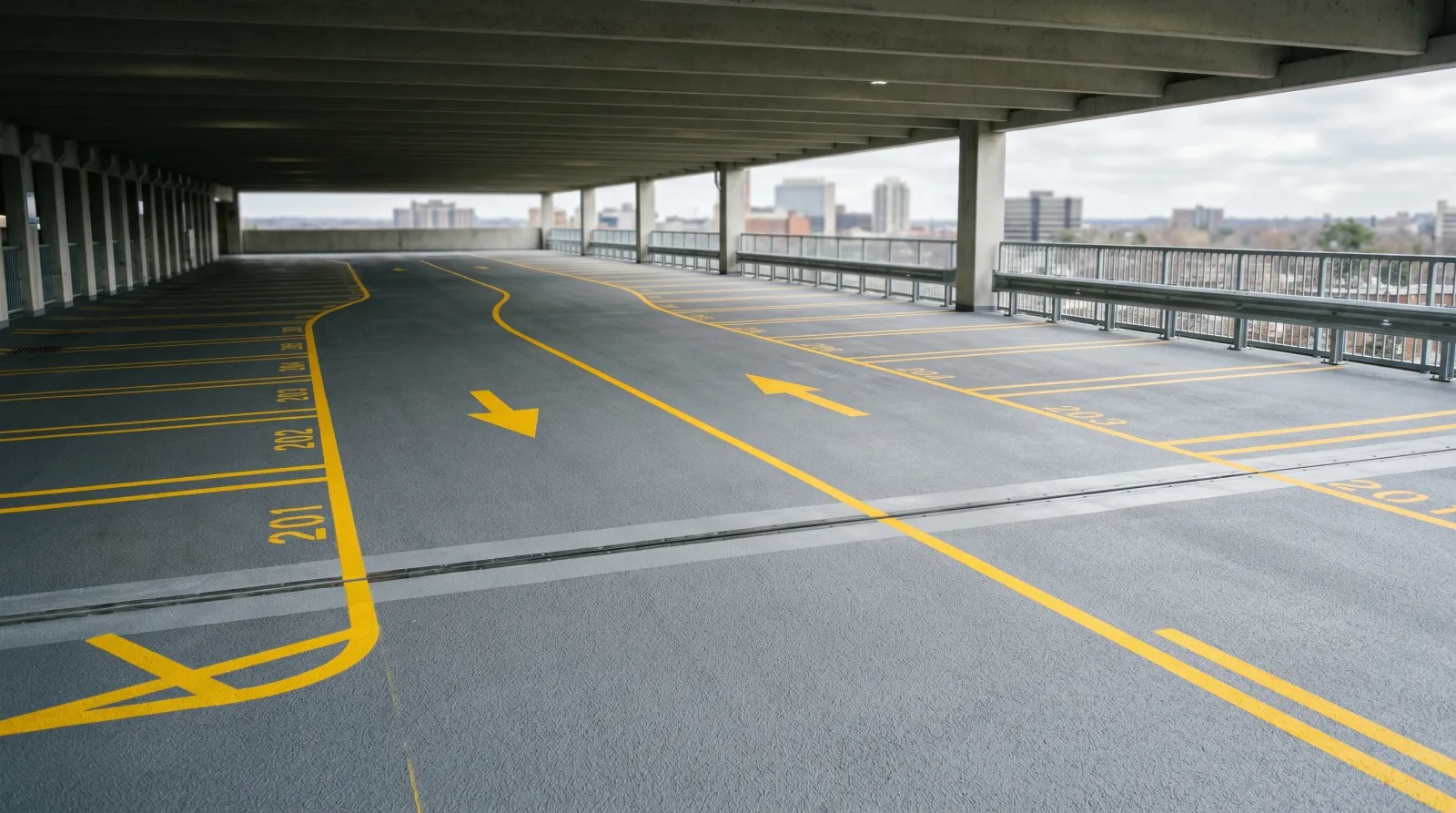
A parking deck coating is a waterproofing system first and a wear surface second. The asset is the structural slab of an elevated, on-grade, or below-grade parking structure: post-tensioned or conventionally reinforced concrete that carries vehicle traffic and, critically, has occupied space or another parking level underneath. The coating exists to keep water and chloride from de-icing salt out of that slab. Chloride drives rebar corrosion, corrosion spalls the concrete, and a spalled post-tensioned deck is a seven-figure structural repair. The membrane is cheap insurance against that.
Service life expectations run 7 to 10 years on open top decks under UV and full weather, 10 to 15 years on covered intermediate levels, and 5 to 8 years on ramps and turn lanes where tire scrub and point loading concentrate. The spec writer is balancing four loads the consumer never sees: hydrostatic and vapor pressure from below, thermal cycling that opens and closes every crack and joint daily, vehicular abrasion and hot-tire scrub, and chloride attack from salt tracked in all winter. A coating that handles three of the four and ignores the joints fails at the joints.
This is not a striping job and it is not a garage-floor epoxy. Striping paint sits at 5 to 7 mils dry and survives because it gets restriped yearly. A traffic-bearing membrane is a 25-to-60-mil elastomeric system engineered to stretch across a moving crack without splitting, tested to ASTM C957. The crossover error is specifying an interior epoxy floor coating on an exposed deck. Epoxy is rigid, it ambers under UV, and it telegraphs every slab crack within two winters. The deck needs elongation, not hardness.
Zoned Recommendation Matrix
A parking structure is not a monolithic slab, and the same membrane does not belong on every level. The spec for a typical multi-level open structure:
| Zone | Recommended system | Why |
|---|---|---|
| Top / exposed deck | System A (full urethane, UV-stable aliphatic topcoat) | Direct UV and weather; aliphatic wearing coat resists chalk and color loss |
| Intermediate covered levels | System A or B at reduced topcoat DFT | No UV load; the membrane is protecting occupied space below |
| Ramps, turn lanes, speed bumps | System B with heavy aggregate broadcast | Tire scrub and braking torque; high COF and extra wearing-coat DFT |
| Entry / splash zone (first 30 ft) | System A, full membrane | Heaviest salt and water load tracked off the street |
| Expansion / control joints | Reinforced detail (fleece or backer rod + sealant), all systems | The membrane bridges movement; joints are where it tears first |
| Pedestrian crossover / stair landings | System C or B, slip-rated broadcast | OSHA 1910.22 walking surface; COF target governs |
The detailing at cracks, cold joints, drains, and the deck-to-wall transition is where the warranty is won or lost. Spec the field-and-detail approach as one system, not as a field coat with joints “to be addressed.”
Spec Requirements
The spec block, before any product name:
| Spec | Value |
|---|---|
| Dry film thickness (DFT) — total system | 25–60 mils; 30–40 mils typical on turn lanes and ramps, 25–35 on covered field |
| Coverage at spec’d DFT | 25–50 sq ft/gal per coat depending on build and broadcast |
| Elongation (membrane) | 200% minimum at break, ASTM D412; the membrane has to bridge a moving crack |
| Crack-bridging | ASTM C1305 / ASTM C957 high-build elastomeric traffic membrane conformance |
| VOC limit | <100 g/L for SCAQMD-compliant urethanes; 250–340 g/L solvent base coats where SCAQMD Rule 1113 does not apply (CARB SCM allowances vary by district) |
| Pot life | 20–40 minutes at 70°F for urethane base; 10–20 minutes for PMMA |
| Recoat window | Honor the data sheet; urethane base-to-top typically 12–24 hr, PMMA 45 min–2 hr |
| Cure to traffic | 24–48 hr urethane; ~1 hr PMMA at 70°F |
| Service temperature (cured) | -20°F to 180°F continuous on exposed deck |
| Substrate prep — concrete | ICRI CSP 3 to CSP 5; shotblast or scarify, then ICRI 310.2 profile verification |
| Moisture vapor emission ceiling | 3 lb/1000 sq ft/24h (ASTM F1869) or ≤80% in-situ RH (ASTM F2170); above, use vapor-tolerant primer |
| Concrete cure before coating | 28 days minimum; verify slab is at design strength and laitance removed |
| Adhesion (pull-off) | ≥200 psi by ASTM D7234 / C1583 substrate failure preferred |
| Ambient at application | 50°F+ rising for urethane (25°F for PMMA); humidity <85%; substrate ≥5°F above dew point |
| OSHA anti-slip COF | 0.5 dry minimum (1910.22) on all walking and ramp surfaces; broadcast aggregate |
Three numbers carry the most weight. The MVE rate decides whether the membrane bonds or blisters from below, and on-grade decks fail this test more often than crews expect. The ICRI CSP profile decides whether the primer keys into the concrete or sits on laitance. The crack-bridging and elongation spec decides whether the membrane stretches across a moving joint or tears the first cold night. ASTM C957 is the controlling membrane standard; put it on the bid sheet by number and off-spec deck paints drop out of the bid.
System Chemistry Compared
Pick the chemistry class before the brand. The chemistries that apply to a traffic-bearing deck:
| Chemistry | Pot life | Recoat window | Service temp | UV stability | $/sq ft installed | Best for |
|---|---|---|---|---|---|---|
| Aromatic urethane base + aliphatic topcoat | 20–40 min | 12–24 hr | -20°F to 180°F | 🟢 UV-stable (aliphatic top) | $4–7 | The default traffic-deck system, open and covered |
| Polyurea (spray-applied) | seconds (plural-component) | 60 sec gel | -40°F to 250°F | ⚪ mid; needs aliphatic top | $7–12 | Fast turnover, heavy crack movement, plural-component crew only |
| PMMA (methyl methacrylate) | 10–20 min | 45 min–2 hr | -20°F to 200°F | 🟢 UV-stable | $9–16 | Cold-weather install, 1-hour cure, no-shutdown garages |
| Epoxy / cementitious wear topping | 1–4 hr | 8–24 hr | up to 140°F | 🔴 ambers, rigid | $3–6 | Interior covered floors only; not a moving-deck membrane |
Aromatic-base-with-aliphatic-top urethane carries most deck specs. The aromatic base coat builds the waterproofing membrane and takes the aggregate broadcast; the aliphatic topcoat resists UV chalk and abrasion. Put the aromatic coat on top of an exposed deck and it chalks and color-shifts within a year, so the layer order is not optional. Polyurea is the fast, high-elongation answer for decks with heavy crack movement, but it is plural-component spray work that needs a trained crew and dedicated equipment. PMMA wins on cold-weather and no-shutdown jobs and loses on odor and cost. Rigid epoxy or a cementitious topping belongs on an interior covered floor that does not move, not on a traffic-bearing deck exposed to thermal cycling.
Recommended Systems
Three full multi-coat stacks at different price-performance points. All three assume ICRI CSP 3+ shotblast prep, the MVE ceiling above, and reinforced detailing at every joint, crack, and drain.
System a — Sika Sikalastic Traffic Deck (premium Urethane, Open and Covered)
| Layer | Product | DFT |
|---|---|---|
| Primer | Sikafloor 161 / Sika Concrete Primer (moisture-tolerant epoxy) | 4–6 mils |
| Base / membrane coat | Sikalastic 715 aromatic urethane, aggregate broadcast | 16–22 mils |
| Topcoat | Sikalastic 720 aliphatic urethane wearing coat | 8–12 mils |
| Total | 28–40 mils |
Service life 10–15 years on covered levels, 7–10 on exposed top deck. The aliphatic 720 wearing coat holds color and resists chalk under UV, which is why this stack goes on the top deck and the entry splash zone. Sika’s plaza-and-parking line is one of the most widely specified traffic systems in North America. Sika parking deck systems.
System B — Tremco Vulkem Traffic Coating (workhorse Mid-Tier)
| Layer | Product | DFT |
|---|---|---|
| Primer | Vulkem 171 epoxy primer (191 on damp slab) | 3–5 mils |
| Base coat | Vulkem 350NF aromatic urethane, silica broadcast to refusal | 20–25 mils |
| Topcoat | Vulkem 351NF aliphatic urethane wearing coat | 10–14 mils |
| Total | 33–44 mils |
Service life 8–12 years on field, 5–8 on ramps. The Vulkem 350NF/351NF stack is the contractor default for ramps and turn lanes because the silica broadcast to refusal builds a thick, high-COF wearing surface that takes braking torque. The “NF” formulations are the lower-odor, reduced-VOC versions for occupied structures. Tremco traffic coatings.
System C — Master Builders MasterSeal Traffic PMMA (fast-Cure, No-Shutdown)
| Layer | Product | DFT |
|---|---|---|
| Primer | MasterSeal P 173 PMMA primer | 5–8 mils |
| Membrane / reinforced base | MasterSeal M 800 PMMA with fleece at cracks and joints | 60–80 mils at detailing |
| Wearing / topcoat | MasterSeal TC 225 PMMA wearing course, quartz broadcast | 30–40 mils |
| Total | 40–60 mils (field), higher at reinforced detail |
Service life 10–15 years, and it goes down in cold weather and reopens in about an hour. PMMA is the spec when a hospital, airport, or downtown garage cannot lose a level for two days, or when the schedule pushes the work into a 30-degree week that shuts urethane down. The cost premium is real and the monomer odor needs ventilation planning in an enclosed structure. Master Builders Solutions.
Systems Compared
| System | Total DFT | $/sq ft installed | Service life | Best for |
|---|---|---|---|---|
| A — Sika Sikalastic 715/720 | 28–40 mils | $5.50–8.00 | 7–15 years | Top deck, covered levels, entry splash zone |
| B — Tremco Vulkem 350NF/351NF | 33–44 mils | $5.00–7.50 | 5–12 years | Ramps, turn lanes, general field, occupied structures |
| C — MasterSeal PMMA | 40–60 mils | $9.00–16.00 | 10–15 years | No-shutdown garages, cold-weather install, heavy crack movement |
Installed pricing assumes a 20,000+ sq ft level through a manufacturer-certified applicator with shotblast prep and joint detailing included. Small repair scopes and single-bay patches run 40–70% higher per foot. Run the cost over the service-life horizon, not the bid line. A System A membrane at $7 a foot lasting 12 years is $0.58 per foot per year. The same deck left uncoated until it spalls is a structural concrete repair at $40–$120 a square foot, plus the lost revenue while the level is closed. The membrane is the cheapest line item that prevents the most expensive one.
Application & Contractor Path
This is not a DIY product and it is not a job for a general commercial painting crew. A traffic-bearing membrane is a reinforced waterproofing system with movement-joint detailing, a primer keyed to a moisture test, an aggregate broadcast timed to the base-coat gel, and a slope-to-drain flood test at turnover. Miss any one and the deck leaks onto the cars or the occupied space below.
Spec a contractor with SSPC-QP1 certification at minimum, and SSPC-QP8 for the waterproofing scope. The bigger qualifier is the manufacturer’s certified-applicator roster. Sika, Tremco, and Master Builders each maintain approved-installer lists by region, and the product warranty is contingent on a certified crew. A non-certified install voids it.
Four contractor-qualifying questions before you sign:
- How is MVE measured, and where? ASTM F1869 calcium chloride or ASTM F2170 in-situ RH, three locations minimum per level, on any slab not freshly placed. A contractor without a moisture protocol will hand you a membrane that blisters from below.
- How are the joints and cracks detailed? The answer should name a reinforcing fleece or backer-rod-and-sealant detail at expansion joints, a routed-and-sealed detail at static cracks, and a termination detail at drains and walls. “We’ll seal them as we go” is not a detail.
- What is the dew-point protocol during application? The substrate has to sit at least 5°F above dew point. A crew without a surface thermometer and a sling psychrometer should not be on the bid list.
- Is there a flood test at turnover? A 24-to-48-hour flood test or a slope-to-drain water check proves the membrane is continuous before the cars come back.
Use the manufacturer rep. Sika, Tremco, and Master Builders all run a free pre-bid site visit through their rep network. The rep catches the MVE problem, the joint-movement problem, and the slope-to-drain problem before the bid lands, which is worth more than any retail discount.
Failure Modes & How to Prevent Them
Five failures account for nearly every traffic-deck warranty claim. Catch these in the spec phase and the membrane delivers its rated life.
- Tearing at expansion and control joints. The membrane is continuous over a moving joint with no reinforcement; the joint opens on a cold night and splits the film, then water tracks in and the tear runs. Prevention: reinforced joint detailing, either fleece-embedded urethane or a backer-rod-and-sealant joint with the membrane terminated and bonded each side. Detail the joints as a separate line item, not “field coat over joints.”
- Osmotic blistering and delamination from below. MVE above 3 lb/1000 sq ft/24h, no moisture test, no vapor-tolerant primer. Water vapor pushes through the slab and lifts the membrane in domes. Prevention: ASTM F1869 or F2170 testing pre-bid; vapor-tolerant epoxy primer (Sika Sikafloor 161, Tremco Vulkem 191) above the ceiling. This is the most common on-grade and below-grade failure.
- Loss of slip resistance on ramps. Aggregate under-broadcast or worn off the turn lanes; the ramp polishes under tire scrub and goes below the OSHA 1910.22 0.5 COF. Prevention: heavy silica or aluminum oxide broadcast to refusal in the wearing coat on all ramps and crossovers, plus a scheduled re-broadcast top coat at year 5 on the high-wear lanes.
- UV chalk and color loss on the exposed deck. An aromatic urethane left as the wearing surface, or an aliphatic topcoat applied below spec DFT. The top deck chalks and fades within a season. Prevention: aliphatic wearing coat on every exposed surface at full DFT; aromatic base belongs under the topcoat, never on top.
- Hot-tire pickup and abrasion in turn lanes. Undersized wearing-coat DFT where braking torque and turning scrub concentrate. The film thins, then lifts in tire-tread strips. Prevention: extra wearing-coat DFT and aggregate in turn lanes, speed-bump faces, and the bottom of ramps; never run the covered-field DFT through a ramp.
The first two (joint detailing and MVE) produce most of the field claims I see, and both are decided in the specification, not the application. A perfect field coat over an undetailed joint still leaks by the second winter.
Where to Buy / Spec
| Channel | Best for |
|---|---|
| Manufacturer-direct (Sika, Tremco, Master Builders) | Spec’d deck projects, free pre-bid site visit, system warranty, certified-applicator roster |
| Waterproofing / restoration distributor | Bulk membrane, primer, broadcast aggregate, joint sealant for certified contractors |
| Pro retail (Sherwin-Williams ProIndustrial, local commercial store) | Smaller repair scopes, primer and topcoat pickup, contractor pricing |
| Amazon Business | Aggregate, sealant cartridges, detail-coat supplies for punch-list and patch work |
For anything above a single-bay repair, manufacturer-direct through a certified applicator is the only channel that carries a defensible warranty. The membrane itself is a small fraction of the total cost; the detailing labor and the prep are the project. Buy the system and the rep support together.
FAQ
Can I apply a deck membrane without a contractor? No, not on a traffic-bearing scope. The reinforced joint detailing, the moisture protocol, the timed aggregate broadcast, and the flood test require a certified crew. A maintenance team can handle isolated patch and re-broadcast work on an existing sound membrane, but the original install and any structural-joint work go to an SSPC-QP1/QP8 contractor on the manufacturer’s approved list.
What’s the warranty? Material warranties run 5 years; the contractor labor-and-material warranty through a certified applicator runs 5 to 10 years, sometimes 15 on a fully reinforced PMMA build. Confirm the installed warranty covers the membrane, the joint and drain detailing, and the wearing coat as one system.
Does this comply with SCAQMD Rule 1113? The low-VOC formulations (Sika Sikalastic, Tremco Vulkem NF series, Master Builders MasterSeal) ship SCAQMD-compliant versions under 100 g/L for the field coats. Solvent-borne aromatic base coats at 250–340 g/L are still sold where SCAQMD and the OTC states do not restrict them. Verify the SDS for the specific product and tint before bidding a California job.
How do I confirm the membrane is continuous before reopening? A flood test (24–48 hours of standing water held by temporary dams) or a slope-to-drain water check at turnover, plus a visual holiday check of the joints, drains, and wall terminations. On an occupied structure with conditioned space below, the flood test is the standard of care.
What ICRI CSP profile does a parking deck need? CSP 3 to CSP 5, shotblast or scarify, never acid etch alone. The aggressive profile keys the primer into sound concrete after laitance removal. CSP 1–2 is under-prepped for a traffic membrane and the system delaminates under wheel load.