Handicap Stencil Paint: ADA Accessible Parking Specifier's Guide (2026)
Handicap stencil paint specs for ADA accessible parking: blue and white waterborne acrylic by DFT, MUTCD color compliance, ADA section 502 layout, and the contractor path on asphalt and concrete.

Disclosure: Affiliate links to retailers and manufacturer-direct programs. Recommendations are spec-driven, not commission-driven.
Use Case
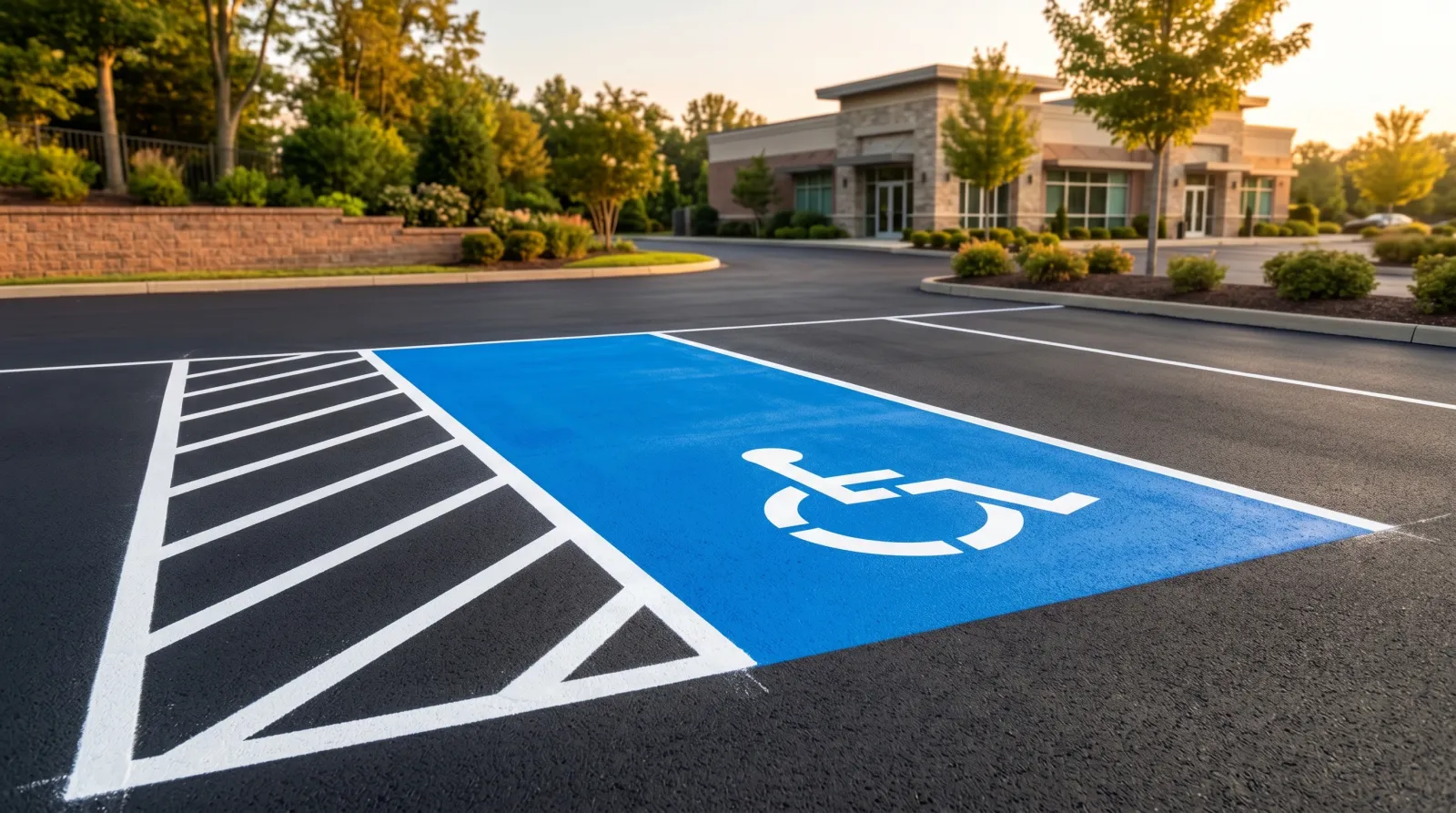
The handicap stencil is the most regulated 36-inch square of paint on any commercial lot. It carries a white International Symbol of Accessibility on a blue field, marks a parking space reserved under the Americans with Disabilities Act, and it is the first thing an accessibility auditor photographs. Get the color, the layout, and the dimensions right and the lot passes a Title III review; let the blue fade to gray or paint the access aisle yellow and the property owner is exposed to a complaint that costs far more than the restripe.
Service life runs 12 to 18 months on heavy-traffic retail with snow plows and de-icing salt, 24 to 36 months on office parks and medical campuses without plowing. The blue field is the limiting factor. Blue pigment is more UV-sensitive than white, so the field reads gray before the symbol loses contrast, and the field is what triggers the repaint. The spec writer’s job is narrow and exact: pick a traffic-paint chemistry that meets MUTCD and OSHA color, clears the state VOC ceiling, dries inside the lot-closure window, and holds blue through at least one winter of salt.
This is pavement-marking work, not a coatings problem in the warehouse-floor sense. The film is thin, the substrate is asphalt or concrete pavement, and the stencil is hand-applied over a cured base. The closest sibling on this site is the parking lot striping paint guide, and the same chemistry families apply. What changes for the handicap stencil is the two-color sequence, the symbol geometry, and the ADA layout the paint has to sit inside.
ADA Accessible Parking Layout, by the Numbers
The stencil is one piece of a layout the spec has to get right end to end. Miss a dimension and the paint passes inspection while the space fails.
| Element | Requirement | Authority |
|---|---|---|
| Standard accessible stall width | 96-inch minimum | ADA Section 502.2 |
| Access aisle width (standard) | 60-inch minimum, white diagonal hatch | ADA Section 502.3 |
| Van-accessible aisle width | 96-inch minimum (or 132-inch stall + 60-inch aisle) | ADA Section 502.2 |
| Ground symbol | International Symbol of Accessibility, white on blue, 36-inch minimum height | State / MUTCD practice |
| Surface slope | 1:48 (about 2 percent) maximum in all directions | ADA Section 502.4 |
| Reserved-parking sign | 60-inch minimum to bottom of sign | ADA Section 502.6 |
| Accessible space count | 1 per 25 spaces up to 100, scaling above | ADA Section 208.2 |
| Van-accessible ratio | 1 of every 6 accessible spaces | ADA Section 208.2.4 |
The 1:48 slope rule catches lots that look compliant. A stall striped over a drainage swale can carry clean blue paint and still fail because water runs across the access aisle at 4 percent. Verify slope with a digital level before striping, not after. The restripe is the cheapest moment to true a layout to current code, and a lot striped to 1992 ADA defaults often has 8-foot stalls, 5-foot aisles, and no van-accessible space. Bringing it current is usually a one-day delta on a routine restripe.
Spec Requirements
| Spec | Value |
|---|---|
| Dry film thickness (DFT) | 12–15 mils wet, 5–7 mils dry per coat (waterborne acrylic) |
| Coverage @ DFT | one 36-inch symbol consumes 0.15–0.25 gal blue field plus white overlay |
| VOC | under 150 g/L waterborne (CARB / OTC compliant); under 450 g/L solvent under SCAQMD Rule 1113 |
| Standards | ASTM D713 (road service), ASTM D2205 (specification), ASTM D2486 (scrub), AASHTO M-248 Type N |
| Blue color | Federal Standard 595 15090 / OSHA 1910.144 information blue |
| Substrate prep (asphalt) | 30-day off-gas on new hot-mix; or sealcoat + stripe over cured sealer at day 7 |
| Substrate prep (concrete) | acid-etch or shotblast to ICRI CSP 2; remove cure-and-seal compound |
| Pavement temp at application | 50–95°F substrate; air temp 50°F and rising |
| Humidity ceiling | 85% RH; dew point 5°F below pavement temp |
| Cure to traffic | 30–45 min no-track; 60–90 min vehicle traffic (waterborne, 73°F, 50% RH) |
| Recoat between colors | blue field cured to no-track before white overlay; 30–60 min typical |
The standards on this list are not interchangeable, and the bid sheet should name them. ASTM D713 is the road-service test that grades adhesion, color hold, and chip loss after the panel sees real traffic; skip it and the symbol picks up off a hot tire by the second summer. ASTM D2205 governs the wet product in the pail, so a D2205-conforming paint stencils clean on day one and does not skin over in storage. AASHTO M-248 Type N is the no-heat traffic-paint standard state DOTs reference, and putting it on the bid sheet forecloses a contractor swapping in consumer-grade marking paint that fades to buff in a season.
Substrate prep is where the spec earns its keep. The blue field has to bond, and a stencil that peels off in one piece after the first freeze is almost always a prep failure rather than a paint failure. On asphalt, the controlling rule is the 30-day off-gas on new hot-mix. On concrete, the controlling rule is profile: open the surface to ICRI CSP 2 and strip any cure-and-seal compound first.
System Chemistry Compared
Pick the chemistry, then the brand.
| Class | Pot life / recoat | Service life | UV stability | $/symbol installed | Best for |
|---|---|---|---|---|---|
| Waterborne acrylic | single-pack; recoat 30–60 min | 12–36 mo | good | $25–55 | Default ADA stencil spec |
| Solvent (chlorinated rubber, alkyd) | single-pack; recoat 20–40 min | 18–36 mo | good | $30–60 | DOT work in non-OTC states |
| Inverted aerosol (acrylic) | single-pack; recoat 15–30 min | 8–18 mo | fair | $20–40 | Small lots, touch-ups, decks |
| Thermoplastic (preformed symbol) | hot-applied; sets 1–2 min | 4–6 yr | excellent | $90–180 | High-traffic municipal, transit |
Waterborne acrylic is the right answer for nearly every private lot. It clears the 150 g/L VOC ceiling that SCAQMD Rule 1113 imposes in the South Coast district and that the thirteen OTC states follow with comparable rules, so it is legal everywhere. It holds blue acceptably through a salt winter, and most striping contractors quote it by default.
Solvent-based dries faster in cold weather and runs slightly more durable, but specifying it in California or the Northeast is a plan-review failure. Inverted aerosol earns a place on small jobs and touch-ups where rolling out an airless striper is not justified, with the trade-off of a thinner build and shorter color hold. Preformed thermoplastic symbols deliver the longest service life and the best UV hold, but the per-symbol cost and the heated-application crew put them on municipal and transit work, not a 40-stall retail lot.
Recommended Systems
Each system below is a two-color stack: a blue field coat, then a white symbol overlay stenciled over the cured field. The white reads cleaner over a fully no-track blue than wet-on-wet, so the recoat window matters.
System a — Sherwin-Williams Setfast Acrylic Waterborne
The commercial striper standard, and the default for ADA stencils. AASHTO M-248 Type N compliant, TT-P-1952F federal spec, ASTM D2205 conformance, available in handicap blue and white.
| Layer | Product | DFT |
|---|---|---|
| Surface prep | Pressure wash; verify asphalt off-gassed 30 days or sealer cured 10 days | — |
| Blue field coat | Setfast Acrylic Waterborne, handicap blue (FS 595 15090) | 12–15 mils wet / 5–7 mils dry |
| White symbol overlay | Setfast Acrylic Waterborne, white, hand-stenciled over cured blue | 12–15 mils wet / 5–7 mils dry |
Sherwin-Williams Setfast product page · Search on Amazon
Setfast’s 30-minute no-pickup time assumes 73°F and 50% RH. On a shaded stall at 60°F and 75% RH, the blue field needs 90 to 120 minutes before the white overlay goes down clean. Plan the symbol work for the afternoon after the field, not the same pass. Freeze recovery is the other sharp edge: Setfast survives one freeze-thaw in the pail with hard mixing, but a second cycle breaks the emulsion, and pails left on a March tailgate overnight are scrap.
System B — Rust-Oleum Industrial Choice 2300 Inverted
Inverted-can aerosol for hand-stencil work where an airless rig is overkill. Right for a single accessible space, a parking deck where airless weight is a problem, or a landlord touch-up.
| Layer | Product | DFT |
|---|---|---|
| Surface prep | Sweep clean; mask stencil; pavement temp 50–95°F | — |
| Blue field coat | Industrial Choice 2300 inverted aerosol, handicap blue | 8–10 mils wet / 3–4 mils dry |
| White symbol overlay | Industrial Choice 2300 inverted aerosol, white, through symbol stencil | 8–10 mils wet / 3–4 mils dry |
Rust-Oleum Industrial Choice 2300 product page · Search on Amazon
The 2300 bites crews that push it past scope. The 3 to 4 mil dry build won’t hold a year of cart and truck traffic behind a big-box, and the blue fades to gray faster than a 6-mil waterborne field. Service life is 8 to 18 months. Right scope: one-off touch-ups, decks, and isolated symbols. For a full lot’s worth of accessible spaces, the per-symbol material cost runs above bulk waterborne once a crew burns through cans.
System C — PPG Aexcel-Stripe Waterborne
Federal Spec TT-P-1952F compliant, AASHTO M-248 Type N, used on DOT and federal work. Comparable to Setfast at a slightly lower 5-gallon pail price through PPG distribution.
| Layer | Product | DFT |
|---|---|---|
| Surface prep | Pressure wash; pavement temp 50–95°F | — |
| Blue field coat | Aexcel-Stripe Waterborne, blue (TT-P-1952F) | 15 mils wet / 6 mils dry |
| White symbol overlay | Aexcel-Stripe Waterborne, white, hand-stenciled | 15 mils wet / 6 mils dry |
PPG Aexcel Pavement Markings page · Search on Amazon
Aexcel-Stripe tracks within about 5% of Setfast on published benchmarks. It earns its line on Buy American work: GSA leases, Postal Service distribution centers, and military bases that need a TT-P-1952F callout. PPG’s industrial distribution is thinner outside the Midwest and Mid-Atlantic, so verify supply on Mountain West projects with a hard occupancy date.
Systems Compared
| System | Total DFT (two-color) | $/symbol installed | Service life | Best for |
|---|---|---|---|---|
| A — SW Setfast | 10–14 mils dry | $35–55 | 18–36 mo | Default spec, full lots, salt climates |
| B — Rust-Oleum 2300 | 6–8 mils dry | $20–40 | 8–18 mo | Single spaces, decks, touch-ups |
| C — PPG Aexcel-Stripe | 12 mils dry | $30–50 | 18–36 mo | Federal / Buy American projects |
Installed cost per symbol covers the blue field plus the white overlay, masking, and labor on an existing layout. New layout, signage, and slope correction are separate line items. A full restripe of a 40-stall lot with two accessible spaces runs the symbols as a small share of total cost; the linework dominates. The accessible spaces are where the liability sits, so they are the wrong place to value-engineer.
Application & Contractor Path
A single repaint over an existing, code-compliant layout is within reach for a facilities crew. Buy a laser-cut International Symbol of Accessibility stencil at 36-inch height, a quality waterborne traffic paint in handicap blue and white, masking film for the field edge, and a kneeling pad. Lay the blue field, let it cure to no-track, then drop the symbol stencil and shoot white. The whole sequence on one space is an hour.
The work that needs a striping contractor is layout to code. Stall and aisle dimensions, the van-accessible ratio under ADA Section 208.2, signage height, and the 1:48 slope cap are the elements an audit checks, and the paint quality is irrelevant if those are wrong. Spec a contractor for any new layout, any space that has never been verified to current code, and any lot where the slope is in question.
There is no NACE or SSPC certification for pavement marking the way there is for tank linings. The right qualifier is a contractor who carries general liability at $2M aggregate, provides SDS, warrants 12 months minimum adhesion, and has done ADA layout work the local building department recognizes. The manufacturer-rep path is the same as the striping guide: a Sherwin-Williams or PPG commercial rep will spec the product, confirm color match to Federal Standard 595, and point to a striping contractor on their applicator list.
Failure Modes & How to Prevent Them
Blue field fades to gray by month nine. The symbol still reads but the field looks washed out, and the space fails a contrast check before the line wears off. Cause is UV breakdown of off-spec blue pigment, common in consumer marking paint with no AASHTO callout. Prevention is the bid sheet: require AASHTO M-248 Type N or TT-P-1952F by number, and spec the blue to Federal Standard 595 15090.
Symbol peels off in one piece. The white overlay or the whole stencil lifts after the first freeze, leaving a clean pavement scar. Cause is a bond failure: green asphalt still off-gassing, a slick cure-and-seal compound on concrete, or an oil stain under the field. Prevention is the prep spec. Off-gas new asphalt 30 days, strip cure-and-seal and open concrete to ICRI CSP 2, and degrease oil stains before the blue goes down.
White symbol ghosts the blue underneath. The white overlay reads bluish or muddy where the field bled through. Cause is stenciling white over a blue field that had not cured to no-track. Prevention is the recoat window. Let the blue reach no-track (30 to 60 minutes warm, longer when cool or shaded) before the white overlay, and check with a thumbnail-press at the edge.
Access aisle painted yellow. The diagonal hatch beside the space is yellow instead of white, and an accessibility auditor cites it. Cause is a designer defaulting to yellow because it reads “no parking.” Yellow on an access aisle reads as a fire lane under OSHA 1910.144. Prevention is the color spec: white diagonal hatch on access aisles, blue field for the symbol, yellow only on fire lanes.
Stencil bridges a slope and water sheets across the aisle. Paint passes inspection, layout passes a tape measure, and the space still fails because the surface runs at 4 percent. Cause is striping over a drainage feature without checking slope. Prevention is a digital level on the stall and aisle before striping, with correction or relocation if any reading exceeds 1:48.
Where to Buy / Spec
| Channel | Best for |
|---|---|
| Manufacturer-direct (SW Setfast, PPG Aexcel, Rust-Oleum 2300) | Spec’d projects, color match to FS 595, rep support, bulk 5-gal pricing |
| Industrial distributor (Pavement Supply, SealMaster, Brown Co) | Bulk paint, laser-cut ADA stencils, masking film for striping contractors |
| Pro retail (Sherwin-Williams stores) | Local 5-gal pickup, contractor pricing on blue and white |
| Amazon Business | Aerosol-can and single-stencil stocking for touch-up work |
Specifier’s Bid Language
“Provide and install AASHTO M-248 Type N waterborne acrylic traffic marking paint per Sherwin-Williams Setfast specification (or approved equal: PPG Aexcel-Stripe, Ennis-Flint waterborne) for all accessible-parking ground markings. Blue field color to Federal Standard 595 15090; white International Symbol of Accessibility at 36-inch minimum height. DFT 12–15 mils wet, 5–7 mils dry per color. Pavement temp 50–95°F at application; air temp 50°F and rising; humidity at or below 85%; dew point 5°F below pavement temp. ADA accessible-space layout per ADA Sections 502 and 208 verified and corrected to current code, including 1:48 maximum slope, 96-inch stall, access-aisle width, van-accessible ratio, and 60-inch sign mounting. Access aisles white diagonal hatch; no yellow. Contractor carries $2M aggregate GL, provides SDS, and warrants minimum 12 months adhesion.”
The 12-month adhesion warranty is the floor. On a sealcoated asphalt or properly profiled concrete substrate, push for 18 to 24 months. The slope and layout verification line is the one most bids omit, and it is the one an accessibility audit checks first.