ADA Blue Paint: Accessible Parking Specifier's Guide (2026)
ADA blue paint specified by color match, DFT, and VOC for accessible parking symbols, access aisles, and blue zone curbing. FHWA Blue spec, MUTCD color, and the airless striper path that survives a year of de-icing salt.

Disclosure: Affiliate links to retailers and manufacturer-direct programs. Recommendations are spec-driven, not commission-driven.
Use Case
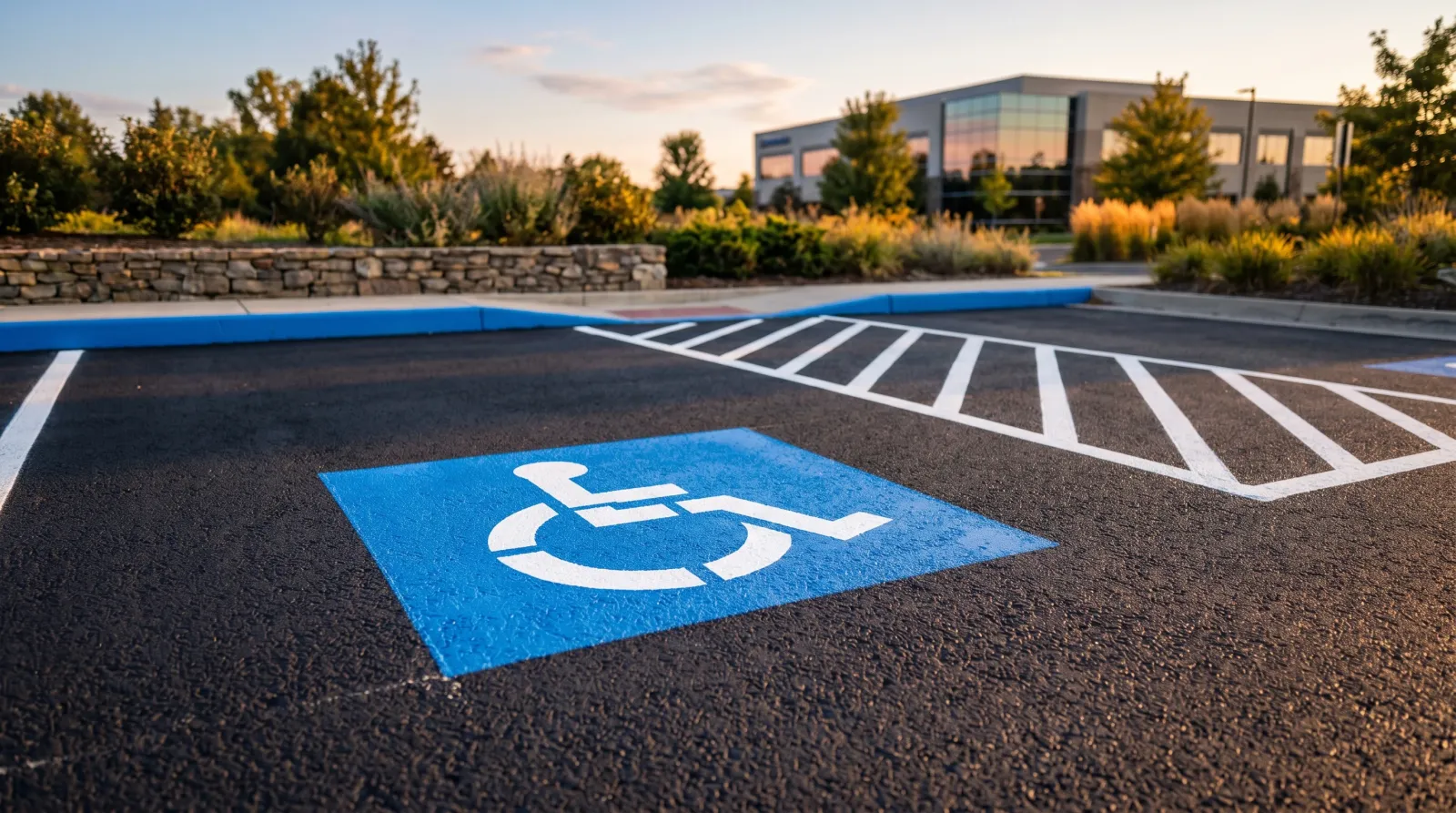
ADA blue paint is the accessible-parking marking: the blue symbol field, the white International Symbol of Accessibility, the white access-aisle hatching, and on many lots the blue curbing that flags a reserved space. It is the most enforcement-driven marking on any commercial lot. A faded standard stall costs nobody anything; a faded or out-of-spec accessible space exposes the property owner to a Title III ADA complaint, a state accessibility audit, and a fire-marshal note if the access aisle gets blocked. The marking has to survive UV, freeze-thaw, hot-tire pickup, plow scrub, and de-icing salt at a dry film thickness under 10 mils, and it has to hold a specific blue.
The asset is the accessible space near a building entrance: a retail strip, a medical office, a municipal building, a grocery anchor. Service life runs 12 months on heavy-traffic retail with plows and salt, 24 months on office-park and medical-campus lots, and 3 to 5 years on light-use lots that never see a plow. Blue is the short pole in that tent. Blue organic pigment chalks and fades under UV faster than the white figure painted over it, so the symbol field is usually the first marking on a lot to drop below compliant contrast even when the white linework still looks fresh.
The spec writer has three things to get right: the color match (FHWA Blue, the working standard), the state VOC ceiling, and the lot-closure window. Get those three and the rest of the spec falls into place. The dimensions belong to the ADA, not the paint. The paint’s only job is to put a compliant blue and white where §502 says it goes, and to keep it there for a service cycle.
Spec Requirements
The accessible space is governed by two rule sets at once: the ADA Standards for layout and color meaning, and the traffic-paint standards for the coating itself. Both have to be on the bid sheet.
| Spec | Value |
|---|---|
| Color | FHWA Blue, Federal Standard 595B 15090 (close to Pantone 294 C); white symbol and border per ADA §703.7.2.1 |
| Dry film thickness (DFT) | 12–15 mils wet, 5–7 mils dry per coat (waterborne acrylic) |
| Coverage @ DFT | 110–120 lf @ 4-inch width per gallon; roughly 1 gallon blue per 6–8 symbol fields |
| VOC | under 150 g/L waterborne (CARB / OTC compliant); under 450 g/L solvent under SCAQMD Rule 1113 |
| Standards (paint) | ASTM D713 (road service), ASTM D2205 (waterborne specification), ASTM D2486 (scrub), AASHTO M-248 Type N, TT-P-1952F |
| Standards (layout) | ADA §502 accessible spaces; §208 count; §703.7.2.1 symbol; MUTCD 3A.05 color |
| Substrate prep — asphalt | Sweep, pressure-wash, off-gas new hot-mix 30 days; degrease and shellac-prime oil stains |
| Substrate prep — concrete | Acid-etch or shotblast to ICRI CSP 2 minimum; never paint over cure-and-seal without a primer |
| Pavement temp at application | 50–95°F substrate; air temp 50°F and rising |
| Humidity ceiling | 85% RH; dew point 5°F below pavement temp |
| Cure to traffic | 30–45 min no-track; 60–90 min vehicle traffic (waterborne, 73°F, 50% RH) |
| OSHA color code | 1910.144 — blue is information / accessibility; never blue for fire lane (red) or caution (yellow) |
| ADA symbol height | 36-inch minimum International Symbol of Accessibility, white on blue |
The color number is the part owners underspecify. The ADA Standards mandate the symbol and that the spaces be marked, but the precise blue is set by state and local DOT specs, and almost all of them land on FHWA Blue / 595B 15090. Buy the manufacturer’s stock handicap or safety blue rather than a custom tint; the stock colors are formulated to that target, and a custom blue mixed at a paint counter will not carry the lightfastness package a traffic line needs.
ASTM D713 is the road-service test: a panel coated to DFT, mounted on a roadway, graded for adhesion, color, and chip loss. Skip it and the first failure is hot-tire pickup where wheelchair transfers and cart traffic pivot on the symbol. ASTM D2205 governs the wet waterborne product in the pail (viscosity, fineness of grind, freeze-thaw). AASHTO M-248 Type N is the DOT reference; putting it on the bid sheet forecloses cheap consumer-grade substitutions that fade by month six.
System Chemistry Compared
Pick the chemistry first, then the brand. Four classes show up on accessible-space work, and for a typical commercial lot only one is the right answer.
| Class | Dry to traffic | Service life | $/sq ft of symbol | Best for |
|---|---|---|---|---|
| Waterborne acrylic | 30–90 min | 12–24 mo | $0.40–0.80 | Default commercial spec; stencil and airless |
| Solvent acrylic / chlorinated rubber | 20–40 min | 18–30 mo | $0.50–0.90 | DOT roadway in non-OTC states only |
| Preformed thermoplastic symbol | 5–10 min (heat-fused) | 4–8 yr | $4–9 | High-traffic transit, hospital, airport blue zones |
| Epoxy / MMA cold plastic | 30–45 min | 4–6 yr | $5–11 | Concrete decks, structural-deck accessible stalls |
Waterborne acrylic is the right answer for nearly every private commercial lot. Solvent dries faster in the cold and is slightly more durable, but SCAQMD Rule 1113 caps traffic paint at 150 g/L in the South Coast district and the thirteen OTC states follow comparable rules. Specifying solvent in California or the Northeast is a plan-review failure, and most contractors elsewhere quote waterborne by default now.
Preformed thermoplastic is worth a hard look on one specific asset: the high-traffic accessible space that gets repainted every single year because of plow and salt abuse. A heat-fused PremarkPlus symbol panel carries the blue field and white figure as a single 90-to-125-mil thermoplastic unit with intermixed glass beads, and it holds 4 to 8 years where paint holds one. The buy-in is the catch. It needs a propane torch, a trained crew, and a per-symbol cost five to ten times a painted stencil. Spec it for hospital entrances, transit centers, and airport blue zones where the closure window for a yearly repaint is the real cost, not the paint.
Recommended Systems
Three systems at different price-performance points. The first two are painted stencil systems for the typical lot; the third is the thermoplastic upgrade for high-abuse spaces.
System a — Sherwin-Williams Setfast Acrylic Waterborne (handicap Blue)
The commercial striper standard for accessible-space work. AASHTO M-248 Type N compliant, TT-P-1952F federal spec, ASTM D2205 conformance, available in a stock Handicap Blue formulated to the FHWA target.
| Layer | Product | DFT |
|---|---|---|
| Surface prep | Pressure wash; degrease and shellac-prime oil stains; off-gas new asphalt 30 days | — |
| Symbol field / access aisle | Setfast Acrylic Waterborne, Handicap Blue | 12–15 mils wet / 5–7 mils dry |
| White symbol + aisle hatching | Setfast Acrylic Waterborne, White, over stencil | 12–15 mils wet / 5–7 mils dry |
| Total (two-color symbol) | 10–14 mils dry combined |
Sherwin-Williams Setfast product page · Search on Amazon
Setfast’s 30-minute no-pickup time assumes 73°F and 50% RH. At 60°F and 75% RH on a shaded stall against a building, expect 90 to 120 minutes, and accessible spaces sit in shade more often than open lot. Freeze recovery is the second sharp edge. Setfast survives one freeze-thaw in the pail with vigorous mixing; a second cycle breaks the emulsion, and a blue pail left on a March tailgate is scrap.
System B — Rust-Oleum Industrial Choice 2300 Inverted (safety Blue)
Inverted-can aerosol for stencil work and touch-ups where rolling out an airless rig isn’t justified. Right for a single accessible space, a landlord punch-list, or a parking deck where airless weight is a problem.
| Layer | Product | DFT |
|---|---|---|
| Surface prep | Sweep clean; degrease oil; pavement temp 50–95°F | — |
| Symbol field (stencil) | Industrial Choice 2300 inverted aerosol, Safety Blue | 8–10 mils wet / 3–4 mils dry |
| White symbol over stencil | Industrial Choice 2300 inverted aerosol, White | 8–10 mils wet / 3–4 mils dry |
Rust-Oleum Industrial Choice 2300 product page · Search on Amazon
The 2300 bites crews who push it past its scope. The 3-to-4-mil dry build won’t hold a year of cart and wheelchair-transfer traffic on a heavy retail symbol, and per-symbol material cost runs high when a crew burns through cans. Service life is 8 to 14 months on the symbol field. Right scope: single-space repaint, punch-list, parking decks, isolated curb runs. The Rust-Oleum industrial portfolio, covered in the Rust-Oleum industrial line review, is the stocking choice for in-house maintenance carts.
System C — Ennis-Flint PremarkPlus Preformed Thermoplastic Symbol
The durable upgrade. A factory-made preformed thermoplastic ADA symbol panel, blue field and white figure as one unit with intermixed beads, heat-fused to the pavement with a propane torch.
| Layer | Product | DFT |
|---|---|---|
| Surface prep | Sweep and fully dry; torch-warm pavement to bond temp | — |
| Preformed symbol panel | PremarkPlus heat-fused preformed thermoplastic ADA symbol | 90–125 mils |
| Total | 90–125 mils |
Ennis-Flint / PPG pavement markings page
Service life 4 to 8 years, against one year for paint on the same abused space. PremarkPlus is operationally heavier: a torch crew, a dry-pavement requirement that kills it on a damp morning, and a per-symbol cost five to ten times a painted stencil. It earns the spec where the recurring closure window for a yearly repaint outweighs the paint cost. Hospital entrances, transit centers, airport blue zones, and any accessible space that takes plow and salt punishment every winter.
Systems Compared
| System | Total DFT | $/sq ft installed (symbol) | Service life | Best for |
|---|---|---|---|---|
| A — SW Setfast Handicap Blue | 10–14 mils dry | $0.60–1.10 | 12–24 mo | Default lot; airless + stencil; full-lot ADA restripe |
| B — Rust-Oleum 2300 Safety Blue | 6–8 mils dry | $0.80–1.40 | 8–14 mo | Single space, punch-list, maintenance carts |
| C — Ennis-Flint PremarkPlus | 90–125 mils | $4–9 | 4–8 yr | Hospital, transit, airport, high-salt abuse |
Installed cost runs higher per square foot than a plain stall stripe because the symbol is two-color stencil work with a layout check, not a straight airless line. A typical 36-inch symbol field plus a 5-foot access aisle of white hatching is a 30-to-45-minute hand operation even for a fast crew.
Application & Contractor Path
A single worn symbol is within reach of a maintenance crew with a stencil kit, two cans of System B, and a tape measure to confirm the layout still meets §502. That is the honest DIY edge of this work. Above that, it is contractor work, and the reason is the layout audit, not the paint. The dimensional tolerances in ADA §502 (8-foot accessible stall, 5-foot access aisle, 8-foot van aisle, the van-accessible ratio under §208.2) are checked with a tape by an accessibility auditor or an ADA plaintiff’s expert. A layout error is a Title III liability that paint quality cannot cure.
For a full lot, spec a striping contractor who works to ADA layout, carries a $2M aggregate general-liability policy, and warrants a minimum 12 months adhesion on the symbol field. There is no SSPC or NACE certification tier for parking-lot striping the way there is for tank linings, so the qualifier is a reference list of ADA-compliant lots and proof the crew lays out to current code rather than copying the old, often non-compliant, footprint. The most common in-the-field error I review is a crew faithfully repainting an 8-by-5 layout that predates the current van-accessible requirement, locking in the violation for another cycle.
The manufacturer-rep path matters less here than on a tank job, but Sherwin-Williams and PPG reps will confirm the blue color match against your local DOT spec and pull the right stock product before a contractor quotes a custom tint. Use it for the color confirmation, because a custom blue is the easiest way to put a non-lightfast pigment on a UV-exposed symbol.
Failure Modes
The accessible space fails in ways a plain stall does not, mostly because of where it sits and what color it is.
Blue fades to compliant-failure before the white does. The symbol field washes out under UV while the white figure still reads crisp, so the symbol loses contrast even though the line still adheres. Cause is the lower lightfastness of blue organic pigment versus titanium-dioxide white. Prevention is the bid sheet: require AASHTO M-248 Type N or TT-P-1952F blue by number, not a counter-tinted blue, and inspect the symbol field annually rather than on the lot’s general restripe cycle.
Oil bleed and bond failure at the entrance. Accessible spaces sit by the door where vehicles idle and drip, so the symbol footprint is the most oil-saturated patch on the lot. The blue lifts in the center of the symbol while the surrounding stall holds. Cause is an oil stain whose residue broke the bond. Prevention is degrease plus a shellac-based stain-blocking sealer (BIN, Cover Stain) on the footprint before the blue, not an acrylic primer, which won’t block the oil.
Layout repainted out of code. The new paint is perfect; the dimensions are not. Cause is a crew copying the existing footprint, which often predates the current §502 and §208 requirements. Prevention is a tape-measure layout check at restripe and correcting stall width, aisle width, and the van-accessible ratio. The restripe is the cheapest moment to true up the layout.
Hot-tire and transfer-point pickup on the symbol. Rubber imprints lift the film where carts and wheelchairs pivot and where transfer happens at the access aisle. Cause is thermal-mechanical stress at a high-pivot point. Prevention is 7 mils dry DFT on the symbol field, or System C thermoplastic on a chronically abused space.
Peeling within one season on new asphalt. The whole symbol lifts in a sheet from a clean substrate. Cause is green hot-mix asphalt still off-gassing under the film. Prevention is the 30-day off-gas window, or sealcoat first and apply at day 7 over cured sealer. The same sequence that governs general striping, covered in the parking lot striping paint specifier guide, governs the blue symbol.
Where to Buy / Spec
| Channel | Best for |
|---|---|
| Manufacturer-direct (SW Setfast, Rust-Oleum 2300, Ennis-Flint / PPG) | Spec’d portfolios, color-match confirmation, bulk pricing |
| Industrial distributor (Pavement Supply, SealMaster, Brown Co) | Bulk paint, stencils, preformed thermoplastic symbols |
| Pro retail (Sherwin-Williams stores) | Local 5-gal pickup of stock Handicap Blue, contractor pricing |
| Amazon Business | Inverted-can and stencil stocking for maintenance carts |
Specifier’s Bid Language
“Provide and install AASHTO M-248 Type N waterborne acrylic traffic marking paint per Sherwin-Williams Setfast specification (or approved equal). Symbol field color FHWA Blue, Federal Standard 595B 15090; International Symbol of Accessibility and border in white per ADA §703.7.2.1. DFT 12–15 mils wet, 5–7 mils dry per coat. Pavement temp 50–95°F at application; air temp 50°F and rising; humidity at or below 85%; dew point 5°F below pavement temp. Accessible-space layout per ADA §502 and §208 verified and corrected to current code, including van-accessible ratio. Contractor carries $2M aggregate GL, provides SDS, and warrants minimum 12 months symbol-field adhesion and color compliance.”
The 12-month adhesion-and-color warranty is the floor. The color clause is the one owners forget; a contractor who warrants adhesion but not color can hand back a faded blue at month nine and call it a wear item. Tie the warranty to compliant contrast, not just film integrity.