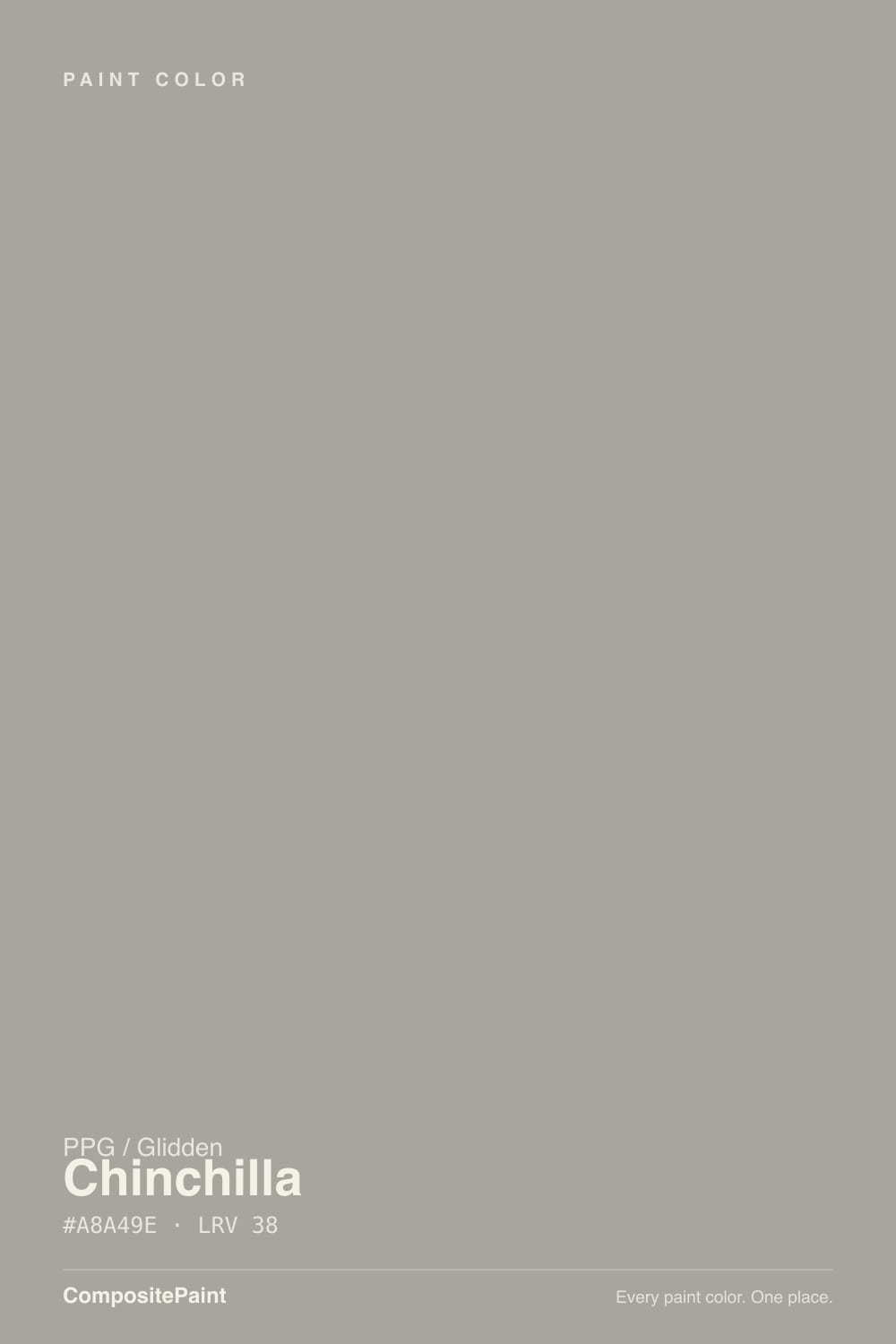
Color spec
| Brand | PPG / Glidden |
| Name | Chinchilla |
| SKU | PPG1001-4 |
| Hex | #A8A49E |
| RGB | 168, 164, 158 |
| HSL | 36°, 5%, 64% |
| LRV | 38 |
| Undertone | warm red-orange tone |
| Family | Gray |
What Color Is Chinchilla, Really?
Chinchilla (PPG1001-4) is a soft mid-tone greige, a gray with just enough warmth to keep it from feeling cold. Its saturation reads at only about 5 percent, so this is a near-neutral color with the faintest warm, red-orange lean rather than an obvious brown or taupe. On the wall it looks like a settled, mineral gray that stays quiet in most rooms.
PPG places it in its trend palettes as a cool mid-greige, which is why it shows up so often on inspiration boards. With an LRV of 38 it sits right in the middle of the light scale, so it has real depth without going dark.
Chinchilla suits people who want a gray that feels grounded and a little organic. It works in transitional and modern homes, and it flatters open living spaces where you want walls to recede without reading stark white.
Chinchilla is best understood as near-neutral. With a hue around 36 and saturation of only 5 percent, the warm red-orange base is present but very quiet, so most of the time you read it simply as a soft gray. The warmth is what keeps it from turning icy or blue in a cool room.
The undertone shows up most in specific conditions. Against a crisp white trim or a bright north window, Chinchilla can look a touch deeper and grayer. Next to a true beige or a warm wood floor, the same faint warmth pulls forward and it feels more like greige.
Test it against a pure white card and against a clear taupe. If it looks cleaner than the taupe but warmer than the white, that is the color behaving normally. Always view samples both in daylight and under lamplight before deciding.
Best Rooms and Uses for Chinchilla
Because it sits mid-scale at LRV 38, Chinchilla is versatile rather than a whole-home light color or a dramatic statement shade. It carries enough depth to feel intentional on full walls without shrinking a room the way a dark color would.
It works well as a main wall color in living rooms, bedrooms, and hallways, and in open-plan spaces where you want a calm, connective backdrop. It also makes a strong cabinet color, giving kitchens and vanities a grounded, mineral look that pairs easily with both warm and cool counters.
As an accent it holds up on a single feature wall or on built-ins. On exteriors it reads as a natural stone gray for siding, and it is a sensible body color paired with white trim. It is generally too deep to use as trim itself, where a lighter neutral serves better.
How Lighting Changes Chinchilla
At an LRV of 38, Chinchilla is a mid-tone, so it reflects a moderate amount of light and reacts noticeably to exposure. In a north-facing room, where the light is cooler and flatter, it reads deeper and grayer, and the small amount of warmth helps balance that chill. In a bright south-facing room it opens up, looks lighter through the day, and its warm side is easier to see.
East light is warm in the morning and cooler by afternoon, so expect Chinchilla to shift over the day. West rooms get warm, golden evening light that pushes the color toward greige.
Bulb choice matters just as much. Warm white bulbs around 2700K bring out the warm undertone and make the color cozier. Cooler bulbs at 4000K and up flatten the warmth and let the gray dominate. Sample large swatches on more than one wall.
Most complaints about Chinchilla are a light mismatch. Upload a photo of your actual room and see it on your walls — then ask for the same wall in north light or evening lamps before you buy a single sample.
TEST IT IN YOUR LIGHT →Chinchilla vs Similar Colors
Chinchilla (LRV 38) has several close PPG neighbors that differ in subtle but useful ways. Hot Stone (PPG1007-4), at LRV 39, is nearly the same depth but leans a little warmer, so it reads as a touch more beige on the wall. Choose Hot Stone when you want the warmth to be more obvious, and Chinchilla when you want the color to stay balanced and gray.
Stepping Stone (PPG1010-4), also LRV 39, is the cooler of the group, with less warm lean, so it feels slightly crisper and more neutral-gray. It is the better pick in a room that already has warm wood and cream where you want the walls to cool things down.
Winter's Nap (PPG1018-4) drops to LRV 35, making it marginally deeper and warmer than Chinchilla, useful when you want a bit more cocooning weight in a lower-light room.
Colors That Go With Chinchilla
For trim and ceilings, Pure White (PPG1001-1), at LRV 88, gives a clean, bright edge that makes Chinchilla look deliberate. If you want a softer, warmer frame, Antique White (PPG1015-2), LRV 78, keeps things gentle.
For a lighter companion wall color in an adjoining space, Limited Gray (PPG1010-3), LRV 56, and Sea Salt (PPG1136-2), LRV 62, both step up in value while staying in the same quiet family. Stone Beige (PPG1024-3), LRV 49, adds an earthier warm neutral if you want more contrast in tone.
For accents and depth, Granite Gray (PPG1010-5), LRV 21, works on built-ins or a darker base. For a front door with real punch, Mariner Blue (PPG1162-7), LRV 8, is a deep navy that plays off the warm gray. Natural wood tones and both warm and brushed metals sit comfortably alongside Chinchilla.
Need It From Another Brand?
Any paint counter can custom-tint PPG / Glidden PPG1001-4 directly — but if you would rather stay in one brand's own deck, these are the closest stock matches:
Similar PPG / Glidden colors
closest in the PPG / Glidden deckThe nearest shades to Chinchilla within PPG / Glidden's own range, ranked by perceptual color distance — useful when you want the same look a touch lighter, darker, or warmer.
Coordinated palette
Generated by hue-rotating #A8A49E in HSL space. Pair Chinchilla with one accent and one neutral — the swatches below are starting points, not final picks.
Accessibility (WCAG contrast)
WCAG 2.1: AA = 4.5:1 normal text · AA Large = 3:1 large text · AAA = 7:1 normal text.
The Questions Everyone Asks
Is Chinchilla warm or cool?
Chinchilla is a near-neutral gray with a very slight warm lean. Its saturation is only about 5 percent with a warm red-orange base, so it is not a cold blue-gray, but the warmth stays quiet. In most rooms it reads as a soft, balanced greige, warming up under lamplight and cooler bulbs make it look more purely gray.
Is Chinchilla more gray or more brown?
It is more gray than brown. The measured warmth is subtle, so Chinchilla mainly reads as a mid-tone gray with a faint greige character rather than a true taupe or brown. You will notice the warm side most next to a crisp white or against a cool-toned floor, but on its own it stays firmly in the gray family.
What trim white goes with Chinchilla?
Pure White (PPG1001-1), with an LRV of 88, is a strong trim and ceiling partner. Its clean brightness makes Chinchilla look deliberate and gives a clear edge between wall and trim. If you prefer a softer, warmer frame, Antique White (PPG1015-2) at LRV 78 keeps the contrast gentle while still reading as a light neutral.
Does Chinchilla work on cabinets and exteriors?
Yes. On cabinets, its mid-tone depth gives kitchens and vanities a grounded, mineral look that suits both warm and cool countertops. On exteriors it reads as a natural stone gray, working well as a siding or body color paired with white trim. Test large samples in your own light first, since exterior sun makes mid-tones look lighter than indoors.
What does an LRV of 38 mean for Chinchilla?
LRV, or light reflectance value, runs from 0 (black) to 100 (white). At 38, Chinchilla sits right in the middle, so it reflects a moderate amount of light. In practice that means real depth without going dark, walls that feel settled rather than airy, and a color that shifts visibly with your room's exposure and bulb temperature.
How is Chinchilla different from Functional Gray?
Sherwin-Williams Functional Gray (SW 7024) is a close match at LRV 37, so the two look very similar on the wall. Both are warm-leaning mid greiges. The differences come down to your brand preference and the exact paint line, since the depth and undertone are nearly identical. Always compare physical samples side by side before committing to either.
Will It Work in YOUR Room?
No page can promise how Chinchilla behaves in your light. Upload a photo and see it on your own walls in seconds — before you spend a cent on samples.
TRY CHINCHILLA ON YOUR ROOM →Ask a Question

Not sure about Chinchilla in your room?
Ask Jessica below — every question gets a real reply, usually within a day.