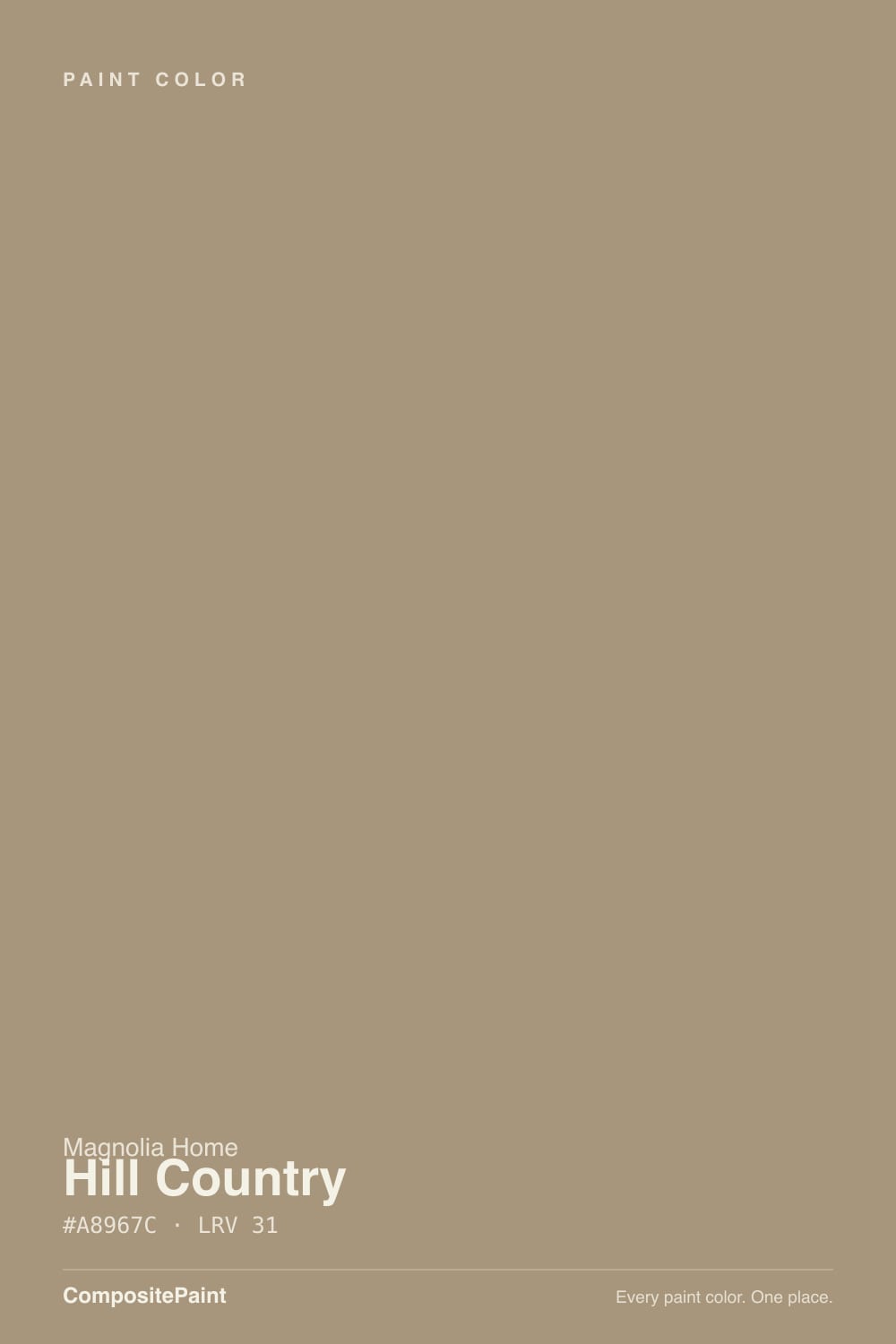
Color spec
| Brand | Magnolia Home |
| Name | Hill Country |
| SKU | JG-013 |
| Hex | #A8967C |
| RGB | 168, 150, 124 |
| HSL | 35°, 20%, 57% |
| LRV | 31 |
| Undertone | warm red-orange tone |
| Family | Neutral |
What Color Is Hill Country, Really?
Hill Country (JG-013) is an earthy taupe. Its hue sits at 35 degrees, right in the tan-to-brown range, with a modest 20 percent saturation, so the warmth is real and visible rather than a faint hint. In plain terms, this is a soft brown-taupe with a whisper of golden orange, not a cool gray. At an LRV of 31 it lands in the middle of the depth scale, dark enough to feel grounded but not heavy.
It is popular as the earthy taupe tied to Joanna Gaines's Texas brand storytelling, which gives it a farmhouse, lived-in association many people already picture.
Hill Country suits homes going for a warm, natural, slightly rustic feel: older houses, wood floors, linen and leather, and rooms with decent daylight. If you want a wall color with more character than beige but less commitment than a full brown, this is the range it works in.
Hill Country leans warm and earthy. With a hue near 35 degrees it points toward tan and soft brown, and the 20 percent saturation is high enough that the warmth clearly reads, so you should not expect a true gray. Depending on your furnishings it can look like taupe with a golden-brown pull, sometimes edging toward a muted khaki.
Because the color carries genuine warmth, the risk is that it can go too yellow or too orange next to strong warm light or warm-toned wood. The safest way to judge it is to test a board against a crisp white and against a cooler gray. Beside white, its warmth is obvious. Beside gray, you will see whether the orange side is showing more than you want.
Keep the sample upright and view it morning and evening before deciding, since a warm mid-tone shifts more than a pale neutral.
Best Rooms and Uses for Hill Country
With a mid LRV of 31, Hill Country is versatile but not a whole-home light color. It works best as a full wall color in rooms where you want warmth and a bit of depth: living rooms, dens, bedrooms, dining rooms, and studies. It reads as a comfortable mid-depth taupe on all four walls in a room with good daylight, and turns more enveloping in low light.
It also does well on cabinets and built-ins, where its earthy body gives millwork a grounded, furniture-like look, and on an accent wall paired with lighter neutrals. On exteriors it makes a natural, warm body color for siding that sits comfortably with stone and wood.
Use it carefully as trim, since at this depth it will read as a color rather than a clean edge; a much lighter white is the better choice for trim against it.
How Lighting Changes Hill Country
At an LRV of 31, Hill Country absorbs more light than it reflects, so the room's exposure matters a lot. In north-facing rooms, where the light is cooler and flatter, it reads deeper and more muted, and its earthy side comes forward. That can be exactly right for a cozy den, or too dim for a room you use in daylight.
South-facing rooms get the most flattering result. Steady warm light through the day keeps the taupe balanced and rich without pushing it muddy. East light in the morning warms it up and can bring out the golden note, then cools by afternoon. West rooms do the reverse, subtle by day and glowing warmer at sunset.
Bulb choice pushes it further. Warm 2700K bulbs deepen the brown-gold; cooler 3500K to 4000K bulbs calm the warmth and make it look more like a neutral taupe.
Most complaints about Hill Country are a light mismatch. Upload a photo of your actual room and see it on your walls — then ask for the same wall in north light or evening lamps before you buy a single sample.
TEST IT IN YOUR LIGHT →Hill Country vs Similar Colors
Antiquing (JG-128), LRV 33, is close in depth but reads grayer and less orange, with more of a soft mushroom feel. If Hill Country looks a touch too golden for you, Antiquing is the calmer, more neutral swap while keeping a similar lightness.
Countryside (JG-52) shares the exact LRV of 31 but its hex pulls toward green, so it looks like a khaki-taupe rather than a warm brown-taupe. Choose Countryside when you want the earthy depth with an olive tilt, and Hill Country when you want the warmer, redder side of taupe.
Quaint Cottage (JG-114), LRV 37, is noticeably lighter and grayer. It is the better pick for a brighter room or a more open, airy neutral, while Hill Country gives you more depth and warmth on the wall.
Colors That Go With Hill Country
For trim and ceilings, True White (JG-079), at an LRV of 87, gives the cleanest, brightest contrast and keeps the taupe looking crisp. If you want a softer, warmer edge that matches the earthy mood, Shiplap (JG-049), LRV 75, is a creamier off-white for trim or an adjacent wall.
For a second wall color or a lighter open-plan partner, Stone's Throw (JG-069), LRV 50, is a pale greige that steps up from Hill Country without clashing. As a related accent, the muted green Sage (JG-022), LRV 35, sits at a similar depth and brings a natural, garden-toned complement.
For an anchor or a front door, Old World (JG-102), a deep brown at LRV 14, or the near-black Coal (JG-040), LRV 3, both give strong contrast. Warm woods, brass, and aged bronze all suit its earthy character.
Need It From Another Brand?
Any paint counter can custom-tint Magnolia Home JG-013 directly — but if you would rather stay in one brand's own deck, these are the closest stock matches:
Similar Magnolia Home colors
closest in the Magnolia Home deckThe nearest shades to Hill Country within Magnolia Home's own range, ranked by perceptual color distance — useful when you want the same look a touch lighter, darker, or warmer.
Coordinated palette
Generated by hue-rotating #A8967C in HSL space. Pair Hill Country with one accent and one neutral — the swatches below are starting points, not final picks.
Accessibility (WCAG contrast)
WCAG 2.1: AA = 4.5:1 normal text · AA Large = 3:1 large text · AAA = 7:1 normal text.
The Questions Everyone Asks
Is Hill Country warm or cool?
Hill Country is a warm color. Its hue sits around 35 degrees in the tan-to-brown range, with enough saturation that the warmth clearly shows. It reads as an earthy taupe with a golden-brown lean, not a cool gray. In warm light it can look more golden, and against a crisp white its warmth becomes obvious.
What trim white goes with Hill Country?
For the crispest contrast, use True White (JG-079), which at an LRV of 87 keeps the taupe looking clean and defined. If you prefer a softer, warmer edge that matches the earthy mood, Shiplap (JG-049) at LRV 75 is a creamier off-white. Both work far better than a mid-tone as trim against Hill Country.
Does Hill Country work on cabinets and exteriors?
Yes. On cabinets and built-ins its earthy body gives millwork a grounded, furniture-like look that pairs well with wood and brass. On exteriors it makes a natural warm siding color that sits comfortably with stone and wood. In both cases, test a board in the actual light, since its mid-depth warmth shifts with exposure.
What does an LRV of 31 mean for Hill Country?
LRV measures how much light a color reflects, on a scale of 0 to 100. At 31, Hill Country absorbs more light than it reflects, so it reads as a grounded mid-depth taupe rather than a light neutral. Expect it to feel richer and cozier in low light and more balanced in rooms with good daylight.
How is Hill Country different from Serengeti Grass?
They are very close warm taupes at nearly the same depth, with Sherwin-Williams Serengeti Grass (SW 9116) at LRV 32 versus Hill Country at 31. The practical difference is small and mostly a matter of which brand and finish you can buy locally. If you already have a Magnolia deck, Hill Country gives you the same earthy taupe look.
Should I sample Hill Country before painting?
Yes, always. Warm mid-tones like Hill Country shift more than pale neutrals, so paint a large board and view it against white and against your furnishings, in both morning and evening light. Check it in the specific room, since north light deepens it and warm bulbs push it more golden. A sample prevents an unwanted orange surprise.
Will It Work in YOUR Room?
No page can promise how Hill Country behaves in your light. Upload a photo and see it on your own walls in seconds — before you spend a cent on samples.
TRY HILL COUNTRY ON YOUR ROOM →Ask a Question

Not sure about Hill Country in your room?
Ask Jessica below — every question gets a real reply, usually within a day.