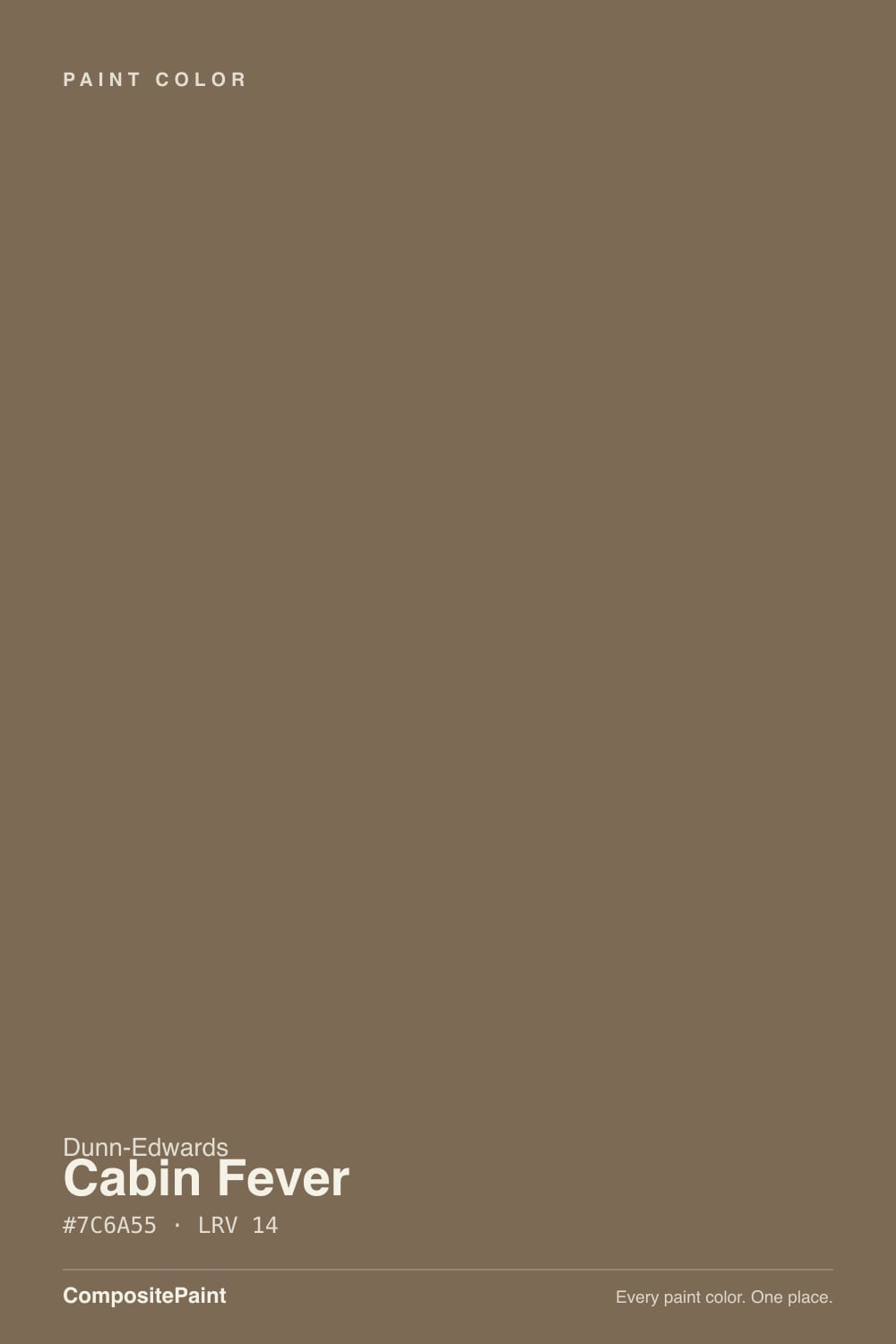
Color spec
| Brand | Dunn-Edwards |
| Name | Cabin Fever |
| SKU | DET647 |
| Hex | #7C6A55 |
| RGB | 124, 106, 85 |
| HSL | 32°, 19%, 41% |
| LRV | 14 |
| Undertone | warm red-orange tone |
| Family | Neutral |
About Dunn-Edwards Cabin Fever
With an LRV of 14, Cabin Fever is a deep, dramatic shade. It soaks up light in north-facing rooms and looks richest where strong daylight hits it. Its orange undertone is the part to watch: it gets picked up by whatever sits next to it, so test it against your trim, floor and the room's main light before committing. Warm artificial light softens it; cool LED can make it look flat, so match your bulbs to the mood you want.
Cabin Fever works best as a feature — a single wall, built-ins, a study or dining room — rather than wrapping a whole bright space. Greige-leaning neutrals like this are the safe whole-home choice when you want warmth without committing to a color.
Closest matches by brand
13 brands within ΔE 5The closest matches per brand by ΔE2000, computed against each brand's full deck. Only colors within ΔE 5 (close enough to substitute on a wall) are shown — brands with no real match are left off. Tap any swatch for its full single-color spec; tap the brand title to browse all neutral from that brand.
Sherwin-Williams
Behr
Benjamin Moore
Valspar
PPG / Glidden
Glidden
Dutch Boy
HGTV Home by Sherwin-Williams
Farrow & Ball
Diamond Vogel
Hirshfield's
Rodda
C2 Paint
Similar Dunn-Edwards colors
closest in the Dunn-Edwards deckThe nearest shades to Cabin Fever within Dunn-Edwards's own range, ranked by perceptual color distance — useful when you want the same look a touch lighter, darker, or warmer.
Coordinated palette
Generated by hue-rotating #7C6A55 in HSL space. Pair Cabin Fever with one accent and one neutral — the swatches below are starting points, not final picks.
Accessibility (WCAG contrast)
WCAG 2.1: AA = 4.5:1 normal text · AA Large = 3:1 large text · AAA = 7:1 normal text.
Dunn-Edwards Cabin Fever Equivalents at Other Brands
Matching Cabin Fever from a different paint counter? Below is the single closest color in each major US deck and how close it really is. Remember that any paint store can also custom-tint Dunn-Edwards DET647 directly — these equivalents are for when you'd rather stay inside one brand's own deck.
Sherwin-Williams Equivalent of Cabin Fever
At Sherwin-Williams, the closest color to Cabin Fever is Roycroft Brass (SW 2843) — very close at ΔE 2.3, though not an exact twin. It sits at the same lightness (LRV 15 vs 14) and carries a warm red-orange undertone; sample both side by side if the room gets strong natural light. See the full Roycroft Brass swatch →
Behr Equivalent of Cabin Fever
Behr's nearest match is Outdoor Cafe (N260-6), visually identical in normal room light (ΔE 1.37). It runs slightly lighter (LRV 16 vs 14) and carries a warm red-orange undertone, so it substitutes for Cabin Fever without repainting risk. See the full Outdoor Cafe swatch →
Benjamin Moore Equivalent of Cabin Fever
The closest Benjamin Moore equivalent of Cabin Fever is Kentucky Birch (CSP-265). At ΔE 0.99 the two are indistinguishable on a wall — it carries the same warm red-orange undertone and runs slightly lighter (LRV 16 vs 14). If Benjamin Moore is your counter, order Kentucky Birch and you'll get the same color. See the full Kentucky Birch swatch →
Valspar Equivalent of Cabin Fever
Valspar's nearest match is Natural Habitat (M119), visually identical in normal room light (ΔE 1.81). It runs slightly lighter (LRV 16 vs 14) and carries a warm red-orange undertone, so it substitutes for Cabin Fever without repainting risk. See the full Natural Habitat swatch →
PPG / Glidden Equivalent of Cabin Fever
At PPG / Glidden, the closest color to Cabin Fever is Salted Pretzel (PPG1077-6) — very close at ΔE 2.07, though not an exact twin. It runs slightly lighter (LRV 16 vs 14) and carries a warm red-orange undertone; sample both side by side if the room gets strong natural light. See the full Salted Pretzel swatch →
Glidden Equivalent of Cabin Fever
At Glidden, the closest color to Cabin Fever is Salted Pretzel (PPG1077-6) — very close at ΔE 2.07, though not an exact twin. It runs slightly lighter (LRV 16 vs 14) and carries a warm red-orange undertone; sample both side by side if the room gets strong natural light. See the full Salted Pretzel swatch →
Dutch Boy Equivalent of Cabin Fever
Dutch Boy's nearest match is Oxide Brown (419-6DB), visually identical in normal room light (ΔE 1.63). It sits at the same lightness (LRV 15 vs 14) and carries a warm red-orange undertone, so it substitutes for Cabin Fever without repainting risk. See the full Oxide Brown swatch →
HGTV Home by Sherwin-Williams Equivalent of Cabin Fever
HGTV Home by Sherwin-Williams's nearest match is Olde Gold (HGSW 3182), visually identical in normal room light (ΔE 1.63). It sits at the same lightness (LRV 15 vs 14) and carries a warm red-orange undertone, so it substitutes for Cabin Fever without repainting risk. See the full Olde Gold swatch →
Farrow & Ball Equivalent of Cabin Fever
Farrow & Ball has no exact twin of Cabin Fever. The nearest is Wainscot (NO. 55) at ΔE 4.3 — close, but the difference shows next to trim and in side light. It sits at the same lightness (LRV 14 vs 14). Compare large swatches before substituting. See the full Wainscot swatch →
Diamond Vogel Equivalent of Cabin Fever
Diamond Vogel has no exact twin of Cabin Fever. The nearest is Monk's Cloth (0220) at ΔE 3.73 — close, but the difference shows next to trim and in side light. It sits at the same lightness (LRV 15 vs 14). Compare large swatches before substituting. See the full Monk's Cloth swatch →
Hirshfield's Equivalent of Cabin Fever
At Hirshfield's, the closest color to Cabin Fever is Portobello (H0129) — very close at ΔE 2.56, though not an exact twin. It runs slightly lighter (LRV 16 vs 14) and carries a warm red-orange undertone; sample both side by side if the room gets strong natural light. See the full Portobello swatch →
Rodda Equivalent of Cabin Fever
Rodda has no exact twin of Cabin Fever. The nearest is Moccasin (CA071) at ΔE 4.46 — close, but the difference shows next to trim and in side light. It sits at the same lightness (LRV 15 vs 14). Compare large swatches before substituting. See the full Moccasin swatch →
C2 Paint Equivalent of Cabin Fever
C2 Paint has no exact twin of Cabin Fever. The nearest is Alhambra (C2-823) at ΔE 4.42 — close, but the difference shows next to trim and in side light. It sits at the same lightness (LRV 15 vs 14). Compare large swatches before substituting. See the full Alhambra swatch →