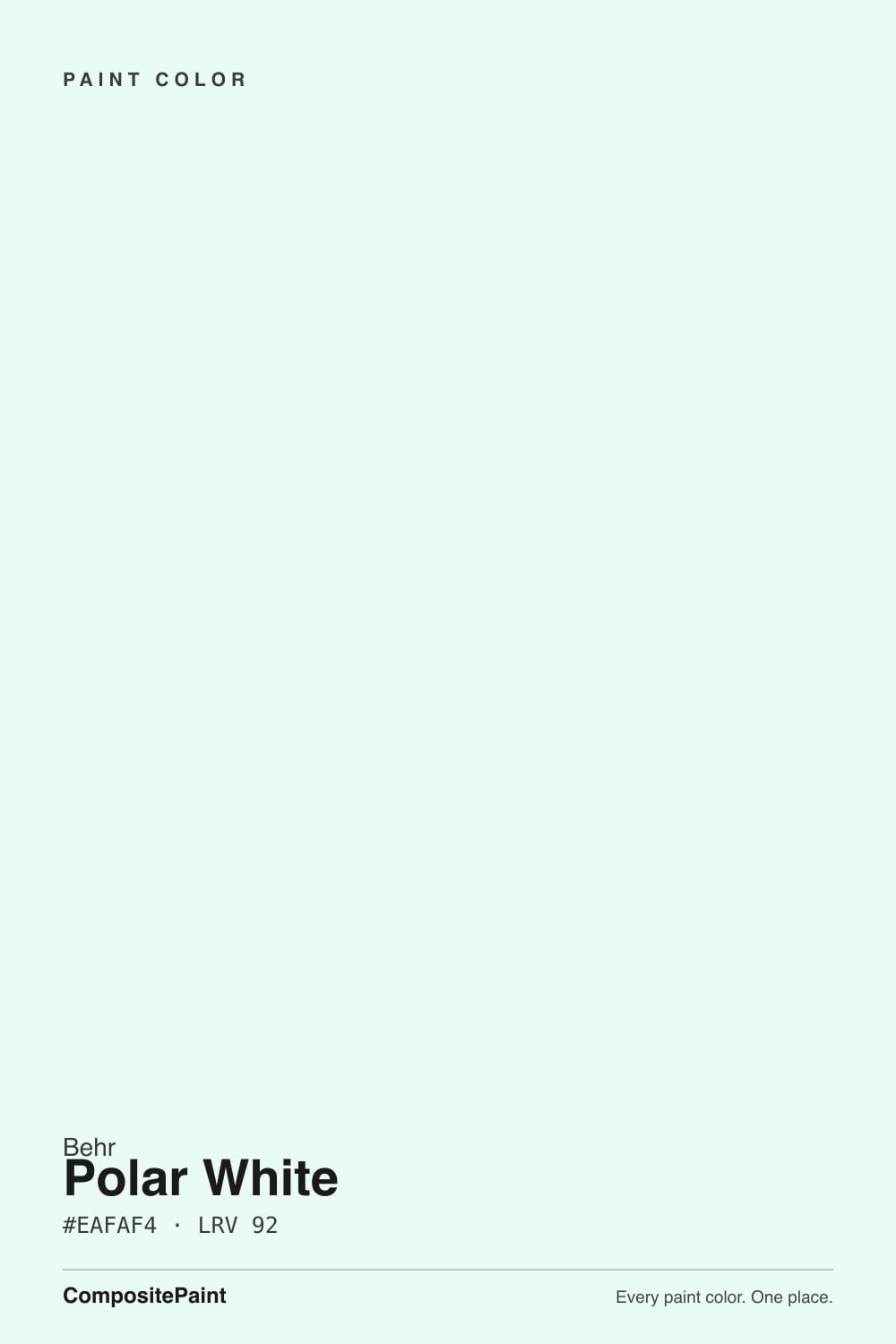
Polar White
730E-1 · #EAFAF4 · LRV 92 — near-white with a hint of color, very light — near-white, broadens small spaces.
- 1Classic Gray74
- 2Alabaster82
- 3Polar White92
- 4Ultra Pure White97
What Color Is Polar White, Really?
Polar White 730E-1 is a bright white with a faint cool tint. Its hex value is #EAFAF4 and its LRV is 92, near the top of the scale, so it reflects almost all the light in a room and keeps walls looking clean and open. The hue sits at 158 degrees, in the green-blue range, which gives the color a very slight mint or glacier cast rather than the cream lean most warm whites have.
People choose a white like this when they want crispness. It reads fresher and sharper than a creamy white, and it keeps whites, chrome, and cool stone looking true instead of yellowed. In bathrooms, laundry rooms, and modern kitchens that clean edge is usually the point. On ceilings it gives a bright, cool cover that makes the room feel taller.
The thing to check is how the tint behaves at scale. Cool light strengthens the green-blue, and a large north-facing room can end up feeling chilly rather than crisp. It can also clash quietly with warm materials: next to honey oak, terracotta, or a cream trim, the mint cast becomes visible and can look like a mismatch rather than a choice. Paint a large sample and live with it for a day before you buy gallons.
The undertone is cool green-blue. At hue 158 degrees the color sits between green and cyan, closer to the green side, which is why it reads as glacier or mint rather than as a blue-white. At 95 percent lightness the tint is faint, so on a chip it looks like a plain bright white and only shows itself once it covers a wall or a ceiling.
Contrast decides how much you see. Beside a warm cream white, Polar White looks distinctly cool and slightly green. Beside a gray-white, it looks cleaner and fresher. Against warm oak or brass the green cast steps forward and can look unintended, while against marble, chrome, and cool tile it disappears and simply reads white.
Before committing, hold it next to the fixed materials in the room, not just against other paint. Countertops, tile, and flooring will amplify or cancel the tint far more than any sample card will show.
Best Rooms and Uses for Polar White
The natural homes for this color are rooms where cool reads as clean. Bathrooms, laundry rooms, mudrooms, and modern kitchens all suit it, and at LRV 92 it keeps small or windowless versions of those rooms as bright as the fixtures allow.
Ceilings are another good use. A cool bright white overhead makes a room feel taller and keeps warm wall colors from bouncing yellow into the room. On trim and doors it gives a sharp, clean line, especially against cool or saturated wall colors.
Be more careful with it as a whole-house wall color. In rooms full of wood, wool, and warm metals, the green-blue tint can look out of step with everything else, and in north light the whole space can feel chilly. Outdoors it works as a bright trim or body color on contemporary elevations and next to cool stone. Behr is sold at The Home Depot, so picking up a sample pot before a large job is easy.
How Lighting Changes Polar White
At LRV 92 Polar White stays bright in almost any condition, so the variable is temperature, not brightness. North-facing rooms receive cool, flat daylight that reinforces the green-blue at hue 158, and the walls can look noticeably icy there. In a bathroom that reads clean; in a bedroom it can feel cold.
South and west light counteract the tint. Warm afternoon sun neutralizes the cool cast and Polar White reads as a straightforward bright white. East rooms look crisp at breakfast and calmer later in the day.
Bulbs matter as much. Warm 2700K lamps mute the mint and can make the walls look slightly gray-green at night rather than white. Neutral 4000K light keeps them clean and cool, which suits the color better. Because a white this reflective picks up bounced color from floors and furniture, look at a large sample in the actual room in daylight and again after dark.
Most complaints about Polar White are a light mismatch. Upload a photo of your actual room and see it on your walls — then ask for the same wall in north light or evening lamps before you buy a single sample.
Need It From Another Brand?
Any paint counter can custom-tint Behr 730E-1 directly. If you would rather stay in one brand's own deck, these are the closest stock matches, measured as ΔE2000. Under 2 is a difference you will not see on the wall.
| Brand | Closest color | ΔE | LRV | |
|---|---|---|---|---|
| Dunn-Edwards | Melting GlacierDEW368 · Dunn-Edwards | 0.9 | 84 | Color page → |
Similar Behr Colors
The nearest shades to Polar White within Behr's own range, ranked by perceptual color distance — useful when you want the same look a touch lighter, darker, or warmer.
WCAG 2.1: AA is 4.5 : 1 for normal text, 3 : 1 for large text, AAA is 7 : 1.
Polar White vs Similar Colors
Within Behr the field is tight. Cascade White W-D-500 at LRV 92 sits at #EDF9F3, a touch less green than Polar White's #EAFAF4. Breaker 550E-1 at LRV 92 leans a little bluer at #E8F9F7, and White Sapphire 530E-1 at LRV 91 is marginally deeper. Breakwater White 470E-1 at LRV 93 pulls slightly toward yellow-green, and Ethereal White BL-W4 at LRV 94 is the brightest of the group. These are differences you see on a fan deck, not from across a room.
Across brands there is only one close measured match on file. Dunn-Edwards Melting Glacier DEW368 has a hex of #E9F9F5 and a deltaE of 0.93 against Polar White, which makes the two the same color for practical purposes on a wall. The one meaningful gap is reflectance: Melting Glacier is listed at LRV 84 against Polar White's 92, so it gives back less light. In a dark room that difference will show even though the color itself does not.
Colors That Go With Polar White
At LRV 92 there is almost nothing brighter to use on trim, so contrast has to come from sheen or from stepping the walls down instead. Painting walls and trim in the same color with different finishes is the cleanest solution in a bathroom or a laundry room.
The closest Behr neighbors will not create contrast either. Cascade White W-D-500 at LRV 92, Breaker 550E-1 at LRV 92, and Breakwater White 470E-1 at LRV 93 are all effectively the same brightness. White Sapphire 530E-1 at LRV 91 and Icy Wind PPL-15 at LRV 91 are only a point lower. If you want a second color to register, drop the LRV substantially.
Materials set the mood. Chrome, nickel, marble, and cool gray tile all sit naturally with the green-blue tint and keep the room feeling crisp. Black hardware and black frames give clean graphic contrast. Warm honey oak, brass, and terracotta fight the cast and make it read green, so use them sparingly or choose a warmer white instead.
Coordinated palette
Generated by hue-rotating #EAFAF4 in HSL space. Pair Polar White with one accent and one neutral — the swatches below are starting points, not final picks.
Polar White FAQ
Is Polar White warm or cool?
Polar White is a cool white. Its hue sits at 158 degrees, in the green-blue range, so it leans mint or glacier rather than cream. At LRV 92 the tint stays faint, and in strong warm afternoon light the color can neutralize and read as a plain bright white.
What LRV is Polar White?
Polar White 730E-1 has an LRV of 92. LRV runs from 0 for black to 100 for pure white, so 92 is near the top of the range. It reflects nearly all available light, which makes it useful for ceilings, small bathrooms, and any room that needs to feel as bright as possible.
Does Polar White work in a dark room?
It brightens a dark room well, because at LRV 92 it returns almost all the light it receives. The caution is temperature. Dark rooms are often north-facing, and cool north light strengthens the green-blue cast at hue 158, so the space can end up feeling chilly even while it looks bright.
What trim white goes with Polar White?
There is very little headroom above LRV 92, so a brighter trim white will not register. The usual approach is to paint walls and trim in the same color and let sheen create the edge, or to keep Polar White on the trim and step the walls down to a softer tone. Avoid a warm cream trim, which will make the walls look green.
Is Polar White good for a bathroom?
Yes, it is one of the best uses for it. The cool green-blue tint reads clean rather than cold in a bathroom, and the LRV of 92 keeps even a windowless room bright. It also sits naturally with chrome, nickel, marble, and cool gray tile.
How is Polar White different from Dunn-Edwards Melting Glacier?
The two colors are nearly the same on the wall. Melting Glacier DEW368 has a hex of #E9F9F5 against Polar White's #EAFAF4 and a deltaE of 0.93, which is below the threshold where most people see a difference. The gap is in reflectance: Melting Glacier is listed at LRV 84 while Polar White is 92, so Polar White gives back more light in a dim room.
Have you painted with Polar White?
Rate it — one tap helps the next reader decide.
Ask a Question