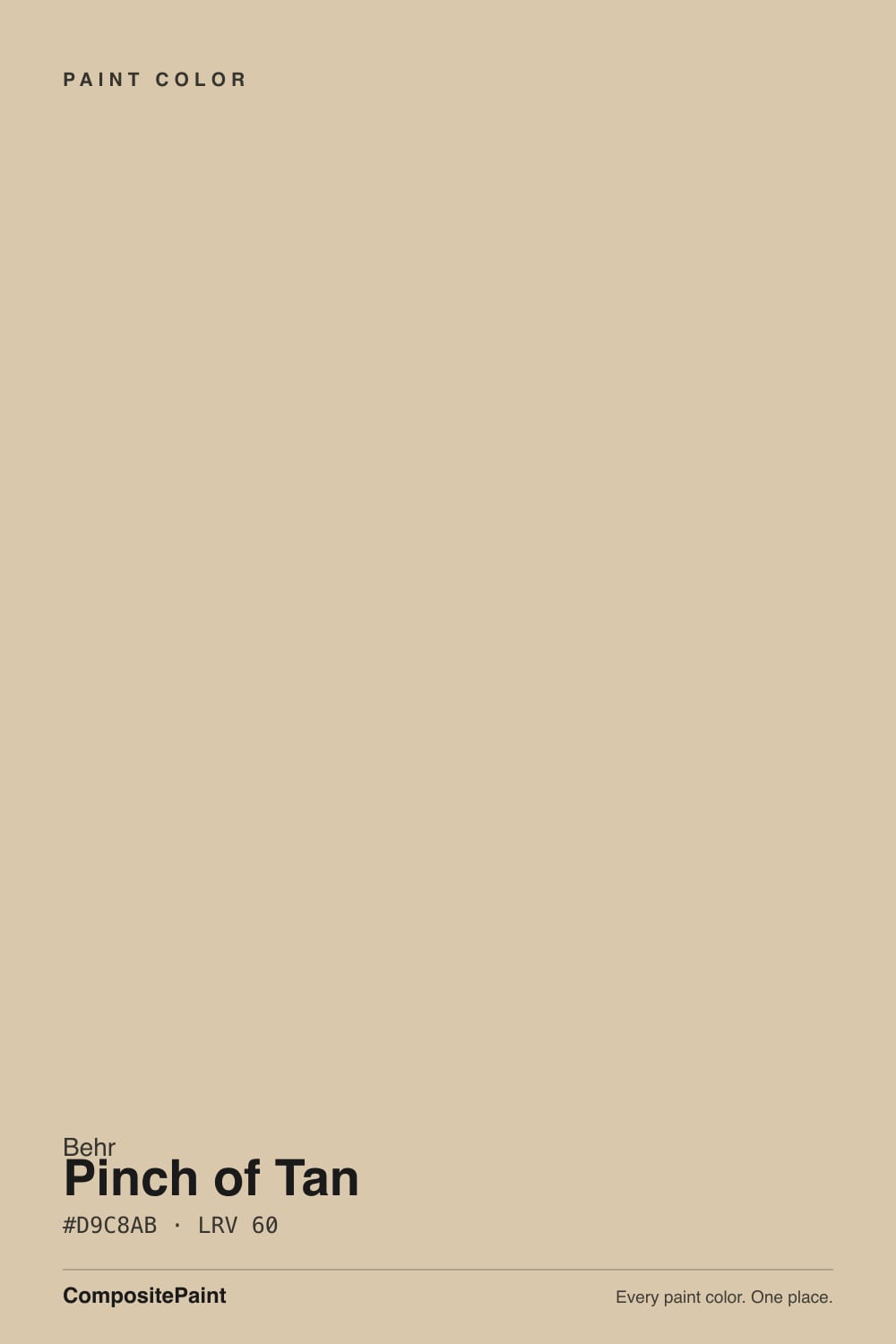
Color spec
| Brand | Behr |
| Name | Pinch of Tan |
| SKU | PPU3-7 |
| Hex | #D9C8AB |
| RGB | 217, 200, 171 |
| HSL | 38°, 38%, 76% |
| LRV | 60 |
| Undertone | warm red-orange tone |
| Family | Neutral |
What Color Is Pinch of Tan, Really?
Pinch of Tan PPU3-7 is Behr's workhorse warm beige. The numbers tell you exactly what to expect: a hue of 38 degrees puts it in the golden-tan zone, 38 percent saturation gives it a clear warm lean rather than a washed-out greige, and an LRV of 60 makes it light enough to keep a room bright without reading as off-white. On the wall it looks like classic tan with a soft red-orange warmth underneath, closer to sand than to mushroom.
Its popularity is practical. In Home Depot spec books it serves as the Behr answer to Manchester Tan, the beige builders and designers have leaned on for years, so it shows up in whole-house repaints, flips, and rentals where one reliable neutral has to work everywhere.
It suits homes with wood floors, cream trim, and traditional or transitional furniture. If your house runs cool, with gray tile and stark white trim, this is not your neutral.
Pinch of Tan carries a warm red-orange undertone. At 38 percent saturation this is not a subtle lean; it is a genuinely warm beige, and you should expect it to read tan in every light, never gray. The red-orange base means it flatters oak, cherry, and other warm woods, but it can pick up a faintly peachy or orange cast on large sunlit walls, especially at sunset.
Where the undertone shows most: broad walls facing strong afternoon sun, rooms with warm bulbs, and anywhere it sits next to a cool gray. Put a swatch against your trim and your flooring before committing. Against a crisp cool white it will look noticeably yellow-orange; against a cream like Behr Swiss Coffee 12 it looks settled and intentional. If a gray sofa or bluish tile turns your sample slightly salmon, that is the red-orange base talking, and a greige would serve the room better.
Best Rooms and Uses for Pinch of Tan
An LRV of 60 makes this a genuine whole-room, even whole-house wall color. It is light enough for hallways, open-plan living areas, and stairwells that need one continuous color, yet has enough depth to define a wall against white trim. Living rooms, dining rooms, and bedrooms with warm furnishings are its natural territory.
It is too light to work as an accent wall or a front door; there is not enough contrast for a statement. On cabinets it can work in a warm, traditional kitchen, but expect it to read as painted tan cabinetry rather than a fashionable neutral, and check it against your counters first.
Outside, it behaves like a classic light-beige body color. Sunlight raises the effective brightness, so it looks lighter and sandier on an exterior than on the chip. Pair it with a deep contrasting door and white trim. Skip it for trim itself; at this depth it just looks like unwashed white next to true whites.
How Lighting Changes Pinch of Tan
With an LRV of 60, Pinch of Tan sits in the light band. It bounces a good amount of daylight, so rooms stay bright, but it holds enough pigment that you always see color on the wall instead of a vague off-white.
In north-facing rooms the cool, bluish light mutes it; it reads flatter and slightly grayer, though it never flips cool. This is actually where many people like it best, because it warms up a cold exposure without going orange. South-facing rooms amplify the warmth all day; expect it to look sandier and more golden, and sample carefully if the room already has warm floors. East light makes it glow in the morning and settle by afternoon; west light does the reverse, with the strongest orange push in the evening.
Bulbs matter as much as windows. Warm 2700K bulbs intensify the tan; neutral 3000K to 3500K keeps it truest to the chip.
Most complaints about Pinch of Tan are a light mismatch. Upload a photo of your actual room and see it on your walls — then ask for the same wall in north light or evening lamps before you buy a single sample.
TEST IT IN YOUR LIGHT →Pinch of Tan vs Similar Colors
Behr New Khaki ECC-54-1, LRV 59, is a near twin; on separate walls most people could not tell them apart. The practical difference is availability of the chip in different displays, not appearance. If you already have one on hand, there is little reason to switch.
Louvre N280-3, also LRV 59, tips slightly more golden-orange. Side by side, Pinch of Tan looks a touch softer and Louvre a touch richer. Choose Louvre if you want the tan to feel a bit more saturated in a dim room; choose Pinch of Tan for larger, sunnier spaces where extra orange would build up.
Parachute Silk UL160-16, LRV 58, is the quieter option. Its warmth is more muted, drifting toward greige, so it reads calmer next to gray furnishings. If your room mixes warm floors with cooler textiles, Parachute Silk bridges them; if everything in the room is warm, Pinch of Tan is the more committed, cohesive pick.
Colors That Go With Pinch of Tan
For trim and ceilings, Behr Swiss Coffee 12 is the easy answer. At LRV 80 it is a soft cream that shares Pinch of Tan's warmth, so the pairing looks seamless rather than stark. If you want sharper contrast on doors and casings, Ultra Pure White 1850, at LRV 92, gives a clean modern edge, though it will make the walls look slightly more yellow by comparison.
For a second wall color in an adjoining room, Back to Nature S340-4 is a muted sage green at LRV 38 that sits naturally beside warm tan; the two share an earthy base. Smoke Blue PPU14-10, a gray-blue at LRV 27, works as a bedroom or office accent that cools the palette without clashing.
For a front door on a Pinch of Tan exterior, Dark Navy PPU14-20 at LRV 5 delivers the depth the body color lacks. Brushed brass, aged bronze, and medium oak or walnut wood tones all fit this palette; chrome and cool-toned grays fight it.
Need It From Another Brand?
Any paint counter can custom-tint Behr PPU3-7 directly — but if you would rather stay in one brand's own deck, these are the closest stock matches:
Similar Behr colors
closest in the Behr deckThe nearest shades to Pinch of Tan within Behr's own range, ranked by perceptual color distance — useful when you want the same look a touch lighter, darker, or warmer.
Coordinated palette
Generated by hue-rotating #D9C8AB in HSL space. Pair Pinch of Tan with one accent and one neutral — the swatches below are starting points, not final picks.
Accessibility (WCAG contrast)
WCAG 2.1: AA = 4.5:1 normal text · AA Large = 3:1 large text · AAA = 7:1 normal text.
The Questions Everyone Asks
Is Behr Pinch of Tan warm or cool?
Warm, clearly. Pinch of Tan has a measured warm red-orange undertone and about 38 percent saturation, which means it reads as a true tan or sandy beige in every light, never as a gray or greige. In cool north light it mutes a little, but it does not flip cool. Pair it with warm woods, creams, and brass rather than cool grays.
What trim white goes with Pinch of Tan?
Behr Swiss Coffee 12 is the most forgiving choice. It is a warm cream at LRV 80, so it complements Pinch of Tan's warmth instead of fighting it. If you prefer crisp, high-contrast trim, use Ultra Pure White 1850 at LRV 92, but expect the walls to look slightly more yellow next to such a bright white.
Does Pinch of Tan work on cabinets or exteriors?
It works well as an exterior body color, where sunlight makes it read as a classic light sandy beige; pair it with white trim and a dark door such as Dark Navy PPU14-20. On cabinets it is usable in warm traditional kitchens, but it reads as tan cabinetry, not a trendy neutral, so test a door front against your counters first.
What does Pinch of Tan's LRV of 60 mean in practice?
LRV 60 means the color reflects about 60 percent of the light that hits it. That puts Pinch of Tan in the light range: bright enough for whole rooms, hallways, and open floor plans without extra lighting, but dark enough that you see real color against white trim. It will not darken a small room the way a mid-tone would.
Is Pinch of Tan the same as Manchester Tan?
It is Behr's closest stand-in. Home Depot spec books use Pinch of Tan PPU3-7 as the Behr equivalent of Benjamin Moore's Manchester Tan, which is why it appears in so many builder palettes. They are not an identical formula, so if you are matching an existing Manchester Tan wall, sample Pinch of Tan next to it before repainting.
How should I sample Pinch of Tan before painting?
Paint two coats on a large white poster board, or use a peel-and-stick sample, and move it around the room for two or three days. Check it in morning and evening light and under your actual bulbs, and hold it against your trim, flooring, and largest furniture. Watch specifically for a peachy cast in strong afternoon sun; that is this color's main surprise.
Will It Work in YOUR Room?
No page can promise how Pinch of Tan behaves in your light. Upload a photo and see it on your own walls in seconds — before you spend a cent on samples.
TRY PINCH OF TAN ON YOUR ROOM →Ask a Question

Not sure about Pinch of Tan in your room?
Ask Jessica below — every question gets a real reply, usually within a day.