Product review · Sherwin-Williams · Updated August 7, 2026
A-100 ExteriorSherwin-Williams paint review
7.6/10The right value exterior on sound, primed siding, and the wrong one on bare cedar or a hard south wall.
Real Sherwin acrylic for $35 to $50 a gallon, with one condition attached: it is a topcoat, not a primer. Skip the prime coat and the savings vanish into the re-do.

Mark Thompson · Pro Contractor & Field Editor · Updated August 7, 2026
22 years running residential and light commercial repaints across the Midwest. Mark has put A-100 on rentals, fences and shaded porch ceilings, and has watched it chalk early on more than one afternoon-sun wall. About the testing process →
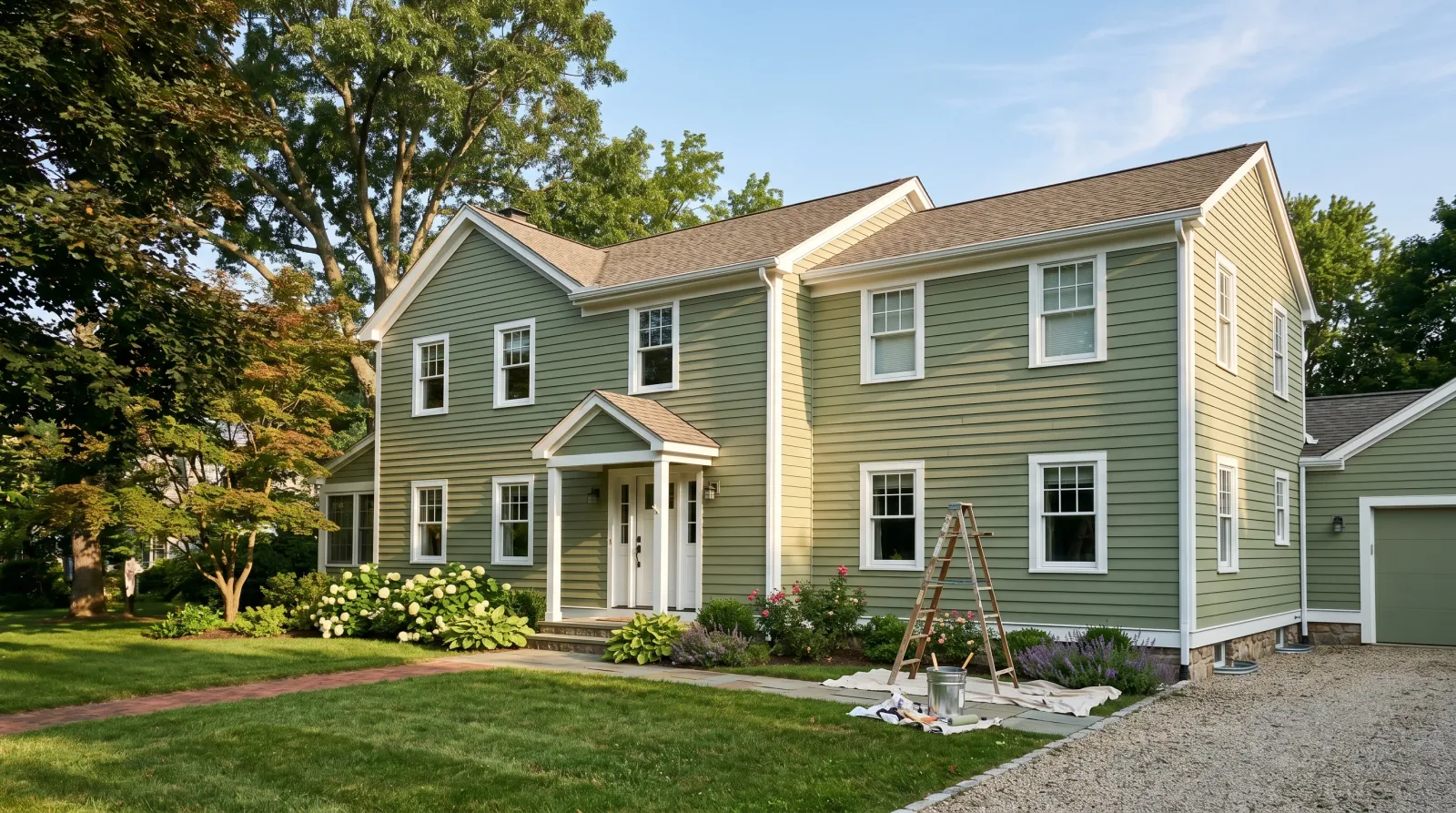
Sherwin-Williams A-100 Exterior4 sheens
Coverage350–400 sq ft / gal
RecoatAbout 4 hr
VOCLow-VOC, region-compliant
Full cure30 days
Sheens FlatLow SheenSatinGloss
Read this first
The Fast Verdict
Yes, on sound, primed siding where budget is the constraint. It is real Sherwin acrylic for $35 to $50 a gallon, it holds color in shade, it sprays and back-rolls clean, and it carries a 15-year limited warranty. No on bare cedar or a wall that bakes in afternoon sun. It is not self-priming, tannins bleed through within a season, and hard sun chalks it by year four or five. Right paint, wrong job, and the savings vanish into the re-do.
Best for
Rental and flip exteriors · Fences, sheds and outbuildings · Sound previously painted siding · North walls and shaded elevations · Covered porch ceilings · Whole-house repaints on a budget
Skip if
Bare cedar or redwood you will not prime · Hard south and west exposures · Chalky old paint you will not wash dead clean · A forever home you want to leave alone for 15 years
What it's good at
- Price-to-name ratio — real Sherwin acrylic at the lowest price the brand sells
- Color retention in shade and on north walls, where it still reads true years in
- Spraying through a .017 tip and back-rolling into siding without fighting the bucket
- Mildew resistance for the tier, thanks to the exterior formula's mildewcide
- A 15-year limited warranty with an SW counter behind it for color matching
- Fences, sheds and outbuildings you repaint on your own schedule
What it's not good at
- Priming itself — it is a topcoat, and bare or chalky substrate needs a real primer
- Bare cedar and redwood, where tannins bleed through within a season
- South and west walls in hard sun, which chalk and fade by year four or five
- Hide over a big color change, where even two coats can ghost
- High-touch surfaces like porch rails and garage doors, which burnish and mark
- Touch-ups after the first year, once the field paint has faded
Same shelf, different cans
Which A-100 Are You Buying?
Sherwin uses the A-100 name across more than one product and the labels look alike on the shelf. This review covers the exterior acrylic latex. Grab the wrong one and the resin is built for a different job.
A-100 Exterior Acrylic Latex
Base100% acrylic latex
SheensFlat, Low Sheen, Satin, Gloss
RecoatAbout 4 hr
Buy it if
This review. Wood siding, fiber cement, brick, stucco, primed metal, exterior trim. It carries the UV package and the mildewcide.
Avoid if
The substrate is bare, chalky or tannin-prone and you are not buying primer to go with it.
A-100 Exterior Alkyd Primer
BaseAlkyd primer
Buy it if
You are prepping bare wood under the topcoat. Pair it with this review, do not substitute it for it.
Avoid if
You think of it as a finish. It is prep, not a topcoat.
A-100 Interior Latex
BaseInterior latex
Buy it if
Budget interior walls. Different product, different job.
Avoid if
The surface is outside. It has no UV package and no mildewcide. If you bought a gallon for siding, return it.
Numbers, not adjectives
Spec Sheet
- Coverage
- 350–400 sq ft / gal (varies with texture)
- Sheens
- Flat, Low Sheen, Satin, Gloss
- Touch dry
- 1–2 hr
- Recoat
- About 4 hr
- Full cure
- 30 days
- VOC
- Low-VOC, region-compliant; exact g/L varies by sheen and state rules
- Application temp
- Down to 35°F
- Primer
- Not self-priming. Prime bare wood, masonry, chalk and metal
- Surfaces
- Wood siding, fiber cement, brick, stucco, primed metal, trim
- Sizes
- 1 gallon, 5 gallon
- Warranty
- 15-year limited
- Price
- $35–50 / gal street; 5-gallon around $320
Application Settings That Work
- Brush
- Brushes and rolls clean and sets like a normal latex, so it does not fight you on a ladder. Two coats, always two coats. Feather the edge into a wet cut-in and keep moving down the course rather than stopping mid-wall.
- Airless
- Sprays clean through a .017 to .019 inch tip with no spitting and no viscosity fight. Back-roll it into the siding behind the gun to build mil thickness and kill holidays. That back-roll is what gets you to the long end of the life estimate on rough or textured wood.
- Thinning
- Thin per the label only if your gun struggles. Most airless rigs handle it as it comes, and thinning a value paint costs you the film build you are already short on.
- Primer
- This is the step people skip and it is the step that decides the job. SW Exterior Latex Primer on wood and fiber cement, Loxon on masonry and stucco, a stain-blocking primer on bare cedar and redwood. Wash chalk dead clean or spot-prime it with a bonding primer. A-100 over live chalk is a guaranteed callback.
Mid-project panic
When It Goes Wrong, and How to Fix It
Rust-colored streaks weeping out of the knots
Why it happens. That is tannin bleed, and it is the single most common A-100 failure. This paint is a topcoat, not a stain blocker, and it is not self-priming. Put it straight on bare cedar or redwood and the tannins come through within a season.
The fix. Prime bare cedar and redwood with a stain-blocking primer before the topcoat. SW Exterior Latex Primer handles ordinary wood and fiber cement; tannin-prone species need the stain blocker specifically. If it has already bled, wash, spot-prime the bleeding areas, and recoat.
Paint sheeting off two years after the job
Why it happens. Almost always chalk. Old exterior paint chalks as it weathers, and A-100 over live chalk has nothing solid to grip. It looks fine for a season or two and then leaves in sheets, taking your labor with it.
The fix. Pressure-wash the chalk and dirt off, then give the wall a full day to dry. Rub the surface with your hand — if it still chalks, wash it again or hit it with a bonding primer. Scrape any lifting paint to sound material and feather the edge so the patch does not telegraph.
Chalking and fading by year four on the sunny side
Why it happens. Hard sun eats the value tier. On a south or west exposure in zones 5 and 6 I see A-100 start to chalk and fade at year four or five, where Duration on the same wall still reads clean at year eight. The pigment package is fine; the resin and binder load is where the money was saved.
The fix. Put the value paint on the shaded and north elevations and spend up on the worst exposure. If one wall of the house takes the afternoon sun, that wall is worth Duration even if the rest is A-100.
The old color ghosting through two coats
Why it happens. Hide over a big color change is thin. Going from a dark brown to a cream, one coat will not carry it and even two can ghost. The pigment load is built for value, not one-coat hide.
The fix. Two coats, always two coats — the 350 to 400 sq ft figure is per coat. On a big color swing, put a tinted primer under it and budget the gallons up front rather than discovering the third coat on the ladder.
A touch-up patch that flashes against the wall
Why it happens. It blends well in the first months. After a year of sun the field paint has faded a shade and the fresh patch sits brighter and different, especially on the sunny elevations.
The fix. Do your touch-ups early, while the job is fresh. Later on, repaint to a natural break — a full course, a corner, a board line — instead of dabbing. Keep a labeled gallon from the original tint batch.
Side by side
A-100 vs SuperPaint vs Duration Exterior
Same store, same color deck, three price tiers. The gap between them is not really chemistry marketing — it is a primer step and a sun wall.
| A-100 | SuperPaint Exterior | Duration Exterior | |
|---|---|---|---|
| Street price per gallon | $35–50 | $60–75 | $80–95 |
| Self-priming | No. Bare wood, masonry, chalk and metal all get primed first. | Primer-in-paint, so you skip a step on previously painted surfaces. | Self-priming claim on most surfaces. |
| Film and hide | Value film. Hide is thin over a big color change; budget two coats. | Better hide and stronger washability than A-100. | Thick, flexible film built for freeze-thaw cycles and movement. |
| Hard sun at year five | Chalks and fades on south and west exposures by year four or five. | Noticeably better chalk resistance on sun walls than A-100. | Still reading clean at year eight on the same wall. |
| Where it wins | Rentals, flips, fences and outbuildings on sound primed siding. | Owner-occupied homes and any wall that takes hard sun. | The worst exposure on the house, stucco that moves, the longest repaint interval. |
Self-priming
A-100No. Bare wood, masonry, chalk and metal all get primed first.
SuperPaint ExteriorPrimer-in-paint, so you skip a step on previously painted surfaces.
Duration ExteriorSelf-priming claim on most surfaces.
Film and hide
A-100Value film. Hide is thin over a big color change; budget two coats.
SuperPaint ExteriorBetter hide and stronger washability than A-100.
Duration ExteriorThick, flexible film built for freeze-thaw cycles and movement.
Hard sun at year five
A-100Chalks and fades on south and west exposures by year four or five.
SuperPaint ExteriorNoticeably better chalk resistance on sun walls than A-100.
Duration ExteriorStill reading clean at year eight on the same wall.
Where it wins
A-100Rentals, flips, fences and outbuildings on sound primed siding.
SuperPaint ExteriorOwner-occupied homes and any wall that takes hard sun.
Duration ExteriorThe worst exposure on the house, stucco that moves, the longest repaint interval.
Buy A-100 if you are a landlord, a flipper, or anyone painting fences, sheds and outbuildings you will repaint on your own schedule anyway, and you are willing to prime properly. Step up to SuperPaint for about $20 to $30 more a gallon when you want the primer-in-paint convenience and better sun performance on a house you live in. Put Duration on the wall that faces the afternoon sun. A whole-house repaint does not have to be one product — spend the money where the sun is.
If not this one
Honest Alternatives
VD
Valspar Duramax$35–45 / gal
About the same price, sometimes a few dollars under on sale, and you do not need an SW store. It holds color decently and Lowe's is everywhere. A-100 has the longer track record and the store-counter support; Duramax wins on convenience if you do not live near a Sherwin store.
Full review →SW
Sherwin-Williams SuperPaint Exterior$60–75 / gal
The natural step up, same store, same color deck. Primer-in-paint so you skip a step on previously painted surfaces, better hide, stronger washability, and noticeably better chalk resistance on sun walls. About $20 to $30 more per gallon and the right pick for owner-occupied homes.
Full review →SW
Sherwin-Williams Duration Exterior$80–95 / gal
The top tier. Thick, flexible film built for freeze-thaw cycles and brutal UV, with a self-priming claim on most surfaces. Twice the price of A-100. Use it on the worst exposure of the house, on stucco that moves, or anywhere you genuinely want the longest interval between repaints.
Full review →Questions people actually ask
A-100 Exterior Questions, Answered
Is Sherwin-Williams A-100 a good exterior paint?
For the money, yes. It is a 100% acrylic latex that holds color and resists peeling on properly primed siding, and it carries a 15-year limited warranty. It is the entry tier, so it will not fight chalking or a brutal south wall like Duration. On a clean, primed surface in a normal climate it does the job for years.
Does A-100 need a primer?
Yes on bare wood, masonry, chalky old paint and metal. A-100 is not self-priming, and that is the main difference between it and SuperPaint. Use SW Exterior Latex Primer on wood, Loxon on masonry. Skip the primer on bare cedar and you will get tannin bleed within a season.
How long does A-100 last on exterior siding?
Six to ten years on well-prepped, primed wood or fiber cement in a moderate climate. The 15-year warranty assumes ideal prep and conditions, which most jobs do not hit. South and west walls fade faster. Two coats over good primer is what gets you to the long end of that range.
Should I buy A-100 or SuperPaint?
A-100 if budget is the priority and you will prime separately. SuperPaint for about $20 to $30 more per gallon if you want primer-in-paint, better hide and stronger washability. On a forever home the SuperPaint upcharge pays for itself. On a rental or a fence, A-100 is the smarter dollar.
Is A-100 the same as SuperPaint with a different label?
No. A-100 is the value tier and is not self-priming. SuperPaint adds primer-in-paint, better hide and stronger washability for about $20 to $30 more per gallon. They share the SW color deck and store network, but the resin and pigment packages are different.
Can I spray A-100 with an airless?
Yes, and it sprays clean through a .017 to .019 inch tip. Back-roll it into the siding to build mil thickness and avoid holidays. Thin per the label only if your gun struggles; most airless rigs handle it as it comes.
What primer goes under A-100?
SW Exterior Latex Primer on wood and fiber cement, Loxon on masonry and stucco, a stain blocker on bare cedar and redwood. A-100 is a topcoat, not a primer, so bare and chalky surfaces always get a prime coat first.
Where should I not use A-100?
On a hard south or west wall in a hot climate, on bare cedar you are not going to prime, and on a forever home you want to leave alone for fifteen years. Those jobs cost you the savings twice over when you repaint early. Put SuperPaint or Duration there and keep A-100 for the shaded elevations, the rentals and the outbuildings.
Keep exploring
All Sherwin-Williams paint reviewsBest exterior paint round-upHow to deal with chalking exterior paint
We may earn a commission when you buy through the retailer link above. It never changes the score or the verdict.
Ask a Question