Product review · INSL-X · Updated August 11, 2026
Stix Waterborne Bonding PrimerINSL-X paint review
9.2/10The bonding primer everything else is judged against — as long as the problem is grip, not a stain.
The urethane-modified acrylic that grips melamine, laminate, tile, and glass every ordinary primer slides off — the standard first coat under cabinet enamel across the trade and this site alike. The honest price of that grip: a film that spends its first week soft, sandpaper that gums where BIN powders, and zero stain blocking.

David Chen · Formulation Lead & Resident Chemist · Updated August 11, 2026
Polymer chemist by training, six years in industrial coatings R&D before joining CompositePaint's formulation team. David writes the binder pieces — why a styrenated acrylic grips a gloss door a plain latex primer slides off, and why the same film lets nicotine walk right through. About the testing process →
INSL-X Stix Waterborne Bonding Primer
Coverage300–400 sq ft / gal
Dry and topcoatTouch dry 30 min
VOCUnder 100 g/L
Full cureMaximum scrape resistance 3–4 days
Read this first
The Fast Verdict
Buy it when the surface is the problem. The urethane-modified acrylic bonds to melamine, laminate, thermofoil, tile, glass, PVC, fiberglass, and galvanized metal — the exact substrates where a topcoat otherwise peels off in sheets — and it accepts almost any finish on top, including lacquer and epoxy. It also applies and cures at surface temperatures down to 35°F, which nothing else waterborne on the shelf matches. The trade-offs are real: $40–65 a gallon, a film that topcoats in 3 to 4 hours but needs 3 to 4 days for maximum scrape resistance and about 7 for full adhesion, sandpaper that gums until it cures, and no stain blocking whatsoever — tannin and nicotine walk straight through the water carrier.
Best for
Melamine and laminate cabinets · Thermofoil doors · Tile, glass, and glazed block · PVC, vinyl, and fiberglass · Glossy factory finishes and pre-coated siding · Priming in 35–50°F spaces
Skip if
The wall has a stain, odor, or knot (that is BIN's job) · The surface is merely glossy paint, not factory-slick (1-2-3 for half the money) · You need same-day powder sanding · You expect the primer to fill or hide · Doors go back on hard use inside a week
What it's good at
- Grip on surfaces nothing else waterborne holds — melamine, laminate, thermofoil, tile, glass, glazed block, PVC, fiberglass, galvanized metal — which is why it is the trade's standard first coat under cabinet enamel
- Cold-weather application down to a 35°F surface temperature, where the rest of the waterborne shelf stops at 50
- Topcoat promiscuity: alkyd, latex, urethane, epoxy, and lacquer all film over it, so it sits under Advance, Cabinet Coat, Emerald Urethane, and sprayed 2K finishes without an adhesion question
- An extremely hard cured film with excellent enamel holdout — half the reason cabinet enamels level so evenly over it
- Low-VOC soap-and-water chemistry, under 100 g/L: near-shellac adhesion without a respirator or two days of airing the kitchen
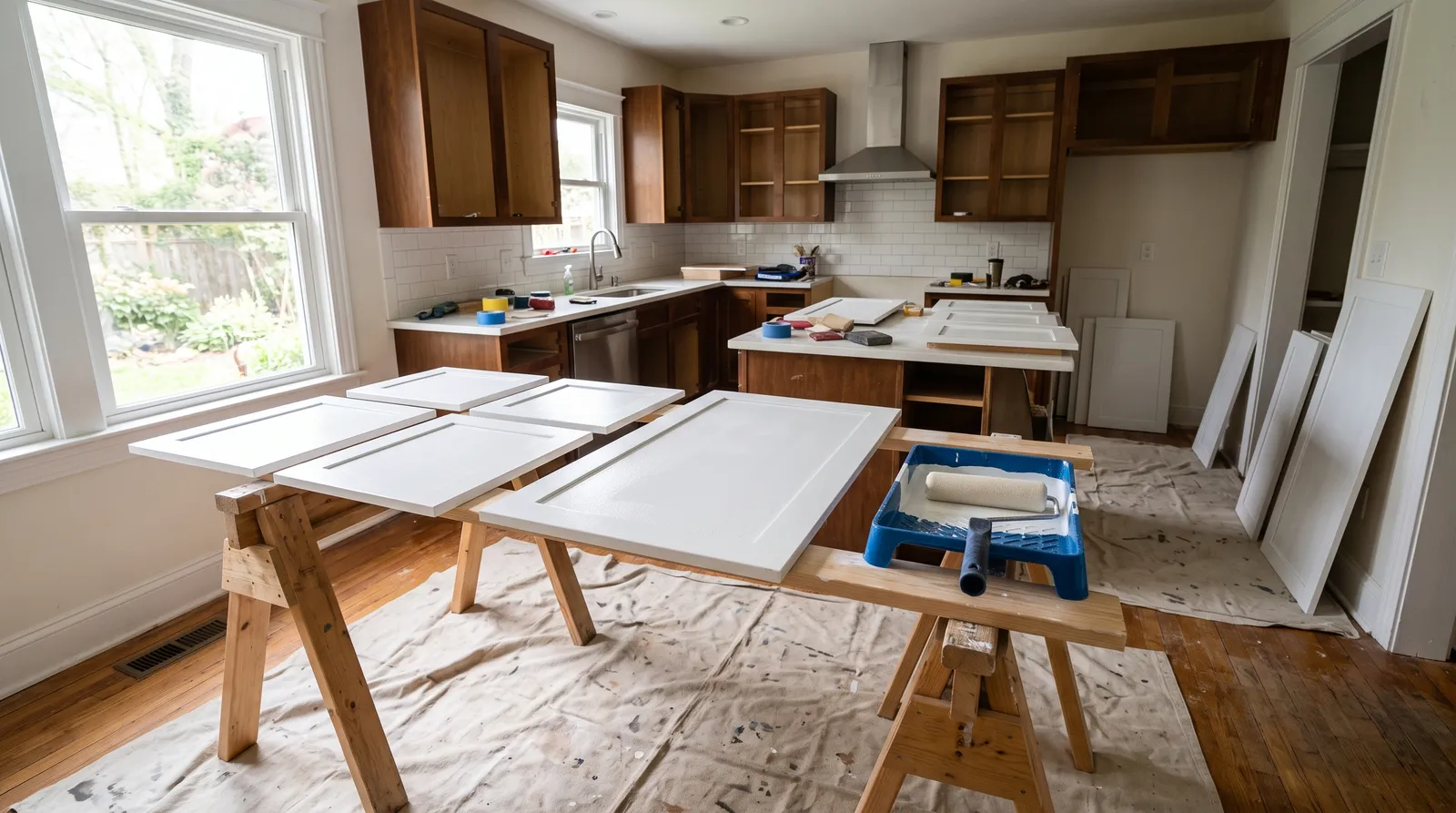
- Spraying straight from the can at 2,200–2,500 PSI through a .013–.017 tip — the standard doors-on-racks setup
What it's not good at
- Stain blocking — none at all; tannin, nicotine, marker, and water rings re-dissolve into the water carrier and ghost through at any coat count
- Sanding before full cure: the young urethane film gums the paper where BIN powders off in an hour
- Patience-free schedules — full adhesion takes about 7 days, and doors rehung and slammed inside that week stick and imprint
- Price: $40–65 a gallon is double a standard bonding primer, wasted on surfaces that are merely glossy rather than factory-slick
- Build and hide — a 1.6–2.1-mil dry film in white only that fills no grain and buries no dark color
- Anything outside its written limits: immersion, polyethylene and polypropylene, Kynar finishes, wood decking, or uncoated exterior exposure — it must be topcoated outdoors
Numbers, not adjectives
Spec Sheet
- Resin
- Urethane-modified acrylic — "acrylic urethane" on the label
- Coverage
- 300–400 sq ft / gal; a quart covers about 100 sq ft
- Film build
- Wet 4.0–5.3 mils · dry 1.6–2.1 mils
- Volume solids
- 40 ± 2%
- Dry and topcoat
- Touch dry 30 min · topcoat 3–4 hr at 77°F / 50% RH · 24 hr before 2-component epoxies or urethanes
- Full cure
- Maximum scrape resistance 3–4 days · full adhesion about 7 days
- VOC
- Under 100 g/L
- Application temp
- 35–90°F surface temperature — cures as low as 35°F, a waterborne outlier
- Topcoats
- Alkyd, acrylic latex, urethane, epoxy, lacquer
- Surfaces
- PVC, vinyl, most plastics, glass, tile, glazed block, glossy paints, pre-coated siding, fiberglass, galvanized metal, plus plaster, drywall, and wood
- Colors and thinning
- White only, tintable up to 2 fl oz colorant per gallon; do not thin
- Price
- $40–65 / gal at dealers; quarts about $25–30; quart, gallon, and 5-gallon sizes
Application Settings That Work
- Brush
- A high-quality nylon brush or a 1/4-inch to 1/2-inch synthetic nap roller, per the label. It levels well for a bonding primer, but the 30-minute touch dry punishes overworking — lay it off and leave it. The low-lustre film shows drips late, so check edges and door profiles a few minutes after each section.
- Airless
- Sprays cleanly at 2,200–2,500 PSI through a .013–.017 tip, straight from the can — the standard setup for cabinet doors on racks. Give spray equipment a final rinse with mineral spirits after the soapy water; the label calls for it to prevent rusting.
- Thinning
- Do not thin — the label is absolute, and the rheology that carries the adhesion package is engineered for the can viscosity. If it will not atomize, the fix is tip size and pressure, not water.
- Primer
- Prep is the whole job. Degrease with a grease-and-oil emulsifier, strip any wax, rinse, and dry — the unparalleled bond is to the surface, not to the kitchen film on it. The no-sand claim holds on most glossy paint, but the data sheet itself recommends deglossing Formica, ceramic tile, and glossy surfaces to enhance adhesion: on cabinets, scuff anyway. Tint it up to 2 fl oz per gallon toward a dark topcoat and save a finish coat.
The Three Clocks: Topcoat, Scrape Resistance, and Full Adhesion
Most one-star Stix reviews are a fingernail test run on day two, and the chemistry says they tested early, not that it failed. A waterborne acrylic urethane hardens in stages: the water leaves and the binder coalesces — the 30-minute touch dry and the 3-to-4-hour topcoat window — and then the urethane develops hardness over days as the film densifies. The data sheet is explicit: maximum resistance to scrape-off takes 3 to 4 days, and full adhesion arrives at about 7. Topcoat at 3 to 4 hours with confidence; the primer and enamel finish curing together. Give 2-component epoxies and aliphatic urethanes 24 hours instead. And treat the first week gently — no scrape tests, no slammed cabinet doors, no scrubbing — because the enamel on top inherits the same slow schedule. Cold and humidity stretch every number, and while the 35°F application floor is real, a primer curing at 40°F sits on the long end of every window. Same-day recoat, seven-day patience: plan around both numbers and Stix never disappoints.
Mid-project panic
When It Goes Wrong, and How to Fix It
The primer scraped off with a fingernail the next day
Why it happens. The film is grippy but soft while the urethane component develops hardness. Maximum scrape-off resistance takes 3 to 4 days per the data sheet and full adhesion about 7 — a day-old film failing a deliberate scrape test is chemistry on schedule, not a defect.
The fix. Wait out the cure before judging it, and keep topcoating on the normal 3-to-4-hour window — the finished system hardens together. If a week-old film still peels, the failure is prep: something slick or greasy was left under it.
Sandpaper gums up instead of powdering
Why it happens. The same thermoplastic urethane flexibility that grips slick surfaces keeps the young film soft, and soft films shave and smear rather than powder. Shellac powders in an hour because it is brittle; Stix is the opposite design.
The fix. Sand as late in the schedule as the job allows — day two or three beats day one — with fresh paper and light pressure. If your workflow depends on powder-sanding the primer flat the same day, use BIN on those components instead.
Yellow or brown bleed came through the white primer on oak
Why it happens. Stain bleed is a solvent problem, and Stix carries water. Tannin from oak, nicotine, marker, and water rings dissolve into the wet film and migrate up through it — exactly as they do through every waterborne primer, at any coat count.
The fix. Spot-prime the stains with a shellac primer like BIN — or on a heavily stained piece, let BIN do the whole first coat and use Stix where the grip is needed. Do not roll a third coat of Stix at the problem; a fifth coat behaves like the first.
Cabinet doors stick to the bumpers or imprint weeks later
Why it happens. Blocking. The primer reaches full adhesion at about 7 days and the enamel on top cures on its own slow clock; rehang doors early and press two young films together and they stick and imprint. It reads as a paint failure but is a schedule failure.
The fix. Rehang late, fit felt bumpers, and keep the kitchen gentle for the first week — no slamming, no taping, no shelf paper. If a door has already imprinted, wax paper between door and frame for a few days usually releases it as the cure completes.
It peeled off laminate in a sheet, even after a full cure
Why it happens. The bond is to whatever the surface presents, and a kitchen presents grease. Cooking film, wax, and silicone polish are release agents, and no binder chemistry bonds through them.
The fix. Degrease with a real emulsifier or TSP substitute, rinse, and let it dry before priming — and scuff Formica and tile even though the label says you can skip it. The data sheet itself recommends deglossing the hardest surfaces; on cabinets that two minutes per door is the cheapest insurance in the trade.
Dragging brush marks on a warm day
Why it happens. A 30-minute touch dry works against you on a hot or sunny surface — the film skins while you are still working it, and the label bars thinning, so there is no cheating the open time back.
The fix. Work smaller sections, keep a wet edge, and stay off surfaces in direct sun or above 90°F. On doors, a foam or quarter-inch microfiber roller laid off lightly beats a brush; for a whole kitchen, the airless at 2,200–2,500 PSI with a .013–.017 tip is how the pros make it disappear.
Side by side
Stix vs Zinsser Bulls Eye 1-2-3 vs Zinsser BIN
The real primer decision, and it resolves on one question: what would fail without the primer — the grip, or the stain?
| INSL-X Stix | Zinsser Bulls Eye 1-2-3 | Zinsser BIN Shellac | |
|---|---|---|---|
| Chemistry | Urethane-modified acrylic | Styrenated acrylic | Shellac in denatured alcohol |
| Grip on factory-slick melamine, laminate, glass | The benchmark — the reason it exists | Good on glossy paint; loosens on truly factory-slick stock | Bites glass and tile well |
| Stain and odor blocking | None — the water carrier lets stains ghost through | Light stains only | The one-coat lock: nicotine, water rings, knots, odors |
| Sanding behavior | Gums the paper until cured; never powders | Sands cleanly at 24 hr | Powders beautifully within the hour |
| Topcoat window | 3–4 hr; 24 hr under 2-component coatings | Recoat 1 hr · topcoat 3–4 hr | 45 min |
| Cold application | 35°F — the waterborne outlier | 50°F floor | The alcohol carrier shrugs off cold too |
| Odor and cleanup | Low odor, soap and water | Low odor, soap and water | Real alcohol fumes; ventilate |
| Street price per gallon | $40–65 | $28–32 | About $55 |
| Where it wins | Factory-slick surfaces where adhesion is everything | Everyday gloss and old oil paint on a budget | Any surface with a real stain, odor, or live knot |
Chemistry
INSL-X StixUrethane-modified acrylic
Zinsser Bulls Eye 1-2-3Styrenated acrylic
Zinsser BIN ShellacShellac in denatured alcohol
Grip on factory-slick melamine, laminate, glass
INSL-X StixThe benchmark — the reason it exists
Zinsser Bulls Eye 1-2-3Good on glossy paint; loosens on truly factory-slick stock
Zinsser BIN ShellacBites glass and tile well
Stain and odor blocking
INSL-X StixNone — the water carrier lets stains ghost through
Zinsser Bulls Eye 1-2-3Light stains only
Zinsser BIN ShellacThe one-coat lock: nicotine, water rings, knots, odors
Sanding behavior
INSL-X StixGums the paper until cured; never powders
Zinsser Bulls Eye 1-2-3Sands cleanly at 24 hr
Zinsser BIN ShellacPowders beautifully within the hour
Topcoat window
INSL-X Stix3–4 hr; 24 hr under 2-component coatings
Zinsser Bulls Eye 1-2-3Recoat 1 hr · topcoat 3–4 hr
Zinsser BIN Shellac45 min
Cold application
INSL-X Stix35°F — the waterborne outlier
Zinsser Bulls Eye 1-2-350°F floor
Zinsser BIN ShellacThe alcohol carrier shrugs off cold too
Odor and cleanup
INSL-X StixLow odor, soap and water
Zinsser Bulls Eye 1-2-3Low odor, soap and water
Zinsser BIN ShellacReal alcohol fumes; ventilate
Where it wins
INSL-X StixFactory-slick surfaces where adhesion is everything
Zinsser Bulls Eye 1-2-3Everyday gloss and old oil paint on a budget
Zinsser BIN ShellacAny surface with a real stain, odor, or live knot
The decision writes itself as a flowchart. Surface merely glossy and sound: 1-2-3, and keep the change. Surface stained, smelly, or knotty: BIN, whatever else is true. Surface factory-slick — melamine, laminate, thermofoil, tile, glass, PVC: Stix, and stop shopping. On a real kitchen the answer is often two cans on one job: BIN spot-priming the water stain under the sink, Stix everywhere the enamel needs to hold onto plastic-coated board.
If not this one
Honest Alternatives
ZB
Zinsser Bulls Eye 1-2-3$28–32 / gal
The budget rung of the same ladder. The styrenated acrylic handles the everyday version of this job — glossy enamel, old oil paint, surfaces slick but not factory-slick — for half the price. On melamine and thermofoil it is a gamble Stix is not; on a repaint of glossy trim it delivers most of the benefit and keeps thirty dollars.
Full review →ZB
Zinsser BIN ShellacAbout $55 / gal
Different failure, different chemistry. Shellac locks nicotine, water rings, tannin, and odors in one 45-minute coat, grips glass and tile, and sands to powder the same hour — everything Stix cannot do, minus Stix's flexibility, exterior manners, and death grip on plastics. Cabinet pros routinely run both on one kitchen.
Full review →KA
KILZ Adhesion$25–30 / gal
The closest thing to Stix on a big-box shelf, rated for a similar difficult-surface list at half the price. Trade consensus puts its grip a clear step below Stix on the worst substrates — which is why refinishers doing warranty work drive to the dealer anyway — but for one bookcase or a thermofoil vanity it is a reasonable saving.
Full review →SW
Sherwin-Williams Extreme Bond Primer$40–50 / gal
Sherwin's entry in the same slot, sold through SW stores where account pricing applies. Comparable positioning and surface list; the forums split roughly along which dealer is closer, which tells you the products are close. If the topcoat is Emerald Urethane from the same counter, staying in-system has a warranty logic.
Full review →Questions people actually ask
Stix Waterborne Bonding Primer Questions, Answered
Is INSL-X Stix a good primer?
For adhesion, the best waterborne primer at retail. The urethane-modified acrylic grips melamine, laminate, tile, glass, PVC, and fiberglass that ordinary primers slide off, and it accepts almost any topcoat, including lacquer and epoxy. It blocks no stains, costs $40–65 a gallon, and needs about a week to reach full hardness. Buy it when the surface is the problem; buy Zinsser BIN when a stain is.
How long does Stix take to fully cure?
Three clocks. Topcoat in 3 to 4 hours. Maximum scrape-off resistance in 3 to 4 days per the data sheet. Full adhesion — final film hardness — in about 7 days, and the enamel on top inherits the same slow schedule. A fingernail test on day two proves only that you tested early.
Do you have to sand before using Stix?
The no-sand claim holds for adhesion on most glossy paint, but INSL-X's own data sheet recommends deglossing Formica, ceramic tile, and glossy surfaces anyway to enhance the bond. On a cabinet job protecting a thousand dollars of enamel and labor, the two-minute scuff per door is the cheapest insurance in the trade. Cleaning is never optional: degrease first, because the bond is to the surface, not the kitchen film on it.
Does Stix block stains?
No, and this is the most common way it gets bought wrong. The water carrier lets oak tannin, nicotine, marker, and water rings re-dissolve and migrate up through the film, exactly as they do through every waterborne primer. If the job has both a slick surface and a stain, spot-prime the stains with BIN and let Stix handle the grip.
Stix vs Zinsser BIN — which should you buy?
Match the can to the failure. Stix wins on grip — factory-slick melamine, laminate, and PVC — plus outdoor flexibility and fume-free work. BIN wins on stains, odors, and knots, recoats in 45 minutes, and sands to powder the same day where Stix gums the paper. Many cabinet pros use both on one kitchen: BIN on the stains, Stix everywhere slick.
What topcoat can you use over Stix?
Almost anything — the data sheet lists alkyd, acrylic latex, urethane, epoxy, and lacquer, which is why it pairs so cleanly under cabinet enamels like Benjamin Moore Advance, Cabinet Coat, and Emerald Urethane. The one exception: allow 24 hours before 2-component solvent-based epoxies or aliphatic urethanes.
Can you apply Stix in cold weather?
Yes, down to a 35°F surface temperature — a genuine outlier among waterborne primers and the reason it wins unheated garages, porch ceilings, and shoulder-season exterior work. Cold stretches every dry, topcoat, and cure window toward the long end, and the can itself should be stored above 40°F.
Can you tint Stix?
Lightly. It comes in white only, and the dealer can add up to 2 fl oz of colorant per gallon — enough to gray it toward a deep topcoat and save a finish coat, not enough to make it a color base. Going to navy or black cabinets, the light gray tint is worth asking for.
Can you use Stix outside?
Yes, with two written conditions: it must be topcoated for exterior use, and it is not recommended as a whole-house primer over bare wood or for decking. Its exterior lane is the problem surfaces — pre-coated siding, PVC and vinyl trim, fiberglass doors, galvanized metal — plus cold-season work its 35°F floor makes possible.
Why did my Stix peel off laminate?
Almost always one of two things. Tested or stressed too early — the film needs 3 to 4 days for maximum scrape resistance and about 7 for full adhesion. Or primed over contamination — kitchen grease, wax, or silicone polish are release agents no binder bonds through. Degrease properly, scuff the slickest surfaces, and give it the week.
Keep exploring
INSL-X brand guide and product linesZinsser Bulls Eye 1-2-3 review (the budget bonding rung)Zinsser BIN review (the shellac stain lock)What a bonding primer actually doesBest kitchen cabinet paint
We may earn a commission when you buy through the retailer link above. It never changes the score or the verdict.
Ask a Question