Product review · Farrow & Ball · Updated August 8, 2026
Full GlossFarrow & Ball paint review
8.0/10The deepest gloss you can get out of a water-based can, and the most honest about your prep.
At around 95 percent sheen this is the brightest water-based finish you can buy, and on a deep color it reads almost wet. It also shows you every dent, every raised grain, and every place your brush dragged.

Jessica Williams · Color Stylist & Interior Editor · Updated August 8, 2026
Jessica spent eight years styling residential interiors in Chicago and Charleston before moving into editorial work. She has watched the same Farrow & Ball colors go cool at breakfast and warm at six o'clock in real rooms, which is the only way to judge a paint sold on depth. About the testing process →
Farrow & Ball Full Gloss1 sheen
CoverageUp to 480 sq ft / US gallon
RecoatAbout 4 hr
VOC6 g/L, low
Sheens Full Gloss only
Read this first
The Fast Verdict
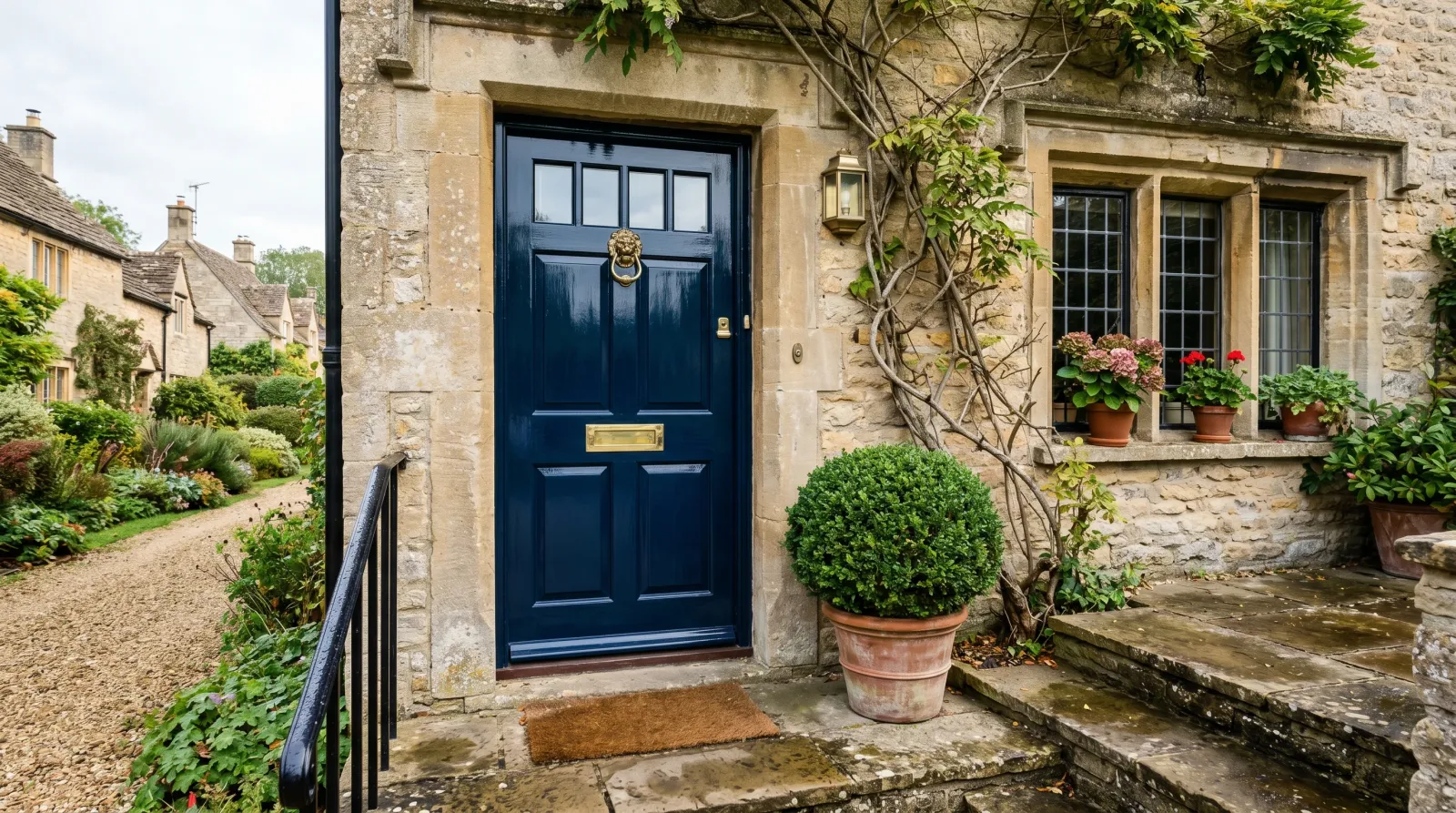
Buy Full Gloss for one feature, not for every baseboard. On a front door, a stair rail, or a fireplace surround, that 95 percent shine over a deep F&B color gives a near-lacquered depth softer sheens flatten out, and you get the whole 294-color deck in gloss. It is not self-priming, so budget the matched Wood Primer & Undercoat plus two thin coats. It magnifies raised grain and dents, touch-ups do not blend, and outdoors the shine dulls by year three or four.
Best for
Front doors · Interior doors · Stair rails · Fireplace surrounds · Metalwork · Exterior woodwork detail
Skip if
Everyday trim throughout the house · Old uneven woodwork you will not sand flat · Tight budgets · Anything you want to spot touch-up
What it's good at
- Depth on deep colors — on Hague Blue or Railings it reads almost wet, close to lacquered
- Giving you the entire 294-color deck in gloss, so a wall color and a door color can be the same color
- Wiping clean around a handle or a letterplate where a matte finish would gray out
- Covering interior and exterior wood, metal, and masonry detail out of one can
- Low odor at 6 g/L, so you can gloss a hallway without living in fumes for a week
- Making a front door the thing people notice from the curb in low morning light
What it's not good at
- Hiding anything — raised grain, dents, dust nibs, and brush drag all get magnified
- Working alone, since it is not self-priming and needs the matched undercoat to look right
- Being cheap by the project — undercoat plus gloss plus a sample pot turns one door into a $150-plus, multi-day job
- Spot touch-ups; a dab flashes and you end up recoating the whole panel or rail
- Holding its shine outdoors, where a south-facing door dulls and shifts by year three or four
- Everyday trim, where a softer sheen hides more and asks far less of you
Same shelf, different cans
Which Farrow & Ball Finish Are You Buying?
Farrow & Ball sells several finishes under the same color names, and the sheen is the whole decision. This review is Full Gloss. If the mirror shine turns out to be more than the room wants, the same color is on the shelf in a quieter finish.
Full Gloss (this review)
SheensFull Gloss only, around 95 percent
Buy it if
The shine is the design decision: a front door, a stair rail, a fireplace surround, a piece of metalwork inside or out.
Avoid if
The woodwork is old and uneven and you are not going to sand it flat first.
Estate Eggshell
SheensLow sheen
Buy it if
You want the same color on interior or exterior wood and metal with a calmer glow that hides a less-than-perfect surface.
Avoid if
You want the near-lacquered depth. A low sheen flattens exactly that effect.
Modern Eggshell
SheensLow sheen, washable
Buy it if
Interior wood, trim, and high-traffic walls that get wiped down.
Avoid if
You are painting a feature door where the shine is the whole point.
Dead Flat
SheensUltra-matte
Buy it if
Interior wood and walls where you want no light bounce at all.
Avoid if
Anything handled daily, or any surface that has to be cleaned.
Estate / Modern Emulsion
SheensWall finishes
Buy it if
Walls and ceilings.
Avoid if
Woodwork. These are not trim paints.
Numbers, not adjectives
Spec Sheet
- Coverage
- Up to 480 sq ft / US gallon, per coat
- Sheen
- Full Gloss only, around 95 percent
- Base
- Water-based, low odor
- Touch dry
- About 2 hr
- Recoat
- About 4 hr
- Full hardness
- Builds over weeks
- VOC
- 6 g/L, low; tested to a US EPA method
- Primer
- Not self-priming. Wood Primer & Undercoat on wood, Metal Primer & Undercoat on metal
- Surfaces
- Interior and exterior wood, metal, masonry detail
- Color deck
- The full 294-color Farrow & Ball library
- Sizes
- Sample pot, quart, gallon
- Price
- $92–125 / gal, about $40–55 / qt US street
Application Settings That Work
- Brush
- A good synthetic brush and a wet edge. Lay the paint on, tip it off in one direction, and leave it alone. On a paneled door, panels first, then the rails and stiles, so laps fall on the natural breaks. Two thin coats, not one thick one.
- Primer
- Not self-priming. Sand smooth and dust-free, fill and re-sand any dents, then prime with Farrow & Ball Wood Primer & Undercoat in the matching tone band on wood, or the Metal Primer & Undercoat on metal. The undercoat tone band is keyed to the gloss color, and that pairing is what gives the finish its depth.
Dry Times in the Real World
Touch dry in about two hours, recoatable at about four, and film hardness that keeps building for weeks after the door looks finished. Plan two thin coats over the tinted undercoat rather than one generous one, because a heavy coat on a vertical door curtains, and a run in a 95 percent gloss is the most visible mistake in painting. Let the first coat have the full recoat window; a second coat into paint that has not finished setting is where brush marks live. On deep colors a third thin coat sometimes evens out the depth, especially on a door that catches direct sun. Give a fresh door a few gentle days before it starts taking keys, bags, and weather.
Mid-project panic
When It Goes Wrong, and How to Fix It
Brush marks sitting in the dry film
Why it happens. A gloss this bright records the way the paint was laid on. The marks almost never come from the first pass. They come from the instinct to go back and fix a spot that does not look right while the surface has already started to set.
The fix. Use a good synthetic brush, keep a wet edge, lay the paint on, tip it off in one direction, and walk away. Trust the leveling. On a paneled door, do the panels first and then the rails and stiles, so any laps fall on the natural breaks where the eye expects a line.
Runs and sags down a vertical door
Why it happens. One thick coat is the culprit. Gloss flows, and on a vertical stile a heavy pass curtains before it sets, usually after you have moved on to the next panel.
The fix. Two thin coats, never one thick one. Walk the door under raking light a few minutes after each section and catch a sag while it is still wet, when a single light pass fixes it. Tomorrow it is a sanding job.
Every dent and raised grain jumping out at you
Why it happens. A 95 percent sheen is a magnifying glass. It finds the dents in an old door, the grain that raised when it got damp, and the dust nib that landed while it dried. On a tired Victorian door you half-sanded, gloss looks worse than a matte would.
The fix. The finish is won before the gloss can is open. Sand the wood smooth and dust-free, fill and re-sand any dents, then prime with the tinted Wood Primer & Undercoat so the color sits on an even base instead of soaking unevenly into bare wood.
A touch-up that flashes against the rest
Why it happens. At this sheen a dabbed repair dries at a different shine than the surrounding film, so it reads as a patch from across the hall. Quieter sheens let you spot-fix. This one does not.
The fix. Do not dab it. Recoat to a natural break: the whole rail, the whole door panel, the full run of the surround. Keep a labeled part-tin from the job so the repair comes out of the same can.
Edges lifting or peeling after a couple of seasons
Why it happens. Full Gloss is not self-priming, and gloss laid straight onto bare, stained, or previously glossy wood or metal has very little to hold onto. Exterior edges and end grain let go first.
The fix. Use the Wood Primer & Undercoat in the matching tone band on wood, and the Metal Primer & Undercoat on metal. It is the undercoat that gives the finish both its grip and its depth, so buy it at the same time as the gloss.
Side by side
Full Gloss vs BM Advance High-Gloss vs a Hardware-Store Gloss
Three ways to get a shiny door, and they are not really competing for the same job. What separates them is whether the exact color matters and how much prep you are willing to do.
| F&B Full Gloss | Benjamin Moore Advance High-Gloss | Rust-Oleum or Behr gloss enamel | |
|---|---|---|---|
| The look in good light | Around 95 percent sheen; on a deep color it reads almost wet. | A waterborne alkyd that levels like oil — glassy, near-sprayed. | Most of the shine from the curb, but it reads a touch plasticky up close next to Full Gloss. |
| Color deck | The full 294-color F&B library, so the door can match the walls exactly. | Benjamin Moore's very large deck, but it does not carry F&B colors, so match carefully. | Stock deep colors. Nothing that matches an F&B wall. |
| Film and cure | Water-based at 6 g/L; hardness builds over weeks. | Cures harder than Full Gloss, but you have to wait out the long cure. | An off-the-shelf enamel that does the job on a door. |
| Price | $92–125 / gal, about $40–55 / qt | $85–95 / gal | $30–50 / qt |
| Where it wins | A front door, stair rail, fireplace surround, or metalwork where the exact F&B color and the shine are the design decision. | A door or cabinet where you want a glassy, durable, near-sprayed film and can wait for the cure. | The door is the only glossy thing in the project and nobody is matching it to the walls. |
The look in good light
F&B Full GlossAround 95 percent sheen; on a deep color it reads almost wet.
Benjamin Moore Advance High-GlossA waterborne alkyd that levels like oil — glassy, near-sprayed.
Rust-Oleum or Behr gloss enamelMost of the shine from the curb, but it reads a touch plasticky up close next to Full Gloss.
Color deck
F&B Full GlossThe full 294-color F&B library, so the door can match the walls exactly.
Benjamin Moore Advance High-GlossBenjamin Moore's very large deck, but it does not carry F&B colors, so match carefully.
Rust-Oleum or Behr gloss enamelStock deep colors. Nothing that matches an F&B wall.
Film and cure
F&B Full GlossWater-based at 6 g/L; hardness builds over weeks.
Benjamin Moore Advance High-GlossCures harder than Full Gloss, but you have to wait out the long cure.
Rust-Oleum or Behr gloss enamelAn off-the-shelf enamel that does the job on a door.
Price
F&B Full Gloss$92–125 / gal, about $40–55 / qt
Benjamin Moore Advance High-Gloss$85–95 / gal
Rust-Oleum or Behr gloss enamel$30–50 / qt
Where it wins
F&B Full GlossA front door, stair rail, fireplace surround, or metalwork where the exact F&B color and the shine are the design decision.
Benjamin Moore Advance High-GlossA door or cabinet where you want a glassy, durable, near-sprayed film and can wait for the cure.
Rust-Oleum or Behr gloss enamelThe door is the only glossy thing in the project and nobody is matching it to the walls.
If the shine and the specific Farrow & Ball color are the point of the project, and the surface is smooth or you are willing to make it smooth, Full Gloss is the one. If you want a harder, glassier film on a door or a cabinet and the color does not have to match an F&B wall, Advance is the more robust finish. If the door is a one-off and nothing else in the house is matching to it, a hardware-store gloss gets you most of the shine for a third of the spend.
If not this one
Honest Alternatives
RO
Rust-Oleum or Behr gloss enamel$30–50 / qt
A hardware-store gloss in a deep color gets you most of the shine on a front door for a third of the spend, and it is stocked everywhere. You give up the F&B color depth and the deck match, and it reads a touch plasticky next to Full Gloss in good light.
BM
Benjamin Moore Advance high-gloss$85–95 / gal
A waterborne alkyd that levels like oil and cures harder than Full Gloss, with a huge color deck behind it. The right call on a door or cabinet where you want a glassy, durable, near-sprayed film and can wait out the long cure. It does not carry the F&B colors.
Full review →FB
Farrow & Ball Estate EggshellSame price tier
If you love the color but the full mirror shine worries you on an imperfect door, drop to Estate Eggshell. Same deck, same interior and exterior wood-and-metal use, far more forgiving of a surface that is not dead flat, and a calmer glow that ages more gracefully outdoors.
Questions people actually ask
Full Gloss Questions, Answered
Is Farrow & Ball Full Gloss worth the price over a hardware-store gloss?
For a front door, a stair rail, or a fireplace surround where the color carries the whole room, the depth and the deck are worth it. For a basement handrail nobody looks at, no. A $30 quart of Behr or Rust-Oleum gloss does the job. Full Gloss earns its money where you actually see the shine in good light.
Does Full Gloss need a primer?
Yes. It is not self-priming. On bare or stained wood, use Farrow & Ball Wood Primer & Undercoat in the matching tone band. On metal, use the Metal Primer & Undercoat. Skip the prep and the gloss will telegraph every flaw and peel at the edges within a couple of seasons. The undercoat is where the finish is really won.
How many coats of Full Gloss do I need?
Two over a tinted undercoat. One coat over bare or contrasting surfaces looks thin and patchy because the finish is so reflective. Let the first coat dry the full recoat window before the second. On deep colors a third thin coat sometimes evens out the depth, especially on a door that catches direct sun.
Can I use Full Gloss outside on a front door?
Yes. Full Gloss is rated for interior and exterior wood and metal, and a glossy front door is one of its best uses. Prime properly, give it two coats, and recoat the south-facing side every few years. A high-shine finish weathers visibly faster than a satin, so plan on touch-ups sooner than you would with eggshell.
How do I avoid brush marks with Full Gloss?
Use a good synthetic brush, keep a wet edge, lay the paint on, and tip it off in one direction. Then walk away. The marks come from going back into a spot that has already started to set, not from the first pass. On a paneled door, do the panels first and then the rails and stiles so any laps land on the natural breaks.
Can I touch up a chip in Full Gloss?
Not with a dab. At this sheen the repair dries at a different shine and flashes against the surrounding gloss, so you see the patch rather than the chip. Recoat to a natural break instead: the whole rail, the whole panel, the whole run of the surround. Keep a labeled part-tin from the job for exactly that.
How long does Full Gloss take to dry and harden?
Touch dry in about two hours, recoatable at about four. Full film hardness keeps building for weeks after the door looks finished. Two thin coats in a day is realistic. Treat the door gently for the first stretch rather than hanging bags on the handle the same evening.
Full Gloss or Estate Eggshell?
Full Gloss if the shine is the design decision and the surface is smooth or you will sand it smooth. Estate Eggshell if the woodwork is old and uneven, if the room wants a calmer glow, or if the surface lives outdoors on a sunny elevation, where a lower sheen ages more gracefully. Same colors, very different amount of forgiveness.
What does one door in Full Gloss actually cost?
More than the gloss can suggests. You want a sample pot to test the color on the actual door, the matched Wood Primer & Undercoat, and enough gloss for two coats, so a single door becomes a three-product, multi-day project north of $150. Budget the system, not the topcoat.
Keep exploring
We may earn a commission when you buy through the retailer link above. It never changes the score or the verdict.
Ask a Question