Product review · Farrow & Ball · Updated August 8, 2026
Exterior MasonryFarrow & Ball paint review
8.0/10Breathable masonry paint that actually breathes, in colors a big box cannot mix — believe about half the 15 years on a sunny wall.
A Class 1 breathable, 2 percent ultra-matt for brick, render and stucco. The physics are right for old solid walls. The price per square foot stops making sense past a small facade.

Mark Thompson · Pro Contractor & Field Editor · Updated August 8, 2026
22 years running residential and light commercial repaints across the Midwest. Mark has coated enough render and soft old brick to judge a masonry paint by whether the wall can still dry out, not by the number on the tin. About the testing process →
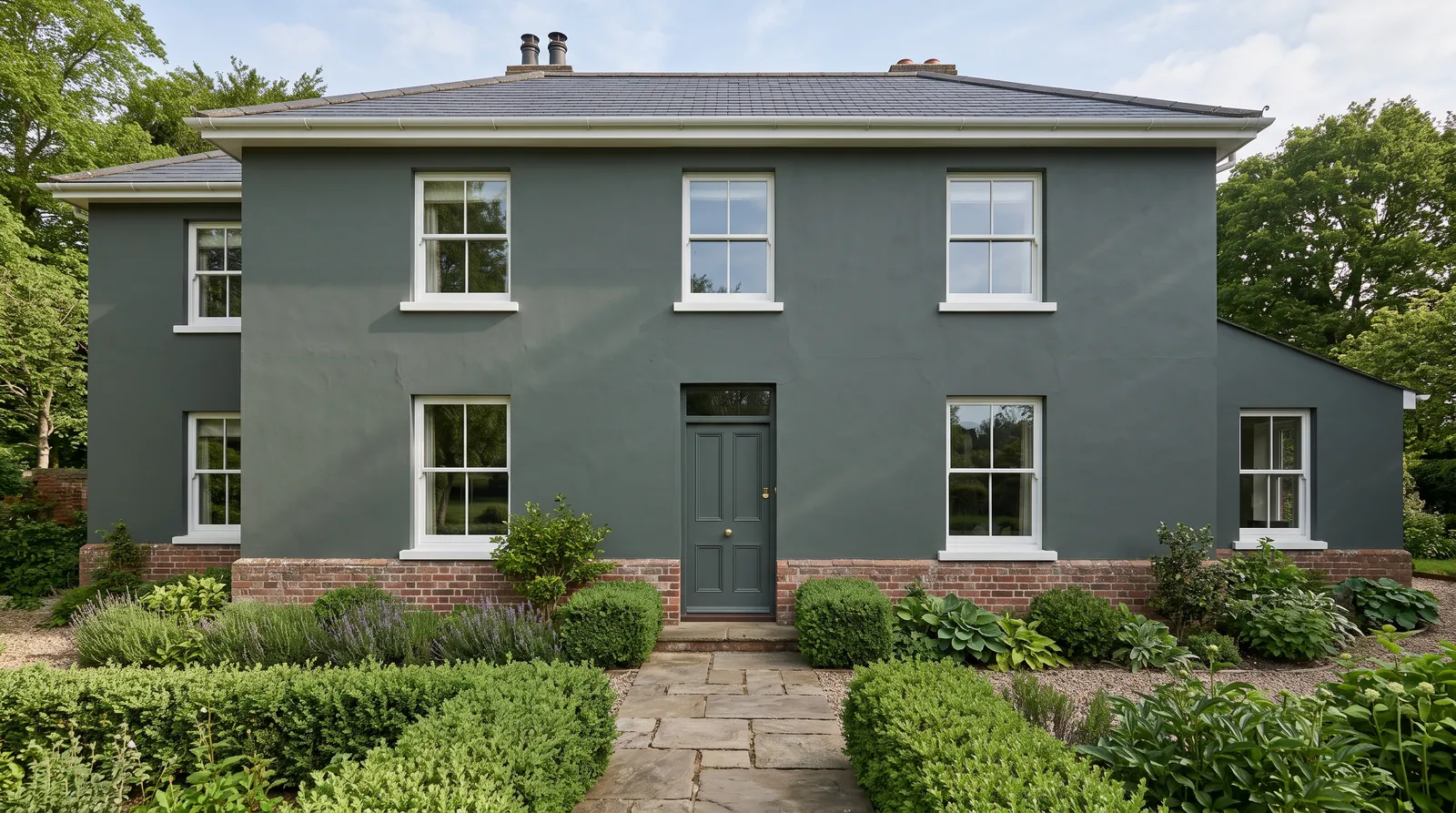
Farrow & Ball Exterior Masonry
CoverageUp to 8 sq m per liter per coat
Recoat5 hr
Read this first
The Fast Verdict
Buy it for a small, visible wall that has to breathe. Class 1 water vapour permeability is the part that genuinely earns the money: the wall sheds rain off the face and still dries inward, which is the right physics for lime render and soft old brick. The 2 percent matt gives a depth a big-box deck cannot mix. It protects fine, but not three times better than a $50 masonry paint, and a 5L tin at about $149 covers roughly 350 square feet at two coats.
Best for
Brick facades · Render and stucco panels · Garden and boundary walls · Old solid walls that must dry inward · Small, visible elevations
Skip if
Whole-house budgets · Cracked, moving masonry · Walls you will want to scrub clean · Damp shaded walls you need to keep spotless
What it's good at
- Breathing — Class 1 water vapour permeability lets a solid wall dry inward while shedding rain off the face
- Old masonry specifically: lime render and soft brick that a sealing film would blow off in sheets
- Color depth on render, where the 2 percent matt reads with a density a big-box deck cannot mix
- Holding color in flat light — the matt drinks daylight instead of bouncing glare back at you
- Slowing algae on a shaded, damp north wall thanks to real fungi and algae preservatives
- Long life on the right wall: shaded elevation, sound substrate, primer where needed, two full coats
What it's not good at
- Square-foot economics — about $149 per 5L tin for roughly 350 sq ft at two coats
- Staying clean; the dead-matt holds grime and shows algae streaks on damp shaded walls
- Taking a scrub — rub a stain hard and you burnish a shiny patch that will not blend out
- Chalky or powdery walls without the stabilising primer, whatever self-priming implies
- Bridging a moving crack; a flat film telegraphs and splits where an elastomeric would stretch
- US availability — no Home Depot, no Lowe's, so order extra before you start a big wall
Numbers, not adjectives
Spec Sheet
- Coverage
- Up to 8 sq m per liter per coat, about 86 sq ft/L or roughly 320 sq ft per US gallon
- Sheen
- Single sheen only, 2 percent ultra-matt
- Touch dry
- 2 hr
- Recoat
- 5 hr
- Breathability
- Class 1 water vapour permeability, water-resistant face
- Durability claim
- Up to 15 years against flaking, peeling, and colour fade
- Mildew
- Protected against fungi and algae
- Primer
- Self-priming on sound masonry; Masonry & Plaster Stabilising Primer on chalky or porous walls
- Surfaces
- Brick, render, stucco, concrete, terracotta, stone, cement
- Application temp
- Not below 50°F (10°C) or above 86°F (30°C)
- Sizes
- Sample pot and a 5L tin — the only full size, about 1.3 US gallons
- Price
- About $149 per 5L tin, roughly $110–115 per US gallon equivalent
Application Settings That Work
- Brush
- Brushes and rolls fine. Back-roll the first coat into the texture so it bites into the hollows instead of bridging them, then a full second coat. The dead-flat finish hides roller marks, which is one less thing to fight.
- Primer
- Self-priming on sound, stable masonry — two coats straight on. On a chalky, powdery, or worn wall, bind the dust first with Farrow & Ball Masonry & Plaster Stabilising Primer, or the topcoat has nothing to grip.
Dry Times and the Weather Window
Touch dry in two hours, recoat at five, so a two-coat wall fits in a day if the weather holds. Do not apply below 50°F or above 86°F — a hot wall in full afternoon sun flashes off the first coat before it can wet into the texture, and a cold one never sets properly. Two full coats at proper film thickness is what the 15-year claim assumes, so nobody gets there by stretching a tin. Bare masonry and textured render drink the first coat, which is why the second one is not optional. Plan the wall by elevation and follow the shade around the house if you can.
Mid-project panic
When It Goes Wrong, and How to Fix It
The topcoat letting go on a chalky wall
Why it happens. Self-priming is doing a lot of work in that marketing. On a chalky, powdery, or worn masonry surface, the paint has dust to grip rather than a sound wall, so it comes away early no matter how good the coat looked going on.
The fix. Rub the wall with your hand first. If it comes away chalky, bind the dust with Farrow & Ball Masonry & Plaster Stabilising Primer before anything else, then two full coats. On sound, stable masonry you can skip the primer and go straight to two coats.
Cracks telegraphing through and splitting the paint
Why it happens. This is a flat film, not an elastomeric. It will not bridge a moving hairline crack, so the crack reappears through the finish and then opens it up.
The fix. Fill and stabilize the crack before you paint. If the render or stucco is actively moving, this is the wrong product — a high-build elastomeric coating stretches over the gap and keeps water out, which is a different job entirely.
Algae streaks and grime on a damp shaded wall
Why it happens. Dead-matt at 2 percent sheen holds dirt, and a north wall in a damp climate grows a green film. The built-in fungi and algae preservatives slow that down; they do not stop it.
The fix. Rinse gently and accept some weathering as part of the finish. Do not scrub a stain out — you will burnish a shiny patch into the matt that will not blend back, and that patch is more visible than the stain was.
A patchy, thin-looking first coat
Why it happens. Bare masonry and textured render drink the first coat. Coverage is average for the money at roughly 320 sq ft per US gallon equivalent, and a textured wall eats more than a smooth one.
The fix. Back-roll the first coat into the texture so it bites into every hollow rather than bridging over them, then lay a full second coat. Two coats always, and order extra up front because there is no big box to top up from mid-wall.
Side by side
Exterior Masonry vs Behr Masonry Paint vs a Mineral Coat
The choice on a masonry wall is really a choice about breathability, and the three tiers answer it very differently.
| F&B Exterior Masonry | Behr Premium Masonry, Stucco & Brick | Romabio limewash or mineral silicate | |
|---|---|---|---|
| Breathability | Class 1 vapour permeable — sheds rain off the face, lets the wall dry inward. | More of a sealing film than a breathable one. | Fully vapour-open; bonds into the masonry itself. |
| Finish and color | 2 percent ultra-matt with F&B color depth a big box cannot mix. | Flat acrylic in big-box colors. | Chalky and mineral rather than a uniform film. |
| Price | About $110–115 / gal equivalent, $149 per 5L | $45–55 / gal | $70–90 / gal |
| Best wall | A small, visible brick, render, or stucco facade that has to breathe. | Sound modern block and stucco where you are covering real square footage. | Historic lime render or raw brick that must dry through. |
| Effort | Two coats, back-roll the first into the texture; stabilising primer on chalky walls. | Two coats and it is on the shelf at every Home Depot. | More prep and more technique than either. |
Breathability
F&B Exterior MasonryClass 1 vapour permeable — sheds rain off the face, lets the wall dry inward.
Behr Premium Masonry, Stucco & BrickMore of a sealing film than a breathable one.
Romabio limewash or mineral silicateFully vapour-open; bonds into the masonry itself.
Finish and color
F&B Exterior Masonry2 percent ultra-matt with F&B color depth a big box cannot mix.
Behr Premium Masonry, Stucco & BrickFlat acrylic in big-box colors.
Romabio limewash or mineral silicateChalky and mineral rather than a uniform film.
Price
F&B Exterior MasonryAbout $110–115 / gal equivalent, $149 per 5L
Behr Premium Masonry, Stucco & Brick$45–55 / gal
Romabio limewash or mineral silicate$70–90 / gal
Best wall
F&B Exterior MasonryA small, visible brick, render, or stucco facade that has to breathe.
Behr Premium Masonry, Stucco & BrickSound modern block and stucco where you are covering real square footage.
Romabio limewash or mineral silicateHistoric lime render or raw brick that must dry through.
Effort
F&B Exterior MasonryTwo coats, back-roll the first into the texture; stabilising primer on chalky walls.
Behr Premium Masonry, Stucco & BrickTwo coats and it is on the shelf at every Home Depot.
Romabio limewash or mineral silicateMore prep and more technique than either.
If the wall is small and visible, has to breathe, and the exact Farrow & Ball color is the point of the job, Exterior Masonry is the right buy. If you are covering a whole house of sound modern block or stucco on a budget, the Behr costs a third as much and protects the wall just as long. If the substrate is old, soft, and breathing matters more than matching a specific color, go past acrylic entirely to limewash or a mineral silicate. And if the wall is cracked and moving, none of these three are the answer — that is an elastomeric job.
If not this one
Honest Alternatives
BP
Behr Premium Masonry, Stucco & Brick Paint$45–55 / gal
The value play, on the shelf at every Home Depot. Flat acrylic that covers brick, stucco, and block in two coats for a third of the price. It is a more sealing film than a breathable one, so it suits sound modern block better than soft old lime render that has to dry inward.
RC
Romabio Classico Limewash or a mineral silicate facade paint$70–90 / gal
If breathability is the actual reason you are here, a true mineral coat goes further than acrylic. Limewash and potassium-silicate paints bond into the masonry and stay fully vapour-open, which is the right call on historic lime render or raw brick. More prep and more technique, and the look is chalky rather than a uniform film.
AE
An elastomeric masonry coating$40–60 / gal
For a wall with active cracking. Exterior Masonry is a flat film and will telegraph and split over a moving crack; a high-build elastomeric stretches over the gap and keeps water out. Thicker, less breathable, and not as good up close, but it solves a problem the F&B cannot.
Questions people actually ask
Exterior Masonry Questions, Answered
How long does Farrow & Ball Exterior Masonry last?
Farrow & Ball claims up to 15 years against flaking, peeling, and fade. On a shaded wall with sound prep, that is reachable. On a sunny south or west elevation in a deep color, plan on less — UV fades the saturated tones first. The prep underneath decides more than the can does. Bind any chalking, prime porous masonry, lay down two full coats. Skip those and it lets go years early.
Do I need a stabilising primer first?
Depends on the wall. On sound, stable masonry it is self-priming, so two coats go straight on. On a chalky, powdery, or worn surface, yes — use Farrow & Ball's Masonry & Plaster Stabilising Primer to bind the dust first. Rub the wall with your hand; if it comes away chalky, the topcoat has nothing to grip and will peel.
Is Farrow & Ball Exterior Masonry worth it over a big-box masonry paint?
For a small, visible facade where you want a specific Farrow & Ball color and that dead-flat 2 percent look, yes. The breathability and color depth are the reason to buy it. For a whole house on a budget, no — a $50 breathable masonry paint protects the wall just as long. You are paying boutique money for color, not for outlasting a good acrylic by a decade.
What does breathable actually mean here?
Class 1 water vapour permeability, which means the film sheds rain off the face but still lets moisture move out through the wall. Masonry holds moisture, and trapping it behind a sealing film is what gives you blown render, spalled brick, and paint coming off in sheets. On old solid-wall masonry that physics matters more than any durability number.
Will it cover a cracked wall?
No. This is a flat film, not an elastomeric, so it will not bridge a moving crack — it telegraphs through and then splits. Fill and stabilize before you paint. If the render or stucco is actively moving, buy a high-build elastomeric coating instead and accept a less pretty finish for a dry wall.
Can I scrub a stain off it?
Gently rinse, do not scrub. The 2 percent dead-matt that looks so good on day one holds dirt and shows algae streaks on damp shaded walls, and scrubbing burnishes a shiny patch into the flat that will not blend back out. Plan to live with some weathering, or keep a part-tin for a spot recoat.
How much do I need for a facade?
Reckon on roughly 320 sq ft per US gallon equivalent per coat, and always two coats — bare masonry and textured render drink the first one. A 5L tin covers about 350 sq ft at two coats. There is no Home Depot to top up from, so measure the wall and order extra up front.
Can I use it on wood or metal trim?
No. Exterior Masonry is for the masonry itself: brick, render, stucco, concrete, terracotta, stone, and cement. Doors, fences, cladding, window frames, railings, and gutters are Exterior Eggshell's job. Use the right one on each and they are designed to sit next to each other.
What temperature can I paint in?
Not below 50°F and not above 86°F. Touch dry is two hours and recoat is five, so two coats fit in a day when conditions are right. Follow the shade around the house rather than working a wall in full afternoon sun, which flashes off the first coat before it wets into the texture.
Keep exploring
Farrow & Ball brand overview and product linesFarrow & Ball Exterior Eggshell reviewBest masonry and brick paint, tested
We may earn a commission when you buy through the retailer link above. It never changes the score or the verdict.
Ask a Question