Product review · Farrow & Ball · Updated August 7, 2026
Dead FlatFarrow & Ball paint review
8.4/10The deepest, quietest version of a color you can put on a wall — and now tough enough to live with.
At about 2 percent sheen this is the flattest paint Farrow & Ball makes, and since the 2022 reformulation it is also Class 1 scrubbable. One finish for the wall, the baseboard, and the radiator.

Jessica Williams · Color Stylist & Interior Editor · Updated August 7, 2026
Jessica spent eight years styling residential interiors in Chicago and Charleston before moving into editorial work. She has watched the same near-matt grey warm toward putty at breakfast and cool by five o'clock, which is the only honest way to judge a paint sold on depth. About the testing process →
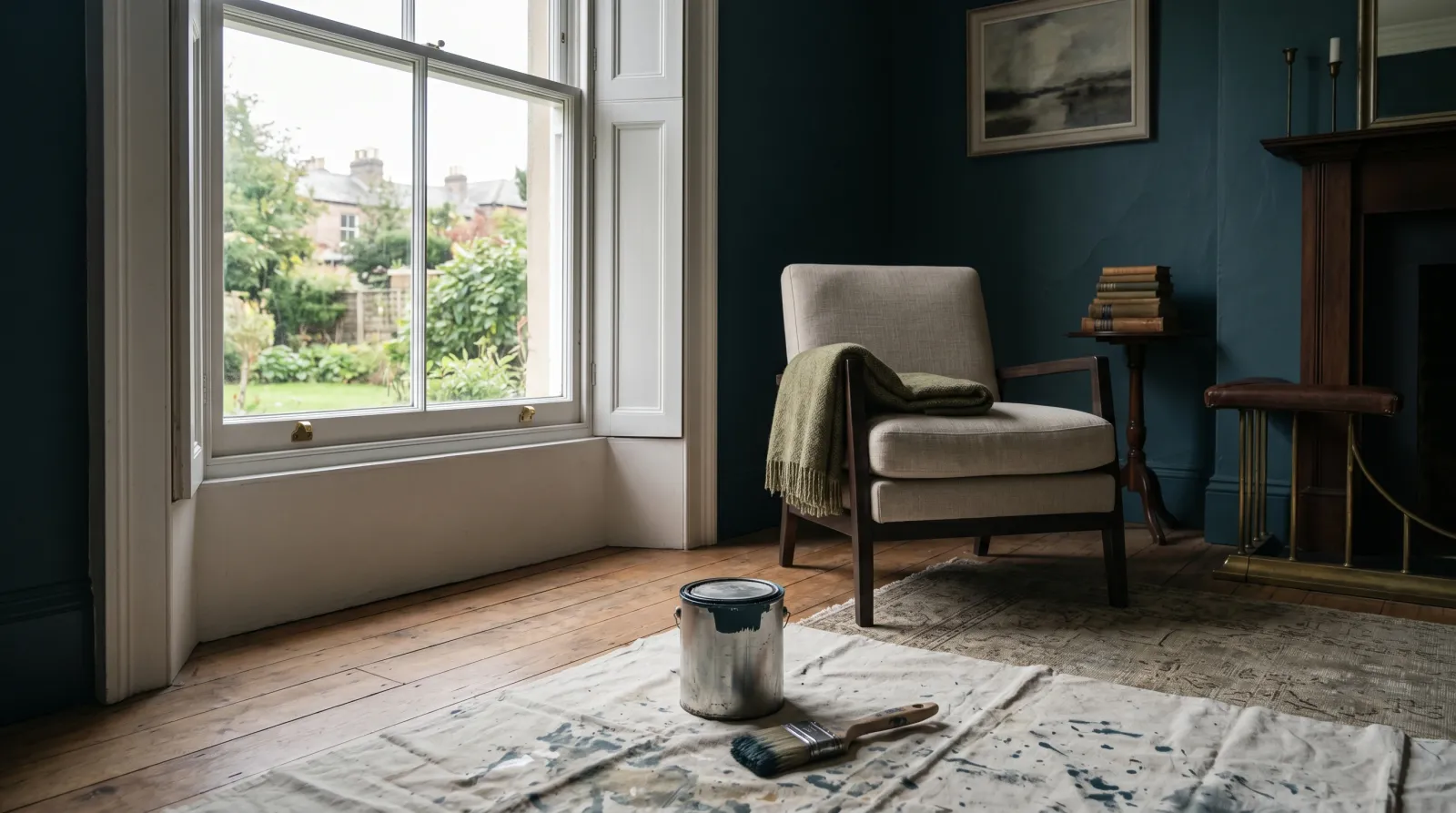
Farrow & Ball Dead Flat4 sheens
RecoatAbout 4 hr
VOCWater-based
Sheens Dead Flat onlyone sheen across wallswoodmetal
Read this first
The Fast Verdict
Buy it for the one or two rooms where the color is the whole point. At about 2 percent sheen almost nothing bounces back, so a deep blue-green or a charcoal sits with a velvet weight that most finishes lose in north light, and you can carry the same finish across the wall, the casing, and the radiator with no sheen break at the trim line. The 2022 reformulation added a Class 1 scrub rating. It runs roughly $110 to $165 a gallon equivalent, and an ultra-matt film still punishes bad prep.
Best for
North-facing bedrooms · Studies and snugs · Color-drenched dining rooms · Walls, woodwork, and metal in one finish · Smooth, well-prepped walls
Skip if
Textured or roughly finished walls · A quick weekend repaint · Whole-house budgets · You want to spot-fix a scuff next year without repainting a wall
What it's good at
- Color depth in low light, where most finishes go flat and lifeless
- One finish across wall, baseboard, casing, and radiator, with no sheen break at the trim line
- Cleaning, finally — Class 1 scrub, and marks lift without paint transferring to the cloth
- Holding its color, thanks to the pigment dose
- Reading almost like suede up close, which is why the room feels calm rather than bouncy
- Low odour and an A+ indoor air rating, toy-safe certified, so the room is livable the same evening
What it's not good at
- The bill — about $55 for 750ml, and a single bedroom can cross $200 in paint alone
- Bad prep, which telegraphs through a 2 percent sheen in raking light
- Touch-ups, which flash until you re-roll the whole wall
- One-coat jobs; two coats every time, and deep colors may want a tinted undercoat
- Quick resupply — metric tins through F&B stores and a thin stockist network
- The first two to four weeks, while the washable hardness is still building
Numbers, not adjectives
Spec Sheet
- Coverage
- Up to 480 sq ft / gal on smooth sealed surfaces; two coats standard
- Sheen
- Dead Flat only — about 2% at 60 degrees
- Touch dry
- About 2 hr
- Recoat
- About 4 hr
- Full hardness
- Builds over 2 to 4 weeks
- Scrub rating
- Class 1, the highest
- VOC
- Water-based, trace VOC, A+ indoor air rating, toy-safe certified
- Primer
- F&B Wall & Ceiling Primer or Interior Wood Primer on bare, metal, or patched surfaces
- Surfaces
- Walls, ceilings, woodwork, trim, and metal including radiators
- Sizes
- Sample pot, 750ml, 2.5L; gallon at select US stockists
- Price
- About $55 for 750ml; roughly $110–165 per gallon equivalent
Application Settings That Work
- Brush
- Low splatter and it lays down nicely, but a flat film shows every lap mark if you let an edge dry. Cut in and roll in sections, keep a wet edge across the wall, and finish a wall before you stop. Two coats every time — there is no one-coat shortcut, and the depth arrives on the second pass.
- Primer
- Previously painted, sound interior walls in a similar color can go straight to two coats. Bare wood, raw drywall, metal, and patched repairs need the matched Farrow & Ball primer first — Wall & Ceiling Primer on walls, Interior Wood Primer on woodwork — or the finish flashes and the patch ghosts through. Deep colors sometimes want a tinted undercoat to land true.
Two to Four Weeks to Full Hardness
Touch dry at about two hours, recoat at four, and then the film spends two to four weeks building the toughness the reformulation is known for. The first fortnight is still a be-gentle zone: the Class 1 scrub rating is what the paint becomes, not what it is on day three. Keep furniture off the fresh wall, no chair backs against it, no wiping, and it will take normal life afterwards. The wipe test is where the new formula proves itself. On the old Dead Flat, a damp cloth left a shiny burnished smear. On this one, marks lift and the matt stays matt. It is not bulletproof, and a hard scour will still polish a spot, but for normal life it holds.
Mid-project panic
When It Goes Wrong, and How to Fix It
Faint bands where you stopped and restarted
Why it happens. An ultra-matt film has nowhere to hide. Roll back into an edge that has already set and the overlap reads as a lap mark in raking light, even though the paint lays down beautifully otherwise.
The fix. Keep a wet edge. Cut in and roll in sections rather than cutting the whole room first, work a full wall before you break, and keep a light raking across the surface while you work so you can see what you have already covered.
A touch-up that reads brighter or duller than the wall
Why it happens. Spot repairs flash on a 2 percent sheen far more than on an eggshell. There is no gloss to soften the edges of a patch into the film around it.
The fix. Re-roll the whole wall corner to corner. Plan for that when you buy: on Dead Flat pricing a repair costs a wall's worth of paint, which is a good argument for keeping this finish to the rooms that deserve it.
Blotchy patches and ghosting seams
Why it happens. Bare wood, raw drywall, metal, and filled repairs all drink differently than sound old paint, so a finish laid straight over them flashes and the patch ghosts through. This is the most common reason a near-matt wall looks uneven at the seams.
The fix. Prime bare and patched surfaces first with the matched Farrow & Ball Wall & Ceiling Primer, or the Interior Wood Primer on woodwork. On previously painted sound walls in a similar color you can usually go straight to two coats.
Every drywall flaw showing up once the walls are done
Why it happens. A flat film reflects almost nothing, so nothing gets softened. Unevenly skimmed seams, filled nail-pops, and roller texture all telegraph through in raking light. They were there before; the paint simply stopped hiding them.
The fix. Do the prep before the paint, not after. Skim and sand the seams flat, feather the fills wide, and check the wall with a work light held close and low. If the walls are textured or roughly finished, that is a reason to choose a higher sheen instead.
Side by side
Dead Flat vs Estate Emulsion vs Modern Emulsion
Three Farrow & Ball interior finishes with matt-sounding names. People land on the wrong one constantly, usually because Dead Flat and Estate Emulsion read almost identically on a chip.
| Dead Flat | Estate Emulsion | Modern Emulsion | |
|---|---|---|---|
| Sheen and feel | About 2%, ultra-matt, almost like suede up close | About 2%, chalky and breathable | About 7%, a washable matte |
| Surfaces | Walls, ceilings, woodwork, trim, and metal including radiators | Walls and ceilings only | Walls and ceilings only |
| Toughness | Class 1 scrub rating since the 2022 reformulation | Delicate; burnishes at the first wet wipe | Washable, built for kitchens, baths, and kids' rooms |
| Touch-ups | Flash; usually a whole-wall repaint | Flash; usually a whole-wall repaint | Blend better, thanks to the extra sheen |
| Where it belongs | The one color-led room you want people to stop and feel | Low-traffic walls and ceilings you rarely touch | Kitchens, bathrooms, and kids' walls that get scrubbed |
| Price per gallon | About $110–165 equivalent | $120–149 | $120–149 |
Sheen and feel
Dead FlatAbout 2%, ultra-matt, almost like suede up close
Estate EmulsionAbout 2%, chalky and breathable
Modern EmulsionAbout 7%, a washable matte
Surfaces
Dead FlatWalls, ceilings, woodwork, trim, and metal including radiators
Estate EmulsionWalls and ceilings only
Modern EmulsionWalls and ceilings only
Toughness
Dead FlatClass 1 scrub rating since the 2022 reformulation
Estate EmulsionDelicate; burnishes at the first wet wipe
Modern EmulsionWashable, built for kitchens, baths, and kids' rooms
Touch-ups
Dead FlatFlash; usually a whole-wall repaint
Estate EmulsionFlash; usually a whole-wall repaint
Modern EmulsionBlend better, thanks to the extra sheen
Where it belongs
Dead FlatThe one color-led room you want people to stop and feel
Estate EmulsionLow-traffic walls and ceilings you rarely touch
Modern EmulsionKitchens, bathrooms, and kids' walls that get scrubbed
Dead Flat is the one to buy when the color is the entire point of the room and you want it to run across the wall, the baseboard, and the radiator without a sheen break. Estate Emulsion gets you nearly the same look on a wall for less, as long as nobody touches it — the right call for a formal room or a ceiling, the wrong one for a hallway. Modern Emulsion is the answer for a family kitchen or a bath that gets scrubbed constantly. If a designer specified flat and you grabbed Estate Emulsion to save money, you got the look and lost the durability.
If not this one
Honest Alternatives
BM
Benjamin Moore Aura in a matte finishAbout $85 / gal
Washable, deep, available at any BM dealer, and the color desk will mix a respectable copy of most Farrow & Ball colors. It reads slightly less velvet because it carries a touch more sheen, but it is half the price and far easier to buy and to touch up.
FB
Farrow & Ball Modern EmulsionSimilar per gallon
Same brand, same colors, about 7 percent sheen instead of 2. You give up the deepest matt look and gain a tougher, more scrubbable wall built for kitchens, bathrooms, and kids' rooms. Choose it when the room takes real abuse and cleanability beats flatness.
Full review →AT
A true mineral limewashVaries by brand
If what you love about Dead Flat is the chalky, dimensional flatness, a real limewash takes it further, with cloudy depth and movement across a breathable surface old plaster prefers. It is a different look and a different skill, and it is not a wipe-clean finish.
Full review →Questions people actually ask
Dead Flat Questions, Answered
Is Farrow & Ball Dead Flat worth it?
In one or two rooms, yes. Nothing else gives a color that much depth in low light, and the 2022 reformulation added a Class 1 scrub rating, so the finish now survives a real house. As a whole-house paint it is hard to defend at roughly $110 to $165 a gallon equivalent, and the ultra-matt film punishes poor prep and never blends a touch-up. Buy it for the one room you want people to stop and feel.
Is the new Dead Flat actually washable?
Yes, and this is the real change. The 2022 reformulation gave Dead Flat a Class 1 scrub rating, the highest there is. You can wipe a fingerprint or a crayon mark off it with a damp cloth and no paint lifts onto the rag. The old Dead Flat marked if you looked at it wrong. The new one holds up in a hallway, which is a genuine shift for a paint this matt.
How is Dead Flat different from Estate Emulsion?
Estate Emulsion is a chalky wall-only matt with a soft, breathable look and almost no toughness. Dead Flat is just as flat at the sheen level but built much harder, and it goes on walls, woodwork, and metal in the same finish. If you want one paint for the wall, the baseboard, and the radiator, choose Dead Flat. For a delicate wall-only room you rarely touch, Estate Emulsion costs less.
Can I use Dead Flat on woodwork and radiators?
Yes, and it is the main reason to pay for it. Wall, baseboard, window casing, and radiator in one finish means the room reads as a single continuous color with no sheen break at the trim line. Bare wood and metal need the matched Farrow & Ball primer first.
Does Dead Flat need a primer?
On previously painted, sound interior walls in a similar color you can usually go straight to two coats. Bare wood, raw drywall, metal, and patched repairs all need the matched Farrow & Ball primer first, or the finish flashes and the patch ghosts through. Skipping primer on bare surfaces is the most common reason a near-matt wall looks blotchy at the seams.
How many coats of Dead Flat do I need?
Two, every time. There is no one-coat shortcut — coverage is good, but the depth needs the second pass, and deep colors sometimes want a tinted undercoat underneath to land true. Budget the undercoat into the room, not just the finish.
Can I touch up Dead Flat?
Not invisibly. Dab a repair on an ultra-matt wall and the patch reads brighter or duller than its surroundings until you re-roll the whole wall. On an eggshell you can spot-fix; here you usually cannot. That is one more reason to keep this finish to the rooms where it earns its place.
How long before Dead Flat is fully hard?
Touch dry in about two hours and recoatable at four, but the washable hardness builds over two to four weeks. Treat the first fortnight as a be-gentle zone — no wiping, no furniture pressed against the wall — and after that the Class 1 scrub rating is real.
Why does Dead Flat cost so much in the US?
You are paying for the pigment load and the import. Farrow & Ball is made in Dorset and shipped over, and the colors carry a heavier dose of pigment than commodity paint, which is what gives the near-matt depth. A 750ml runs about $55 and a gallon equivalent lands near $110 to $165. A US color-match in a cheaper line saves money but rarely reads with the same depth in low light.
Keep exploring
Farrow & Ball brand hub: what the price buysBest interior trim paint, testedSheen guide: matte through gloss
We may earn a commission when you buy through the retailer link above. It never changes the score or the verdict.
Ask a Question