Product review · Benjamin Moore · Updated August 7, 2026
Element GuardBenjamin Moore paint review
8.2/10Buy it for the weather, not for the color. The early-rain window is real; the deep-color hold is not flagship.
Benjamin Moore's moisture-first exterior can take rain or dew as soon as 60 minutes after it goes on. That one number is the whole reason to buy it, and the one number people misread.

Mark Thompson · Pro Contractor & Field Editor · Updated August 7, 2026
22 years running residential and light commercial repaints across the Midwest. Mark has rolled Element Guard on lap siding with a storm in the forecast and still takes side jobs to keep the numbers honest. About the testing process →
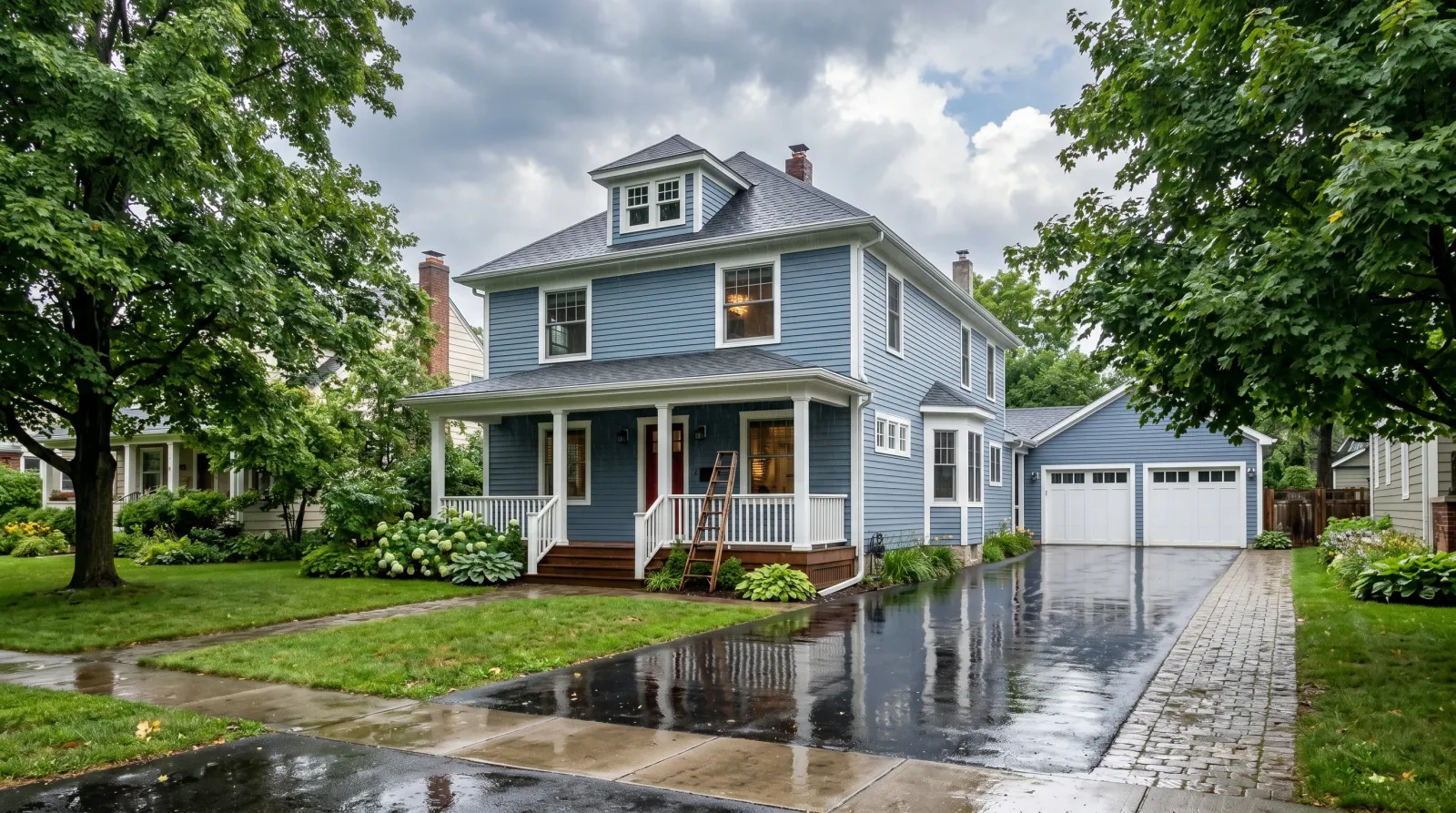
Benjamin Moore Element Guard3 sheens
Coverage300–400 sq ft / gal per coat
Recoat4 hr
VOCAbout 40 g/L
Sheens FlatLow LustreSoft Gloss
Read this first
The Fast Verdict
Buy it if the weather keeps ruining your coats. On a sound, prepped wall it takes rain or dew about 60 minutes after application, and in the Southeast, the Gulf, or the Pacific Northwest that hour is the difference between a finished wall and a callback. It cures through humidity that leaves ordinary acrylics soft, and at $60 to $75 a gallon it sits more than $20 under Aura Exterior. In a dry climate you are paying for a moisture spec you will never use.
Best for
Humid and rainy climates · Sound previously painted siding · Fiber cement · Walls that get wet before they cure · Cool-season starts down to 35°F · Shaded north walls
Skip if
Dry climates where color depth is the point · Deep charcoal or red body colors · You want a true satin sheen · Bare cedar or redwood with no primer · You are staining bare wood instead of painting it
What it's good at
- Early rain resistance that holds up in the field — dew or a shower about an hour after application on a sound wall
- Curing through Gulf Coast and Pacific Northwest humidity that leaves ordinary acrylics soft
- Mildew resistance on the film, so a shaded north wall reads clean at year three instead of green
- Going down to 35°F, which stretches the season on both ends in zones 5 and 6
- Honest mid-tier price — $20-plus a gallon under Aura Exterior on the same job
- Low tinted VOC near 40 g/L, so an occupied house stays liveable with windows open
What it's not good at
- Color depth on deep tones — Aura reads richer in the same charcoal or deep red
- Long hand-cut trim pulls, where the brush starts dragging at the end of the stroke
- Sheen choice — Flat, Low Lustre, and Soft Gloss only, no satin
- Holding saturated color on a south or west wall, which fades and chalks first
- Touch-ups after a year of UV, which flash unless you recoat to a break
- Bare cedar, bare masonry, or chalky paint, none of which the self-priming claim covers
Numbers, not adjectives
Spec Sheet
- Coverage
- 300–400 sq ft / gal per coat
- Sheens
- Flat, Low Lustre, Soft Gloss
- Touch dry
- 1 hr
- Recoat
- 4 hr
- Rain-ready
- As soon as 60 minutes after application
- Application temp
- 35°F to 100°F
- VOC
- About 40 g/L; Gennex zero-VOC colorant
- Primer
- Self-priming on sound prepped siding; prime bare wood, bare masonry, chalky paint
- Surfaces
- Wood and composite siding, fiber cement, vinyl, primed metal, masonry, trim
- Warranty
- Limited lifetime
- Sizes
- Quart, gallon, 5-gallon
- Price
- $60–75 / gal at BM dealers
Application Settings That Work
- Brush
- Fine on the field, honest about its limits on long pulls. Use a quality 2.5-inch sash, work shorter passes with more reloads, and back-brush behind the roller on siding so the film keys into the surface.
- Primer
- Self-priming on sound, previously painted siding and fiber cement. Prime first on bare wood, bare masonry, chalky old paint, and tannin-bleeding cedar or redwood — the self-priming claim does not cover those.
The Rain-Ready Window: Read It Right
Sixty minutes is the soonest the film can take rain or dew, on a properly prepped surface, applied inside the temperature window, in normal drying conditions. That is a real and useful spec. It is not a license to paint in the rain. What stretches the window: application below 50°F, deep shade with no air movement, high humidity at dusk, vinyl or hardboard, and a heavy driving rain instead of a passing shower. What helps it: morning starts so the coat has daylight to set, sun or moving air on the wall, and a porous, well-prepped substrate. Element Guard buys you a margin against weather that ruins a standard exterior coat. It does not let you ignore the forecast. Start early, watch the dew point, and stop before dusk.
Mid-project panic
When It Goes Wrong, and How to Fix It
The brush drags at the end of a long fascia pull
Why it happens. Roll it or spray it and it behaves. Cut a long fascia line with a 2.5-inch sash and it starts pulling toward the end of the stroke. Aura goes further before it wants a reload. That is resin and pigment load, not a bad can.
The fix. Work shorter passes and reload more often. Back-brush behind the roller on siding instead of trying to cut a whole run in one pull. If long hand-cut trim is most of the job and the money is there, that is the case for Aura Exterior.
A fresh coat washed off in a shower
Why it happens. The 60-minute number is a best case, not a promise. Cold, deep shade with no air moving, a non-porous substrate like vinyl or hardboard, high humidity at dusk, or a hard driving rain all stretch how long the film needs before it can take water.
The fix. Start in the morning so the coat has daylight and moving air. Treat 60 minutes as the floor under good conditions and give it more when it is cold or shaded. Stop before dusk and the dew point. Then scrape and recoat the washed section back to sound paint.
Brown ghosts bleeding through white on cedar or redwood
Why it happens. That is tannin, and self-priming is a coverage claim, not a substrate claim. On sound previously painted siding the paint primes itself. Raw cedar, redwood, bare masonry, and chalky old paint are a different problem, and the acrylic does not lock them down.
The fix. Prime first on anything bare, chalky, or tannin-heavy, then paint. Skip the primer on raw cedar and the tannin comes through in a season, and at that point you are stripping or sealing and repainting the whole elevation.
A touch-up spot flashes a year later
Why it happens. Inside the first season a dab blends fine. After a year of UV the surrounding film has faded and chalked slightly, so a fresh spot reads brighter and at a different sheen, especially raking across the wall late in the day.
The fix. Recoat to a natural break instead of dabbing: the full board run, the full trim piece, the whole elevation face. Keep a labeled quart from the job and fix dings in the first season, when they still blend.
Side by side
Element Guard vs Aura Exterior vs Regal Select Exterior
Three Benjamin Moore exteriors, three different problems. The names blur at the counter, so match the can to what is actually going wrong on your wall.
| Element Guard | Aura Exterior | Regal Select Exterior | |
|---|---|---|---|
| Early rain resistance | Rain or dew as soon as 60 minutes on a sound, prepped wall. The reason the line exists. | No marketed rain-ready window. A great paint that still wants a dry afternoon. | No marketed rain-ready window. |
| Color depth and hold | Reads a touch flatter side by side in the same deep tone. South and west walls fade and chalk first. | Color-lock holds deep tones in direct sun longest. The gap shows by year four on a south wall. | The smooth all-rounder in stable weather. |
| Brush feel | Merely fine. Drags toward the end of a long trim pull. | Buttery under a quality sash and pulls longer before a reload. | Good all-around flow. |
| Best climate | Southeast, Gulf, Pacific Northwest — humidity and surprise rain. | Dry, stable weather where the color is the whole point. | Dry climates, as the general-purpose acrylic. |
| Chalk resistance on dark colors | Fair. Deep tones chalk before the flagship does. | A step better than Element Guard at the deep end. | Between the two. |
| Price per gallon | $60–75 | $85–100 | A few dollars over Element Guard |
| Where it wins | Repaints that keep getting rained out, and whole-house budgets. | A forever home in a saturated color on a sunny wall. | An everyday repaint where the weather is not the problem. |
Early rain resistance
Element GuardRain or dew as soon as 60 minutes on a sound, prepped wall. The reason the line exists.
Aura ExteriorNo marketed rain-ready window. A great paint that still wants a dry afternoon.
Regal Select ExteriorNo marketed rain-ready window.
Color depth and hold
Element GuardReads a touch flatter side by side in the same deep tone. South and west walls fade and chalk first.
Aura ExteriorColor-lock holds deep tones in direct sun longest. The gap shows by year four on a south wall.
Regal Select ExteriorThe smooth all-rounder in stable weather.
Brush feel
Element GuardMerely fine. Drags toward the end of a long trim pull.
Aura ExteriorButtery under a quality sash and pulls longer before a reload.
Regal Select ExteriorGood all-around flow.
Best climate
Element GuardSoutheast, Gulf, Pacific Northwest — humidity and surprise rain.
Aura ExteriorDry, stable weather where the color is the whole point.
Regal Select ExteriorDry climates, as the general-purpose acrylic.
Chalk resistance on dark colors
Element GuardFair. Deep tones chalk before the flagship does.
Aura ExteriorA step better than Element Guard at the deep end.
Regal Select ExteriorBetween the two.
Price per gallon
Element Guard$60–75
Aura Exterior$85–100
Regal Select ExteriorA few dollars over Element Guard
Where it wins
Element GuardRepaints that keep getting rained out, and whole-house budgets.
Aura ExteriorA forever home in a saturated color on a sunny wall.
Regal Select ExteriorAn everyday repaint where the weather is not the problem.
If your repaint keeps getting rained out or the air never dries, buy Element Guard and stop arguing about resin clarity. If the point of the job is a moody charcoal or a deep red holding on a south wall for a decade, pay the extra $20-plus a gallon for Aura Exterior. Regal Select Exterior is the pick when the weather is stable and you just want a smooth, reliable acrylic. Across 12 to 15 gallons on a whole house, the Element Guard-to-Aura gap is $250 to $350 — spend it where your actual problem is.
If not this one
Honest Alternatives
BP
Behr Premium Plus Exterior$35–45 / gal
Half the price, sold at every Home Depot, and a fair acrylic for a low-stakes repaint. No early-rain spec and it chalks faster on south walls, but for a shed, a rental, or a dry-climate body you will repaint in five years, it is enough paint.
Full review →BM
Benjamin Moore Aura Exterior$85–100 / gal
The best homeowner-grade color hold on the market and a smoother brush. Costs $20-plus more a gallon and markets no rain-ready window. The right call for a forever home in stable weather where the color is the point.
Full review →SW
Sherwin-Williams Emerald Exterior$90–105 / gal
The other top-tier acrylic, with a strong early dirt-shed story. Trades blows with Aura. Worth a look if a Sherwin-Williams store is closer than your BM dealer — the 10-minute drive matters more than the spec-sheet difference.
Full review →Questions people actually ask
Element Guard Questions, Answered
Is Element Guard worth it?
In a humid or rainy climate, yes. It takes rain or dew as soon as 60 minutes after application on a sound prepped wall, it cures through humidity that leaves ordinary acrylics soft, and at $60 to $75 a gallon it sits more than $20 under Aura Exterior. In a dry climate, no. You would be paying for a moisture spec you never use, and color depth and brush feel both trail Aura.
What is Element Guard rated for moisture?
It is built for wind-driven rain and high humidity. The headline spec is early rain resistance: on a sound, prepped surface in the right conditions, it can take rain or dew as soon as 60 minutes after the coat goes on. That is the whole reason to buy it over a standard exterior. In the Southeast and the Pacific Northwest, that window saves jobs from washing off the wall.
Is Element Guard better than Regal Select Exterior?
Different jobs. Element Guard wins when moisture is the problem: humid climates, walls that get wet before they cure, a forecast you cannot trust. Regal Select Exterior is the better all-around acrylic in a dry climate and runs a few dollars more. If your repaint keeps getting rained out, buy Element Guard. If you have stable weather, Regal Select is the smoother all-rounder.
Does Element Guard need a primer?
On sound, previously painted siding in good shape, no. It self-primes there. On bare wood, bare masonry, chalky old paint, or tannin-bleeding cedar and redwood, prime first. Self-priming is a coverage claim, not a substrate claim. Skip the primer on raw cedar and the tannin bleeds through in a season.
How long does Element Guard last on siding?
On prepped, sound siding in most climates, plan on 8 to 12 years before a full recoat. South and west walls fade and chalk first, and trim takes the weather harder than the field. Prep decides this far more than the can does. A pressure wash and a scuff sand buys you years; skipping them costs you years.
How cold can I apply Element Guard?
Down to 35°F, with a window of 35 to 100°F. Most exteriors quit at 50°F, so that low end is worth as much as the rain spec in zones 5 and 6 — it stretches the painting season on both ends. Cut the day short before the dew point catches you, though. Cold and damp at dusk is still where coats fail.
Does Element Guard come in satin?
No. Three sheens only: Flat, Low Lustre, and Soft Gloss. For most siding that is enough, and Low Lustre is where most bodies land. If a true satin body is the look you are after, this line will not give it to you and you are shopping a different product.
How far does a gallon go and how many coats do I need?
300 to 400 sq ft per gallon per coat, and that number is honest. Plan two coats on most siding. Going over the same color in good light, one coat can carry it. Recoat is 4 hours, so a two-coat elevation fits in a day when the weather cooperates.
Element Guard or Aura Exterior?
Aura wins on color hold in direct sun, brush feel on long trim pulls, and chalk resistance on dark colors, for $85 to $100 a gallon. Element Guard wins when the weather is the problem and on price — $20-plus less a gallon, which is $250 to $350 across a whole house. Wet climate: Element Guard. Deep color in stable weather: Aura.
Where can I buy Element Guard?
Benjamin Moore dealers and many Ace Hardware stores. There is no big-box shelf for it. Buy from a dealer so the tinting happens at the counter against the full Benjamin Moore deck, and ask which sheen they actually stock before you commit to a 5-gallon. The 5-gallon is the move on a whole house.
Keep exploring
Benjamin Moore brand hub and product lineupBest paint for humid climates round-upHow to fix peeling exterior paint
We may earn a commission when you buy through the retailer link above. It never changes the score or the verdict.
Ask a Question