Product review · Behr · Updated August 7, 2026
Premium Plus ExteriorBehr paint review
7.2/10The best price-to-result exterior gallon at this tier, as long as the wall is sound, previously coated, and not getting cooked all afternoon.
The cheapest exterior gallon Home Depot stocks that still passes the mildew, weathering, and flexibility standards. The trouble starts with the paint-and-primer line on the label and with any wall the afternoon sun stands on.

Mark Thompson · Pro Contractor & Field Editor · Updated August 7, 2026
22 years running residential and light commercial repaints across the Midwest. Mark has sprayed and back-rolled this gallon on lake-house siding in zones 5 and 6, and still takes side jobs to keep the numbers honest. About the testing process →
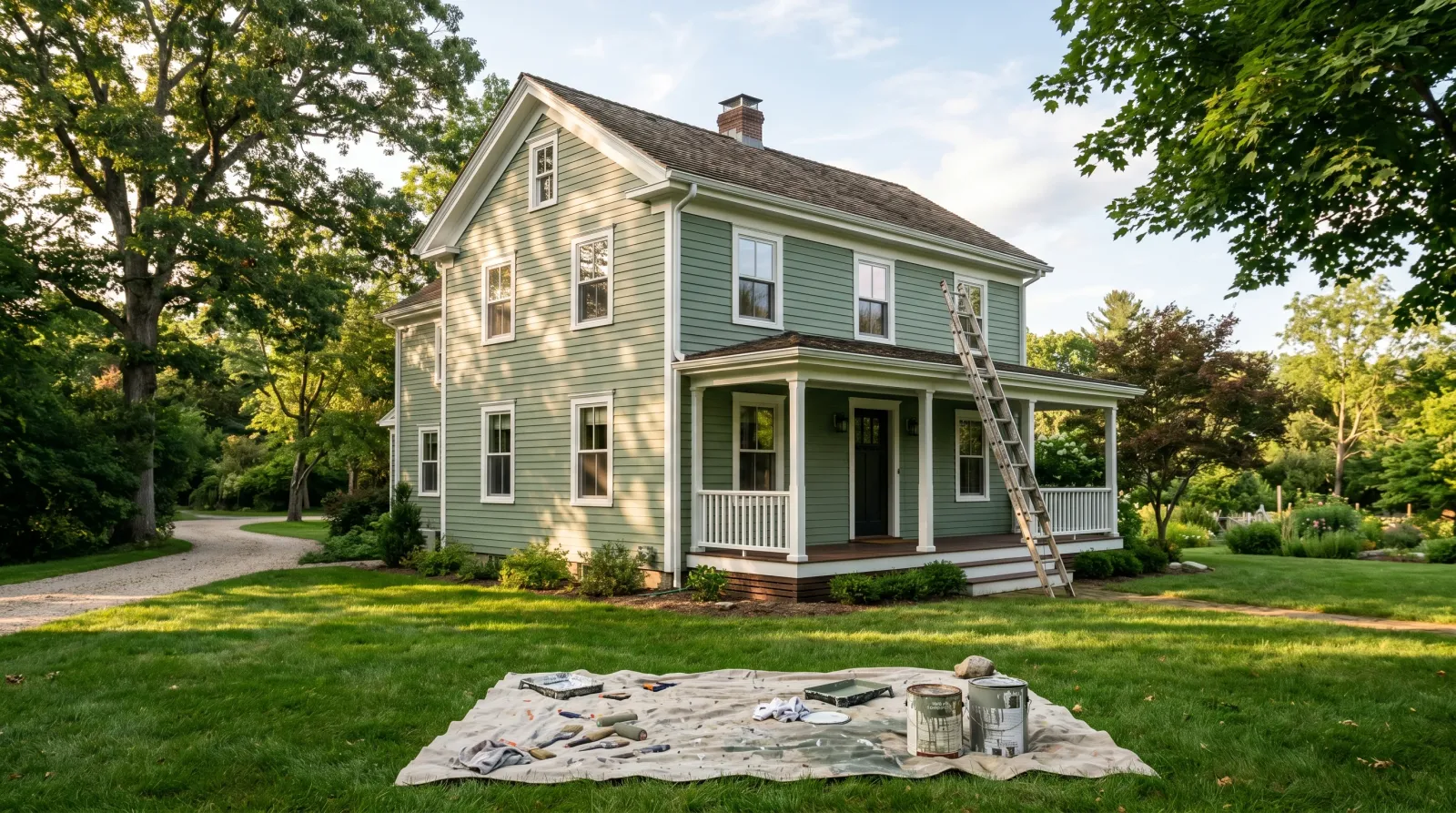
Behr Premium Plus Exterior3 sheens
Coverage250-400 sq ft / gal
Dry / RecoatTouch dry 1h
VOCUnder 50 g/L
Full cureAbout 30 days
Sheens FlatSatin EnamelSemi-Gloss Enamel
Read this first
The Fast Verdict
Buy it for a rental, a flip, or a low-exposure house you will repaint inside seven years. At $34 to $46 a gallon it is a real 100% acrylic at 40 percent volume solids, the mildewcide package keeps a shaded north wall clean, and the 35F floor hands you spring and fall days most acrylics will not. Skip it on a south-facing forever home, a salt coast, or raw cedar. And read paint-and-primer the way the data sheet does: first coat primes, second finishes, on sound coated siding only.
Best for
Rentals and flips · Sound previously painted lap siding · Shaded and low-exposure walls · Vinyl and aluminum siding · Cool shoulder-season days · Light and mid-tone colors
Skip if
Full south or west sun · Coastal salt air · Raw cedar or redwood · Deep saturated colors · You want 15-plus years between repaints · Going darker than the original color on vinyl
What it's good at
- Keeping a shaded north wall from going green and furry, on a mildewcide package tested to ASTM D3273
- Covering sound, previously painted siding in one coat when you are going back over a similar color
- Painting a cool spring Saturday or a mid-October afternoon, thanks to the 35F application floor
- Low-smell work with the windows open and soap-and-water cleanup, under 50 g/L VOC
- Price-to-result on a rental, a flip, or any house you will repaint inside a decade
- Hiding waves and dents in old wood and aluminum siding, since the flat runs a true 0-5 gloss at 60 degrees
- Surviving a soft wash at over 2,500 scrub cycles
What it's not good at
- Holding color on a south or west wall, where it chalks and fades by year four or five
- Taking a pressure wand up close; the film is softer than Marquee and burnishes or strips
- Bare cedar, chalky failing paint, and stain-blocking generally, whatever the paint-and-primer tag implies
- Deep saturated colors, which need two coats minimum and fade first
- Coastal salt air or a forever home you want to leave alone for 15 years
- Touch-ups after a season of UV, where the patch flashes against the faded field
Numbers, not adjectives
Spec Sheet
- Resin
- 100% acrylic latex; 40% ± 2 solids by volume
- Coverage
- 250-400 sq ft / gal; porous wood siding runs the low end
- Sheens
- Flat, Satin Enamel, Semi-Gloss Enamel
- Dry / Recoat
- Touch dry 1h · recoat 2h at 77F and 50% RH
- Full cure
- About 30 days; no washing for 4 weeks
- Application temp
- 35-90F air, surface, and paint; at least 5F above the dew point
- Film build
- 6.4 mils wet / 2.5 mils dry at 250 sq ft per gallon
- VOC
- Under 50 g/L
- Primer
- Self-priming on sound coated siding only; bare wood, masonry, metal, vinyl, and concrete block each want the matching Behr primer
- Surfaces
- Wood, vinyl, fiber cement, aluminum, stucco, masonry, primed exterior trim
- Tint bases
- 4050 Ultra Pure White · 4400 Medium · 4300 Deep
- Price
- $34-46 / gal at Home Depot
Application Settings That Work
- Brush
- Brushes and rolls easily in mild weather with decent open time. On lap siding, spray and back-roll each pass and keep a wet edge and it lays down without lap marks. Two coats on porous wood and on any deep color; one coat plus a touch-up only on sound, light-colored siding going back over a similar color.
- Airless
- Airless tip .015 to .021 inch with a 60-mesh filter at 1,400 to 2,400 psi. Back-roll after spraying so the film works into the texture and the lap edges instead of sitting on top of them. Aim for 6.4 mils wet, which is about 250 sq ft per gallon. Stretch it past 400 and you are under-filming the wall.
- Thinning
- Do not thin it for brush or roller work; 100-110 KU is where the viscosity should be. If you must thin for spray, Behr allows a maximum of 1/2 pint of water per gallon and no more. Past that you drop the film build, and the film build is the whole product.
- Primer
- Wash first, let it dry a full day, then scrape and feather any failing paint. Bare wood, masonry, stucco, and fiber cement get Multi-Surface Primer & Sealer No. 436, which handles masonry pH up to 13. Bare or rusted metal gets Metal Primer No. 435. Vinyl, PVC, and plastics get Bonding Primer No. 432. Concrete and cinder block get DryPlus Masonry Waterproofer No. 875. Caulk after priming, before topcoat, with a paintable exterior caulk. New masonry and stucco need 30 days of cure and a pH of 10 or lower, or 7 days plus an alkali-resistant primer.
The Weather Window That Decides the Job
More failed exterior jobs trace back to the calendar than to the can. Behr allows 35 to 90F on air, surface, and paint, at least 5F above the dew point, with no overnight drop below 35F for 48 hours after you finish. Recoat at 2 hours at 77F and 50 percent humidity, and keep rain or snow off it for the first 2 to 3 hours. Surface temperature governs, not the forecast: a south or west wall in afternoon sun can sit 20 to 30F above the air, and paint hitting a wall that hot skins over before it can flow out and bond. Chase the shade around the house. In spring and fall, stop several hours before sundown so the wall does not hit the dew point on a film that has not cured. Then leave it alone for four weeks before you wash it.
Mid-project panic
When It Goes Wrong, and How to Fix It
Color on your hand when you rub the wall at year four
Why it happens. Chalking, and it is this paint's main limit. On a south or west wall taking full afternoon sun the film gives up its binder and the color goes flat and slightly powdery. Deep saturated tones fade faster still, because they ride the 4300 deep base and carry more colorant to lose.
The fix. There is no fix once it has chalked, only a wash-and-recoat. Prevent it by matching the tier to the exposure: Behr Ultra Exterior for $6 to $10 more a gallon, or Marquee Exterior for the full upgrade on a wall that bakes. If you are staying on Premium Plus, keep the color light to mid-tone and accept a seven-to-eight-year cycle.
New paint peeling off in sheets inside two years
Why it happens. Paint-and-primer got read as skip-the-primer. Behr's own data sheet defines the claim as first coat primes, second coat finishes, and only on sound previously coated siding. Raw cedar, chalky failing paint, bare metal, vinyl, and concrete block are not on that list, and none of them will hold a topcoat on their own.
The fix. Prime by substrate: Multi-Surface No. 436 on bare wood, masonry, stucco, and fiber cement; Metal Primer No. 435 on bare or rusted metal; Bonding Primer No. 432 on vinyl, PVC, and plastics; DryPlus Waterproofer No. 875 on concrete block. Wash the chalk off first or the primer has nothing to grip either.
Vinyl siding buckling and pulling off the nails after a repaint
Why it happens. The panels were painted darker than they started. Vinyl is engineered around the heat its original color absorbs. Drop the LRV and the panels take on heat they were never designed to shed, and they wave and warp. This one costs siding, not paint.
The fix. Nothing brings warped vinyl back; you replace the panels. Going forward, stay at the same shade or lighter, and prime vinyl with Bonding Primer No. 432 plus two coats, because Behr's own spec does not treat vinyl as self-priming. If you want a dark house on vinyl, the honest answer is new siding.
Lap marks and poor adhesion on the sunny elevation
Why it happens. The wall was hotter than the air. Your phone says 88F, inside the window, but a west wall in afternoon sun can be 115F or more. Paint that hot skins over before it levels or bonds, so you get lap marks that look fine in June and a coat that lets go in year three.
The fix. Never paint a wall the sun is standing on. Work the east side in the morning, the north wall through midday, and the west side after it drops into shadow. If the whole house is in sun, stop and come back tomorrow.
A visible stripe partway across a sunlit wall
Why it happens. Batch-to-batch tint drift. The mixing machines are accurate but not identical, and a half-shade difference between gallon four and gallon five reads as a band once the sun crosses the wall. It is one of the most common complaints on this paint and one of the most avoidable.
The fix. Box the gallons before you start. Pour every tinted gallon of the same color into a five-gallon bucket, stir it, and pour it back. Five minutes for the whole house. On a large job, buy the 5-gallon bucket instead, which is one tint batch and $4 to $6 a gallon cheaper than singles.
Side by side
Premium Plus vs Ultra vs Marquee Exterior
Behr stacks four exterior lines under similar names and people grab the wrong can constantly. Per-gallon prices make the upgrade feel small; whole-house numbers are the ones that decide it. A typical 2,400 sq ft house wants about 12 gallons for two coats.
| Premium Plus Exterior | Ultra Exterior | Marquee Exterior | |
|---|---|---|---|
| Price per gallon | $34-46 | $39-50 | $52-64 |
| 12 gallons for a whole house | About $480 | About $600, or $120 more | About $768, or $288 more |
| Stain and scuff blocking | None | Yes, and it is the main reason to step up | Yes |
| Fade and chalk in hard sun | Chalks by year four or five on south and west walls | Splits the difference for less money | Chalks slower and holds deep colors longest |
| Bare tannin wood | Makes no self-priming claim; prime cedar and redwood | Data sheet allows self-priming tannin woods with two coats | Not the reason to buy it |
| Film build | 40% volume solids in the flat | Higher solids, thicker dry film | Thickest film and the heaviest UV package |
| Where it wins | Rentals, flips, shaded lots, repaints inside a decade | Raw or tannin-prone wood and walls that get brushed by bikes and hoses | High-sun and coastal forever homes |
12 gallons for a whole house
Premium Plus ExteriorAbout $480
Ultra ExteriorAbout $600, or $120 more
Marquee ExteriorAbout $768, or $288 more
Stain and scuff blocking
Premium Plus ExteriorNone
Ultra ExteriorYes, and it is the main reason to step up
Fade and chalk in hard sun
Premium Plus ExteriorChalks by year four or five on south and west walls
Ultra ExteriorSplits the difference for less money
Marquee ExteriorChalks slower and holds deep colors longest
Bare tannin wood
Premium Plus ExteriorMakes no self-priming claim; prime cedar and redwood
Ultra ExteriorData sheet allows self-priming tannin woods with two coats
Marquee ExteriorNot the reason to buy it
Film build
Premium Plus Exterior40% volume solids in the flat
Ultra ExteriorHigher solids, thicker dry film
Marquee ExteriorThickest film and the heaviest UV package
Where it wins
Premium Plus ExteriorRentals, flips, shaded lots, repaints inside a decade
Ultra ExteriorRaw or tannin-prone wood and walls that get brushed by bikes and hoses
Marquee ExteriorHigh-sun and coastal forever homes
The whole spread between the cheap gallon and the premium one across a full house is under three hundred dollars, and that cuts both ways. If you are hiring the labor out, upgrading the paint is the cheapest lever you have, so pay for Marquee on a wall that bakes. If you are doing it yourself, the money you save staying on Premium Plus is about what a pressure-washer rental, a few gallons of primer, and a box of prep supplies cost. Spend it there. A well-washed, scraped, primed wall in Premium Plus beats a lazy wall in Marquee every time, and it is not close. The tier is the second decision. Prep is the first one.
If not this one
Honest Alternatives
BU
Behr Ultra Exterior$39-50 / gal
The rung directly above and the one most Premium Plus shoppers should price out, since it is on the same shelf for six to ten dollars more. Adds stain and scuff blocking, more solids for a thicker film, and better fade hold, and its data sheet lets it self-prime tannin woods like redwood with two coats. If you searched for this paint as Premium Plus Ultra, this is the can you actually want.
Full review →GP
Glidden Premium Exterior$25-32 / gal
The true budget gallon, a few dollars under Behr. Acceptable acrylic for a shed, a fence-line outbuilding, or a low-stakes repaint. Thinner film, weaker mildew package, fades quicker in sun. Right when the structure barely matters and the budget is the whole decision.
Full review →BM
Behr Marquee Exterior$52-64 / gal
Same brand, same counter, about $288 more across a whole house. Chalks slower, holds deep colors longer, and the thicker film and heavier UV package add years on a wall that gets cooked. This is the Behr exterior for a forever home in hard sun.
Full review →SW
Sherwin-Williams SuperPaint Exterior$55-70 / gal
The contractor default. Best film toughness and color hold of this group, and a 30-day cure that handles cooler, damper shoulder seasons better. Costs more and means a trip to a Sherwin store. The pick for a coastal or high-sun house you want to leave alone for a decade-plus.
Full review →Questions people actually ask
Premium Plus Exterior Questions, Answered
Is Behr Premium Plus Exterior any good?
For the money, yes, with limits. At roughly $34 to $46 a gallon it is a clean, low-VOC 100% acrylic that holds color and shrugs off mildew on sound, prepped siding. It is a fair pick for a rental, a flip, or a house you will repaint in seven or eight years. For a forever home in hard sun or a freeze-thaw climate, step up to Behr Ultra, Marquee Exterior, or a Sherwin product.
Does Behr Premium Plus Exterior need a primer?
On clean, sound, previously painted siding, no. Behr's data sheet defines the paint-and-primer claim plainly: the first coat is the primer and the second coat is the finish. You still need a separate primer in four cases. Bare wood and masonry get Multi-Surface No. 436, bare metal gets Metal Primer No. 435, vinyl and PVC get Bonding Primer No. 432, and concrete block gets DryPlus Waterproofer No. 875. This paint is not a stain blocker and it will not bond to heavy chalk.
Is Behr Premium Plus latex or oil-based?
Latex, specifically a water-based 100% acrylic latex. Latex just means water-based, and 100% acrylic is the better-grade resin next to cheaper vinyl-acrylic blends, which is why it flexes with siding and resists fading. It cleans up with soap and water and the VOC is under 50 g/L. Behr does not offer an oil-based exterior in this line.
What is the difference between Behr Premium Plus and Behr Ultra Exterior?
Behr Ultra, sold as Premium Plus Ultra before the rename, is one rung up. It adds stain and scuff blocking, carries higher volume solids for a thicker film, and holds color longer in sun, for roughly $6 to $10 more a gallon. On a 12-gallon whole-house job that is about $120 extra. Premium Plus is the better dollar on sound, light-colored siding you will repaint within a decade. Ultra earns the gap on tannin-prone wood and higher-wear walls.
What temperature can you apply Behr Premium Plus Exterior?
Behr's data sheet allows 35 to 90F for air, surface, and paint, as long as you stay at least 5F above the dew point and temperatures will not drop below 35F within 48 hours. That 35F floor is lower than many acrylics, which stop at 50F. Do not paint in direct sun, allow 2 to 3 hours before any rain, and remember a south or west wall can be 20 to 30F hotter than the air. Recoat after 2 hours and do not wash the film for 4 weeks.
Can I use Behr Premium Plus on vinyl siding?
Yes, the flat is marketed for vinyl, but with two rules. Behr's own spec sheet calls for a bonding primer, No. 432 or Multi-Surface No. 436, plus two coats on vinyl and PVC, so do not treat it as self-priming there. And never go darker than the siding's original color. A darker shade absorbs more heat and can warp the panels. Same shade or lighter is safe.
How long does Behr Premium Plus Exterior last?
On well-prepped siding in a mild climate, plan on seven to ten years before it needs a recoat. In hard south or west sun, or a wet freeze-thaw zone, knock a few years off. Behr lists a lifetime limited warranty, but read the fine print: it covers product defects on prepped surfaces, not labor and not prep failures.
Behr Premium Plus Exterior or Marquee Exterior?
Marquee costs roughly $20 to $25 more a gallon and earns it on a high-sun or coastal house. It chalks slower, holds deep colors longer, and its tougher film handles hairline movement better. Premium Plus is the smarter dollar on a low-exposure house, a rental, or any siding you will repaint inside a decade. For a forever home in full sun, pay up for Marquee, or split the difference with Behr Ultra.
Why does my wall have a stripe where one gallon ended and the next began?
Tint machines are accurate but not identical, so gallon five can land a half shade off gallon four, and sunlight makes that read as a band. Box your gallons before you start: pour them all into a five-gallon bucket, stir, and pour back. On a whole house, buy the 5-gallon bucket instead. It is one batch and the per-gallon price is $4 to $6 lower.
Can you spray Behr Premium Plus Exterior?
Yes. Run an airless tip of .015 to .021 inch with a 60-mesh filter at 1,400 to 2,400 psi, and back-roll each pass on lap siding so the paint works into the texture and the lap edges. Do not thin it for brush or roller work. If the gun is straining, half a pint of water per gallon is the published maximum, and past that you are cutting the film build you paid for.
Keep exploring
Behr brand hub — all lines reviewedBehr Ultra Exterior reviewBest exterior paint round-upHow to fix chalking exterior paint
We may earn a commission when you buy through the retailer link above. It never changes the score or the verdict.
Ask a Question