Product review · Behr · Updated August 7, 2026
Premium Plus Ceiling PaintBehr paint review
7.8/10The best value in a dedicated ceiling paint Home Depot stocks, and it is genuinely dead flat where it counts.
About $23 a gallon for a dead-flat white that buries seams, fastener pops, and roller laps. The limits are spatter, zero scrubbability, and the one job it flatly cannot do: covering a water ring.

Maya Patel · Reviews Editor & Product Tester · Updated August 7, 2026
Maya spent five years running comparative product testing at a consumer testing nonprofit before joining CompositePaint. She has rolled every rung of the Behr ladder and priced the same gallons against the premium ceiling whites at full retail. About the testing process →
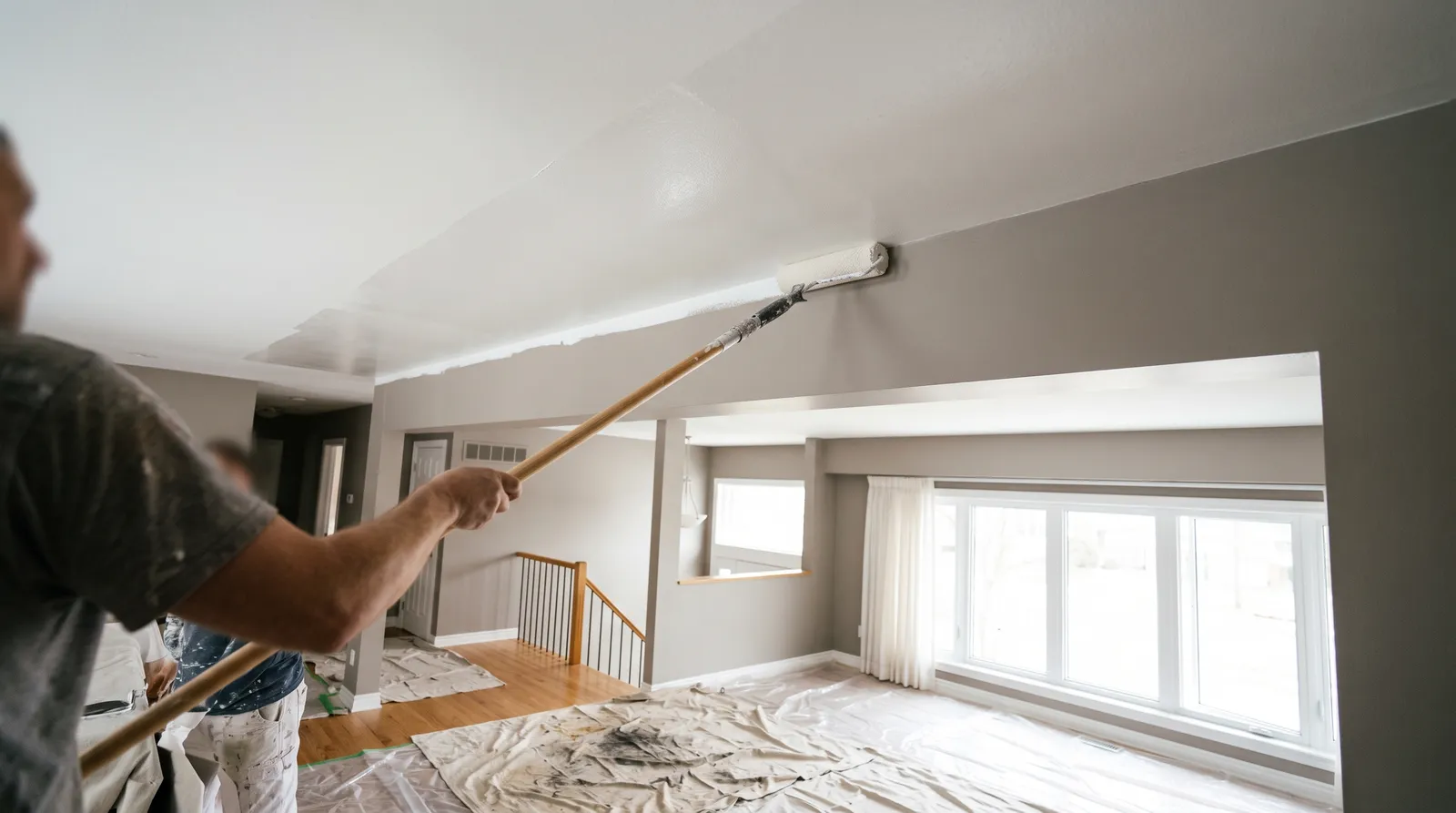
Behr Premium Plus Ceiling Paint
Coverage250-400 sq ft / gal
Dry / RecoatTouch dry 1h · recoat 2h
VOCZero VOC
Read this first
The Fast Verdict
Buy it if you want a ceiling that is white, flat, and cheap. At about $23 a gallon it is a third the cost of the premium ceiling whites, it dries non-reflective so seams and roller laps disappear, and white-over-white on a sound ceiling covers in one pass. Zero VOC, so you can sleep in the room that night. Skip it if you want the lowest spatter overhead, a saturated color, or you are covering a water stain: it tints light only and it is not a stain blocker.
Best for
Bedrooms and hallways · Closets · Rental turnovers · Whole-house ceiling repaints · Popcorn and acoustic texture · Budget overhead work
Skip if
A ceiling you will study every day · Dark or saturated ceiling colors · Water rings and smoke halos · You want near-zero spatter · Low kitchen and bath ceilings that need wiping
What it's good at
- Price, at roughly a third of what the premium ceiling whites cost
- Genuine dead-flat glare control that hides seams, fastener pops, and roller laps under raking light
- Throwing fewer droplets overhead than a wall flat
- One-coat hide white-over-white on a sound, previously painted ceiling
- Keeping the original acoustical properties of popcorn and acoustic texture instead of bridging it
- Zero VOC and GREENGUARD Gold, so the room airs out fast enough to sleep in that night
What it's not good at
- Any color past a pastel; it tints light only and is built to stay pale
- Matching a premium ceiling paint on spatter over a big overhead job
- Taking a wipe at all, since dead flat means zero scrubbability
- Spot touch-ups, which flash against the surrounding flat
- Covering a water ring or a smoke halo without a stain-sealing primer first
- Forgiving a break in the middle of a large ceiling
Numbers, not adjectives
Spec Sheet
- Coverage
- 250-400 sq ft / gal, depending on texture and porosity
- Finish
- Flat, non-reflective, spatter-resistant
- Dry / Recoat
- Touch dry 1h · recoat 2h
- Hide
- One-coat-hide claim; light tints and stained or patched ceilings want two
- VOC
- Zero VOC; GREENGUARD Gold certified, low odor
- Tint range
- White and Ultra Pure White plus light tints only
- Primer
- Paint-and-primer on a clean, previously painted ceiling; not a stain blocker
- Surfaces
- Ceilings only: drywall, plaster, textured, popcorn, acoustic
- Sizes
- Quart, gallon, 2-gallon, 5-gallon
- Price
- About $23 / gal at Home Depot
Dry Times in the Real World
Touch dry in an hour, recoatable at two. That speed is the reason a ceiling is a one-afternoon job, and it is also the thing that trips people up. The same fast dry shortens your wet edge, so a big ceiling has to be chased corner to corner without a break. Cut the perimeter in first, then roll the whole field in one continuous run. Stop in the middle for a phone call and the dry edge shows up as a lap line under the next sunny morning, and on a flat film the only fix is rolling the whole ceiling again. Plan the room so you never have to set the pole down mid-field.
Mid-project panic
When It Goes Wrong, and How to Fix It
A lap line running across the middle of the ceiling
Why it happens. The wet edge dried while you were away from it. Touch dry is one hour, which is fast, and a ceiling gives you nowhere to hide a seam because every light source in the room rakes across it.
The fix. Cut in the full perimeter first, then roll the field wall to wall without pausing. Work in overlapping passes and keep the roller loaded. On a large room, get a second person on the pole rather than taking a break. If a lap line has already dried in, recoat the whole ceiling, not the strip.
A brown ring or a smoke halo ghosting back through
Why it happens. This is not a stain blocker. A flat ceiling white sits over a water or nicotine stain rather than sealing it, and the stain keeps bleeding up through the film. Two coats does not change the chemistry.
The fix. Spot-prime the stain with a sealer first, then topcoat. Zinsser Covers Up is the stain-sealing ceiling flat built for exactly this, and it works either as the primer under the Behr or as the whole fix on a small patch.
A scuff you cannot wipe off, and a repaired patch that flashes
Why it happens. Dead flat is the entire point of this paint and it means the film has no scrubbability at all. Rub a mark on a low kitchen or bath ceiling and you either fail to remove it or you polish the spot. Then the repainted patch dries at a slightly different film thickness and shows.
The fix. Do not spot-fix a flat ceiling. Recoat to the natural break, which on a ceiling means the whole plane. If the ceiling is low enough to get touched regularly, this is the wrong sheen and the wrong product; use a washable wall flat instead and accept a little more glare.
Droplets on the floor, your glasses, and your hair
Why it happens. Spatter-resistant is a real claim, but it is a step up from a wall flat, not the near-drip-free experience of a premium ceiling white. On a large roller job directly overhead you will still throw droplets a Benjamin Moore ceiling paint would have caught.
The fix. Drop-cloth the whole floor rather than the middle of it, wear safety glasses, and do not overload the roller. If the ceiling is big and you care about the mess more than the money, the premium ceiling white is the upgrade that actually buys you something.
Side by side
Behr vs the Premium and Builder Ceiling Whites
Three ceiling paints cover the whole price range at Home Depot and one paint store, and the decision is almost entirely about how closely you will look at the ceiling.
| Behr Premium Plus Ceiling | Benjamin Moore Waterborne Ceiling | Glidden Ceiling | |
|---|---|---|---|
| Price per gallon | About $23 | About $50-61 | About $18 |
| Flatness | Genuinely dead flat, a hair short of premium | The flattest of the three | Flat, but the film is thinner |
| Spatter overhead | Spatter-resistant; better than a wall flat | Least spatter of the three on a big roller job | No spatter-resistance tuning; the messiest |
| Hide | One coat white-over-white; two over patches and tints | Strong | Thinner hide |
| Special trick | Keeps acoustical texture on popcorn ceilings | Color-indicator base rolls on pink and dries white so you stop missing strips | None; it is the price |
| Best for | Bedrooms, halls, closets, rental turnovers, whole-house repaints | A living-room or bedroom ceiling you look at daily | Garages, closets, and flips where nobody studies the finish |
Price per gallon
Behr Premium Plus CeilingAbout $23
Benjamin Moore Waterborne CeilingAbout $50-61
Glidden CeilingAbout $18
Flatness
Behr Premium Plus CeilingGenuinely dead flat, a hair short of premium
Benjamin Moore Waterborne CeilingThe flattest of the three
Glidden CeilingFlat, but the film is thinner
Spatter overhead
Behr Premium Plus CeilingSpatter-resistant; better than a wall flat
Benjamin Moore Waterborne CeilingLeast spatter of the three on a big roller job
Glidden CeilingNo spatter-resistance tuning; the messiest
Hide
Behr Premium Plus CeilingOne coat white-over-white; two over patches and tints
Glidden CeilingThinner hide
Special trick
Behr Premium Plus CeilingKeeps acoustical texture on popcorn ceilings
Benjamin Moore Waterborne CeilingColor-indicator base rolls on pink and dries white so you stop missing strips
Glidden CeilingNone; it is the price
Best for
Behr Premium Plus CeilingBedrooms, halls, closets, rental turnovers, whole-house repaints
Benjamin Moore Waterborne CeilingA living-room or bedroom ceiling you look at daily
Glidden CeilingGarages, closets, and flips where nobody studies the finish
On a bedroom, hallway, closet, or a whole-house ceiling repaint, the Behr is the right buy and the price gap is not close. Pay triple for the Benjamin Moore only where the ceiling is part of the room you look at every day, or where the color-indicator base saves you from missing strips on a white-on-white recoat. Drop to the Glidden only when every dollar counts and the finish will never be studied. And if the real problem is a stain rather than a color, none of these three is the answer; a stain-sealing ceiling flat is.
If not this one
Honest Alternatives
BM
Benjamin Moore Waterborne Ceiling Paint$50-61 / gal
The premium step-up. Goes flatter and spatters less than the Behr on a big overhead job, and it offers a color-indicator base that rolls on pink and dries white so you stop missing strips on a white-on-white recoat. Roughly triple the price, so it is worth it on a living-room or bedroom ceiling you look at daily and overkill in a closet.
Full review →ZC
Zinsser Covers Up Stain-Sealing Ceiling Paint$25-30
This is what Premium Plus Ceiling is not: a stain blocker. If the real problem is a water ring or a smoke halo, a flat ceiling white ghosts over it while Zinsser's stain-sealing flat is built to bury it, often in one spot-coat. Use it as the primer under the Behr, or as the whole fix on a small stained patch.
GC
Glidden Ceiling PaintAbout $18 / gal
The builder-grade step-down, also at Home Depot and a few dollars under the Behr. Thinner hide and no spatter-resistance tuning, so it rains more overhead. Right for a garage, a closet, or a rental flip where good enough is the goal, and wrong anywhere the finish gets looked at.
Questions people actually ask
Premium Plus Ceiling Paint Questions, Answered
Why use ceiling paint instead of leftover wall paint?
Most wall paint carries some sheen, and even a flat wall paint reflects more light than a dedicated ceiling flat. Overhead, that extra glance of light lights up every seam, fastener pop, and roller lap when the sun crosses the room. Behr's ceiling formula dries dead flat to bury those flaws and spatters less when you roll above your head. Leftover wall paint saves a trip and gives you a patchy ceiling.
Does Behr ceiling paint really cover in one coat?
Behr advertises one-coat hide, and white-over-white on a primed or previously painted ceiling usually does cover in one pass. A stained, patched, or repaired ceiling, or any of the light tints over a darker color, will want a second coat for even color. Treat one coat as the best case, not the plan, and budget paint for two on anything that is not already clean white.
Can you tint Behr Premium Plus ceiling paint a color?
Only to light colors. It comes in White and Ultra Pure White, and the base accepts pastel and tinted-white formulas, but it will not make a deep or saturated ceiling. If you want a moody dark ceiling, you need a flat wall paint in a deep base instead. This product is built to stay pale and recede.
Is Behr Premium Plus Ceiling Paint worth it?
For a cheap, dead-flat white ceiling, yes. At about $23 a gallon it is roughly a third the cost of the premium ceiling whites, it buries seams, patches, and roller laps, and white-over-white usually covers in one coat. It is not worth it if you want the lowest possible spatter overhead, a saturated ceiling color, or you are covering a water stain, because it tints to light colors only and it is not a stain blocker.
Will it cover a water stain?
No. It is not a stain blocker, and a brown ring or a smoke halo ghosts back through even at two coats. Spot-prime the stain with a sealer first. Zinsser Covers Up is the stain-sealing ceiling flat built for it, and you can either use it as the primer under the Behr or as the entire fix on a small patch.
How soon can I put the second coat on?
Two hours. Touch dry is about an hour, so a ceiling is realistically an afternoon. The catch is that the same speed shortens your wet edge, so cut in the perimeter first and then roll the whole field without stopping, or a lap line dries in and you end up recoating the entire ceiling.
Can I use it on a popcorn or acoustic ceiling?
Yes, and it is one of the better reasons to buy a dedicated ceiling flat. The non-reflective film maintains the original acoustical properties of textured, popcorn, and acoustic ceilings rather than bridging and flattening the texture. Coverage runs at the low end of the 250 to 400 sq ft range on heavy texture, so buy accordingly.
Can I scrub a mark off a ceiling painted with this?
No, and that is the trade for the flatness. Dead flat means no scrubbability, so a scuff or splatter on a low kitchen or bathroom ceiling will not clean off. Repainting the patch risks flashing, so you end up rolling the whole plane. If the ceiling is low enough to get touched, pick a washable wall flat instead.
Keep exploring
Behr brand hub — all lines reviewedBehr Premium Plus (wall paint) reviewBest ceiling paint — full round-up
We may earn a commission when you buy through the retailer link above. It never changes the score or the verdict.
Ask a Question