Product review · Benjamin Moore · Updated August 7, 2026
Waterborne Ceiling PaintBenjamin Moore paint review
8.6/10The category benchmark for glare control — and the wrong can for a closet, a dark ceiling, or a water stain.
Dead flat, low spatter, and a version that rolls on pink and dries white. It costs roughly triple a builder-grade ceiling white, and on a ceiling you look at every day it is worth it.

Maya Patel · Reviews Editor & Product Tester · Updated August 7, 2026
Maya spent five years running comparative product testing at a consumer testing nonprofit before joining CompositePaint. She judges a ceiling paint by how much of it ends up on her glasses and how the surface reads under raking light an hour later. About the testing process →
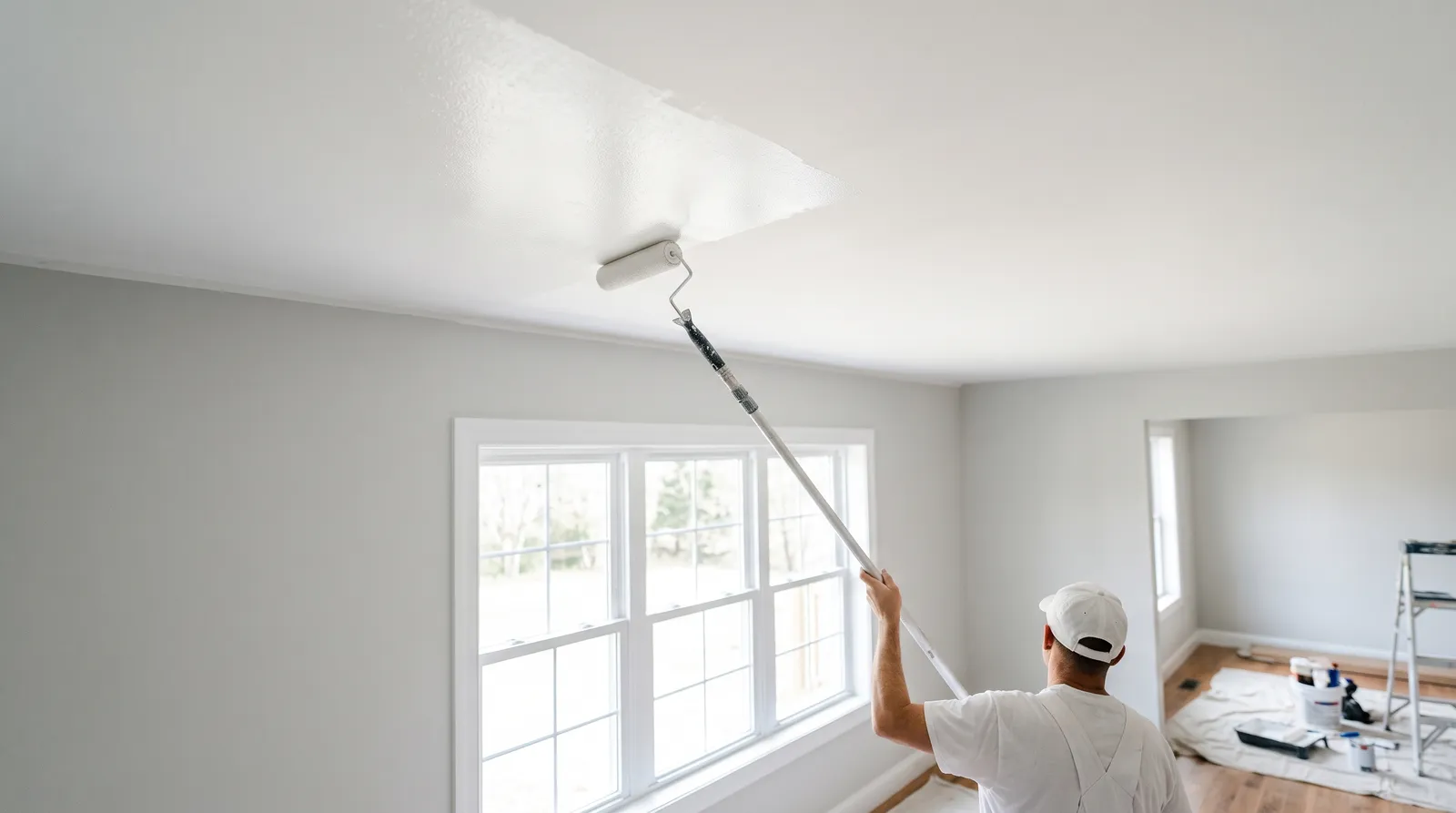
Benjamin Moore Waterborne Ceiling Paint
Coverage400–450 sq ft / gal
Recoat1–2 hr
VOCUnder 50 g/L
Read this first
The Fast Verdict
Yes for a ceiling you look at every day, no for a closet. At about $50 to $61 a gallon it costs roughly triple a builder-grade white, and what that buys is dead-flat glare control, noticeably less spatter overhead, and a color-indicator version that goes on pink and dries white so you stop missing strips. It will not give you a dark ceiling, it will not cover a water stain, and a scuff on it is a repaint rather than a wipe.
Best for
Living room, bedroom, and hallway ceilings · White-on-white recoats · Ceilings under daylight or a single fixture · Hiding drywall seams and fastener pops · Anyone tired of spatter overhead
Skip if
You want a dark or saturated ceiling · The ceiling has a water stain or smoke halo · A closet, garage, or rental turnover · You need a wipeable ceiling in a kitchen · You cannot roll the whole field in one go
What it's good at
- Dead-flat glare control — under a single fixture or raking window light the surface reads as one plane
- Hiding drywall seams, fastener pops, and roller texture
- Low spatter overhead, which your floor, your glasses, and your patience all notice
- The color indicator, which finally lets you see your wet edge on a white-on-white recoat
- Open time generous enough to feather adjacent passes into a uniform matte
- Same-day two-coat work — touch dry in an hour, recoat in one to two
- Strong hide on an even, previously painted ceiling
What it's not good at
- Anything darker than a pastel; the 1X base has no depth behind it
- Value against builder-grade white, at roughly triple the price
- Scrubbability — ultra-flat means a scuff on a low kitchen ceiling is a repaint
- Forgiving a break mid-ceiling; the fast dry leaves a lap mark where you stopped
- Blocking stains — water rings, smoke, and tannin ghost through even at two coats
- Touch-ups, which go blotchy on the flat absorbent film
Same shelf, different cans
Standard White or the Color Indicator?
Same paint, two ways to buy it, and the difference only matters while you are on the ladder. Decide before the counter tints it.
Waterborne Ceiling Paint, Ultra Flat
BaseWhite, or a 1X light base across Benjamin Moore's 3,500 colors
SheensUltra-flat only
Recoat1 to 2 hr
Buy it if
You are painting a ceiling a different color from what is up there now, or a tinted white where you can see your wet edge without help.
Avoid if
You want a saturated or dark ceiling. The 1X base tops out at pastels, and a moody dark ceiling needs a flat wall paint in a deep base instead.
Color-indicator version
BaseRolls on a light pink, dries flat white as the tint flashes off
SheensUltra-flat only
Recoat1 to 2 hr
Buy it if
You are recoating white on white. Wet paint and dry paint look identical from a stepladder, and the pink gives you a live map of where you have been. It prevents the most common ceiling do-over.
Avoid if
You are tinting the ceiling to a pastel. The indicator trick only helps on a white finish.
Numbers, not adjectives
Spec Sheet
- Coverage
- 400–450 sq ft / gal
- Finish
- Ultra-flat (dead flat)
- Touch dry
- About 1 hr
- Recoat
- 1–2 hr
- VOC
- Under 50 g/L; compliant in all regulated areas
- Surfaces
- Drywall, plaster, ceiling tile, masonry, wood, composite wood, ceramic
- Tint range
- White plus light tints — 1X base across 3,500 Benjamin Moore colors
- Stain blocking
- None. Spot-prime water, smoke, and tannin with a shellac or oil sealer first
- Scrubbability
- None — ultra-flat means a scuff is a repaint, not a wipe
- Sizes
- Quart, gallon
- Price
- About $50–61 / gal
Application Settings That Work
- Brush
- Cut in the perimeter first, then roll the field corner to corner in one uninterrupted pass. The generous open time lets you feather adjacent passes together for a uniform matte — provided you keep moving. Plan on two coats for even color, especially over a patched or previously colored ceiling.
- Primer
- Not a stain blocker. Spot-prime water rings, smoke halos, and tannin bleed with a shellac or oil sealer such as Zinsser BIN before the finish coats, or they ghost through even at two coats.
Dry Times in the Real World
Touch dry in about an hour, recoat in one to two, which means a two-coat ceiling is a one-afternoon job rather than a two-day one. That speed is the best thing about it and the thing that punishes you. The same fast set that lets you recoat before dinner shortens your wet edge on a big room, and pros working large ceilings have flagged it drying too fast to chase laps. Plan the whole field as one continuous pass: cut in first, then roll corner to corner without a coffee break. Stop halfway across a living room ceiling and the dry edge shows. And do not save touch-ups for later — the flat, absorbent film makes spot patching blotchy, so a missed patch means recoating the plane, not dabbing it.
Mid-project panic
When It Goes Wrong, and How to Fix It
A visible lap line across the middle of the ceiling
Why it happens. The one-hour dry that enables same-day recoats also closes your wet edge fast. Break in the middle of a large ceiling — a phone call, a coffee, moving the ladder the long way around — and the edge you left has already set.
The fix. Cut in the perimeter, then roll the field wall to wall in one continuous run. Load the roller properly rather than stretching the last of the paint, and set the ladder or pole up so you never have to stop and reposition mid-run.
A brown water ring ghosting through two coats
Why it happens. This is not a stain blocker. Water stains, smoke, and tannin bleed keep coming through no matter how many flat coats go over them.
The fix. Spot-prime the stain with a shellac or oil sealer such as Zinsser BIN, let it dry, then topcoat with the ceiling paint. For a badly stained ceiling, a stain-sealing ceiling white does the burying and this can does the finish.
A touched-up patch reading blotchy
Why it happens. The film is flat and absorbent and sets quickly, so a dabbed repair dries at a different texture and absorbency than the surrounding paint. Touch-up and flashing resistance is the weakest attribute on this paint.
The fix. Do not spot-patch a ceiling. Recoat the whole plane wall to wall. Keep the leftover gallon labeled, and when you do need a fix, plan an afternoon rather than a five-minute dab.
You wanted a moody dark ceiling and the color came out pale
Why it happens. It tints only into a 1X light base. Pastels and tinted whites are the ceiling of the range — there is no deep base behind this product.
The fix. Use a flat wall paint in a deep base for a dark ceiling. You give up the low-spatter tuning and the color indicator, so protect the floor properly and keep your wet edge moving.
Side by side
Waterborne Ceiling Paint vs Muresco vs Behr Premium Plus Ceiling
Three ceiling whites at three prices. What separates them is how flat they dry, how much lands on you, and whether the ceiling is worth the difference.
| BM Waterborne Ceiling | BM Muresco | Behr Premium Plus Ceiling | |
|---|---|---|---|
| Flatness / glare control | The category benchmark — as close to zero sheen as a rollable paint gets | A classic flat with a heavier, more textured film | Flat, but not quite as dead-flat |
| Spatter overhead | Tuned for low spatter and you feel it after an hour | A traditional formula without the low-spatter tuning | Falls short of the Benjamin Moore on a big roller job |
| Color indicator | Yes — pink on, white dry | No | Yes, a tinted-goes-on, dries-white version |
| Hiding a rough plaster ceiling | Strong hide; two coats for even color | The heavier film is why some painters prefer it on rough plaster | Hides reasonably for the money |
| Where you buy it | Benjamin Moore dealers | Benjamin Moore dealers | Every Home Depot |
| Street price per gallon | About $50–61 | About $37 | About $20–25 |
Flatness / glare control
BM Waterborne CeilingThe category benchmark — as close to zero sheen as a rollable paint gets
BM MurescoA classic flat with a heavier, more textured film
Behr Premium Plus CeilingFlat, but not quite as dead-flat
Spatter overhead
BM Waterborne CeilingTuned for low spatter and you feel it after an hour
BM MurescoA traditional formula without the low-spatter tuning
Behr Premium Plus CeilingFalls short of the Benjamin Moore on a big roller job
Color indicator
BM Waterborne CeilingYes — pink on, white dry
BM MurescoNo
Behr Premium Plus CeilingYes, a tinted-goes-on, dries-white version
Hiding a rough plaster ceiling
BM Waterborne CeilingStrong hide; two coats for even color
BM MurescoThe heavier film is why some painters prefer it on rough plaster
Behr Premium Plus CeilingHides reasonably for the money
Where you buy it
BM Waterborne CeilingBenjamin Moore dealers
BM MurescoBenjamin Moore dealers
Behr Premium Plus CeilingEvery Home Depot
Street price per gallon
BM Waterborne CeilingAbout $50–61
BM MurescoAbout $37
Behr Premium Plus CeilingAbout $20–25
For a ceiling in a room you sit in every day, the Benjamin Moore is worth the money — the flatness and the low spatter are both real, and the color indicator saves a do-over on a white-on-white recoat. Muresco is the pick when you want a Benjamin Moore ceiling finish on a tighter budget or a heavier film for rough plaster, and you can live without the modern application niceties. For closets, garages, and rental turnovers, the Behr is honestly enough and costs a third as much.
If not this one
Honest Alternatives
BP
Behr Premium Plus Ceiling PaintAbout $20–25 / gal
The value pick and the easiest to grab, at every Home Depot, and it also offers a tinted-goes-on, dries-white version. It hides reasonably for a third of the price. It does not go quite as dead-flat and spatter control falls short on a big roller job. Right for closets, garages, and rentals.
Full review →ZC
Zinsser Covers Up Stain-Sealing Ceiling PaintAbout $25–30
This is what the Benjamin Moore is not — a stain blocker. If your problem is a brown water ring or a smoke halo, a flat ceiling white ghosts over it and this one is built to bury it, often in one spot-coat. Use it as the primer underneath, or as the whole fix on a small stained patch.
BM
Benjamin Moore Muresco Ceiling PaintAbout $37 / gal
Benjamin Moore's traditional, lower-cost ceiling paint. It dries to a classic flat and lays down a slightly heavier, more textured film some painters prefer on rougher plaster ceilings. It skips the color-indicator trick and the low-spatter tuning.
Questions people actually ask
Waterborne Ceiling Paint Questions, Answered
Is Benjamin Moore Waterborne Ceiling Paint worth it?
For a ceiling you look at every day, yes. It dries dead flat, so a single fixture or a sunlit afternoon does not light up every seam and roller lap, it spatters far less than a commodity flat when you are rolling overhead, and the color-indicator version goes on pink and dries white so you stop missing strips. At about $50 to $61 a gallon it costs roughly triple a builder-grade white, so it is not worth it for a closet, a garage, or a rental.
Why use ceiling paint instead of leftover wall paint?
Wall paint usually carries some sheen, and even eggshell throws glare across a ceiling under daylight or a single fixture — every roller lap and drywall seam lights up. Ceiling paint is formulated dead flat to bury those flaws, and it spatters far less overhead. Leftover wall paint saves a trip to the store and costs you a ceiling that looks patchy at the first sunny afternoon.
Does the pink version really dry pure white?
Yes. Benjamin Moore offers a color-indicator version that rolls on a light pink so you can see exactly where you have been, then dries to flat white as the tint flashes off. It works as advertised. It is most useful on a white-on-white recoat where wet and dry areas otherwise look identical from a stepladder and you walk away certain you covered a strip you actually skipped.
Will it cover water stains and old flashing in one coat?
It hides flashing and patched drywall well once it is down, but it is not a stain blocker. A water stain or nicotine bleed ghosts through even at two coats. Spot-prime stains with a shellac or oil sealer such as Zinsser BIN first, then topcoat with the ceiling paint. Plan on two coats for even color regardless.
Can you tint it to a dark ceiling color?
No. It tints only into a 1X light base across Benjamin Moore's 3,500 colors, so pastels and tinted whites are the top of the range. A moody dark ceiling — a real design trend — needs a flat wall paint in a deep base instead, and you give up the low-spatter tuning and the color indicator when you switch.
How many coats does a ceiling need?
Two for even color, especially over a patched or previously colored ceiling. Hide is strong but not magic. The upside is the schedule: touch dry in about an hour and recoat in one to two, so a two-coat ceiling is a one-afternoon job rather than a two-day one.
Why did my ceiling end up with a line across it?
You stopped. The fast dry that enables same-day recoats also shortens your wet edge, and a break in the middle of a large ceiling leaves a dry edge that shows. Cut in the perimeter first, then roll the field corner to corner without a coffee break, and keep the roller loaded rather than stretching the last of the paint.
Can I wipe a mark off this ceiling?
Not cleanly. Ultra-flat is the whole point of the product and it means zero scrubbability, so a scuff or a splatter mark on a low kitchen ceiling is a repaint rather than a wipe. If the ceiling sits somewhere it gets touched or splashed, plan on recoating the plane when it happens.
Waterborne Ceiling Paint or Muresco?
Waterborne if you want the flattest finish, the low-spatter tuning, and the color indicator on a ceiling you look at daily. Muresco at about $37 a gallon is the traditional, lower-cost Benjamin Moore ceiling paint with a slightly heavier, more textured film that some painters prefer for hiding rougher plaster. It skips the modern application niceties.
Keep exploring
All Benjamin Moore paint reviewsBenjamin Moore Regal Select reviewBest ceiling paint — full round-up
We may earn a commission when you buy through the retailer link above. It never changes the score or the verdict.
Ask a Question